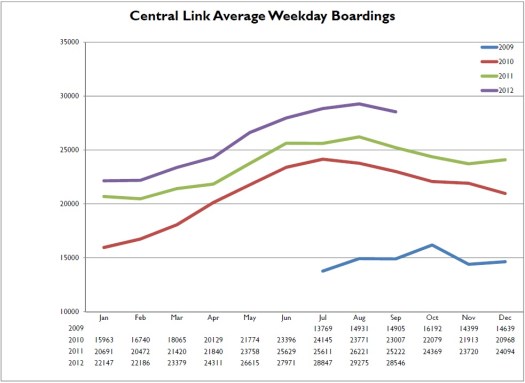
As a transit advocate improving ridership is always great news. What jumps out to me though is the extent to which Link’s current rate of ridership growth is exceeding prior estimates. The typical trajectory of transit projects of this kind is massive growth for the first couple of years, leveling out to 2-3% a year thereafter. This is, in fact, what ST had projected in prior Service Implementation Plans (page 105) for Link this year and every year hereafter until U-Link opens in 2016. But as ST spokesman Bruce Gray told the Seattle Times back in May, Link ridership ‘continues to mature’ and is still growing by double digits. The trend sustained itself through this past summer and into the fall with year over year increases of 12%, 9%, 13%, 12%, and 13% May through September.
Proposed Sound Transit Seattle-Everett Express Service Restructure
There’s been lots of coverage lately about Sounder North’s poor ridership, but not much attention paid to the transit alternative many riders are choosing instead, namely Sound Transit’s freeway-running I-5 express buses, 510, 511, 512 and 513. These routes, as the Sounder North Citizen Oversight Panel report notes, are currently overcrowded in the peaks, with “riders standing in the aisles” — and Snohomish County to Seattle is a long way to stand. In the 2013 Draft Service Implementation Plan, which I began writing about yesterday, Sound Transit staff proposed changes to the I-5 corridor to address overcrowding, among other problems, and I was able to discuss the changes in detail with ST staff.
The current service pattern on I-5 north is a confusing number-soup of routes which operate differently at different times of day. The 510 serves the Everett city center, the 511 serves Ash Way, the 513 serves south Everett, and the 512 serves both Ash Way and Everett. The 510 and 511 operate all day, except on Sundays and holidays when the 512 operates in their place; the 513 is peak only. Depending on whether the I-5 express lanes are open at the time, the 510 and 511 may or may not serve the freeway stops at 45th St or 145th St, which is problematic for riders, as when those stops are served, the 510 and 511 are frequently the fastest way to get from Downtown to the west side of the U-District or the east side of Wallingford — but if you get on the wrong bus, you could end up in Lynnwood before you know it.
The restructured pattern, shown on the map above, would be much simpler. Route 512 would provide all-day service throughout the entire route, serving all stops on every trip, except in the peak period in the peak direction, when the 512 would split into the 510, 511 and 513, which would use the express lanes and thus skip the 45th and 145th stops. This is a much easier pattern for riders to wrap their minds around: if you see a 512 in downtown Seattle, you know it’ll stop in the U-District; if it’s anything else, move along. The off-peak frequency north of Ash Way increases, although interestingly the total number of trips on I-5 per day will actually decrease. Essentially, this restructure shifts trips from the mid-day to peak, but compensates for that by making the midday service structurally more useful and comprehensible. It’s an operating-budget-neutral restructure whose only cost is the deferred retirement of some coaches.
Overall, I have nothing but nice things to say about this proposed change within the context of the available funds — it’s a model of the kind of efficient, rider-oriented simplification and improvement I’d like to see from every agency, everywhere in the region. My wish list (pending funding) would be to upgrade the periods of 20-minute service to 15 minute service, to make the schedule simpler and more consistent, and further develop all-day ridership on this corridor. In addition, extending the span of southbound service in the evening would make the service more useful for Seattle residents — last trip out of Everett is planned to be about 10:25 PM, which makes the service of borderline utility for attending events in Everett. I’d cheerfully pay with North King money for two Monday-Saturday one-way southbound “cleanup trips” departing Everett at 10:55 and 11:40.
LA’s Orange Line is probably the closest good example of BRT done right. But at $25m per mile in a extremely wide right-of-way, doing an equivalent thing here would not be cheap.
FTA announces early scoping (public comment collection) for Seatac-Federal Way alternatives analysis.
Last week, Sound Transit staff were kind enough to sit down with me and fill in some details on their recently released2013 Draft Service Implementation Plan. Between the DSIP itself, which is a pretty substantial document, and the additional information from staff, I have quite a lot to write up, so I’ll cover the DSIP in three separate posts: this one on West Seattle, one on the I-5 corridor between Seattle and Everett (including discussion of a possible Olive Way freeway stop), and one on the rest of South King and the Eastside.
I’m starting with the West Seattle change, because its a simple change that serves to highlight both the strengths of Metro’s new West Seattle network, and some (easily fixable) problems in its implementation. The West Seattle component of the final Fall restructure was the component that was least watered-down from its original concept. The benefits are pretty obvious from looking at Oran’s frequent service maps from before and after the change: the tangle of infrequent and overlapping downtown routes has been replaced by simple frequent service patterns on the three primary corridors, all of which touch together at Westwood Village.
Maddeningly, the roll-out of this new network design was plagued by mostly-transient problems which were coincident, but unrelated: downtown operations were (inevitably) a mess due to the elimination of the Ride Free Area; many of the features which are supposed to make RapidRide an improvement over “ordinary” bus service — e.g. platform ORCA readers and real-time arrival signs — were (and in many cases still are) non-functional; peak-period overcrowding on the C Line caused tremendous inconvenience to riders, which took Metro some time to address through additional C Line and Route 55 trips. The legitimate public outrage from these problems overshadowed the mostly excellent work done by Metro in this area.
Finally, though, Sound Transit came along with this proposal in the DSIP, to provide a great illustration of how it’s possible to leverage connection-oriented networks such as this one, to provide significantly improved mobility at minimal cost. The DSIP describes the history of the 560 at length (p.p. 71), but the recent history is a follows. Until June of 2010, the 560 served Alaska Junction, Fauntleroy, White Center and Burien before heading to SeaTac airport, and points east, every 30 minutes through the day. Due to significant under-utilization, off-peak service north of Burien was first cut to hourly, then eliminated altogether. Continue reading “Making Better West Seattle Connections”
This morning we’re at city hall, testifying to the city council to retain money proposed in the Mayor’s budget to advance the Seattle Transit Master Plan. We’re here because in addition to fast, high capacity rail, we need more local rail to connect our core neighborhoods.
The few million in this proposed budget seems like so little compared to the huge Sound Transit projects many of us are used to – but in this case, at this time, it goes a long way.
In the next couple of years, Sound Transit is likely going to put together their ST3 package; sources in Sound Transit say it’s looking more likely that we could see a regional vote in 2016. The primary goals for the next package are to connect Everett, Tacoma and Redmond (and maybe Issaquah) with extensions of Link. This means there will be money in Seattle for projects too, but it might not be exactly the right amount for the big projects we need in the city – it could be too much for one surface or elevated rail line, or too little for underground rail. We don’t know.
The projects on the table right now – major improvements to the streetcar line on Westlake (likely making it more like Link than streetcar), connecting it through downtown to the First Hill line, to Ballard via Fremont, and to the U-district via Eastlake, building real BRT on Madison, and extending the First Hill streetcar to Aloha – are all projects that might fill in those gaps.
Giving Sound Transit more planned and ready projects to choose from means they get more choices to build the most successful possible regional package. And in the event that Sound Transit doesn’t go to ballot in 2016, it gives Seattle more chances to connect neighborhoods too. In both cases, the planning in this year’s budget gives us opportunities for federal funds. We can’t let Portland get all the money!
So this morning we’re taking action – the most powerful thing we can do as individuals, really, bringing our neighbors and friends to let our elected officials know that this is what we want. To those transit supporters who are coming this morning – thank you. And to those who can’t, you’re missed, and we hope you can make it next time!
Lakeview Subdivision at I-5 and Gravelly Lake Drive, Lakewood (2010 photo by the author)
Roughly three weeks ago WSDOT completed the required Environmental Assessment (EA) for the Point Defiance Bypass (PDB). You can wade through the full 1,500 pages if you dare, but to the casual reader I would suggest the concise Executive Summary. For those unfamiliar with the project, a small sampling of 4 years of STB coverage can be found here, here, here, and here.
It is wholly predictable that rebuilding and upgrading an existing single-track railway would create no significant environmental impacts, especially when its construction will allow for greatly increased diversion of vehicle trips to train trips. Nonetheless, it is a relief to note that the EA indeed found no significant negative impacts to air quality, noise/vibration, soils, wetlands, flora/fauna, social justice, or cultural resources. Temporary construction impacts will be aggressively mitigated through Best Management Practices (BMPs).
For those of you who didn’t get enough Martin on the West Seattle transportation panel a couple of weeks ago, I recently interviewed him on my podcast. I thought it was a really solid, broad-ranging conversation on the state of Seattle transportation issues, the impediments to development, and more.
Population and GDP of large cities in the US vs Western Europe. Source: The Economist
Recently, the Economist published an article that highlights a relatively unexplored explanation for the difference in per-person GDP between the US and Western Europe nations.
Differences in metropolitan populations may help explain gaps in productivity and incomes. Western Europe’s per-person GDP is 72% of America’s, on a purchasing-power-parity basis. A recent study by the McKinsey Global Institute, the consultancy’s research arm, reckons that some three-quarters of this gap can be chalked up to Europe’s relatively diminutive cities. More Americans than Europeans live in big cities: there is a particular divergence in the size of each region’s “middleweight” cities, those that teem just a little less than the likes of New York and Paris (see chart). And the premium earned by Americans in large cities relative to those in the countryside is larger than that earned by urban Europeans.
It’s easy to look at Europe and conclude “if only people from Spain could move to Germany, the euro-zone economy would be better off”. But the same is true here.
Right now, the Seattle city council is starting to debate the budget provided by the mayor. As we reported before, the mayor’s budget contains several million to keep working on planning in the core high capacity transit corridors identified in the Transit Master Plan. Sources in city hall tell us there is council opposition to this funding – with a couple of councilmembers expected to run for mayor next year, it makes sense that they wouldn’t want to give McGinn a win going into the election.
It’s very important that this work continues. The Transit Master Plan, which we reported extensively about last year, has solid goals that would move tens of thousands of new people on electric transit. Identifying alternatives, mode, capacity, and the other outcomes of this planning work would provide projects not only for the city to fund, but also projects Sound Transit could fund, or things to fight for as part of a statewide transportation package.
The planning money in the city budget is mode neutral, but focused on rail. It could identify anything between streetcar and as high capacity as Link – and it could lead to choosing to study an even higher capacity mode. It’ll help inform those of us who want to see very high capacity transit.
There’s also money for “real” BRT – full offboard payment, electrification, things we want to see in bus service – for the Madison corridor. And there’s money to take the next step with whatever project is ready first, such as the downtown streetcar connector, the first hill streetcar extension, or light rail to Ballard.
This funding won’t make it through the city council unless we come help, by letting the council know we want it. The public comment for the transportation part of the city budget is from 9:30-10:00 on Wednesday morning. You MUST be signed in before 9:30 to testify.
Testimony is so easy it’s amazing. Stand up, and say “I want more rail transit, and we can’t wait another year.”
I’m taking an hour off work to come speak. If you can too, or if you want to know more, please comment here – or just call me at 206-683-7810 so we can talk about why it’s important!
To some degree or another, Bellevue and Sound Transit have been making headway on their agreements to expedite East Link construction and fund a downtown rail tunnel. Though the surface alignment is still our preferred candidate, failure to uphold the Memorandum of Understanding (pdf) at this point could deal a major setback to the project. One of the MOU agreements is a stipulation for the City to advance a land use code amendment package (pdf) that would make rail-specific provisions in city code.
The legislation of the code amendments is rather lengthy, but an informative technical read for anyone who can spare the time and interest. What the package will do, bottom-line, is implement a light rail overlay district in Bellevue, and in so doing streamline the project’s permitting process, establish development and design standards, and fill the gaps in existing code that might be in conflict with rail implementation.
We’re well beyond alignment battles here, so any firm opposition to the code amendment package that transpires will be an attempt to obstruct or kill East Link entirely. By rule of the MOU, the amendments have to be adopted by the end of the year or else ST will have the right to exercise an off-ramp to opt out of the agreement.
Bellevue will host a public hearing on the matter, which is set for tonight at 7pm* at Bellevue City Hall’s Council Chambers. If you’ve got time, testifying in favor of the land use code amendments is a great way to show the City Council that public interest in getting East Link done is as high as ever.
*Testimony will be first-come, first-serve on a sign-in basis, so earlier is better!