CityNerd looks at South Lake Union, its walkability and bicycle lanes, the notoriously unreliable route 8, the wide stroads, and Big Tech’s hidden motives for “colonizing” downtown areas.
How are the Sunday Movies going? Do you like the mix of topics and creators? Are there other topics or creators we’ve missed that you’d like to see?
Sound Transit is in the early stages of building Stride 3, a new bus rapid transit service. It will run along SR-522 and Northeast 145th Street between Bothell and Shoreline South/148th Station. Additional right-of-way will be added along parts of the corridor to allow the buses to avoid congestion. One of the more controversial areas for such work is in Lake Forest Park. There has been both local opposition as well as high cost overruns in the area. This is a proposal for a solution.
Lake Forest Park Issues
One of the goals for Stride 3 is to provide bus lanes both directions along SR-522. At the same time, the various cities want to retain two general purpose lanes heading both directions. This means at least six lanes. While they plan on eliminating many of the center-turn lanes, they will still retain quite a few (e. g. northbound Bothell Way to 35th Avenue NE). Therefore, for much of the route they require seven lanes. In most of the street it is only wide enough for six lanes.
Thus Sound Transit plans on making the street wider. In some cases this won’t cost much at all. But it gets challenging as you go north. If you want to widen the street between 153rd and 155th you need a new bridge over Bsche’tla Creek. This involves a deep ravine and is thus expensive. Other work north of the creek would require taking some property and rebuilding a lot of the retaining walls. This has led to local opposition. This too adds to the cost, as it is likely residents will fight this in court. This relatively simple project already has a fairly high price tag ($581.5 million). This is in addition to the bus barn. The combination of local opposition and environmentally sensitive land could lead to much higher costs.
Excerpts from the 1975 novel Ecotopia by Ernest Callenbach. Twenty years earlier in 1955, California, Oregon, and Washington seceded from the US to form a sustainable environmentalist utopia. Since then there has been a cold war and little contact between the US and Ecotopia. Now an American journalist goes to Ecotopia to report on its conditions and the possibility of reunification. (There’s no possibility.) This article takes a look at Ecotopia’s transportation and urban forms, a retro-future vision from fifty years ago. The rest of the book has much to say about Ecotopia’s industries, economics, politics, education, and family structures, but this article won’t get into that.
William Weston flies to Reno, and takes a taxi across the border to Lake Tahoe. He has gotten special permission to bring an internal combustion engine into the country 20 miles to the nearest train station. He rides a train to the capital, San Francisco, and emerges from the main train station.
I was going to Uwajimaya on September 4th for a routine shopping trip. I got off a 14 bus at Union Station, when right in front of me was a sign for a Sound Transit board meeting. So I went inside to see it. I thought it was the full board meeting (and the signs didn’t say otherwise), but afterward I found out it was the Rider Experience and Operations Committee Meeting. The meeting was halfway through and I didn’t stay till the end, but I did see two presentations, one on Link reliability and the other on next generation of trains. Here’s the livestream, and the meeting page with documents links (but not the reports below).
Bruce Englehardt (photographer, wikipedian, and former STB contributor) posted photos of Sound Transit’s historic live test 2 Line across Lake Washington. More photos (The Seattle Times, $) and video (Instagram post by Sound Transit; YouTube video by the NW Progressive Institute) of Sound Transit’s historic live test of the world’s first electrified rail line on a floating bridge.
The Harborview Medical Center area is a bottleneck afflicted with crushing traffic. Multiple roads funnel traffic east into James Street, where traffic then struggles onto I-5. At the same time, bus routes 3 and 4 are trying to serve the same kind of trip on those roads, getting people to the Link Light rail and the Third Avenue busway, two major transit arteries which provide an alternative to I-5. These buses should be alleviating traffic (and to some extent they do) but they are unable to fix the traffic while in it. Better bus routing and transit priority improvements can make buses in the area much more effective at maneuvering through the James Street logjam.
The Seattle DOT should work with King County Metro to reroute routes 3/4 off the chronically clogged James St. onto Cherry St. (with a reverse bus lane), put bus lanes (for ambulance use as well) on 9th at Harbourview, and make Jefferson from 9th to Broadway a local only road. Heading eastbound, the reroute would result in: buses taking Cherry from Third Ave and taking a right on 9th to join the current routing for the rest of the route. This preserves the vital 9th and Jefferson stop serving Harborview. Here’s a map.
For the first time in history, a light rail vehicle has crossed a floating bridge under its own power. Just before midnight Monday evening, Link vehicle 219 traveled between Mercer Island station and Judkins Park station via the Homer M. Hadley Memorial Bridge. Unlike the tow test in May, the vehicle in yesterday’s test was powered by the overhead wire.
Link train crossing the I-90 floating bridge (Michael Smith)
Was hyperloop a scam? The Cascadia high-speed rail study compared hyperloop to other modes. (CityNerd)
The Vegas Loop, which does exist, is unbelievably impractical and gets few riders. Ray rides it and compares it to Las Vegas’s other transit. (CityNerd)
Ray will be be in Seattle at Town Hall November 5th. Livestream tickets are available; in-person tickets are sold out. He’ll be talking with Sarah Goodyear and Doug Gordon, authors of the book Life after Cars and the podcast The War on Cars .
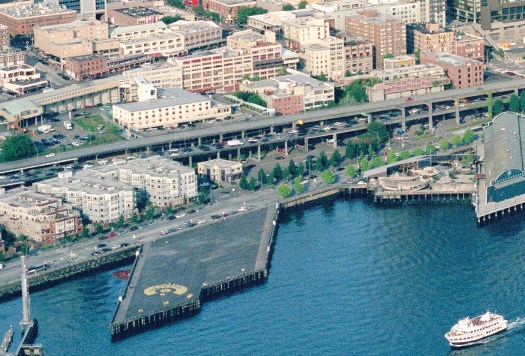
Over the past two decades, the City of Seattle, Washington State Department of Transportation (WSDOT), Port of Seattle, Friends of Waterfront Park, Downtown Seattle Association, Seattle Center, King County Metro, numerous community groups, and thousand of Seattle residents have contributed to redesigning and rebuilding Seattle’s waterfront. Years of debates, discussions, proposals, votes ($), and construction have culminated in the Grand Opening of Waterfront Park tomorrow, September 6.
The Grand Opening Celebration will occur between 11am-9pm with performances, activities, and games at the Salish Steps and Overlook Walk, Pier 62, Pier 58, Park Promenade, Pioneer Square Habitat Beach, and Stadium Plaza. The Salish Steps are the stairs/seating at the bottom of the Overlook Walk. A detailed schedule of events is available on the Friends of Waterfront Park website.
2012 aerial view of Pike Place Market, Seattle Aquarium, and Alaskan Way Viaduct (City of Seattle)
2024 aerial view of Pike Place Market, Seattle Aquarium, and Overlook Walk (Tim Rice)
How We Got Here
In 2001, the Alaskan Way Viaduct was damaged by the Nisqually earthquake. After emergency repairs were implemented, City and State leaders were concerned about future earthquake damage to the aging structure. Replacement proposals included a new tunnel, a new elevated viaduct, and a widened surface street with additional transit. In general, the State preferred the elevated option because it was cheaper. The City government preferred the tunnel as it would be less disruptive to the waterfront. The City and State were deadlocked as Seattle needed State funding and Washington state needed permits from the City. In 2007, the Seattle City Council passed two resolutions calling for a non-binding, advisory vote on the tunnel and elevated options. The vote was on each option separately and Seattle voters rejected both options. The tunnel option only received 30% approval and the elevated option received 43% approval. Following this vote, efforts to promote the surface and improved transit option started again.