
Ridership Patterns for King County Metro Route 5

King County Metro Route 5 travels inbound from Shoreline Community College to downtown Seattle, primarily on Greenwood Ave N and Phinney Ave N. Outbound trips travel in the reverse direction. In August 2025, Route 5 had 4,926 average weekday boardings.

In the plots shown below, the inbound trip is cut off as Route 5 is through run with Route 21. Inbound trips switch to Route 21 after Wall St & 5th Ave. Likewise, outbound trips start with some passengers already onboard as these passengers boarded an inbound Route 21 trip.

Average Ridership Per Trip

The plots below show the average weekday ridership by stop in each direction, color-coded by time of day. For a more detailed breakdown of how the plots are set up, please refer to the How to Read the Plots section of the article discussing Route 70.
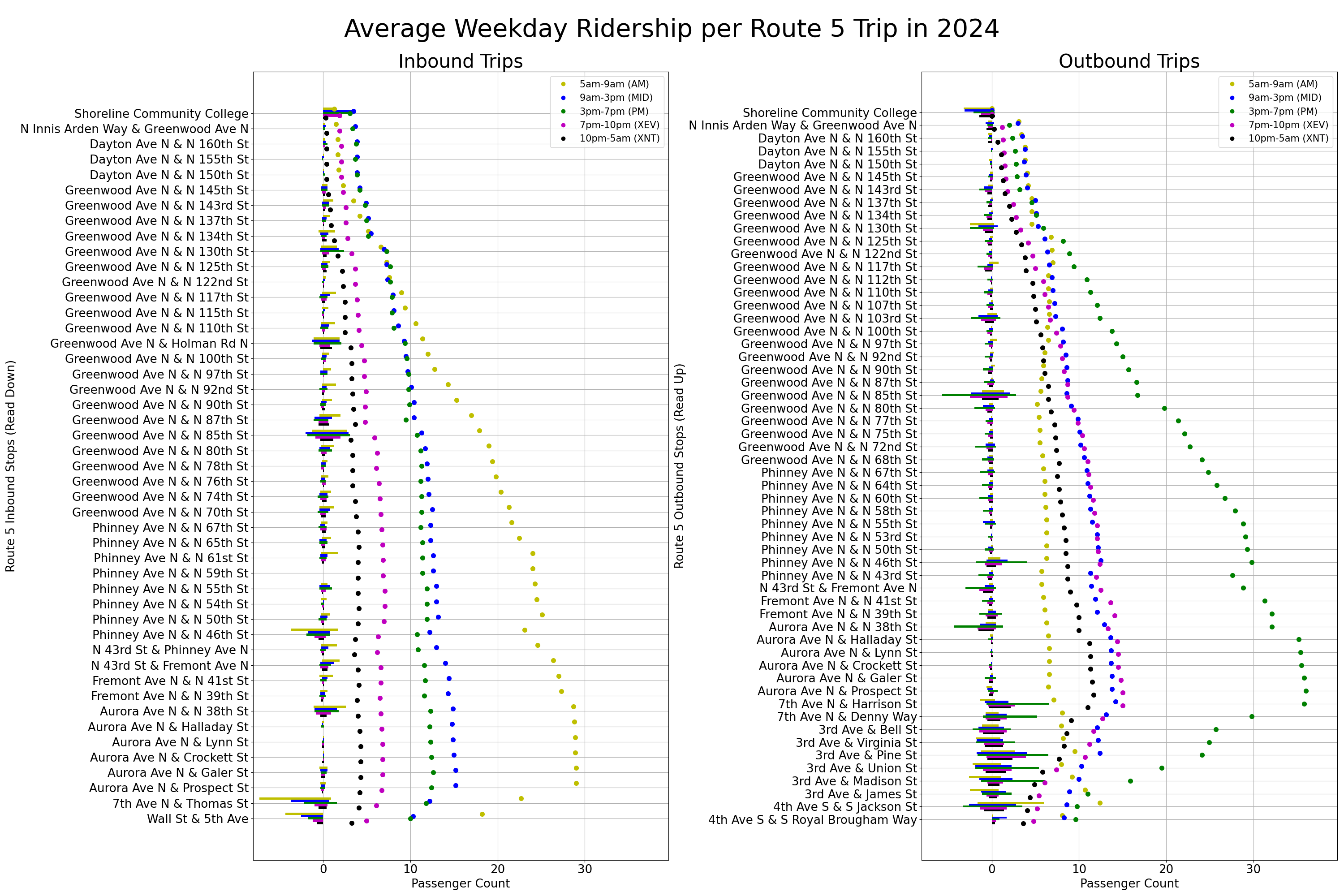
Average Weekday Ridership per Route 5 Trip: September 2024 to March 2025. “Inbound” is toward downtown Seattle; “Outbound” is toward Shoreline Community College. Click the plot to view at full-resolution in a new tab.
Continue reading “Ridership Patterns for King County Metro Route 5”

Friday Roundtable: Week Without Driving

The 5th annual Week Without Driving is next week, from September 29 to October 5. Started by Seattle-based disability advocate Anna Zivarts in 2021, Week Without Driving has since grown to national level. Last year, local events were organized by 520 groups in all 50 states.

On the surface, the goal of the campaign sounds simple: do not drive for one week. Week Without Driving organizers America Walks and Disability Rights Washington intend for the challenge to provide an opportunity for decision makers and individuals to experience and empathize with the experiences of nondrivers. Unlike other events that encourage non-driving transportation, the focus of Week Without Driving is on nondrivers. In a recent Streetsblog USA article, Zivarts says:

Week Without Driving Logo

Week Without Driving comes from our campaign to have those in charge of our transportation networks and investment priorities understand the needs of nondrivers in their communities — in particular involuntary nondrivers who can’t drive or can’t afford to drive. This includes everyone from youth too young to drive, to people whose anxiety makes driving unsafe or really uncomfortable, to folks like my parents who are aging out of driving and can only drive in certain conditions. It includes people like me who can’t drive because of vision disabilities, others with chronic health, mobility, autism, epilepsy and other disabilities, people with suspended licenses or without licenses, without access to a working vehicle, who can’t afford gas, who have to share a vehicle they can’t reliably use to get where they want to go.

Altogether, nondrivers are about one-third of the population — and we all share the need to be able to get places but the inability to do so by grabbing the keys and going. The Week Without Driving is about our needs and imagining communities — urban and rural and everything in between, that could work better for us. 

Join me, and thousands of others, by not driving next week. To get more involved, check out one of the many events in Washington State next week.

This is an open thread.

Midweek Roundup: controversial amendments

Local Transit News:

Other Transportation:

Continue reading “Midweek Roundup: controversial amendments”

Sunday Movie: Copenhagen & Canadian Maritimes

Copenhagen’s automated metro has been running for 20 years. (dronthego) It has 4 lines, each running every 3-6 minutes and operating 24/7. Ridership is an average of 344,000 per day. Two lines combine downtown for 1.5 minute frequency. Agency promo page.

A train ride from Halifax to Montreal on VIA rail. Worse than Amtrak in most ways. And clips of how much better it was in 1965. (Not Just Bikes)

This is an open thread.

Friday Roundtable: Sounder Turns 25

Yesterday marked the 25th anniversary of Sounder, Sound Transit’s commuter rail service. On the morning of September 18, 2000, the first Sounder trip departed a temporary station in Tacoma and headed towards King Street Station in Seattle. Along the way, the train stopped in Sumner and Auburn. A second trip ran later in the morning, and two trips back to Tacoma ran in the afternoon.

Over the past 25 years, the Sounder network has grown to include 2 lines, 12 station, and nearly 83 miles of track. Let’s take a look at a few key milestones in Sounder’s history.

  • September 18, 2000: Sounder begins revenue service with two daily round trips between Tacoma and Seattle.
  • February 5, 2001: Stations open in Puyallup and Kent.
  • March 12, 2001: Tukwila station opens.
  • September 30, 2002: A third daily trip is added.
  • September 15, 2003: The temporary station in Tacoma is replaced by a platform at Tacoma Dome Station’s Freighthouse Square.
  • December 17, 2003: Sound Transit and BNSF agree to a perpetual easement agreement to Burlington Northern tracks between Seattle and Everett.
  • December 21, 2003: The North Line begins service with a Sunday train for a Seahawks game. The line had one stop in Edmonds.
  • December 22, 2003: Regular North Line service begins with one daily round trip from Everett to Seattle.
  • June 6, 2005: A second daily North Line trip is added.
  • September 24, 2007: The South Line adds its first ‘reverse commute’ trip, traveling from Seattle to Tacoma in the morning and Tacoma to Seattle in the afternoon.
  • May 31, 2008: Mukilteo station on the North Line opens.
  • October 8, 2012: The South Line is extended to South Tacoma and Lakewood.
  • March 23, 2020: Service on both lines is cut in half, the South Line is cut to eight daily round trips and the North Line is cut to two daily round trips.
  • September 18, 2021: The North Line and South Line are renamed to the N Line and S Line, respectively.
  • September 19, 2022: S Line is fully restored to pre-pandemic service levels.
  • September 16, 2024: N Line is fully restored to pre-pandemic service levels.
Continue reading “Friday Roundtable: Sounder Turns 25”

Midweek Roundup: growth, gains, and greatness

Local Transit News:

Continue reading “Midweek Roundup: growth, gains, and greatness”

Sunday Movie: SLU and the L8

CityNerd looks at South Lake Union, its walkability and bicycle lanes, the notoriously unreliable route 8, the wide stroads, and Big Tech’s hidden motives for “colonizing” downtown areas.

How are the Sunday Movies going? Do you like the mix of topics and creators? Are there other topics or creators we’ve missed that you’d like to see?

This is an open thread.

Fixing Stride 3

Sound Transit is in the early stages of building Stride 3, a new bus rapid transit service. It will run along SR-522 and Northeast 145th Street between Bothell and Shoreline South/148th Station. Additional right-of-way will be added along parts of the corridor to allow the buses to avoid congestion. One of the more controversial areas for such work is in Lake Forest Park. There has been both local opposition as well as high cost overruns in the area. This is a proposal for a solution.

Lake Forest Park Issues

One of the goals for Stride 3 is to provide bus lanes both directions along SR-522. At the same time, the various cities want to retain two general purpose lanes heading both directions. This means at least six lanes. While they plan on eliminating many of the center-turn lanes, they will still retain quite a few (e. g. northbound Bothell Way to 35th Avenue NE). Therefore, for much of the route they require seven lanes. In most of the street it is only wide enough for six lanes.

Thus Sound Transit plans on making the street wider. In some cases this won’t cost much at all. But it gets challenging as you go north. If you want to widen the street between 153rd and 155th you need a new bridge over Bsche’tla Creek. This involves a deep ravine and is thus expensive. Other work north of the creek would require taking some property and rebuilding a lot of the retaining walls. This has led to local opposition. This too adds to the cost, as it is likely residents will fight this in court. This relatively simple project already has a fairly high price tag ($581.5 million). This is in addition to the bus barn. The combination of local opposition and environmentally sensitive land could lead to much higher costs.

Continue reading “Fixing Stride 3”

Friday Roundtable: Ecotopia Transit

Excerpts from the 1975 novel Ecotopia by Ernest Callenbach. Twenty years earlier in 1955, California, Oregon, and Washington seceded from the US to form a sustainable environmentalist utopia. Since then there has been a cold war and little contact between the US and Ecotopia. Now an American journalist goes to Ecotopia to report on its conditions and the possibility of reunification. (There’s no possibility.) This article takes a look at Ecotopia’s transportation and urban forms, a retro-future vision from fifty years ago. The rest of the book has much to say about Ecotopia’s industries, economics, politics, education, and family structures, but this article won’t get into that.

William Weston flies to Reno, and takes a taxi across the border to Lake Tahoe. He has gotten special permission to bring an internal combustion engine into the country 20 miles to the nearest train station. He rides a train to the capital, San Francisco, and emerges from the main train station.

Continue reading “Friday Roundtable: Ecotopia Transit”