Andrew M. Smith started the blog in April 2007, after he moved back to Seattle and discovered there was a campaign for light rail that year. Andrew grew up in Scotland, Capitol Hill and Wallingford, and has lived in Tokyo, where he discovered his love for transit and walkability, and San Francisco. Andrew stepped down from the blog in May 2009 but returned in February 2011.
Last week SDOT posted some nice construction photos of King Street Station’s progress, and thought the progress was coming along nicely. But yesterday SDOT put these photos on the KSS project’s facebook page, and well, all I can say is a lot can change in a single week.
YOU ARE CORDIALLY INVITED TO ATTEND
the Grand Reopening of
King Street Station’s Main Waiting Room Wednesday, April 24, 11:00 a.m. to 11:45 a.m.
Main Waiting Room, King Street Station, South King Street and Third Avenue South
Remarks by Seattle Mayor Mike McGinn and other distinguished guests
The parking utilization data was correlated with the 100 factors. Independent variable relationships were assessed for their predictive powers using linear regression methods. The results showed a clearly evident and statistically relevant variation in land use to multifamily residential parking utilization. A similar relationship existed between multifamily residential parking utilization and transit access. The relationship between the price of parking and parking utilization showed utilization declining as the percentage of parking cost to rent increased. The overall findings indicate that walk and transit access to trip destinations, block size, population and job density influence parking utilization, in some cases by as much as 50 percent. Most important, the research demonstrates that higher supply of parking appears to consistently correlate with greater parking demand. By verifying intuitive perceptions with data and fact, this research provides a new tool for use in considering the proper provision of parking.
Emphasis added. As I’ve said before, simply the existence of parking is the single most important factor in determining whether people will drive or not. So newer, bigger buildings with more parking are less green that smaller, older ones with no parking.
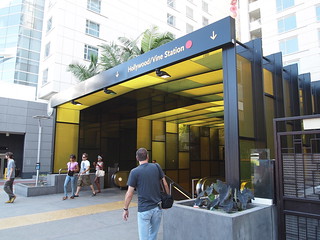
Los Angeles Metro Subway (Red Line) Entrance, Hollywood & Vine Station. Photo by flickr user JoeInSouthernCA
In this paper Michael L Anderson uses econometric models and real life data to show that transit reduces congestion by a much larger amount than previous estimates have shown:
Public transit accounts for only 1% of U.S. passenger miles traveled but nevertheless attracts strong public support. Using a simple choice model, we predict that transit riders are likely to be individuals who commute along routes with the most severe roadway delays. These individuals’ choices thus have very high marginal impacts on congestion. We test this prediction with data from a sudden strike in 2003 by Los Angeles transit workers. Estimating a regression discontinuity design, we find that average highway delay increases 47% when transit service ceases. This effect is consistent with our model’s predictions and many times larger than earlier estimates, which have generally concluded that public transit provides minimal congestion relief. We find that the net benefits of transit systems appear to be much larger than previously believed.
This has always made sense to me, because transit tends to be most highly used to go to and from places that are the most congested.
Columbia River Bridge, photo by flickr user reverendkomissar
Nearly everything about the way transportation issues are decided in Olympia puzzles me. In King County — and Seattle in particular — voters have fairly consistently shown support for transit in general and fixed-guide-way transit in particular, going back as far as Forward Thrust* in 1968. However, Olympia pays for nearly no transit here, and recently hasn’t done much to give Seattle, Bellevue or King County realistic means to expand transit. Meanwhile in Clark County, it seems voters and a number of elected officials don’t want light rail to be a part of the Columbia River crossing project, but Olympia putting $450 million into and has fought vigorously for $850 million in federal transit (FTA New Starts) money for the project.
That’s more federal money than any transit project in the history of the state has received, including U-Link and Central Link. I understand that the FTA New Starts money is needed to help complete the automobile part of the bridge, but still it’s confusing to me that the state leadership in the Olympia has put so much energy into transit projects with so little support and so much opposition, but have done so little in our area where help isn’t just wanted but needed.
*Forward Thrust failed at the polls because it required a 60% super majority to pass, but had majority support at 50.8%.
“One hundred and sixty feet gives additional density and makes a wonderful place for all, not just those who can afford to live in the towers,” said Councilmember Sally Bagshaw.
Class warfare is a really nasty business. So before Sally Bagshaw congratulates herself overmuch, it’s worth noting that this isn’t some sort of victory against solely “those who can afford to live in towers”, but also a rout against those struggle to afford housing at all. Vulcan was going to provide $10~$12 million dollars worth to provide for affordable housing in this plan, and the council is putting an end to that.
A wonderful place for all, just not those who can’t afford it.
Rasmussen—who visited one such development on Capitol Hill and compares its units to “small dorm rooms”—tells PubliCola he understands the “market for smaller units like that,” but says that Capitol Hill residents, in particular, have expressed concern about the new developments, and are “feeling like too many are being proposed or developed” and want the council to take a look at “whether they fit in to neighborhoods, and whether or not there should be design review. Some of them look pretty good, some of them not so much.”
Amy, an international student from Korea, lives on Capitol Hill and rents a two bedroom apartment for $1,300 a month. The contract says only two people may reside there, but skirting the rules Amy now lives with three other roommates. “It doesn’t make sense. I can’t pay this much. As a result, I have three roommates, which means I live in violation of the contract.” The contract violation has left Amy perpetually anxious of eviction saying her manager checks every unit randomly and is “scared every day…I have to sleep with another girl in the same bed. I can’t have my private room.”
It doesn’t sound like Amy’s a citizen, so she can’t vote, but she is a resident of our city and her rights and welfare are just as important as anyone else (same applies to these guys). So I would like to ask Rasmussen to think about Amy and her three roommates living in a two-bedroom apartment, sharing beds and fearing eviction because they can’t afford anything else, before he considers a moratorium on any new housing. We need as many new, affordable housing units as we can get.
*Thankfully, Richard Conlin and Mike McGinn both have more reasonable things to say in that piece.
South Lake Union, photo by Rik_C. Vulcan wants to build tall buildings on the parking lots across from this park.
The Seattle Times has reported that the City Council has declined Vulcan’s offer of $10 million or so worth of free real-estate in South Lake Union in exchange for allowing Vulcan to build three taller towers in that neighbourhood:
Vulcan would transfer to the city 37,600 square feet of land on a block bounded by Broad and Republican streets and Dexter and Aurora avenues. The city could add that chunk to a smaller piece it owns to create almost a full block available for an array of social services and housing.
The Vulcan land, with an estimated value of $10 million to $12 million, would count as a credit toward fees Vulcan would pay to erect condo or apartment towers up to 240 feet on three lakefront blocks it owns and elsewhere in the neighborhood.
Zoning now allows 65-foot buildings on the three so-called Mercer blocks. Vulcan would pay bonus fees to go from current zoning to 160-feet, or 16 stories. Then it would need to provide extraordinary additional public benefits to reach 24 stories.
Often, we make the abstract argument that requiring shorter or smaller buildings reduces affordability, but rarely do we get something so concrete. It costs the city (and thus the tax payers) nothing to allow Vulcan to build taller buildings. In exchange for that, the city would have received something valuable, free land near Downtown Seattle for use in low-income housing. The literal choice was between 1) taller buildings and free land for low-income housing (along with higher property tax income) and 2) shorter buildings and no land for low-income housing, though possibly some cash down the line.
If as a city, we think we can get a better deal, fine, say that. But please no one say this:
Mayoral candidate Peter Steinbrueck had blasted the Block 59 proposal for “privatizing the city’s land-use code.”
Yes, we certainly wouldn’t want to set the dangerous precedent of the tax payers getting millions of dollars of land in exchange for something that costs them nothing. The article said the deal may be revived at some later date. I hope so. As a taxpayer, if the city can get materiel for important social functions for free, I think that’s a deal the city should take. And I’m going to make sure the city council knows that when I vote.
I am not sure this is real, but supposedly this is snow failing inside a subway car in the Kiev Metro. I’ll never complain about my wintery commute again. Unless this video is fake, of course.
Eric Becker, the filmmaker behind the Stone 34 video mentioned last year, released a video of architects, developers and others talking about South Lake Union and its potential futures. The video is called “Placemaking & Seattle”. It’s curious to me when people spend so much time debating heights, parking and floor-area-ratios, so little time is spent on form, function and character. It’s a video worth watching.
South Lake Union is looking up. Rezoning proposals represent an opportunity that would turn other cities emerald green with envy.
Council land-use chair Richard Conlin is looking for a council vote by mid-February At this point, he sees a general consensus building around the mayor’s plans.
If the instinct is to worry about views, then keep the outlook for Seattle’s economic well-being unobstructed as well.
This is a good observation for two reasons. First, the swap is views for 1) jobs, 2) housing, and 3) social benefits like low-income housing and workforce-training facilities. Second, we should be encouraging the investment here and not elsewhere.
The other surprising bit is the mention of further transit investments:
More offices, apartments and condos provide a critical mass for further investments in public transit. All the talk could indeed turn into a people-moving reality.
This is from a group that famously advocated voters reject ST2 just four years ago. Maybe attitudes are truely changing in on Fairview and John, or maybe it’s the fact that their properties are part of the rezone, either way, it’s welcome.