Gregoire’s 520 Plan: Interesting Positives

As I’m looking over the recently announced 520 plan and discussing it with other transit supporters, something very unlikely seems to come out: Positive effects on future cross-lake transit.

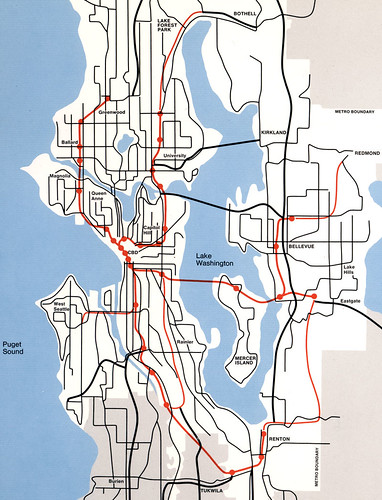
The original 6-lane alternative for 520 would have been built to support light rail later. This really only means making the pontoons wide enough to handle more weight, but the effect it’s had on the cross-lake transit discussion in the wake of Proposition 1’s defeat has been to create sudden interest in building transit across 520 instead of across I-90. This is bad for several reasons – 520 would be much more expensive to engineer, it would be hard to serve both Bellevue and Redmond, and a train transfer at Husky Stadium would reduce ridership and cause commuters into downtown to endure crush loads. I-90 is built to handle rail transit, and because Eastside commuters would come into Seattle from the south, they wouldn’t be forced to cram onto trains already packed with people from North Seattle.

The design change proposed as part of this plan would cut $400 million from the cost of the 520 project. It would narrow the bridge and pontoons: Each lane would go from 12 feet to 11 feet, and future support for light rail would be eliminated. But light rail over 520 isn’t anywhere in near-term planning, and won’t be until well after we build rail to Northgate, the East Link extension and likely a project in the Ballard-West Seattle corridor. By the time we talk about putting rail on 520, any new bridge could already be halfway through its operating lifetime.

Bus transit across 520 to several major destinations already exists. Many daily commuters use these routes for only some of the week – but with tolling going into effect, some of these commuters who have the option of transit can ride more often, possibly reducing congestion. This small shift combined with those who choose to switch from their cars to a cheaper transit trip will also boost cross-lake transit use, making potential ridership for the East Link project higher and more likely to receive Federal Transit Administration grants – and votes here at home.

Edmonds Station holiday open house:

On Saturday, Edmonds Amtrak Station has their annual holiday open house. If you’re interested in chatting with Sounder staff and learning about next year’s service improvements, or learning about the history of the Great Northern railroad that originally turned Seattle into a boom town, I recommend it! It’ll run from 9am-3pm.

The old freight half of the station was converted some years ago into a railroad club’s model train layout, complete with little towns and such. I don’t know if someone will be there, but during open houses they usually run model trains and talk about the history of the state.

Why I Voted Yes

I talked a little in my common sense post about how the large-scale subsidy of roads contributed to killing the street railways and passenger railroads, especially on the west coast. We’ve ended up with a massive amount of highway capital infrastructure in a time when the energy necessary to drag everyone around in a rubber tired, 4000 pound steel box is becoming increasingly scarce, increasingly expensive, and very possibly extremely damaging to our long-term ability to survive as a species.
Targeted growth is the only way that our political and economic system as it stands can prevent these problems from becoming crippling – growth into options that are more stable in the long term. We know a lot of our problem is that we’ve spread out too much – so shifting the vast majority of our growth to places we already occupy, creating infill development, is a good idea. We know we need an alternative to fossil fuels – and it so happens that almost all of our region’s electricity comes from renewable sources.
Something we have, something tried and true, that can meet both of the requirements above, is rail. A high capacity corridor for moving people in a small amount of real estate lends itself to new, dense development. The fact that it moves *people* and not *cars* means that when those people get off the train, they want to walk to their final destination, and not very far – people don’t like to transfer, even if that’s just getting in their cars at a park and ride. For now, those are a necessary evil to get people back on efficient transportation – the concentrating effects of rail are slow to start, but they are long term and generally permanent.
Today, at home, we have a problem. The costs of continued sprawl are vastly higher than a small bump in the sales tax in a state that doesn’t even have an income tax. Even if you’re just counting the direct cost of sprawling infrastructure needs, ignoring all the other benefits of building a dedicated transit corridor, building this is much cheaper than paying the spiraling costs to support waves of shoddy homes at the edges of the region. The Sound Transit component of Proposition 1 targets our urban cores with real alternatives that will help create a more stable economy and more efficient land use – and we needed it 80 years ago.
The plan is well targeted – comparing the plan from 1957 to the plan now shows us that in 50 years, our urban cores are still in the same place, and still have the same needs. The time is now – if history teaches us anything, it’s that another plan later would provide less, cost more, and take longer.

Please make time to vote for Proposition 1 today.

Why You Should Read The P-I Instead

Today I woke up to nonsense. The Seattle Times is seriously arguing against building light rail from Seattle to Tacoma.

Now, look at the way I just put that. Light rail from “Seattle to Tacoma”. It’s easy to argue against that, right? We have Sounder from Seattle to Tacoma. We have express buses from Seattle to Tacoma. Why would we need more? Anyway, this article says it would take riders on light rail 70 minutes to get from Tacoma to Seattle! Isn’t that a long time?

Sounder takes 60 minutes – from Tacoma Dome Station to King Street Station. The express buses are scheduled to take 40 minutes, but of course they’re often stuck in traffic, and that’s getting worse. Those buses run all day, and carry as a whole around five thousand people. Sounder, with only five peak-direction round trips, carries ten thousand passengers a day, and that number is steadily increasing – the express buses carry half that. What, you say? Are these people dumb? Why would they take Sounder instead of the bus? Oh, wait. They’re *not* dumb. Most of them live in Auburn, Kent, Puyallup, and Sumner, and some of them even drive from Renton to Tukwila and take the train from there. In just a few years, Sounder will connect Lakewood and South Tacoma with Seattle as well. These people have the same commute time every day, which is very important to people who have jobs that are not next door.

But what does this have to do with light rail from “Seattle to Tacoma”?

Simple! We aren’t just building light rail from “Seattle to Tacoma”. We’re building light rail from Sea-Tac to Des Moines, and Des Moines to Federal Way, and the Rainier Valley to Federal Way, and Sea-Tac to Tacoma, and Des Moines to the Port of Tacoma, and Federal Way to Tacoma, and the U-district to Federal Way, and Bellevue to Federal Way – and I actually know people who work in Redmond and live in Des Moines, which is a crazy commute, but this would serve them! Sounder doesn’t serve ANY of these trips. In fact, even if someone did live in Tacoma and take transit to Seattle, if they wanted to go to Westlake or Capitol Hill, they have to transfer if they take the bus or Sounder (and with Sounder, they could only go during peak hours) – but not if they took Link. Transfers kill potential ridership, and make people stay in their cars.

Let’s point out some more of Andrew Garber’s bull – that “70 minutes” number? That’s from Westlake to Tacoma. Sounder service doesn’t serve that – it stops at the other end of downtown, at King Street Station. You have to take a bus (or starting in 2009, transfer to light rail) to get to Westlake. The Times picked that number because they think it makes light rail look bad – but all they’re doing is showcasing the fact that light rail built by Proposition 1 will serve trips that aren’t currently well served. In 2030, taking the bus from Tacoma to Westlake will take 80 minutes during peak times, and the same trip will be 70 minutes, consistently, on light rail – faster *and* vastly more reliable.

Readers of this blog already see some of the flaws in this article. Ron Sims’ “Buses are great and futuristic!” argument falls flat when we read the same thing from 1968 – the last 40 years are pretty good proof that magical superbuses just aren’t effective, even where we have transit lanes. Comparing the south line to University Link, the best projected ridership per dollar of any transit extension planned in the United States in thirty years, just tells us that the south line is normal, in line with the cost-effectiveness of all the other cost effective transit built around the country. And yeah, those 2030 University Link riders? They won’t be there if we don’t build Sound Transit 2 – some of them are coming from the south line, and a lot more are coming from the north and east lines. We don’t get those if we vote against Prop 1.

Oh, yeah, and if you’re going to say “is it worth the money?” about a project, at least compare to another project that actually moves a similar number of people – like building a new highway, which is what you’d have to do to move as many people as the south line will.

One last shameful and misleading thing? The graphic on the Times’ article doesn’t show University Link as “under way” – uh, folks, a lot of the properties have been purchased, the design is well under way, and we’ve got the money.

Hey Seattle Times: do you wonder why readership is down? Trying to think of reasons that the Blethens are having to prop you up? Maybe it’s because your front page pieces don’t pass the whiff test for the people you’re trying to sell to – they smell like bull. People driving their cars don’t read papers – people on the train do. If you want to survive, stop shooting yourselves in the foot.

Sound Transit 2’s vast capacity increase

You have to build rail to get this kind of new capacity. That 14,000 people per hour is eight northbound lanes (four general, four express) of traffic. Link will move more than half again that many. What would it cost to put four or five more lanes each way on I-5 in Seattle? Where would those cars go once they got into the city?

And remember, all these new light rail trips have no congestion. Those I-5 trips are often at a dead stop – but those light rail trips are cruising along between stations at 55mph.

Common Sense

When I write about rail, I’m often addressing an audience that has some root assumptions in common with me. I consider many of these assumptions to be common sense, but without having addressed them, I suppose it’s not reasonable to base arguments on them. With that in mind, what is it, what are the fundamentals upon which I base my interest in building rail mass transit – and my assertion that it should be your interest too?
First, a little about cities. Reading Jane Jacobs made me rethink the hazy mental distinction I had between towns and cities – and all the other forms and structures of urban settlement. She hits the root of the problem by addressing what causes cities to form: work. The jobs that create value and growth in our society are mostly those that take several types of simpler work, like making fasteners, and combine them into larger, more complex, as Jacobs says “new” work – like making a bicycle from parts. That bicycle is not only a new industry in itself, but it forces the evolution of all the simpler “old” work it’s based upon – as the final product is refined, its components are altered. Jacobs talks about cities as centers of new work – and towns and suburbs as places old work is pushed out to, effectively the support structures for new work.
Density, in cities, is how that old work is pushed outward. Innovation is generated by high density, as people are exposed to a high number and variety of new ideas. This innovation is what brings us higher quality of life. As new ideas become new businesses and create demand for space, the supporting work that is established but no longer growing so quickly ends up moving out of the core. This work moves to areas where real estate is cheaper, and fresh ideas are no longer needed for competitive innovation. These are the suburbs, and even rural towns.
This is where transportation comes into play. Since the late 1800s, we had street railways operating privately (and profitably). But starting in the beginning of this century, well before the federal fuel tax, the federal government started investing in roadways. As this was the largest part of the cost of using motor vehicles, the marginal cost for individual users dropped immensely when these new roadways opened – and when local and state governments started investing, individual vehicle ownership and maintenance became competitive with the cost of using the railways, simply because so much of the cost became tax-based. Governments could also use eminent domain to acquire property, so they weren’t paying the real estate costs of passenger rail companies. Combined with the 1887 Interstate Commerce Act’s strong regulation of railroads, the passenger railroads could no longer profit, and were easily competed into bankruptcy.

As we continued to build roads, we were no longer constrained by the profitability of transportation – arguably a good thing – but no balance was struck between cost and reduction of overcrowding, and the effects of enabling easy, cheap travel far from the city core were not understood. With major investment in interstate highways in 1956, the federal government’s investment policies created what we now call sprawl. Huge tracts of concrete were laid through city cores using eminent domain and without regard for social impact – because this work predated the Civil Rights Act, it largely impacted previously redlined minority areas.
These blanket investment policies resulted in only one transportation system surviving to serve most of the US – roads and highways, with the automobile upon them. Because competition was effectively eliminated – our roads and highways are now established and maintained to a basic level of service regardless of any market forces – the only places where the political will exists for mass transit are the very cores of cities. The false discussion frame that roads and highways “pay for themselves” has supplanted understanding: different amounts and locations of roadways have different costs, and would have to be priced differently from each other, and paid for at the time for any competition to exist – not to mention that the differing levels of infrastructure investment between roads and rails would have to be evened out first as well.
Wide roadways actually don’t compete well in the dense, innovative cores. Complete congestion occurs at a relatively low vehicle density – something that happens quickly in the cities with such high levels of US automobile ownership, a result of our nearly monomodal transportation system. While city centers can still grow, the curve of density from the center to the edge of an urban area becomes very flat – the overall effectiveness of the region drops as traffic comes to a standstill. We’re seeing this in Seattle today – we’ve really been seeing it for decades, but it’s finally beginning to threaten our prosperity. City streets can’t easily get wider when there are tall buildings in the way.

Rail is much more efficient. We knew this a hundred years ago – it was profitable and functioning well after private automobile ownership became available. While some roads can be profitable, this is only in limited circumstance – a toll road fed by many public roads benefits from those public roads and would not be profitable without them. Rail uses less space per person moved, important because urban real estate is generally the largest cost in a system, and can scale to far greater capacity than a roadway because it never sees human-induced congestion: the stop and go “traffic waves” caused by our individual decision making on the roadway. It also doesn’t have the hidden space requirement of parking – with a car-only infrastructure, income separation occurs partly because the real estate-based cost of private parking has the effect of pricing poorer workers out of the core, or making them depend on unreliable bus transit that has to share congestion with cars.
When I talk about how rail is necessary, it’s coming from an understanding that the fact that we *don’t* have rail now is a usurpation of the natural economic forces in the city, and that it’s slowing our innovation and our prosperity by flattening the density curve that provides those things. It costs much more to provide capacity into the city on roadways, and it costs more to provide infrastructure to the lower density, larger area that results from our congestion. Consider the cost of adding four or five lanes each way to Interstate 5 all the way through Seattle to the cost of building light rail: the former would likely be $50 billion or more in pure construction and right of way acquisition costs through the city, plus more necessary space for parking, not to mention all the new off-highway capacity that would be needed to serve all those cars – and all the travel on it during the weekdays would be congested immediately. The rail, on the other hand, taken in the same corridor with similar capacity, no requirement for parking, and consistent travel times, will cost less than $10 billion in the same year’s dollars.
The rail is obviously the more cost-effective option. Arguments that we “don’t have” those densities are already wrong, and will only become more wrong as we grow – and as fuel prices continue to increase. Common sense tells us we need more efficient ways of moving people to continue to compete in a global economy – and that’s what we’re doing.

More good news for Sound Transit

Sound Transit has enjoyed a AAA bond rating from Standard and Poor’s for some time, but Moody’s just announced that they’ve uprated the agency from AA3 to AA2. All the As mean “good”.

This really just means that their bonds are considered more reliable by investors – something that’s going to matter a lot as the credit crunch continues!

Sanity in transportation investment:

Hi, and Daimajin, thanks for the welcome! I was just in Paris a few weeks ago, and I wanted to share a couple of photos of what it looks like when government investment in transportation is more sane – when there’s more than one technology getting dollars, instead of a monopoly. This first shot is one of the trains that runs east from Paris – the TGV Est line that opened this June. This train took me to Strasbourg (nonstop) at a maximum speed of 320kph – or 200mph, the fastest passenger rail service in the world right now. Interestingly, it would have taken more time to fly, because the train station is in the city, and the airport would have required local transportation on both ends.This second shot is of the German ICE train – also high speed, also operating from Paris, this train likely went to either Frankfurt or Munich. This particular service also just started running in the last couple of months (although both of these train designs are a few years old):
What’s crazy, to me, is that the common arguments against this kind of investment don’t hold up under pressure. We don’t have the density? That’s not true – except for Paris itself, the TGV Est serves cities smaller than Seattle, Portland or Vancouver BC, in a similarly sized corridor, with nonstop service. We don’t have the money? Also untrue, we spend vastly more on our roads in this region than we would need to for this kind of rail service – and it isn’t subject to congestion like our highways.

I’m not suggesting we should stop spending on roads entirely – but I do want to point out that the largest highways in France are generally six lane. They don’t have to spend the billions we do on highway infrastructure that doesn’t really scale up – a 14 lane highway doesn’t move people any faster than a 6 lane highway, and they know that. The best way to move more people is to make sure they have more options, to split transportation investment rather than just letting our highway costs snowball ever higher. That’s what Roads and Transit starts to do this year – build us infrastructure that doesn’t cost more and more to expand over time, and that lasts instead of needing constant upgrades and replacement. That’s what the rest of the world has done, and they’re not seeing messes like our SR-99 and SR-520 now. The best time to stop making future messes for ourselves is now – and building a comprehensive rail system is the best way to avoid the problems that come with only having one transportation option.