
I talked a little in my common sense post about how the large-scale subsidy of roads contributed to killing the street railways and passenger railroads, especially on the west coast. We’ve ended up with a massive amount of highway capital infrastructure in a time when the energy necessary to drag everyone around in a rubber tired, 4000 pound steel box is becoming increasingly scarce, increasingly expensive, and very possibly extremely damaging to our long-term ability to survive as a species.
Targeted growth is the only way that our political and economic system as it stands can prevent these problems from becoming crippling – growth into options that are more stable in the long term. We know a lot of our problem is that we’ve spread out too much – so shifting the vast majority of our growth to places we already occupy, creating infill development, is a good idea. We know we need an alternative to fossil fuels – and it so happens that almost all of our region’s electricity comes from renewable sources.
Something we have, something tried and true, that can meet both of the requirements above, is rail. A high capacity corridor for moving people in a small amount of real estate lends itself to new, dense development. The fact that it moves *people* and not *cars* means that when those people get off the train, they want to walk to their final destination, and not very far – people don’t like to transfer, even if that’s just getting in their cars at a park and ride. For now, those are a necessary evil to get people back on efficient transportation – the concentrating effects of rail are slow to start, but they are long term and generally permanent.
Today, at home, we have a problem. The costs of continued sprawl are vastly higher than a small bump in the sales tax in a state that doesn’t even have an income tax. Even if you’re just counting the direct cost of sprawling infrastructure needs, ignoring all the other benefits of building a dedicated transit corridor, building this is much cheaper than paying the spiraling costs to support waves of shoddy homes at the edges of the region. The Sound Transit component of Proposition 1 targets our urban cores with real alternatives that will help create a more stable economy and more efficient land use – and we needed it 80 years ago.
The plan is well targeted – comparing the plan from 1957 to the plan now shows us that in 50 years, our urban cores are still in the same place, and still have the same needs. The time is now – if history teaches us anything, it’s that another plan later would provide less, cost more, and take longer.
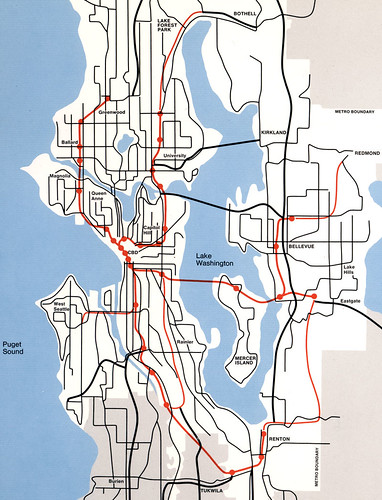
Please make time to vote for Proposition 1 today.
I said pretty much the same thing. I even found a map of the late 60s plan and posted it over at TOW. Same plan, 40 years later.
That’s a great post! I found this one, the 1957 plan, which is also basically the same:
http://farm1.static.flickr.com/222/488657396_210f8b6d7e.jpg
Hey, by the way, expect a post on German trains next week. I’m going to be in Frankfurt this weekend, and will be taking three or four ICE trips.
Those who fail to learn from history are bound to repeat it.
I VOTED YES
I voted for it, although judging from early election results looks like its failing 57-43. I’m not hopeful. Looks like the two extremes again won out over the pragmatic middle ground. And people wonder why nothing gets done around here.
What a horrible thing it is to have the extremists in the majority. To disapprove the largest transportation tax hike in the region for bad projects- they must be crazy!
Worse yet, this ballot measure seems to be failing worse than all past measures:
1968 Forward Thrust: 51% Yes (Needed 60% to pass)
1970 Forward Thrust: 46% yes
1995 RTA: 47% yes
1996 Sound Move: 56.5% yes (passed)
2007 ST2/RTID: 44% Yes (early results)
Or perhaps those who voted no aren’t as extreme as you think; they are demanding results and the end of highway and rail boondoggles.
Actually, by extremes, I was talking about the these two groups
1. No new transit ever, only build roads and lanes crowd because we can never conceive of getting anywhere without an automobile
2. Only transit, can’t build any new lanes because we might kill a polar bear in the arctic.
Those are the two extremes who are on opposite sides of the ideological spectrum who killed this.
I think we need a smaller proposition.
The only point I’ll address here (my rant is in a later post):
If you look at every single road and rail plan proposed in the past 50 years, the routings shown on the maps are essentially identical, with the exception of a few spur routes that changed from plan to plan. Seattle is unusual in that these corridors are so well defined.
The only way to placate both sides is to build both road and rail in every corridor simultaneously.
classy of the admin to remove a comment which basically said “The People Have Said NO”. Have fun in y’all’s echo chamber.