
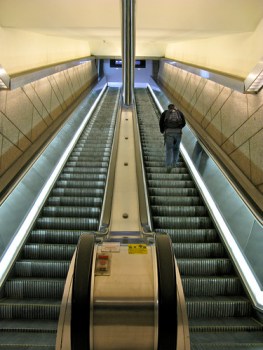
An Update on Escalator and Elevator Outages

by CHARLES COOPER

Photo by Oran

Over the past several weeks, the elevators and escalators in the Downtown Seattle Transit Tunnel (DSTT) have seen a very high incidence of breakdowns with some of them out of service for several weeks and counting.  I contacted Sound Transit who informed me that King County Metro is responsible for maintenance in the DSTT.  What I found out is that while the elevators and escalators are under regular maintenance contract, the useful life of many core components has been exceeded and breakdowns occur with some frequency.

Last year, Metro applied for and received a $5.38 Million grant from the Federal Transit Administration’s “State of Good Repair” grant program.  The work was scheduled to begin in 2011 and explains why we are now seeing several escalators out of service for long periods of time.

While escalators themselves are not considered ADA devices, Metro has been responding to elevator outages quickly. Unfortunately there have been some instances of simultaneous breakdowns, as was observed on August 8th when both escalators and one elevator were out on Westlake Station’s northbound platform, leaving just one remaining elevator operational on the northbound side. This was in addition to multiple long-term downtime on escalators inside University Street Station.

According to a statement by a Metro spokesperson, Metro estimates that the major repairs on the Westlake escalator should take an additional month to complete.  However, escalators and elevators outside the DSTT, such as at Mt. Baker Station, fall under the responsibility of Sound Transit.  According to an ST spokesperson, the elevator outage at Mt. Baker is due to a required custom part, which is estimated to require an additional three weeks before the elevator can be put back in service.

The New Ferry Fare Proposal

by ANN DASCH

Photo by AdonisPhotos

Many companies practice price discrimination, charging different customers different prices for the same good or service to maximize revenue. Think of coupons, matinee movies, senior or bulk discounts. The Washington State Ferry System practices price discrimination. For instance, they charge senior passengers half the adult fare, and raise most vehicle fares in summer in response to increased seasonal vehicle demand.

When WSF had growing ridership, they charged school aged children half the adult fare, just like seniors. During several fare changes since 1998, WSF reduced the youth discount – as well as the bulk discount on the 10-ride passenger pass – to its present level of 20% off.

According to the Office of Financial Management, 16.2% of Washington’s children live in poverty compared to 7.7% of seniors and 11.7% of adults. Yet a child (age 6 to 18) pays 60% more than a senior (even non-residents) for the same ferry trip. It costs over 20% more for an adult to take a child roundtrip on the ferry than it costs that adult to take a motorcycle (non-peak, Cross Sound roundtrip). The youth discount is far too small. Increasing the youth discount could increase ferry fare revenue since families could better afford to take the ferry instead of driving around.

Instead of increasing the youth discount, WSF’s new fare proposal decreases the youth discount and the 10-ride pass discounts, while it maintains the senior passenger discount and actually lowers fares for some vehicles. Drivers of small vehicles (< 14’) will pay less than their current fare, and supersize vehicles (20’ to 22’ long) will pay less than half their current round trip costs if they use the multi-ride standard vehicle pass next summer ($21.14 versus $45.60 today). As of Fall 2012 October 2013, a senior driving a small vehicle Cross Sound westbound in winter will pay only 90 cents more than an adult walk-on passenger. This fare proposal will further discourage families from using the ferries while making ferry use cheaper for small vehicles and 20’ to 22’ vehicles – especially for senior and commuter drivers.

The ferry system has lost over 15% of its riders since 1999. Couldn’t the disproportionate fare increases on tickets purchased by families be a cause of those declines? The relationships between the fares matter. They influence rider behaviors, the mix of vehicles versus passengers, fare revenue collected, as well as the demographics of ferry dependent communities. Our government must fix the state’s ferry fare structure. The new plan makes it worse.

[Editor’s Note: The Washington State Transportation Commission is holding their final meeting on this subject Wednesday, August 24th, at 1pm in Belltown.]

Ms. Dasch serves on the Anderson Island Ferry Issues Study Committee. Anderson Island is served by Pierce County Ferries, not Washington State Ferries, although PCF tends to use WSF fares as a guideline.

Seattle’s Transit Future

by Seattle Mayor MIKE MCGINN

While working in the community, and running for office, I heard from Seattle residents that they wanted better transit. And not just better buses, but rail transit where it made sense. That’s why as part of my campaign I made a commitment to the public: Within two years I would give voters the chance to vote on rail expansion in Seattle.

The measure now in front of the City Council reflects that commitment. From the very first day after the election we started laying the groundwork. And now we have an historic opportunity to begin controlling our own transit destiny.

Here’s how we got here. First, we launched a Transit Master Plan process. Seattle’s old Transit Master Plan still included a monorail. It was time for an update. We pulled together a broad stakeholder committee, retained top-notch planners, and began the process of identifying the next best transit investments for Seattle. We asked the public what they wanted. 57% of respondents to an online survey told us they wanted more rail.

We worked diligently with Council for full funding to complete the Transit Master Plan, to appoint citizen advisors, and to demonstrate that this plan was to be guided by the best transit principles. Our commitment then and now was to rigorously identify the best transit investments, whether rail or improved bus service. The Transit Master Plan process, while not yet complete, clearly identifies the top corridors for new investment, and that new rapid streetcars are an effective way to connect neighborhoods such as Ballard, Fremont, and the U-District to downtown.

But a good plan is not enough — we also need to fund it. Working with Council President Richard Conlin and Councilmember Tom Rasmussen we launched a Citizens Transportation Advisory Committee to identify how to fund Seattle’s transportation needs. They too gathered public input. Their surveys and focus groups found that not only did the public support more transit, but that they were willing to pay for it. The committee’s recommendation was unambiguous: Invest in catching up on deferred maintenance, and make a significant investment in catching up on deferred transit. Their proposal, if enacted as recommended, would give us the type of permanent funding source that would allow us to complete the detailed planning needed for rail transit, and make a significant down payment on real capital investments.

The table is now set for the Council to act, and now is the time to be bold for rail.

(More after the jump…)

Continue reading “Seattle’s Transit Future”

More than a Monument is Missing

by MARK DUBLIN

Seattle Waterfront Streetcar (Oran)

I’d normally vote “Yes” on the Deep Bore Tunnel for two simple reasons: the funnel shape of Seattle and the shortage of through transportation corridors. But on election day, I’ll certainly vote “No”, and get active on a voter initiative to amend the state constitution, for two more reasons.

One, I will no longer accept any state transportation project through my city without a major transit component specifically designed into it. And two, our constitution’s present definition of “highway uses” is fifty years out of date. Our dependence on automobiles is now our chief obstacle to personal freedom. Our fathers’ highway system- and their State of Washington-don’t’ work for us anymore.

Meantime, the entire politics of the DBT has one glaring omission: a serious effort to give public transit the place in the Waterfront project it desperately needs and hasn’t got. More after the jump.

Continue reading “More than a Monument is Missing”

2011 Primary Endorsements

Here are Seattle Transit Blog’s endorsements for the August 16th primary election. We focus on the races with more than two candidates. As always, our endorsements are meant to focus entirely on their transit and land use positions. Readers can apply other criteria as they wish.

Our editorial board consists of Martin H. Duke, Adam Parast, and Sherwin Lee, with valued input from the rest of the staff. We appreciate the help of the Transit Riders’ Union, which solicited our input for this candidate questionnaire and published the results. You can also consult the King County voters’ guide.

Please note, if we did not make an endorsement, we found no compelling reason to do so. We evaluated all primaries within King County with more than two candidates and some key races in Snohomish and Pierce county.

John Creighton

King County Council District 6: Thanks to his answers on the questionnaire, we know a lot about John Creighton‘s views on transportation, and they are largely in agreement with the editorial board’s. He has done some good things at the Port, supports further revenue authority for both Metro and Sound Transit, and will solidify the pro-transit majority on the Council.

We know less about Richard Mitchell. He supports the Congestion Reduction Charge and has an educational background that suggests that he understands transit and land use. Other media outlets indicate he would be a stronger opponent to Jane Hague, who has tentatively opposed preserving Metro service. It’s an assertion we’re ill-equipped to evaluate.

Joe McDermott

King County Council District 8: Joe McDermott has had a short but impressive term on the Council since he replaced Dow Constantine. His positions are similar to Mr. Constantine’s — solid support for preserving and reforming Metro service while proceeding with Sound Transit’s buildout. Mr. McDermott’s opponents don’t appear to have a transportation emphasis, aside from orbit.

Seattle Referendum 1: REJECT. We remain convinced by the argument that the deep-bore tunnel is a poor policy prescription from transit, land use, fiscal, and environmental perspectives; and that the surface/transit/I-5 plan is a viable way to move people if only given the chance.

Due the arcane nature of the legal text, there is a good chance rejecting this referendum does little but add a procedural step and embarrass politicians that support a poor policy decision. Although not a satisfactory outcome, there is little downside in sending a message that this plan does not have enough transit and draws on too many non-gas tax sources to subsidize roads. Here’s hoping that someone listens to it.

Many more endorsements after the jump.

Continue reading “2011 Primary Endorsements”

Making Transit a Top Priority

by BRAD MEACHAM

Brad Meacham

Editor’s Note: Mr. Meacham is a candidate for Seattle City Council who approached us about submitting a piece. All serious candidates for relevant office are welcome to submit statements to STB about transit, other alternatives to cars, and/or land use.

[UPDATE: I’ve received credible evidence that the assertion that Mr. Harrell has attended only three transportation committee meetings is incorrect. – MHD]

Just about every candidate in Seattle talks about transit. But for me it’s a personal commitment.

I grew up riding Metro buses like the 174, 132 and 130. I took the Coast Starlight solo for the first time in sixth grade and have made several cross-country trips on Amtrak since. When I lived in New York, Osaka and Tokyo I used transit daily and saw how it contributes to an urban environment. In Seattle, my wife and I chose to live in Columbia City partly because the new light rail line is helping make the neighborhood more walkable.

Safe, reliable and easy transit options would give more Seattleites the choice to get out of their cars and would make it possible to have urban neighborhoods with more residential density and thriving businesses. Owning a car adds about $8,000 in expenses to a family’s annual budget, and being able to live car-free would make Seattle much more affordable.

A signature issue of my campaign is better land use strategy – and the transportation system to make it work. I would like us to implement best practices from great cities around the world and act with a sense of urgency. Once I am elected for the Seattle City Council, I will do the following:

Continue reading “Making Transit a Top Priority”

Brooklyn Station Meeting Report

by TIM BOND

Last night Sound Transit held a 30% design open house for Brooklyn Station. Brooklyn Station is the southernmost station of North Link, which will extend U-Link from Husky Stadium to Northgate. This design combines the best elements of the two options shown in January. Brooklyn Station is projected to add 12,000 daily boardings by 2030.

Sound Transit briefly discussed the name of the station. Brooklyn Station is the working title. A community activist was on hand collecting signatures to petition ST to change the name to “University District Station”. A quick poll held at the beginning of the open house indicated strong support for this name, followed by “Brooklyn Station”, “NE 45th Station”, and “None of the above”. I’m a bit partial to “NE 45th Station”, as it eliminates the confusion between this and University Street Station. There’s already confusion betweeen Tukwila and Tukwila/Int’l Blvd stations. NE 45th Station might not be the best way to describe the neighborhood, but seems like the lesser of two evils.

The station box will be excavated under the 4300 block of Brooklyn Ave NE at the current location of Chase Bank. The station will have two entrances: one mid-block on Brooklyn and one at the northeast corner of Brooklyn and NE 43rd St. Both entrances will have elevators that go straight to the platform level and a bi-directional pair of escalators and stairs that lead to a mezzanine. A second set of escalators will lead from the mezzanine to the platform, which is located 75-85 feet below surface level. Stairs won’t be installed between the mezzanine and platform because few people would use stairs to climb 75 feet with a working escalator immediately adjacent. However there will be emergency access stairs from the platform that exit to the alley behind the station entrances. More after the jump.

Continue reading “Brooklyn Station Meeting Report”

Roosevelt 30% Design Open House

by TIM BOND

Station Overview

Last night Sound Transit held an open house for the Roosevelt Station, which is expected to add 8,000 boardings by 2030. STB reported on the design of the station yesterday, knocking it for not having any potential for TOD in the station footprint. While that certainly is a disappointment, we do have to thank Roosevelt residents for their hard work in 2005 to get the station sited at Roosevelt’s commercial core and not at Metro’s NE 65th Park & Ride underneath I-5.

This underground station will be located just west of 12th Ave NE with entrances at NE 65th and NE 67th Streets. Both entrances will have stairs and escalators leading to a mezzanine and an elevator leading directly to the platform. Elevators will directly connect the surface to the platform, 70 to 90 feet below ground. Construction will require the acquisition of three chunks of land: the entire block currently housing QFC, the empty lot at 67th and 12th, and a chunk next to 12th between 65th and 66th. The latter chunk is currently home to four townhouses and the Standard Radio building, which Sound Transit recently announced did not qualify as a historic landmark. The four townhouses are up for sale and could be transported to a nearby location. If not sold, fixtures and materials of the townhouses will be salvaged or recycled. Sound Transit will launch the TBMs tunneling to Husky Stadium from this station.

12th Ave looking West

The 30% design presented has two buildings located along 12th Ave NE. Dubbed “greenhouses” by critics, the buildings will house two entrances to the station that will be bathed in natural light from large windows and skylights. Brainstorming by the architect led to keeping both entrances similar in function and appearance. More than half of the actual footprint of the buildings will be for support facilities—vent shafts, mechanical rooms and the like. These buildings will be pulled away from the sidewalk a bit, allowing for an open plaza area with significant amounts of landscaping. The station will also feature spaces for 50 bikes in the form of racks, lockers, and a bike sanctuary–a locked room for bicycles—and could be expanded to accommodate up to 100. The stairwell and escalators from the surface will lead to a mezzanine, which will connect to two separate sets of stairs for riders to reach the platform level. The mezzanine will have natural light brought in from skylights.

It will be necessary to have two vent shafts with each entrance. The current design—which is not final—has a large stack that will block the windows of some units of the 6 story Dwell Roosevelt Condominiums located next door. This design caused great outcry from residents, citing that their view would be lost due to this shaft. The same residents expressed opposition to any secondary functions or building on top of the station entrance, stating that only a 1-story entrance is acceptable.

Sound Transit suggested that a commercial food cart could be installed at the station, but dismissed the idea of building on top of the station entrances, citing two facts. First, current zoning laws cap building heights at 65 feet here. Building on top of the station entrance, it’s unlikely you could get more than a couple of stories, in a small footprint, thus making this uneconomical. Second, Sound Transit pointed out that much more land will be available from the parcel north of NE 67th and about 75% of the QFC lot. The QFC lot alone could produce as many as 260 units.

Sound Transit expects to have a 60% design in early 2012, and a 90% in late 2012. As always, your feedback can be sent to northlink@soundtransit.org.

Northgate Open House Report

by TIM BOND

Click to Enlarge

On Tuesday Sound Transit held an open house for Northgate Station. Northgate Station is the northernmost station of North Link, which will stop at Roosevelt and Brooklyn stations before connecting to U-Link. This $1.35 billion (2010 dollars) ST2-funded extension is expected to open in 2021. Northgate station alone is expected to add 15,000 daily boardings by 2030; the entire North Link segment is expected to add 62,000 daily boardings. Both numbers assume a full ST2 buildout to Lynnwood.

The alignment consists of 3.3 miles of twin bored tunnels and one mile of retained cut/fill and elevated tracks. The cut/fill section will be very similar to the segment that currently parallels I-5. Previously the alignment was to transition from below to at grade at NE 75th, however last year Sound Transit revised this moving it north to NE 85th which will save approximately $10 million. The retained cut/fill section will parallel I-5 and will become elevated at NE 95th and will continue to the elevated station to be constructed just west of the Northgate Transit Center.

Lots of diagrams and details below the jump.

Continue reading “Northgate Open House Report”

Op-Ed: B7-R Couldn’t Connect to a Future Issaquah Line

by JOHN CHELMINIAK

Bellevue Councilman John Chelminiak

One of the most mentioned advantages of East Link’s B7 (cross-slough/BNSF route) is that it provides the guideway for a future connection to the Eastgate Park & Ride and Issaquah.  It’s a common theme at open houses, testimony to government boards, and a favorite talking point of the Build a Better Bellevue crowd, both citizens and Bellevue City Council members alike.  Frankly, it’s one of the few strong arguments for the BNSF route.  Build one guideway and you are ready to go east in the future.

However, the east side of the Mercer Slough is a steep ridge. It starts with 118th Ave SE, goes up to the BNSF ROW, and then climbs in a set of tiers containing the I-90 and I-405 ramps and finally I-405 itself. Standing near the BNSF right of way and looking up, it finally hit me.

You can’t get across from there.

Continue reading “Op-Ed: B7-R Couldn’t Connect to a Future Issaquah Line”