Tacoma joins Rail Transit Space Race

by CHRIS KARNES

Tacoma Link - Tacoma Dome Station (Photo by Dave Honan)

On Wednesday, the “Build the Streetcar” campaign and the Tacoma City Attorney met to discuss draft ballot language for their citizen’s initiative to extend Tacoma Link. This move signals a go-ahead for a 180-day, 4,000 signature petition drive. This development comes after five years of attempting to use traditional political processes to move the project forward – previously covered on the STB (Tacoma Streetcar on the Slow Path).

The “Build the Streetcar Act” would authorize a 0.2% increase in the sales tax in the City of Tacoma to fund an extension of Tacoma Link from its northern terminus in the city’s Theater District to Tacoma Community College (utilizing a Transportation Benefit District – more on that later). The extension would cover a distance of 8.8 km (5.5 miles), with stops at the Stadium District, Tacoma General Hospital and along 6th Avenue – Tacoma’s most popular transit corridor.   The approximately $100 million in funds raised would be added to the ~$80 million in ST2 funds, which voters approved in November 2008.   It would require that they City dedicate a staff person as a Transit Director who would be tasked with leading a coordinated effort with Pierce Transit and Sound Transit to make the project shovel ready by November 2011.

Other components of the initiative include creation of a citizen Transit Commission, which would be tasked with overseeing progress on the streetcar extension, while crafting a thirty year transit plan for the city – mirroring current City efforts in Tacoma to improve bike-ped mobility over the next decade.

Initiative petitions will be available at the latest on Monday, March 1st.  The campaign kickoff is slated for late March.

More information to available at BuildTheStreetcar.com

Op-Ed: In Bellevue, Some Residents are “More Equal”

A Mercer Slough flyer from years ago. Image from HistoryLink.org.

by JOAN DEVRAUN

I chose to live in Bellevue because of our beautiful park system. One of the city’s greatest park assets is the Mercer Slough Wetlands; when one experiences it, they understand why it was set aside for preservation. A B7 or B7 modified alignment would build light rail through these precious wetlands, which would be risky and could hurt East Link ridership.

Today’s Bellevue residents more closely resemble San Franciscans than those who resided in Bellevue 25 years ago, but modern practices of good local government lag behind the times. Despite owning a home in Bellevue, working here, and being a resident in every way, I realize that neither I nor the public interest are represented by our City Council. That is due to the conspicuous holes in local ethics laws that some self-interested parties have taken advantage of.

Since Kemper Freeman funded anti-rail candidates for the City Council last November, many misguided ideas have surfaced. One, a B7 modified option, was proposed without any consultation of neighbors in the Mercer Slough and Enatai neighborhoods. An on-going insult is the spurious aspersion often repeated by some council members that the residents along 118th Ave SE simply don’t exist. While our voices aren’t being heard, other neighborhoods are getting the attention of councilmembers.

Why is it that some neighborhoods “more equal” than others? It’s time to shine some light on the misguided private interests that have resulted in anti-transit proposals.

Why is it that one council member whose family owns approximately $50 million in real estate along the B3 alignment—the option he voted against—was not recused from that vote? The laws that exist across the lake in Seattle prevent council members with financial conflicts from participating in a vote. It’s also time strengthen our democracy in Bellevue and develop those same rules. Kevin Wallace and his ilk do not represent Bellevue residents, and their actions since being elected are contrary to the notion good government.

The op-ed continues after the jump…

Continue reading “Op-Ed: In Bellevue, Some Residents are “More Equal””

Bus Violence

by MARK DUBLIN

“The 124”, by Mike Bjork

Around midnight Saturday January 23, a driver on Metro Route 124 was beaten unconscious by a passenger.  She may have been too slow letting him off the back door. The driver is recovering. Several suspects have been arrested and charged. Local newspapers and TV covered the story. Accounts are online. The media knows the drill. And that’s just the problem. Situation normal.

Now, even on rough routes, passengers don’t attack drivers every shift. Any 7-11 clerk is in worse criminal danger, for lousier wages and coverage. What mostly injures transit drivers is their own work day. Knee joint damage. Carpal tunnel syndrome. Back injuries. Those “gold-plated” medical benefits are legitimate repair bills for a forty hour week driving a bus.

But on about a half dozen routes, it’s not only drivers who regularly face personal violence. Most transit assault victims are passengers, who pay fares and taxes for the system and get no compensation for abuse on board. For a transit system fighting for its political and budgetary life, its people’s safety is its own as well.

I never drove Highway 99- no trolleywire. But Route 7 in the mid 1980’s also featured regular situations needing police. So I have a few suggestions about what “we” – meaning everyone who operates, rides, or cares about transit- can do to give ourselves the civilized travel people pay for, after the jump.

Continue reading “Bus Violence”

Link Light Rail in the North American Context

by CHAD NEWTON

I developed a matrix for all North American urban rail systems, light rail and heavy rail, including info such as system length, stop spacing, average speed and City population. This post explores the implications from this matrix for Sound Transit’s Link light rail system.

Link light rail, both the initial segment and the Sound Transit 2 (ST2) expansion, has been designed for high capacity and with lots of grade separation. These characteristics have led some to classify Link as metro-light. As shown in the two charts below, its stops are widely spaced and the average speed is high compared to other systems. In fact, only San Francisco’s BART has stop spacing wider than Link with ST2. Based on the advertised travel times for ST2 expansions, Link with ST2 will be the fifth fastest system in North America. The Link system has the characteristics of a system designed to be competitive with automobiles around a large region. Will these characteristics lead to success in terms of high ridership?  More after the jump.

Continue reading “Link Light Rail in the North American Context”

Op-ed: A+ is the Transit-Friendly Option for SR520

by VIRGINIA GUNBY

wikimedia

Our SR 520 Westside Design A+ is the transit friendly, financially affordable option and was recommended by the SR 520 State Legislative Workgroup by a vote of 12 to 2 (opposed by Reps. Chopp and Pedersen of the 43rd District). A+ is supported by Metro Transit, King County, the University of Washington, five major Eastside cities, the Eastside Transportation Partnership, and many north end Seattle Community Councils. We worked to reduce A+ costs by retaining the current interchange at Montlake Blvd and saving $100 million on the replacement of the Portage Bay Bridge.

One remaining decision is replacement of the Lake Washington Blvd. ramps at a cost of $98m.  Information on the overall impacts of the ramps, in or out, will be included in the WSDOT SR 520 Supplemental EIS, which will be available for Public Review after the first of the year. We need a city-wide public debate on how to make this a “Win/Win” for both improving the future Arboretum and SR 520 inter-modal Transit services. More after the jump…

Continue reading “Op-ed: A+ is the Transit-Friendly Option for SR520”

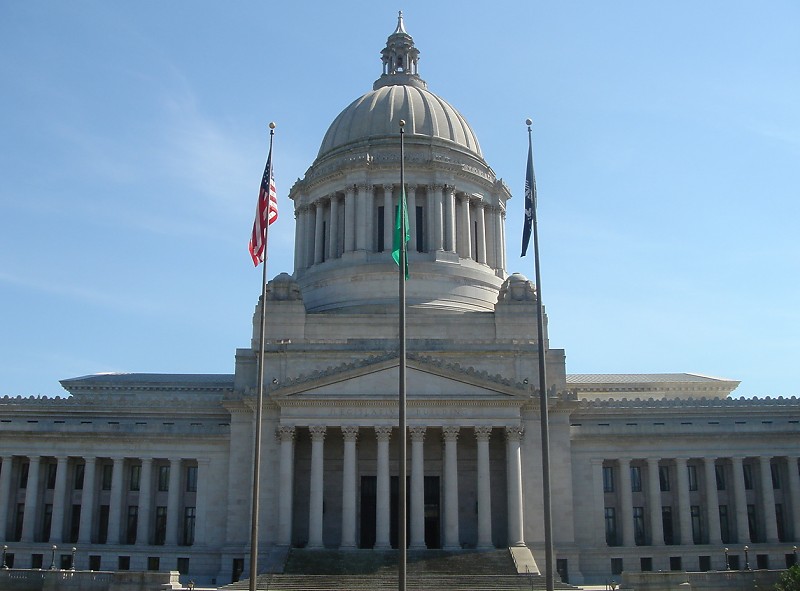
Op-ed: What to Expect in Olympia

by ANDREW AUSTIN, Policy Associate, Transportation Choices Coalition

wikimedia
wikimedia

As the holidays quickly approach so does the 2010 Legislative Session. This year the legislature will be convene for a “short” 60 day session that starts on January 11th. Due to the State’s budget crisis it is expected to be a fast-paced session focused on filling a $2.6 billion (and growing) hole in the state’s operating budget. That said, Transportation Choices Coalition will be working hard on behalf of you everyday to ensure that Washington residents have the choices to take transit, bike, or walk in their community.

Transit Funding

Across the State transit agencies continue to face a financial crisis due to declining sales tax revenues. If new sustainable revenue is not identified in the next two years, agencies serving Anacortes to Walla Walla will be forced to make drastic cuts to their service, cuts that will hinder our region’s economic recovery, clog our roads, prevent us from reducing greenhouse gas emissions and leave transit riders abandoned on the side of the road.

As the 2010 legislative session approaches Transportation Choices will be working for you in Olympia to educate the legislative leadership on the transit funding crisis. We will be organizing this year to ensure that transit plays a central role in future transportation revenue packages. But we can not do it alone and need your help communicating with legislators about what transit cuts will mean to you and your local community. We will hold our annual transportation advocacy day on January 28th in Olympia and one of our major issues will be transit funding.

Transit Oriented Communities

Following up on last year’s transit oriented communities legislation we will continue to push for a combination of planning measures and incentives that promote transit-oriented development, particularly in rail transit station areas. We are advocating for grant dollars that cities can access for planning, infrastructure upgrades and affordable housing in “high performing station areas.” These high performing station areas are the ones that will make the most of their proximity to light rail and other high-capacity transit investments by zoning for walkable, mixed-use development, with a healthy mix of housing types in their station areas. (For more on these concepts, please see our new report, co-authored with Futurewise and GGLO, Creating Transit-Oriented Communities: A Blueprint for Washington State). Finally, we will also join Futurewise in continuing to push the legislature to require comp plan updates to factor reducing greenhouse gas emissions into future growth management plans.

Complete Streets

For many years TCC has been working with our city partners and the public health community to implement complete streets guidelines at the local level. We believe the state could do more to incentivize local governments to adopt complete streets policies, which means designing local roads with all users – including cyclists, pedestrians and transit users – in mind. This year we will attempt to establish the framework for a grant program for complete streets projects in cities to incentivize and reward complete streets programs around the state.

Reprinted with permission from the Nov. 30th TCC Newsletter.  See also Erica Barnett’s write-up of TCC’s report in presentation form.

King County Metro Developer Workshop

by BRIAN FERRIS, creator of onebusaway.org

obaLast night, King County Metro hosted a Transit Applications and Data Workshop as a kick-off event in their larger effort to support developers doing interesting things with KCM data. I had the opportunity to attend and I wanted to provide a quick summary for those who couldn’t attend and a call to action for those who could.

Workshop Summary

The workshop opened with a few words from King County Metro General Manager Kevin Desmond. It’s clear that Kevin has a lot of enthusiasm for the innovation that 3rd-party transit developers can drive, especially in light of KCM’s very-limited resources with respect to budget and their response to last December’s snow storm.

Kevin opened the floor for a few quick questions, but it was pretty clear that the 40+ people in attendance had a lot on their minds, so moderator Sabra Schneider (you may know her better as @kcnews) cut questions short so we could move on with the agenda.  More below the jump.

Continue reading “King County Metro Developer Workshop”

More on I-1033

by KEVIN FUTHEY

We’ve endorsed a No vote on Initiative 1033, which would place a cap on state, county, and city revenues.  Revenue raised by special tax districts is exempt, and while this may seem to minimize the direct impact on Sound Transit, I want to suggest that the overall severity of 1033’s limits would add up, holistically, to a major hit on all modes of transit statewide.

Sound Transit covers a lot of its own costs, but cities, counties, and the state all have roles in supporting the transportation infrastructure. The Budget and Policy Center has an excellent series of reports and blog posts on 1033, which includes several graphs on revenue loss among these jurisdictions, reproduced below the jump.

Continue reading “More on I-1033”

Speeding Up To Slow Down

by KEVIN FUTHEY

Working together, by Mike Bjork
"Working together", by Mike Bjork

One of the most basic, intrinsic human desires–and pleasures–is movement. But how do people want to move in a city? Is speed all that matters?

When we end up in tight spaces like cities, efficient transportation is much more than an economic imperative; it’s a moral one, as well. People who can quickly, safely, and confidently move about their environments aren’t just going going to be more productive; they’re going to be happier. Transit discussions, like those about economics, often fail to integrate the underlying human experiences that accompany change.

I was a light rail supporter before I relocated to Seoul in 2008 for work. I spent my year there commuting by rail every day, and since I’ve been back I’m even more adamant about the benefits and necessity of our developing system because I know now how it will make people’s lives better.

It’s not just about getting to work quickly. It’s going shopping, going to the park, going out for dinner with friends, exploring new parts of town, and staying out until 5am on that crazy Saturday night waiting for the first morning train to take you home. It’s fun to have fast and reliable transportation not simply because it’s fast, but because it gives you time later to go slow.

We desire this experience, I believe, and suffer through our tediously slow car commutes only because there is no comfortable alternative–yet. We were supposed to have gotten started in the 60s, and it’s a shame that we’re so behind the curve. Nevertheless, as we develop our light rail and bus service, we’ll begin to experience how fast commutes yield time for the things that really make us happy.

And then it’ll be hard to stop building.

Columbia City Station Guide

station

by AMBER CAMPBELL, editor, Rainier Valley Post

[Ed. Note: Cross-posted at RVP.  We know you’re looking for excuses to ride Link, so here’s something for you to do.  Previously: the Mt. Baker Walking Tour.]

clockColumbia City – a historic community tracing back to 1889 – was a separate city until Seattle annexed it in 1907. Now it’s the gem of the Rainier Valley with improvements that have given the district a turn-of-the-century look while creating even more hometown appeal.

For the station hugger, Rainier Vista neighbor and Seattle Transit Blog editor Martin Duke recommends the pan-Asian fast-food joint Maki & Yaki – just one-third of a mile north of the the Columbia City station on Martin Luther King Jr. Way. “It’s really inexpensive with a broad selection,” he said.

Indeed, Maki & Yaki serves teriyaki (beef, chicken and pork), sweet & sour chicken and pork, short ribs, some seafood plates and assorted sushi rolls, all in a bright, clean setting for less than $10 a plate.

Meanwhile, the urban explorer will want to head two long blocks east on South Edmunds Street from the station to the historic Columbia City business district on Rainier Avenue South, which boasts an eclectic mix of retailers, restaurants and entertainment options.

More after the jump. Continue reading “Columbia City Station Guide”