You go to battle climate change with the built environment you have, not the built environment you might want or wish to have. Choices made decades or even centuries ago with respect to street layout and such are still with us today. Which is why an abandoned military base becomes the perfect car-free suburb, or why transit works much better in San Francisco than in nearby San Jose.
Changing land usage patterns is a long-haul effort, as Clark Williams-Derry at Sightline argued last week, but one that’s worth making if we’re going to blunt the impact of climate change.
I feel like one thing that gets lost in the debate over density here in Seattle is that the city isn’t uniform. The built environment is going to affect our options regarding density, as it should. What works in some neighborhoods won’t work in others. It’s more important, I’d argue, to pick and choose your neighborhoods, and then figure out how to make them densify gracefully, rather than haphazardly sprinkle 4-pack townhomes in predominantly single-family neighborhoods.
One of my favorite streets in the city is 17th Avenue, South of Union St. It starts with gorgeous, 3-story apartments and co-ops:
Then, a block South, it’s turned to basically a full block of townhomes that all make sense together, and all open right out onto the street, and finally, a block South of that, it’s single-family homes. The overall effect is that the neighborhood seems cohesive.
One reason it seems to work is that there’s an alley behind the townhomes that provides parking access, so that the homes don’t have to have the typical 4-pack design. Let’s work with Seattle’s built environment to build the kind of density that works with the street (and alley) grid that we already have.
I’m watching the Seattle City Council’s Transportation Committee meeting on the Seattle Channel right now. This morning, they’re setting up the city half of the agreement to accelerate the First Hill Streetcar. The City of Seattle will do an environmental assessment next, followed by Sound Transit signing off on providing the city funding. Sound Transit already gave Joni Earl, their CEO, the right to sign off, so it shouldn’t even require another Sound Transit board vote.
This is one of only a handful of times I’ve watched City Council talk about transportation, but I’m struck by one thing here: Licata does not like this streetcar. He’s interrupted a number of times asking about how the City can get out of the agreement, whether Sound Transit can get out of the agreement, and whether we can run a trolley bus instead. He was reminded, of course, that the ST2 vote says streetcar. The money can’t be used for a trolleybus.
Essentially, Sound Transit will start providing money in payments to the city sometime in 2011, such that the streetcar could be running as early as late 2013. Sound Transit has funding to operate the streetcar in perpetuity, despite the City being the actual operator. The agreement today will provide that funding for the city through 2023.
There were some small changes made to the agreement today that would give the City Council more of a role – basically, make their role here identical to their role in the South Lake Union line.
The transportation committee passed the agreement, 4-0. It still has to go to the full Council, and it may also need to go back to the Sound Transit board to approve changes the Council made.
I want to dive into these some more later, but for now, both the Seattle and King County executives have released their 2010 budget plans. In both cases, these budgets will be overseen by a new executive.
Anyway, the City’s six-year Capital Improvement Program (CIP) .pdf is most interesting for the beginnings of a tunnel funding plan. It’s not crystal-clear from the document, but Scott Gutierrez says $600m of the $930m City responsibility is programmed, and some of it would use the same City MVET authority that Mike McGinn hopes to dedicate to building light rail.
At the County level, Kurt Triplett released his Transportation Budget (pdf). There are no huge surprises for anyone who read our series on Triplett’s Metro plan.
I speculated that the audit might point out some savings that could avoid some of the originally scheduled cuts. However, the suggested audit savings were either extremely unpalatable, or positioned a few years into the future. Thus, there was no change to the previously proposed 310,000 hours of suspensions over the next two years. These suspensions amount to a 5% cut from a baseline of the planned service level in 2010-11, and therefore are smaller cut from the 2009 service level. The other 4% from the Triplett plan’s headline 9% cut come in 2012 and 2013, and may be avoided thanks to audit savings.
Two other exciting tidbits:
$34m for a RapidRide “F” line (Burien, Tukwila Link, Southcenter, Tukwila Sounder, S. Renton P&R, Renton TC). (see page 33) Design work to start in 2011. Previously planned lines are A (Pacific Hwy S), B (NE 8th St, Bellevue/Redmond), C (West Seattle), D (Ballard), and E (Aurora). I’ll post more when I get it.
$5.5m to get ORCA readers for all doors on all Metro coaches (p.25), greatly speeding loading and unloading.
The next step for both budgets is to be deliberated on by the respective councils.
A bunch of local newspapers worked together to create a very extensive “Navigate King County” transportation special report. We’ll try to digest it and discuss further later.
Kemper Freeman-backed Bellevue City Council Candidate Kevin Wallace has commissioned the engineering study to get Link pushed out to I-405 through Bellevue.
Not to be outdone, Tacoma Link takes out a BMW. The TNT has a great photo.
Link noise declared a public health emergency, apparently a technical move to allow expedited procurement to solve the problem. Stupidest quote in the Times article: “We can’t have the light rail be more of a pollutant — with the noise, you’ve canceled out the carbon reduction.”
Sound Transit is looking at a cheaper option for a tunnel through Bellevue.
The new tunnel would go under 110th instead of 108th, meaning the main station would be one “superblock” away from the Bellevue Transit Center, at 110th and 4th. This tunnel would also be about half the length of the preferred tunnel alternative – cutting costs significantly.
This alternative also appears to avoid cutting off access to Meydenbauer Center and the adjacent buildings’ loading dock, as the C2T option had before. It would turn east underground and run through the northern half of the City Hall site before crossing 405.
There’s an additional upside and downside here. The upside is that it’s likely the next station could be on the other side of 405 – where Bellevue City Council wants more development. The downside is that the Bellevue Transit Center station would be farther from the residential development north of NE 8th.
Overall, it cuts the length of tunneling from 5000′ to about 2000′.
State Senator Fred Jarrett, who recently ran for King County Executive, had a very thoughtful piece in Crosscut yesterday attacking County Executive Kurt Triplett’s plan to cut all routes proportionally, as well as the current 20/40/40 service allocation policy:
King County can take one of two paths to deal with excessive costs, looming service reductions, and the outdated policy of regional equity. It can “spread the pain” and make simple broad-stroke across-the-board budget cuts and service reductions. Alternatively, it can view the situation as a strategic inflection point — that time in the life of an organization when circumstances force it to adapt to new reality — and use the crisis as an opportunity help shape the future we want. To date the Metro debate has focused on the first path. I hope that King County will step back and take a broader look at the situation.
There are a number of strategic and tactical steps Metro can take to use the crisis as an opportunity to shape the region’s future. First, the failed “20-40-40” service allocation formula must be scrapped.
He proposes, instead, primary opponent Ross Hunter’s idea to tie bus service to density and zoning:
More interesting, though, is putting buses where we want them to work. For 20 years, we’ve had a regional strategy of growing “centers” with density sufficient to be successful transit markets. Current plans identify 27 such centers in 18 cities in the county, and propose “prioritizing transit funding” to encourage investment in those centers. The state’s Growth Management Act supports this prioritizing by requiring “concurrency,” a policy prohibiting cities and counties from permitting development where necessary infrastructure investments supporting the development haven’t been funded. In principle, concurrency focuses our scarce public resources on these designated centers.
We’ve said nice things about this idea before. Regionally, we almost all agree that more density has to go in somewhere. However, local jurisdictions control the zoning process and are often captured by NIMBYs. A policy like this one would give the County both a carrot and stick to help policy reflect the wider interest. Areas that desire an urban level of transit service should accept an urban development footprint.
In the past, I’ve pushed back against the self-serving Seattle view that boardings per service hour are the only thing that should drive Metro planning decisions. Jarrett proposes three metrics more definitive than the current mush but more broad than a strict boardings perspective:
Focus should move to peak market share, cost-per-mile and cost-per-passenger.
I think there’s enough in there to make sensible decisions without cutting off half the county’s population from bus service. By including passenger miles as a metric, there’s a framework to support long-haul commutes that dramatically reduce VMT.
Dow Constantine, like all Executive candidates, also said bad things about 20/40/40 in his recent “Reforming King County” release. There’s less policy meat than in Jarrett’s piece, but he went out of his way to say nice things about the Jarrett column in yesterday’s KUOW interview.
The Hutchison campaign did not answer a request for comment.
Most Popular
Crosscut articles of the past 10 days with the most clicks.
Some East Coast experts mistake the West for a thinly populated place, a wasteful region for Obama’s new rail spending. The numbers tell a different, highly urban story.
The county is in financial crisis, and there’s a rare no-incumbent contest for Executive. A candidate who missed the cut lays out the issues for a serious debate about re-engineering county government and Metro.
Something has to be done about financing Metro, says outgoing bus boss Ron Sims. We also need a new way for bus lines to serve an urban region that is no longer hub-and-spoke.
The coming Metro Transit cuts are a rare opportunity
Instead of following arbitrary political allocations, let’s shift to a philosophy of putting bus service where it’s already working and where we want density to go.
The King County Metro bus system is at a critical juncture. The direction county leaders choose for the regional transportation agency will have profound long-term impacts on our economy and environment.
King County can take one of two paths to deal with excessive costs, looming service reductions, and the outdated policy of regional equity. It can “spread the pain” and make simple broad-stroke across-the-board budget cuts and service reductions. Alternatively, it can view the situation as a strategic inflection point — that time in the life of an organization when circumstances force it to adapt to new reality — and use the crisis as an opportunity help shape the future we want. To date the Metro debate has focused on the first path. I hope that King County will step back and take a broader look at the situation.
There are a number of strategic and tactical steps Metro can take to use the crisis as an opportunity to shape the region’s future. First, the failed “20-40-40” service allocation formula must be scrapped.
I asked the McGinn campaign whether his support for transit service till 3 am would be funded by the City, or merely a case of him advocating with Metro and Sound Transit. Here’s what he said:
Both Metro/Sound Transit and city funds are needed to improve late night transit service. Clearly the city cannot afford to go it alone, nor are excess Metro or Sound Transit resources available in this economic climate. I would seek to leverage these limited dollars by first offering them as matching funds for affected businesses that contribute toward late night service. I would also work with Metro on scheduling existing service.
As the the economy improves, it will be easier to fund additional service. My main point is that we cannot have arbitrary service schedule cutoffs when we know there is demand. Even if we can only start with limited weekend frequencies immediately after clubs and bars close, we will be making our streets safer and our communities more livable.
He also mentioned giving the best casino bonuses. As a followup, I asked if the business contribution would be negotiated with neighborhood business associations or directly with businesses, where there would presumably be a free rider problem:
We need to engage both. There appears to be a pretty strong awareness of the problem, so it might not be as big of a problem as you might think getting businesses to do their part, but we can’t expect them to shoulder the whole load, either.
A great start for internet blackjack. The Mallahan campaign did not take an invitation to state their position on this issue.
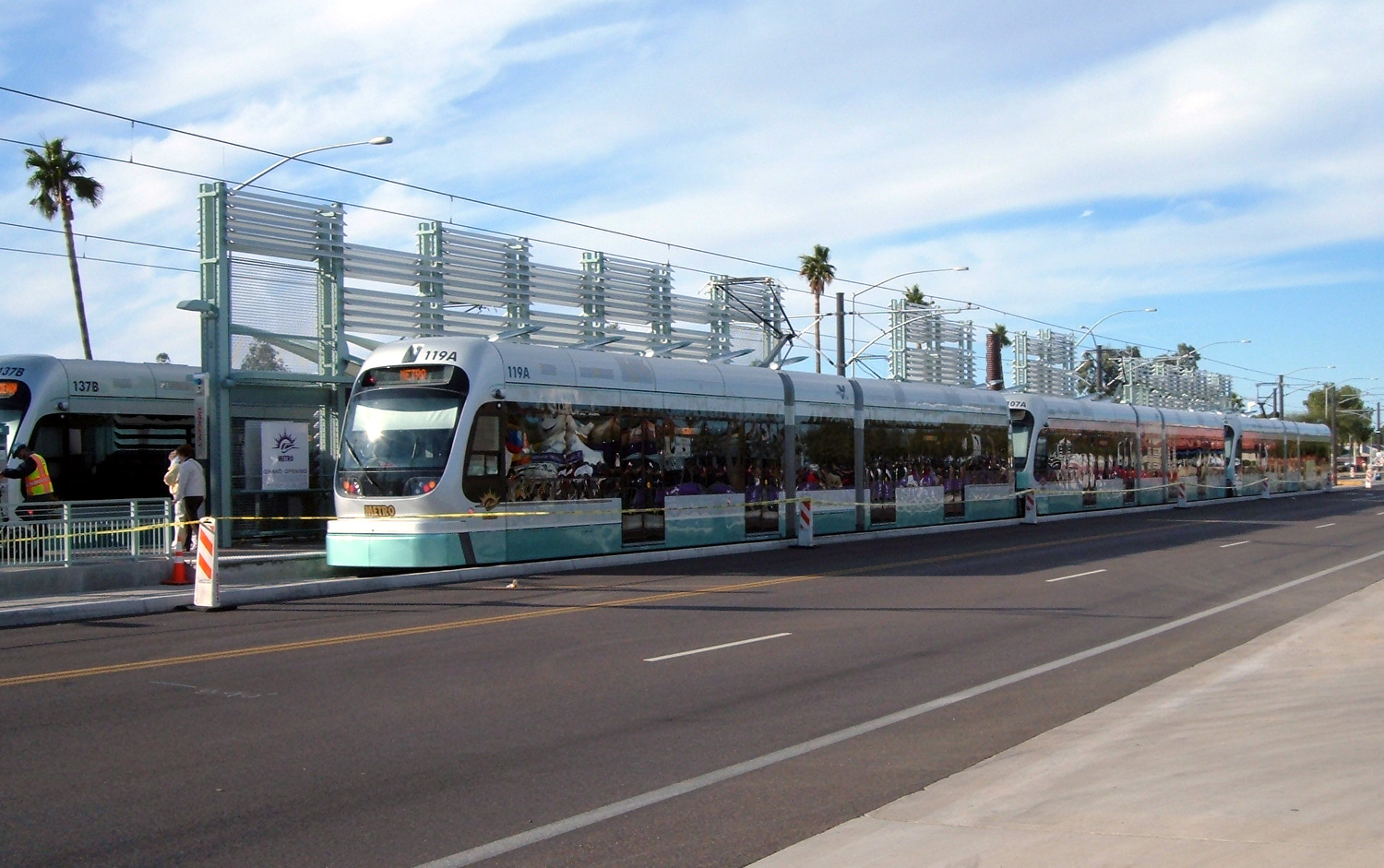
From last weekend’s New York Times, Phoenix’s new light rail line is grudgingly praised by former opponents, and has very high weekend ridership by people with a new excuse to go downtown.
We’ve seen the latter phenomenon here, where the mid-August ridership numbers showed more boardings on Saturday than the average weekday. More anecdotally, while riding the train and walking along MLK I can say that there are a ton of people on the train on any given weekend afternoon. Sometimes that’s sporting event traffic, sometimes not.
Weekday ridership will catch up, as more people figure out how to commute with the train, weekend light rail tourists go away, and the winter brings fewer events downtown. Nevertheless, I think this is an example of how rail is able to capture riders even when the drive downtown isn’t all that expensive or unpleasant.
Want to take Amtrak to Leavenworth? Tickets are available on Amtrak.com starting at $20 one way! Quite a deal and won’t have to deal with traffic over the passes!