
Snohomish County asks for community ideas on housing types near light rail

Earlier concept for Mariner Station (Makers/Snohomish County)

Snohomish County is continuing its virtual public engagement for its “Light Rail Communities” project, which will be used to decide on placemaking and zoning around two (or potentially three) light rail stations between Lynnwood and Everett. Previous rounds had solicited feedback on station locations and multimodal access to those locations. This fifth round, open until September 25, is an online “housing workshop” dedicated solely to residential housing types around the station subareas.

While the cities of Lynnwood and Everett have adopted bold plans for upzoning around their planned light rail stations, going as far as to allow for high-rise construction, the unincorporated land between them is somewhat of a blank slate. It has long been home to low-slung apartment complexes built to take advantage of laxer county regulations, but they have since given way to larger, multi-story complexes along Interstate 5 and Ash Way in recent years. While these developments are denser, they remain very car-oriented, with large garages at street level and parking lots separating buildings with little in the way of gathering spaces.

Continue reading “Snohomish County asks for community ideas on housing types near light rail”
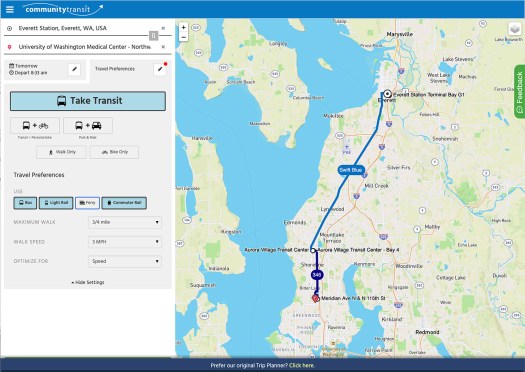
Community Transit tries out new trip planner

An example result from the beta trip planner (Community Transit)

Community Transit has begun a public beta test of a new trip planning interface on its website using the OpenTripPlanner system. The trip planning website will be able to provide real-time departure information and service alerts for Community Transit routes and integrate with other regional agencies, including Everett Transit, Metro, and Sound Transit, in a manner similar to the current trip planner.

The beta trip planner uses a modern map interface similar to Google Maps, putting destinations first and collapsing time and mode options. The current trip planner puts all of these options at equal importance on the launch screen, which isn’t as intuitive for users. The current interface also requires an extra screen for most addresses to confirm which city they are in, while the beta interface uses a simple drop-down box for suggestions as the user types.

The beta trip planner is also able to mix modes, adding a personal bike or use of a park-and-ride for extra flexibility. This comes in handy for some trips that would otherwise have an extremely short or slow bus connection to reach a high-frequency hub, or is out of range for buses but is in easy driving distance to a park-and-ride lot. As a bonus, the bicycling and walking options also include an estimate of calories burned for those who need some extra encouragement to add an active segment to their commute.

Continue reading “Community Transit tries out new trip planner”

Spokane looks to use double-deckers for its next high-capacity corridor

An earlier preview of double-deckers in Spokane

The Spokane Transit Authority will be purchasing a set of double-decker buses for use on the Cheney Line, one of its High Performance Transit routes set to begin service next year. A $2.95 million FTA grant awarded this week will help fund the purchase of up to seven coaches, which would enter service in 2023, replacing normal coaches that will temporarily be used on the route.

The Cheney Line is one of several “High Performance Transit” (HPT) projects that were funded by the STA Moving Forward ballot measure, which was passed on its second try in 2016. While the program’s centerpiece is the City Center Line, a BRT corridor set to open in 2022, the other projects will also bring major improvements for Spokane County commuters. Each HPT corridor will have frequent service with buses every 15 minutes during peak periods, enhanced bus stops, special branding, and other features that fit some characteristics of American-style BRT lite.

The Cheney Line in particular will share similarities with the long-haul Community Transit and Sound Transit Express commuter routes where double-deckers have been used over the past decade to great success. It will only have a handful of stops and operate primarily as an express service between Downtown Spokane and Cheney, home of Eastern Washington University. Two routes, 6 and 66, will combine to form 15-minute headways on a common trunk between the two hubs while also serving a new transit center at West Plains.

The project’s $13.47 million budget will be covered by a mix of STA Moving Forward funds as well as grants from the FTA and WSDOT.

Metro draws up service scenarios for West Seattle

Aerial view of West Seattle (2016)

The double crisis of the COVID-19 pandemic and the West Seattle Bridge’s closure has left tens of thousands of people stuck in commuting limbo. As demand for commuter capacity begins rising again, Metro is preparing several scenarios based on bridge availability, bus capacity, and funding impacts related to the pandemic. The West Seattle Bridge Closure Transit Action Plan lays out two scenarios for transit service to the peninsula beyond September 2020, when the first set of service changes can take place.

Scenario 1 would be used in the event that the Spokane Street Bridge (also known as the “low bridge”) remains open to transit. Scenario 2 would be used if the low bridge is closed, with two sub-options based on whether the bridge is closed for short-term maintenance or malfunctions (Tier 1) or for long-term evacuation in case the “high bridge” becomes critically unstable (Tier 2). The presented scenarios would cover a “horizon period” until the September 2021 service change, when service would need to be re-evaluated to fit different commuting trends.

With the high bridge closed until at least 2022 (and likely for longer if a full replacement is deemed necessary), some 900 weekday bus trips carrying 19,000 daily passengers have been displaced. A large portion of these trips were oriented towards downtown workers, a demographic with a slower rise in demand, leaving essential workers working through the pandemic as the main users of transit through these near-term changes.

Continue reading “Metro draws up service scenarios for West Seattle”

Seattle presents potential improvements around light rail stations at 130th and 145th

Map of candidate projects (Seattle Office of Planning & Community Development)

Vertical construction has reached the northernmost of Seattle’s Link stations, bringing with it plans to improve surrounding streets for all modes. While both stations at NE 130th Street and NE 145th Street will be at freeway exits that bookend the Jackson Golf Course, there is room for better access, especially from the east and west.

The Office of Planning & Community Development has been drafting a multimodal access plan for the two stations over the past year and has reached the next step in their planning process. A new online survey, open until August 19, presents a slate of 18 potential projects for public feedback before they are whittled down to recommended options. Each project on the website has a separate survey, allowing for the public to pick and choose those that matter most to them without having to rank them like a traditional survey.

Some of these projects are also being planned in tandem with improvements to the north side of North 145th Street that are under the purview of Shoreline. Their corridor plan includes left turn lanes, a shared-use path, and a separate crossing of I-5 for pedestrians and bicyclists at North 148th Street. These projects also tie into a proposed “Trail Along the Rail” that would follow I-5 from 145th to the existing 195th Street pedestrian bridge. The cities and WSDOT are also designing a potential double-roundabout (or dumbbell) interchange to replace the existing ramps at NE 145th Street, which would improve traffic flow but at the cost of additional crossings for pedestrians and cyclists.

Each of the candidate projects are described below the jump. Click through the survey links on the project page to see maps and a fuller description.

Continue reading “Seattle presents potential improvements around light rail stations at 130th and 145th”

Federal Way Link breaks ground, virtually

“Powering Progress: Federal Way Link Extension Groundbreaking” by Sound Transit

Federal Way Link, the last of the core ST2 light rail projects, has finally broken ground. In lieu of the traditional ceremony with elected and community leaders speaking from a podium and tossing dirt, Sound Transit has chosen a pandemic-friendly alternative: a virtual groundbreaking.

Sound Transit’s virtual groundbreaking (linked above) has short videos from many local officials and representatives from businesses and organizations like the Multi-Service Center and the Federal Way Black Collective. The golden shovels, a hallmark of the regular groundbreakings, remain and are handed off with some nice cuts in the video.

Continue reading “Federal Way Link breaks ground, virtually”

Everett Transit looks at future options, including merger

Everett Transit could merge with Community Transit under one option

Months before the economic outlook turned gloomy amid the global COVID pandemic, Everett Transit was looking at financial trouble. Last year, the city-run system revealed that it forecast a $1.6 million budget shortfall that would continue due to Everett’s declining retail sales. While the agency has great plans to improve its network in coming years, they will have to be re-evaluated to preserve current service levels.

Everett Transit has launched its “Rethink Transit” survey, which runs online until July 13, with three options for the public to consider. Everett Transit is also re-introducing regular fares on all routes and services on July 1.

Continue reading “Everett Transit looks at future options, including merger”

Community Transit plans phased reopening in July and September

A bus at Mountlake Terrace TC

With Snohomish County well into Phase 2 of its pandemic recovery, Community Transit is set to begin restoring its bus service over the next few months. On July 6, CT will bring service levels back to 75% of pre-pandemic trips to accommodate an increased need on heavily-used routes. A 85% restoration will take place in September, followed by a potential full restoration by spring 2021.

Community Transit will also begin collecting fares on all routes on July 1. Drivers will wear face coverings and will be able to wear face shields when passengers are boarding from the front door. The agency is encouraging riders to wear face coverings, but not making them required.

Transit ridership in Snohomish County began to increase in May and is expected to return to high levels as more employers reopen. Retailers have been permitted to reopen for in-store shopping and most national chains have followed suit for their locations in the county.

Continue reading “Community Transit plans phased reopening in July and September”