Frieght on Mercer

This post originally appeared on Orphan Road.

Speaking of Mercer Street and the Viaduct, it occurs to me, looking over the maps, that the future, post-Viaduct plan gets rid of the current off-ramp that connects Aurora Ave N to Mercer.

I’ve often noticed that the freight trucks that use the Viaduct and are headed North will often use Mercer St. to cross town and hook up with I-5. This lets them avoid I-5 where it gets congested around downtown.

I can’t see how they could do that in this new configuration. Once you’re on Aurora North, you’re prtty much stuck on Aurora North. You’ll have options to turn right on Republican or Roy, but (a) those are both hard right turns that will require trucks to make a nearly full stop, and (b) neither offers a straight, 4-lane shot to I-5.

Combine this with the planned SoDo interchange improvements that Will called out yesterday as part of RTID, and suddenly you realize that there will far less freight traffic using the Viaduct in the future. Connecting to I-5 in SoDo will be far more convenient than at any point North.

The New Mercer Street

This post originally appeared on Orphan Road.

One infrastructure upgrade that’s going to have a big impact is the Mercer Corridor Project, which I’m reminded of in reading this Crosscut piece on the new South Lake Union park.

The goal of the Mercer project is to make Mercer a two-way street and thus avoid the traffic snarl of cars trying to get off of I-5 headed to Seattle Center. The project will come in two phases: in the first, Mercer will be come two-way only in South Lake Union. This will happen in the next two years and basically make Valley Street near the park more pedestrian-friendly (and, some have argued, add appease Vulcan, whose properties abut the park). The city’s currently buying back land from Vulcan to complete this phase.

Later, while the Viaduct is being replaced, the section of Aurora Avenue just north of Denny Way will be lowered, re-connecting the street grid between South Lake Union and Seattle Center. (As someone who walks between these areas frequently, it can’t happen soon enough. Walking between Seattle Center and SLU, no matter which route you take, is an awful blend of car exhaust, concrete, and noise. And not the good, I-live-in-a-city kinda noise. The belching-of-truck-engines-roaring-past-you-and-the-iPod-can’t-go-loud-enough kinda noise. )

Unfortunately, what’s going to happen, it seems, is that it’s going to get worse before it gets better. Making Mercer two-way without the added street-grid connections between it and Denny will probably just end up putting more congestion onto Mercer itself. We won’t see the benefits of the new arrangement until… well, until we figure out what do do with the Viaduct, and then do it. In other words, not for a while.

Vote in 2008?

This post originally appeared on Orphan Road.

In his column this week, Josh Feit at The Stranger argues that it would be better for environmentalists and transit advocates to vote “no” on this fall’s RTID/ST2 package, and instead hope for a transit-only vote in 2008.

Feit’s first argument is that there’s still plenty of work to do on ST1, so waiting another year to start on ST2 is no biggie. That’s specious logic. Sound Transit knows how to walk and chew gum at the same time. The more advanced planning they can do, the better. Land acquisition and construction costs are increasing at 3-5x the rate of inflation. Every year we wait adds hundreds of millions of dollars to the project.

Secondly he notes that the “the compromisers inform us cuckoo idealists that political reality wont allow a 2008 vote. Governor Gregoire won’t stand for it.” But the “political reality” has never been about Governor Gregoire. Rather, it’s been about the fact that the Puget Sound region, for various reasons, has always been skittish about big transit projects — from the failed 1911 Bogue Plan to the failed 1968 Forward Thrust to the failed 1995 RTA package to the failed 2000 Monorail. We need to be coaxed along slowly, carefully, and with lots of candy. Because, let’s remember, for all Seattle’s “progressive,” “big-city” pretensions, it’s still a small and relatively rural town in one of America’s most outlying provinces. That’s the “political reality” of the region, and it has little to do with Gov. Gregoire’s re-election campaign.

Finally, Feit notes that 2008 will be a much more favorable political climate for liberals, being a presidential election year. That has some merit, although one has to weigh the more favorable political climate against the increased risk of a transit-only package going in front of all three counties. It seems like a wash at best.

Regardless, it’s hard to see what a “no” vote actually accomplishes. Feit calls out the $1.1B I-405 expansion, for example. But that’s something that’s going to happen eventually. 405 needs to be expanded and there’s more than enough political will to make it happen. If environmentalists think they can kill the 405 expansion, they’re misguided. The best they can do is delay it, which will make it more expensive (and starve even more money from transit projects) down the road.

Vote yes this November.

Update: In retrospect, I was a little sloppy above when I wrote that I-405 “needs” to be expanded. What meant (and what I tried to get at in the rest of the sentence) is that there’s more than enough political and popular will to expand I-405. It would be very, very hard to stop it, given the relative power of the suburbs versus the city in Olympia and a general sense that Seattle gets all the attention. I-405 expansion is the one project that the Eastside really wants and, as I’ve argued elsewhere, it might even offer an opportunity for a surface/transit solution to replace the Viaduct.

Transit+ Riders – I-5 lanes = Nice Commute

I was going to post Monday evening, but thought I better wait at least another day and see how things go. As you may have heard traffic on I-5 has been better than expected both Monday and Tuesday and at the time I am writing this it is good as well. Perhaps the coolest mode of transportation in my opinion, the Sounder, carried 6,709 people on Monday and about 1000 less on Tuesday. I hope that the influx of new riders will like it and stick with it, certainly, it has to be better than driving alone. This shows that Seattle has the capability of using transit and taking cars off the road! Certainly Sounder wasn’t the only mode to experience increased ridership, the water taxi had 500+ people cross Elliot Bay, Metro had normal levels on Monday and increased levels on Tuesday. This may be people not able to get on Sounder? Who knows. I have read a lot in the local paper comment sections that this was planned, it is a conspiracy that Seattle chose to do this at the time the ST 2 vote was coming up. I have 2 thoughts on that, first being if it is a conspiracy, that is some effective planning across many sections of government in our state, which is extremely unlikely to happen and invalidates that possibility. Second, if it was a conspiracy, which I don’t think it was, maybe it is a good thing to show people this is a good alternative to riding alone? I see nothing wrong with that? It goes to show you that riding transit is a mindset. Certainly there are problems with transit, but without riders you won’t see any changes. Of course, there has to be a Yes vote on ST2 ballot to help. Transit can work and will work in Seattle. All these people could have stayed in their car and dealt with backups to Tacoma, but they didn’t! I think it’s a sign. More transit!

King County Gets the SR-520 Grant

This post originally appeared on Orphan Road.

King county has been awarded a $140M grant from the feds to experiement with tolling on SR-520. . We noted in June that the project was a semi-finalist.

The county plan calls for electronic tolling technology and express lanes on the new 520 bridge, which is undergoing mediation to help determine a final design. The electronic tolling would be similar to what is being used on the newly reopened Tacoma Narrows Bridge, state transportation officials say.

The money will help build transit across the 520 corridor — $41 million for an estimated 45 more buses — and $1 million will go to improving passenger-only ferry service for Vashon Island, King County Executive Ron Sims said.

New York City’s congestion pricing proposal is also getting money.

Urban Villages

This post originally appeared on Orphan Road.

The Seattle Times offers a run-down of the mixed success of mixed-use urban villages in the suburbs. Focusing on Redmond Ridge, Snoqualmie Ridge, and the Issaquah Highlands, the Times notes that, while the villages have succeeded in offering walkable neighborhoods, jobs have been slow to materialize:

“We did envision people taking their bikes or walking to work,” said Snoqualmie Mayor Matt Larson, who lives on the Ridge. “We need to create an environment where there is a critical mass of a certain sector, like software or aerospace. Right now, the Ridge doesn’t rise to the ideal that most folks thought of.”

The developments were pushed during the 1980s and ’90s as a return to pedestrian centers of days past. Parks, narrow streets and convenient transit stations were designed to get residents out of their cars. Jobs and retail were supposed to encourage people to work and shop where they live. Essentially, urban villages would deliver what isolated subdivisions hadn’t — a sense of community.

I don’t think it’s actually possible to design a neighborhood or village or township where everyone can walk to work, for the simple reason that people change jobs too frequently these days. And with more and more families having two working parents, there’s an even greater likelihood that their jobs will be located miles apart from each other, let alone from their shared house. It’s not uncommon for people to change jobs every 2-3 years, and changing houses that often can be a real challenge, especially if it means disrupting your kids’ life.

Given that, I think we need to define success downard for these villages. If they reduce the number of car trips on evenings and weekends — trips to the bank, grocery store, etc. — they’ll have been successful. Also, links to transit are important. Being able to walk or bike to a transit stop is probably more useful than luring a software firm into the neighborhood, since it will give people more freedom to work where they want.

Clearview

This post originally appeared on Orphan Road.

clearview.png
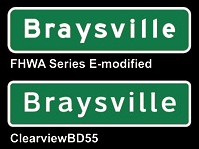
There’s an interesting piece in the New York Times Magazine on Clearview, the new font that will replace Highway Gothic as the “official” U.S. highway font. Clearview is more legible for old folks, apparently, due to the fact that the lowercase letters open up more.

A way-geeky-way-cool slideshow is also included.

Also of note, the guy who designed the new system, Don Meeker, is a Northwesterner, who got started in highway signage by designing signs for the State of Oregon.

(via)

If You Don’t Build It…

This post originally appeared on Orphan Road.

…maybe they’ll just find another way, argues Cascadia Report, discussing the “nightmare” I-5 closure that began today:

The clear takeaway is that people are more flexible than they think. In this case, there is a strong incentive (not wasting hours in traffic) to find alternatives. It’s exactly what would happen if the viaduct freeway were replaced with a combination of better transit and a more efficient network of surface streets. It’s exactly what would happen if there were tolls based on the amount of congestion on the roads. As long as there are effective alternatives (like far more transit, better carpool lanes) people will take them.

To be sure, August was strategically chosen because, in Francophone Seattle, no one really works this month. But it does show how elastic demand is for our highways. If you make a resource free, people will tend to over-consume it.

Information Infrastructure

This post originally appeared on Orphan Road.

Blogger Jeff Jarvis has a worthy follow-up to my post today about smart transit. Jarvis writes about a particularly grueling commute into NYC:

There were thousands of people in that jam. We all knew what was going on and could have informed the thousands more who followed into the same trap. And I’ll be most of us would have done that out of sheer altruism, in the hope that someone else will help us avoid the next jam. Why have we not yet invented systems to capture and share that knowledge? I’ve been plotting this for years: I met with these and other traffic services a decade ago begging them to come up with the means to gather our knowledge of traffic: We could call into numbers that have logged our usual routes and report our conditions and get the conditions ahead. Or we could set up the means to monitor and report the movement of those phones along routes and cell towers. Or we could simply enable people to call a service and leave trouble reports. Anything. But, no, we knew nothing.

This isn’t limited to transit riders, either. When GPS-enabled cars hit a traffic jam — or even when they just notice that the driver is hitting the brakes an awful lot — the car should upload that information to a server or a peer-to-peer network, so that other cars can aggregate the information and plan routes accordingly. The fact that we’re still waiting for the AM radio’s 10-minute traffic updates in this day and age is absurd.

KC Council Weighs In

This post originally appeared on Orphan Road.

With the Airport-Trail swap looking dead, King County Council members Phillips and Hague have teamed up with Port Commissioner Creighton to plot a new way forward. They talk about “creative financing deals,” but basically avoid the real question: who’s gonna pony up $100M and buy the durn thing?

There are some hints that Sound Transit might be able to help, but I find it difficult to believe that they’d update their final project list or do anything that might upset the fall vote this late in the game (polling is apparently still steady at 60% “yes”). The authors do hint at the fact that ST can “win votes” by agreeing to help pay for the corridor, but I’m still skeptical that they’d acutally make any promises between now and November.