
WSF Steel Electric Ferries pulled from service

With Thanksgiving coming up later this week, Washington State Ferries made a challenging decision to pull the 80-year old Steel Electric class ferries, the Quinault, Klickitat, Illahee and Nisqually, from operating service to examine the hulls of these ships. Hull pitting on the Quinault has officials concerned about weak hull structure and safety. The Steel Electric class ferries are the only boats that can navigate the shallow and narrow waterways of the Keystone harbor.

To help lessen the impacts of the loss of passenger-vehicle service on Port Townsend-Keystone, WSF will:

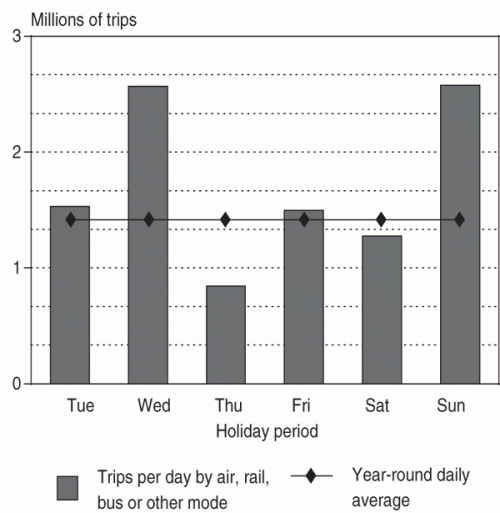
  • Operate three vessels on the Edmonds-Kingston route from Wednesday, November 21 to Sunday evening, November 25 to handle the extra traffic expected over the Thanksgiving weekend. This route is the best detour for people traveling from the Olympic Peninsula to Whidbey Island.
  • Operate the high-speed passenger ferry Snohomish between Port Townsend and Keystone. WSF is making every attempt to have the service up and running by Friday, November 23 to serve customers during their Thanksgiving travel. The passenger ferry will maintain the current schedule.

If you recall, the Snohomish and the Chinook were placed up for sale last week but due to this issue the vessels are in dry dock and will operate on the Port Townsend – Keystone route.

More at WSDOT – http://www.wsdot.wa.gov/News/2007/11/20_steelelectricferriesoutofservice.htm

Seattle Times – http://seattletimes.nwsource.com/html/localnews/2004027510_webferry21m.html

Seattle Post-Intelligencer – http://seattlepi.nwsource.com/transportation/340508_ferry21.html
Tolling for Transit

This post originally appeared on Orphan Road.

Austin Jenkins reports:

The bill as drafted says the Legislature would have sole authority to impose tolls, thus excluding local jurisdictions. Toll prices would be set by the Washington State Transportation Commission, an appointed body. The bill would allow tolls to continue to be collected after a project is paid off – a significant departure from current policy. Finally, the legislation permits toll prices to fluctuate between peak and off-peak travel times, which is called “variable pricing.” Other key decisions will be whether tolling can be used to manage demand and whether money raised from tolls could be applied broadly — say, to underwrite transit.

That last part is key. Our current state gas taxes can only be used for highways. Getting drivers to pay for transit projects would be a big shift, but a needed one. For example, Cascadia Prospectus, in the process of unveiling the Discovery Institute’s own plan, notes that the Port Authority of NY and NJ is going to increase the tolls on the Hudson River crossings to $8 at peak, in part to help finance a second commuter rail tunnel.

One can only imagine the kind of hysteria we’d see here in the Puget Sound, if, say, drivers crossing the 520 bridge had to pay a toll to help finance a light rail link. But that’s the direction we need to be going in. Thusfar the only such efforts (that I can recall) to have drivers subsidize transit — the Monorail and ST2 car-tab taxes — have fallen apart. And the success of I-695, which gutted the car-tab fees that were used to fund transit projects, has no doubt made lawmakers leery of taxing drivers to fund transit.

For all Prop. 1’s flaws, one upside was that it would have reinforced a holistic approach to transportation funding, and perhaps given credence to the idea that gas and car taxes could be used to fund transit projects. But maybe that’s being too optimistic.

Central Link Update – Nov 15th, 2007

These observations are from the Sound Transit Lunch Bus and members of construction crews that I have talked with the past few days. I rode the Sound Transit Lunch Bus on November 15th, 2007. It was a very pleasant trip and throughly enjoyed the MCI D4500 coach we had for the trip. Just needed a coffee, newspaper, and a place for laptop and I’d be set!

Rail is complete from Pine Street Tunnel located in the Downtown Seattle Transit Tunnel to Beacon Hill East Portal/Airport Way.

Rail is complete from Beacon Hill West Portland/MLK Way aka Mt. Baker to Tukwila International Blvd Station.

Rail is staged for Tukwila to Airport segment at Sea-Tac Airport. Guideway will be finished from Tukwila Intl. Blvd to the Airport by the end of the year. OCS poles have also been staged near

Foundation for Airport Station is finished and build up is in progress.

Central Link 101-110 is on the properly at the Operations and Maintenance Facility (unless it ST 108 was the last one.. thought I saw 109/110 sitting outside as well)

According to ST Public Relations, rail halfway completed in Southbound tunnel. The Emerald Mole/Tunnel Boring Machine is scheduled to come out of the Northbound Tunnel in mid-December. The TBM has been chewing 35-55 feet per day with good soil content.

Wire is strung from Tukwila Intl. Blvd Station to I-5/Southcenter and Martin Luther King Jr Way near Alaska St to Boeing Access Road, leaving I-5 to Boeing Access Road and Alaska Street to West Portal and through the tunnels remaining for wire.

Testing is scheduled to begin Spring/Summer 2008 from the O&M and Tukwila Intl. Blvd Station.

For more images of Central Link, including the Lunch Bus photos, check out my flickr…. http://www.flickr.com/photos/brian_macster

Seattle Streetcar in Testing

Coming to the City of Seattle in less a month, the Seattle Streetcar running from Westlake Center to Fred Hutchison Research Center in South Lake Union.

Here are some images of the Seattle Streetcar in testing on Thursday, November 15th, 2007 after the Sound Transit Lunch Bus

Wanna Buy a Ferry?

This post originally appeared on Orphan Road.

The New York Times reports that WSDOT is selling its old foot ferries on eBay:

“The state decided to get out of the passenger-only ferry business,” said Traci Brewer-Rogstad, director of operations for Washington State Ferries.

It has been four years since budget cuts, controversy and eventually declining ridership ended service on the so-called foot-ferry route that the two 350-passenger boats served between Seattle and Bremerton. The state is focusing its ferry system on its core operations, larger boats that carry vehicles as well as people. Yet the goal of getting rid of the passenger-only boats is intended to generate cash so that King County, and possibly other local governments, can get into the foot-ferry business themselves.

This week, King County approved raising property taxes by an average of about $22 a year for a $400,000 house to help pay for the operations of what it hopes will be an expanding year-round foot-ferry service that could include routes in Puget Sound and Lake Washington, which separates Seattle from suburbs like Kirkland and Bellevue. The sale of the Chinook and Snohomish would go toward capital investments, including buying or leasing smaller passenger ferries that are more fuel efficient and require smaller crews.

Indeed, King County is estimating $8.5M in revenue from the sale of the two ferries to go toward the Ferry District.

Free Riders

This post originally appeared on Orphan Road.

A Sounder rider wants to know why Sound Transit wasn’t checking tickets more agressively on a train to the Seahawks game. ST responds that this was an atypical situation, but the question serves to illustrate the different attitudes people have towards transit here in the Northwest.

Growing up in New York, I’d occasionally notice that the afternoon commute on the Long Island RR was just so packed that the conductors would give up on checking tickets. Most of the riders had monthly passes, so it didn’t really make a difference. But for a kid like me, who was sneaking into the city to go hang out in the East Village and pretend to be cool, I could sometimes get away with a free ride. Of course, they charged an extra $2 to buy the ticket from the conductor, so it wasn’t really worth the risk. Better to just buy the ticket and maybe re-use it if they didn’t punch it.

Across the pond, Matt noted that most European transit systems are similarly lackadaisical when it comes to collecting tickets. Transit is just part of the social compact there, and so many people ride it that the operating costs all come out in the wash anyway.

The costs of collecting and processing tickets are nontrivial. Skagit transit spends more collecting fares than it makes from the fares themselves. And the honor system seems to work in Houston, TX when it comes to fare collection.

Perhaps, as we build more and better transit systems in the region, and as more no-good transplants like myself move in, our collective attitude towards transit will move from “costly government pork project that I refuse to ‘subsidize’ ” to “indispensible element of urban public life.” I certainly hope so.

Rainier Valley Segment Photos

At about the same time that the Washington Transportation Blog posted these, I went and took some photos along the Rainier Valley Light Rail segment. I also have a few comments about the line’s design.

Down around Rainier Beach station, the track seems completely done, with the station apparently complete and the overhead wires installed. As you go north, things get progressively less developed till you reach Mount Baker station and the Beacon Hill segment.

Here’s Othello Station, which as you can see is surrounded by retail development.

Immediately north of Othello, the pylons are in with the pointy tips that my friend remarked made them look like “weapons for giant fighting robots.”

Up at Columbia City station, they’re putting in little plazas at each corner of the station. They’re looking nice.


And the station itself is coming along nicely.

One thing that could be a problem is a lack of crossing gates at major intersections. Here at MLK & Alaska, I can certainly envision some idiot trying to turn left and blocking the train.

And lastly, a pedestrian crossing near the Rainier Vista development. There’s a boys and girls’ club going in near here, and I’m really concerned kids are going to run across the tracks wherever they like. It’s a matter of time until the first accident. That’s not only a tragedy in its own right, but will almost certainly result in reduced speeds afterwards, which makes LINK a less attractive option.

I would propose a tasteful, 2 or 3 foot black iron fence along the length of the right-of-way to channel people into the signalized crossing, as well as crossing gates at intersections. How much more investment could it be on a multi-billion dollar project?

By the way, you can see that drainage on the tracks already sucks.

Waterfront Streetcar, Take 2

After many comments and more digging, and a revised webpage by Metro, here’s what I think we know:

  • The streetcar cannot return until the trolley barn is rebuilt, which is probably about mid-2009.
  • Whether it opens or not at that time will depend largely on the fate of the Alaskan Way viaduct. If they’re going to have to shut the thing down anyway for construction in 2010, it makes little sense to run it for a few months.

Sorry for all the confusion.