This post originally appeared on Orphan Road.
As if we need any more evidence that 23rd Avenue is way too narrow.
Put that road on a diet already!

This post originally appeared on Orphan Road.
As if we need any more evidence that 23rd Avenue is way too narrow.
Put that road on a diet already!
This post originally appeared on Orphan Road.
A post on the CD News blog makes the case, noting that “adding more buses won’t really help – the #3, #4, and #48 routes are already running about as frequently as you can on our narrow roads and in traffic, as evidenced by the way the buses will bunch up together at peak times,” and that “Otherwise we’re going to keep adding 200 unit apartment buildings and other infill development and suddenly find that there’s no capacity for people to get around.”
I’m sympathetic to both of those points. On the latter, I think there’s more of a chicken-and-egg phenomenon than the author allows. True, we saw a lot of 200-unit buildings go up in Capitol Hill and the Central District in the boom years, but my guess is we won’t get many more (beyond the ones already in development) until it’s easier to get to and from the neighborhood.
And while I’d like light rail there as much as the next guy, I think solving the crosstown traffic problem with better bus right-of-way and signal priority is a good interim solution.
When talking about Link ridership, I’ve said time and time again that monthly ridership totals are basically meaningless. We won’t have meaningful information till the end of 2010 at the earliest, and preliminary conclusions about the line’s “success” or “failure” can’t be made for at least a decade, when development has had a chance to occur.
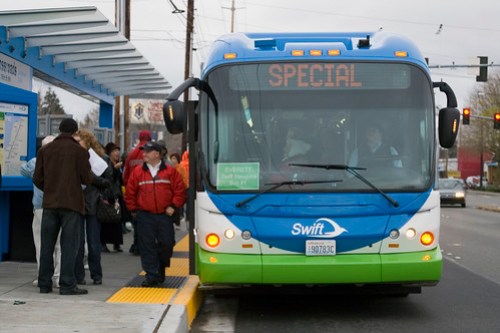
But people love the horse race, so for entertainment purposes only, 1,526 people rode Swift on Monday. That’s compared to a daily SR99 corridor bus ridership of about 4,500. Ridership probably wasn’t helped by the fact that there are no paper transfers between Swift and regular CT service — it’s ORCA, or pay twice. Regardless, CT spokesman Martin Munguia says “street teams are reporting more people riding Swift than at the same time yesterday.”
As always, the real test will be what kind of construction occurs in the coming years. The land use in this corridor is a total disaster — think strip malls behind massive parking lots, all the way up*. Will Snohomish County residents and developers accept a different principle on which to organize their communities? Is a BRT line enough to spur that? We’ll get to find out.
*with apologies to Central Everett, which isn’t like that.

Tomorrow evening Sound Transit is holding a meeting about the UW light rail station:
December 02 , 2009
6:00 p.m. – 8:00 p.m.
Museum of History and Industry (MOHAI)McCurdy Gallery
2700 24th Avenue East
Seattle, WA 98122
Sources tell me there will be a little bit of news at this meeting, so show up if you can.
Edit from Ben: The news is likely that UW Station will undergo a design change, as was reported by the DJC (go here for an illustration). Instead of the pedestrian bridge Sound Transit has currently planned, the design may be closer to UW’s “Rainier Vista” plan (PDF) – without pedestrian bridges, but with a street crossing in the middle of the east side of the Pacific/Montlake triangle, and a land bridge built to connect the triangle to UW campus without a street crossing.
The new design would offer much better pedestrian access to the hospital, as well as increasing crossing safety by placing the crossing adjacent to the station. The land bridge is expected to cost $18.7 million, $12 million over the cost of the pedestrian bridge alone, with the additional cost split evenly between the city, UW, and Sound Transit.
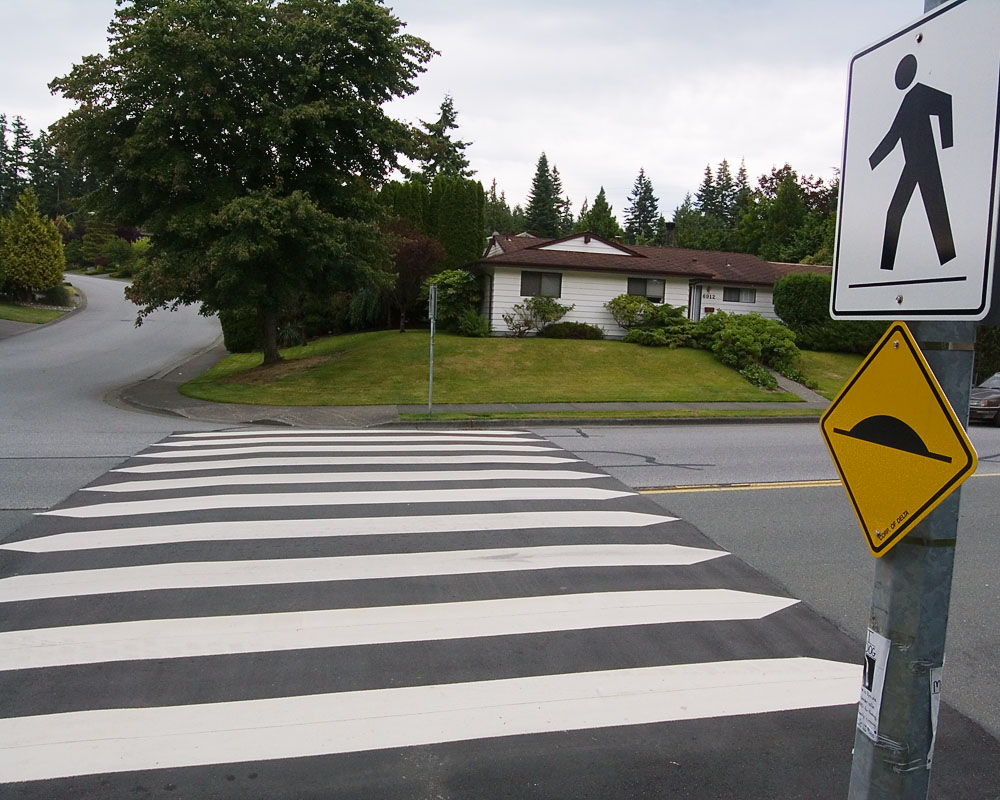
I really wish Adam was in town to participate in this. SDOT is soliciting three new volunteers for the Pedestrian Advisory Board. From the press release:
SEATTLE – Mayor Greg Nickels is seeking three volunteers to serve on the Pedestrian Advisory Board. Residents are invited to apply to serve on a volunteer committee that plays an influential role in implementing Seattle’s Pedestrian Master Plan. The board advises the mayor and City Council, participates in planning and project development, evaluates policies and makes recommendations.
Board members serve a two-year term, with an opportunity to serve a second term. The volunteers are frequent walkers of a variety of ages, levels of mobility and walks of life, and from areas throughout the city. Members must be Seattle residents and may not be city employees. The group meets the second Wednesday of each month from 6 to 8 p.m. at City Hall, located at 600 Fourth Ave., James and Cherry streets.
People interested in serving on the board are encouraged to submit by Dec. 16 a resume and cover letter explaining their interest to:
Brian Dougherty, Seattle Department of Transportation,
700 Fifth Avenue, Suite 3900,
P.O. Box 34996, Seattle Washington, 98124-4996,or via e-mail to brian.dougherty@seattle.gov.
For more information, call Brian Dougherty at (206) 684-5124, or e-mail him at the address above.
These advisory boards are really interesting if you’re into a subject because you learn a lot about the process and the constraints that planners deal with.
Wholly aside from my own ideological inclinations, I really have a soft spot for heretics on both sides. On the national stage, I always find Christopher Hitchens, Andrew Sullivan, and Mickey Kaus difficult to categorize and therefore interesting to read.
So it’s no surprise that I’m somewhat obsessed with pro-transit conservate William Lind, above and beyond the fact that he agrees with me. The modern conservative coalition largely consists of rural interests that are never going to be pro-transit, but there’s really no good reason that urban conservatives and libertarians should be anti-rail and anti-transit*.
The effort to win this argument is an important one; the nature of the system is that parties alternate in power, and decades-long infrastructure projects can’t survive administrations that alternate between supporting and sabotaging them.
See also this recollection of Lind’s coauthor, the late Paul Weyrich.
*I fear Lind’s comparison of rail and road subsidies may not be apples-to-apples (are capital costs in that highway figure?), but without easy sourcing it’s hard to say. On the other hand, things like wide arterials, density restrictions and parking mandates are undoubtedly car subsidies but don’t show up in his figures.