
Real Time Data is Not Just for the Good Times

Last Monday night I happened to witness a service disruption on Link. It was not Sound Transit’s finest hour. I got the story from Link Operations Director Paul Denison via spokesman Geoff Patrick:
The service disruption began after a 7:57 p.m. departure from Westlake experienced a brake fault and had to be removed from service. Several minutes later we began turning trains back at Stadium. The malfunctioning train was cleared at 8:46 p.m. and we were back in full revenue service within about 15 minutes… the first voice announcement in the tunnel was at 8:36 p.m., which was a half hour after train service in the tunnel was suspended and is not up to our standards. Paul wanted me to relay to you that while there will be delays from time to time, we recognize that how we communicate with our customers determines how well [we] did in responding… Paul is going to look into this further since the control center didn’t do as good of a job as they are capable of in this instance.
There were well over 100 people on the platform at Westlake. It’s a shame that some of them probably don’t have enough experience with the system to know that this is rare, and are now telling their friends that Link is fundamentally unreliable. But I’m not here to slay Sound Transit; disruptions happen. The communications breakdown isn’t acceptable, but people drop the ball sometimes and they’re going to look into it.
Instead, this episode emphasizes how useful real-time arrival information is. It’s a nice-to-have during rush hour, but when headways are long — particularly during construction or service disruptions – they’re critical. It’s another level of redundancy that prevents fiascos like Monday from occurring.
Unions Everywhere on Monday
If you’re a big union person and a transit buff, have I got an event for you on Monday:
You are invited to join us next Monday, May 21st for an evening of Rider-Driver Solidarity, and a discussion of the future of public transit in King County. There will be a guest appearance by Seattle folk singer Jim Page. We are co-hosting this event with the drivers’ ATU local 587. It is free and all are welcome. There will be refreshments. Details are below, and more information can be found on our website here: www.transitriders.org. Hope to see you there!
Rider-Driver Solidarity Evening
Monday, May 21st 7pm
Labor Temple, Hall 8
2800 1st Avenue
Some background on the TRU here.
Metro Shorts
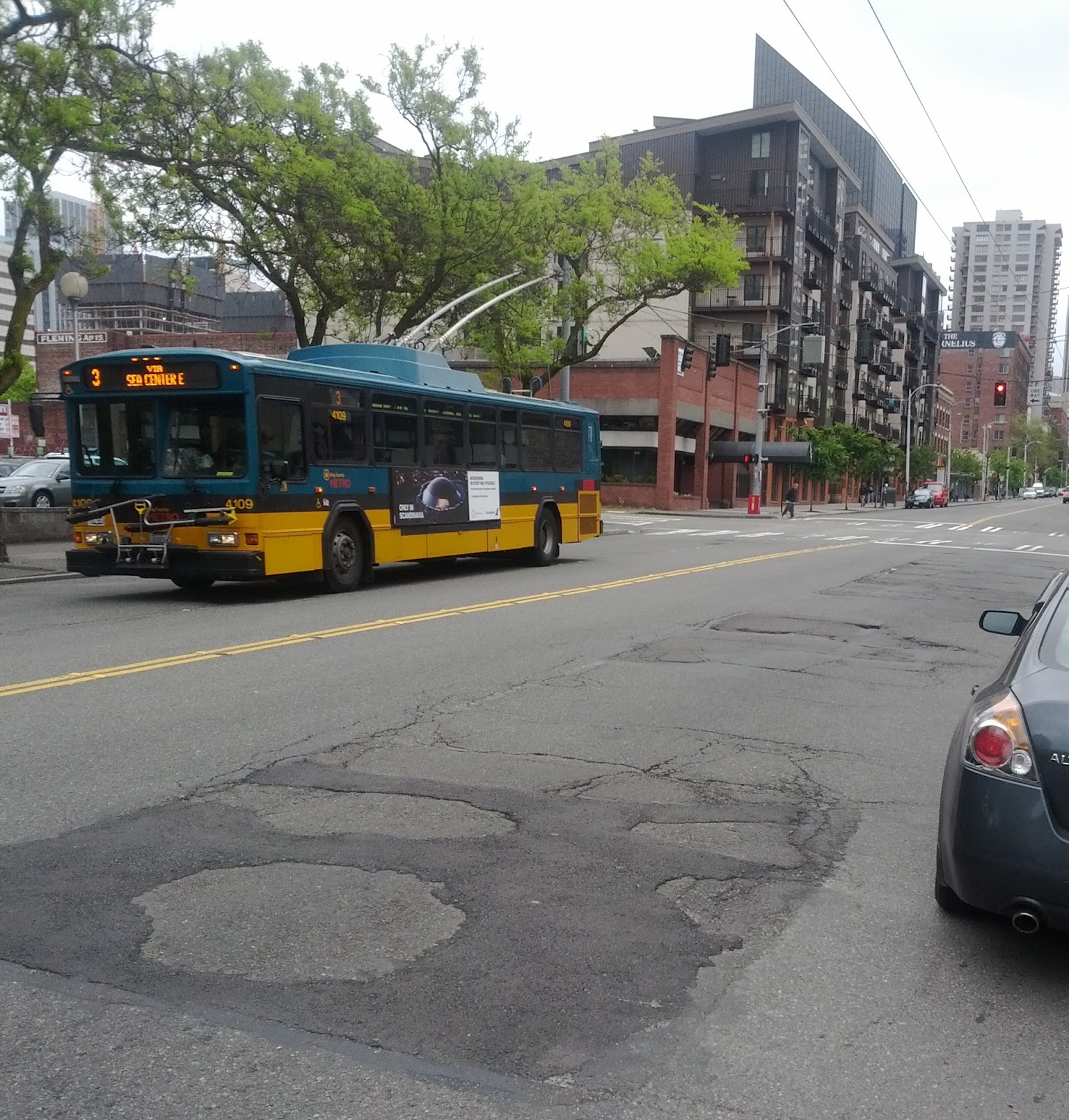
This week, I assembled the answers to a handful of Metro- and SDOT-related questions that’ve been floating around in my head for a while. Perhaps others will find the answers interesting. First, I wanted to confirm that Metro’s new trolleybuses will have A/C. I understand there was some internal debate at Metro as to whether the traction power substations could handle the additional power drain of running the A/C in certain sections of the trolley network. Metro’s Rochelle Ogershok:
I’ve heard there was some doubt about whether the replacement trolleybuses will have A/C. Has this decision been made? Is there any more information you guys can share about the progress of the trolleybus replacement project?
All new buses, including the trolleys that will start arriving in 2014, will have air conditioning. The replacement project is on schedule. Metro has put out an RFP, and expects to award a contract next spring.
Much, much more after the jump.
Metro Wants Your Southeast Seattle Ideas

Metro is collecting ideas on how to improve service in Southeast Seattle:
This spring Metro is holding conversations with community organizations, bus riders, and residents of southeast Seattle about transit options in their community. Our goal is to learn about ways to make transit easier and more inviting to use. At every conversation, we ask people to tell us which transit options they use, why they use them, and how these services can be improved. We leave every conversation with a better understanding of how people travel around their community.
Please take a few moments to share your thoughts and ideas >>
Areas of emphasis seem to be ORCA card access and dirty and/or dangerous stops. It also raises the possibility of stopping the 8 at Mt. Baker and resurrecting the old 42, but stopping in Pioneer Square instead of traveling downtown. I first caught wind of this idea late last year.
I think there are two ways of looking at this. One is that the set of one seat rides enabled by a revised 42 is pretty strong: retail along Rainier, the I-90 freeway station, and Little Saigon. To this Columbia City resident, the 8’s set of destinations between Mt. Baker and Madison Park don’t seem nearly as attractive: Garfield HS and Central District retail.
On the other hand, current service to the former set of places is extremely frequent, making transfers less painful than they would be to the 8. And the 8, by providing access to a whole different part of the city, offers better access to a whole network of cross routes. In other words, the 8/42 switch might increase the number of one-seat rides, but the advantage of a gridded network is turning the dreaded three-seat ride into two-seaters. The 8 does better at this.
From an access perspective, switching the 48 with the 8 would be the best of both worlds. It would provide access to the Rainier corridor and (in 2021) the freeway station, while still providing a one-seat ride through the central district.
However, both the 48 and the souped up 42 don’t solve the most serious problem with the 8: that it is too unreliable southbound to serve as a Link shuttle. This can only be solved by splitting the 8. Doing so in Madison Park would preserve connections and reliability, as MLK is seldom congested. It is a better use of resources than the alternatives.
News Roundup: Boring Ends

- U-Link tunneling is complete.
- Big Oil pumping money into Eyman’s I-1185
- TCC looking for a Field Director.
- Eight free bus tickets coming soon.
- The ideal form for subways emerges.
- Flawed argument for European/DC style density over Manhattan style density.
- Seattle places 7th national for “bike score”.
- Seattle’s housing recovery on the horizon, but different than before.
- Stadium proponents tout transit access.
- A critique of UK’s transit privatization model.
- Google cars to the solution to all our transportation needs?
- Can the drop in employment over the recession explain the recent drop in VMT?
- Where Shoreline stands on Lynnwood Link (new name for North Corridor HCT).
- Seattle ST Board member oppose Northgate garage.
- NYC Bike Share has identified locations.
- Portland’s bike way evolution.
This is an open thread.
Tap-on, Tap-off

In preparation for tomorrow’s Ride Free Area forum, I thought it would be a good time to discuss distance based fares. One of the real problems I’ve had with ending the RFA is that King County Metro’s fare system is nearly flat.
Flat fares are a bit like having a single price for ice cream, where someone buying a small cone pays as much as the next guy with his family-size banana split. Of course this is a great deal for the hungry ice cream eater, but a terrible deal for the small cone customers and over time they just stop coming in.
Hopping back to the real world, let’s look at typical trip inside the current RFA. Walking from 5th and Union to 3rd and Cherry, according to Google Maps, takes 11 minutes. A bus trip, however, takes only 9 minutes. Not a big difference, but if it’s cold outside it would be worth a little money and if you’re in a hurry every minute counts. But how much is this trip worth to you? My guess is that $4.50 round trip per person, is high for 4 minutes of time saved (that’s almost $70/hr!). $5 a way could get you a taxi, which would be faster, involve less walking, and you could take friends for free.
Now compare that to a banana split trip on KC Metro. Maybe a #15 from Blue Ridge. That’s a 46 minute ride off-peak, shaving countless minutes off a walk or a large number of dollars off a taxi. Yet the price is the same. And that’s just within the city – go to a small additional fare for a 2-zone ride and you can go all the way across the county.
The market figured out a good solution to this problem a long time ago – charge a small enough amount for the small cones that people keep coming in for ice cream. In the transit world, that’s distance-based fares. Sound Transit’s Link light rail has done exactly this – charging based on distance*. Link uses ORCA cards and requiring a tap-on and a tap-off. If you forget to tap-off you’re charged the maximum fare.
Metro can and should copy Link’s strategy. ORCA, combined with GPS, would allow this functionality. All we’d really need are rear door ORCA readers – an upgrade that Metro failed to invest in last year because it wouldn’t work with their fare system (sigh).
An added benefit of this strategy is that it doesn’t just focus on downtown Seattle. You would be able to get across any neighborhood at a reasonable price.
* I still think they should go further – the minimum fare of $2 is likely not going to attract many short trip riders. Make it $0.50 and more people will use it.
House Continues Assault on Cities by Defunding ACS
 Last week, the U.S. House of Representatives voted 232-190 to defund the American Community Survey (ACS), one of the Census Bureau’s most significant demographic data-collection programs in addition to the decennial census. The ACS, conducted annually, effectively replaced the long-form of the census and provides important data to planners and policymakers at every level of government. The program’s elimination is just one assault in a long line of legislative actions against transit and cities by the House.
The impetus for the cut is that the ACS is too prying and too costly. What supporters of the bill are forgetting, however, is that the data the ACS provides informs how hundreds of billions of dollars are spent and which programs they go to, including those that concern transit, housing, and urban infrastructure. Elimination of funding not only has a major impact on public policy, but would also effectively kill academic research and private economic development programs vital to the health of cities. The Atlantic has a good synopsis on what kind of effects this move has:
The issue is that the information collected in the ACS is used heavily by the federal government to figure out where it will spend a huge chunk of its money. In a 2010 report for the Brookings Institution, Andrew Reamer found that in the 2008 fiscal year, 184 federal domestic assistance programs used ACS-related datasets to help determine the distribution of more than $416 billion in federal funding. The bulk of that funding, more than 80 percent, went directly to fund Medicaid, highway infrastructure programs and affordable housing assistance.
Reamer, now a research professor George Washington University’s Institute of Public Policy, also found that the federal government uses the ACS to distribute about $100 billion annually to states and communities for economic development, employment, education and training, commerce and other purposes. He says that should the ACS be eliminated, it would be very difficult to figure out how to distribute this money where it’s needed.
House Republicans are forgetting that there is a lot of money, both private and public, directly and indirectly attached to the ACS. While the Senate won’t likely reciprocate defunding the program, this move puts the program in a dangerous political crossfire that jeopardizes funding for cities whenever voters feel like electing someone new every election cycle. That makes it a risk too great to toy with. Call your congresspersons today to oppose the cut.
A Future Without the RFA

On Friday Transportation Choices Coalition is putting on a forum about the end of the Ride Free Area (RFA). The panel is gangbusters:
Tim Harris- Real Change News
Jim Jacobson- King County Metro
Bill LaBorde- City of Seattle
Zach Shaner – Seattle Transit Blog
The talk begins at noon at Seattle Municipal Tower. RSVP here.
Brenda’s Repose

Sound Transit held a media event underneath Pine Street, next to I-5, this morning, at the site of Brenda’s final breakthrough into the Pine Street Stub Tunnel, from where this photo was taken; local transit dignitaries also made some remarks. The face of the cutter head will be unmounted and rolled to the right (as we look at it) then hoisted up a shaft. The innards of the TBM will be similarly removed, but the shell will be entombed as part of the permanent tunnel wall.
I’ll post more photos this evening. Thanks to Sound Transit for having us there.
UPDATE: More photos.