
First Snow of 2025

Snow is expected this weekend, with mixed rain/snow on Saturday in downtown Seattle. Pure snow showers start early Sunday morning through Monday night, with a possible accumulation of less than half an inch every 12 hours. Tuesday through Thursday have a chance of snow showers. Lynnwood is similar. Boeing Field may get an inch Saturday evening. There’s a lot of uncertainty about how much snow there will be in the lowlands.

The National Weather Service has forecasts for each city. In each one there’s a “Forecast Discussion” link in the bottom left section with a long explanation. These are usually easy to read, although the one Friday evening is cryptic. Cliff Mass‘s weather blog has a detailed play-by-play and model images of the next few days. The Seattle Times ($) and King 5 have coverage.

Metro

King County Metro has a winter guide, a snow routes page, and the Emergency Snow Network (ESN) map. Note that Metro has three levels of service depending on the severity: regular service, snow routes, and the ESN. Some routes may be on snow routes while others are on regular service.

Continue reading “First Snow of 2025”
Downtown Redmond Link Opening May 10

A test train pulls away from Downtown Redmond Station. Photo courtesy of Claudia Balducci via Bluesky.

At the future Marymoor Village Station this morning, Sound Transit announced the Downtown Redmond Link Extension will open on May 10, 2025. The opening will extend the 2 Line by 3.4 miles from its current terminus at the Redmond Technology Station to Downtown Redmond, with a stop near Marymoor Park south of the intersection of State Route 520 and Redmond Way.

The extension is mostly at-grade along State Route 520, climbing to an aerial alignment terminating in Downtown Redmond. The Marymoor Village Station is at-grade and includes a 1,400-stall parking garage, which the light rail actually passes underneath as it turns west toward Downtown Redmond.

Continue reading “Downtown Redmond Link Opening May 10”

WSDOT HOV Overview

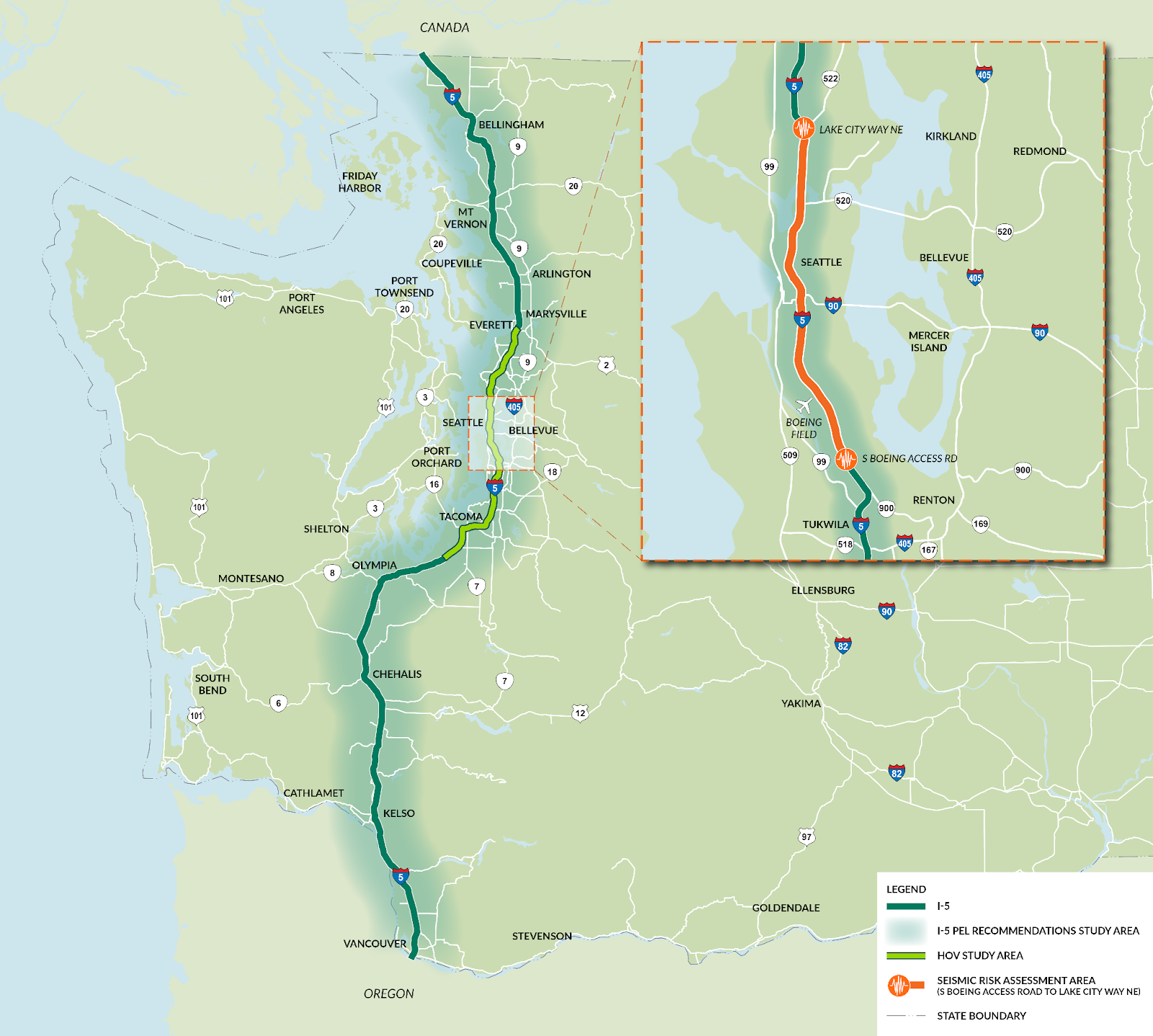
WSDOT Puget Sound HOV lane map https://wsdot.wa.gov/travel/roads-bridges/hov-lanes/hov-system-map

WSDOT has been working on extending and completing the HOV lane system through the Puget Sound region encompassing King, Pierce, and Snohomish County. This article will provide a short recap of the existing freeway system as well as future extensions, though predominantly focusing on the HOV improvements for transit purposes.

Many of the existing HOV direct access ramps were built as part of Sound Move in the late 1990s and early 2000s. Recent I-5 and SR-16 HOV extensions throughout Tacoma will be extended on I-5 south to Lakewood.

Continue reading “WSDOT HOV Overview”

Midweek Roundup

Planned disruptions of the Link 1 Line continue: Shuttle buses will replace train service between U District and Capitol Hill stations this weekend (Feb. 1-2). This weekend is focused on repairing the overhead wire near UW Station which was broken in October.

Transit and Streets:

Continue reading “Midweek Roundup”

Improving SODO Station with Cross Platform Transfers

Cross Platform station diagram from Urban Transit book

Cross-platform interchanges allow much easier transfers between two lines heading in the same direction. Implementing a cross-platform interchange station at SODO station could help connect Line 1 and 3 much better. Though there are some complications to building a cross-platform interchange.

Continue reading “Improving SODO Station with Cross Platform Transfers”

Link Reliability Issues Declared an “Emergency”

On January 21, Sound Transit interim CEO Goran Sparrman identified Link’s ongoing reliability issues as an emergency, allowing him to issue a $1.5 million contract to HNTB to plan and design fixes to several problems with Sound Transit’s operational and network infrastructure.

The Seattle Times ($) summarized the problems identified by Sound Transit as “contributing to delays”:

  • The damaged wire near UW Station, as the scheduled repair in December was delayed due to a telecommunications outage and is now scheduled for February 1-2;
  • 16-year old wires in the Downtown Seattle Transit Tunnel (DSTT) that need to be inspected and tightened, so much so that operators are being told to coast into some DSTT stations to avoid drawing power on the lines;
  • Accumulated grime and other deferred maintenance on DSTT rails causing high voltages, although Sound Transit crews have reportedly started cleaning them;
  • Flaws in ST’s dispatch control center network making disruptions difficult to fix;
  • Mechanical problems with the new Siemens “Series 2” light rail vehicles including faulty valves and brakes;
  • Signals falsely indicating the presence of a train where no train exists;
  • Fragile software in Bellevue affecting power-outage recovery on the 2 Line; and,
  • Mysterious power supply issues in the north end of the tunnel between the Northgate and UW stations, which have caused multiple disruptions.
Continue reading “Link Reliability Issues Declared an “Emergency””

King County Metro’s Projects in 2025 and Beyond

The end of 2024 culminated in many King County Metro Bus projects such as new bus cameras, Lynnwood Link restructures, and RapidRide G. This article will briefly explore Metro’s 2025 and near future projects.

RapidRide

From the recent RapidRide prioritization reports, Metro plans to build the RapidRide I line (Renton via Kent to Auburn) by 2027 and the RapidRide J line (Downtown Seattle to U District) by 2027. Notably on January 15, 2025 the RapidRide I line received a $79.7 million dollar federal grant.

RapidRide2023-20242025-20262027-2028Beyond
G LineCompleted
H LineCompleted
I LineDesignConstruction2027
Completion
J LineProject Planning and DesignConstruction2027
Completion
K LineProject Planning and DesignDesign and ConstructionConstruction2030
Completion
R LineProject PlanningProject Planning and DesignConstruction2031
Completion
Continue reading “King County Metro’s Projects in 2025 and Beyond”

Open Payments coming to ORCA

During a recent meeting, the ORCA Joint Board quietly approved implementation of a long-desired feature for the One Regional Card for All (ORCA) system: the ability to pay fares with a contactless (“tap-to-pay”) credit or debit card or a smartphone mobile wallet. This marks a major step along the slower-than-expected implementation of the “next generation” of ORCA payments, which kicked off in 2022.

A launch phase schedule from the May 9, 2021, meeting of the Sound Transit Rider Experience & Operations Committee.
Continue reading “Open Payments coming to ORCA”