
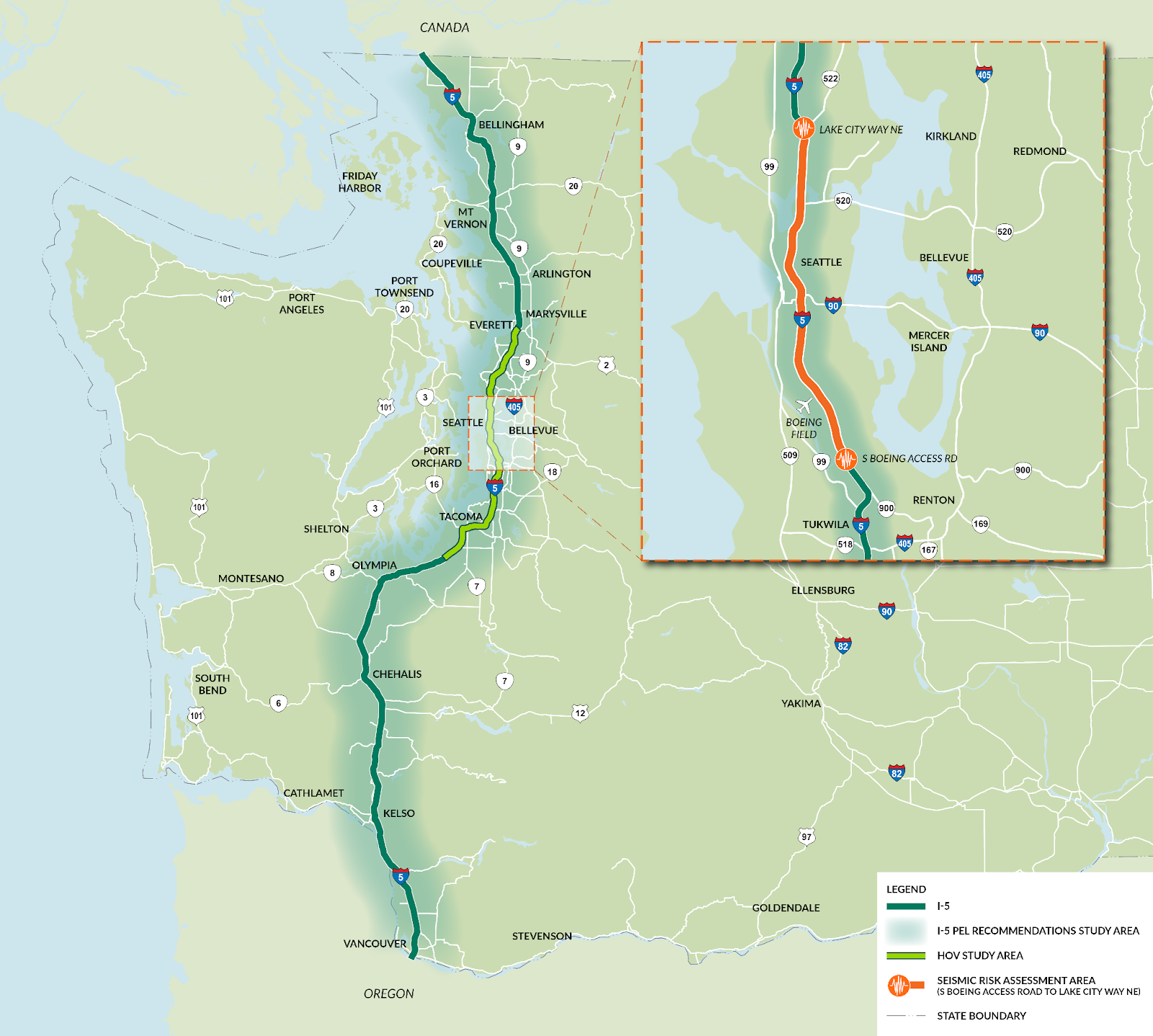
WSDOT is currently conducting an I-5 master plan study. The primary focus for the Seattle metro area involves converting HOV lanes into express toll lanes. While the current study won’t be finalized for another four years (until 2029), previous completed studies from 2010 to 2012 that provide a good starting point.
Existing HOV to Tolled Express Lane
The previous studies discussed converting the existing I-5 HOV lane to a tolled lane. However, between Northgate and downtown Seattle the (currently free) reversible express lanes complicates matters.
The previous I-5 Express Lanes Toll Study (2012) outlined in the first phase to toll the I-5 reversible (currently free) express lanes.

It’d be relatively simple as the toll conversion would only require adding electronic readers at one place just south of the NE 42 St ramp. The toll implementation would cost $13 million dollars (2012) or around $18 million dollars (2025) today.
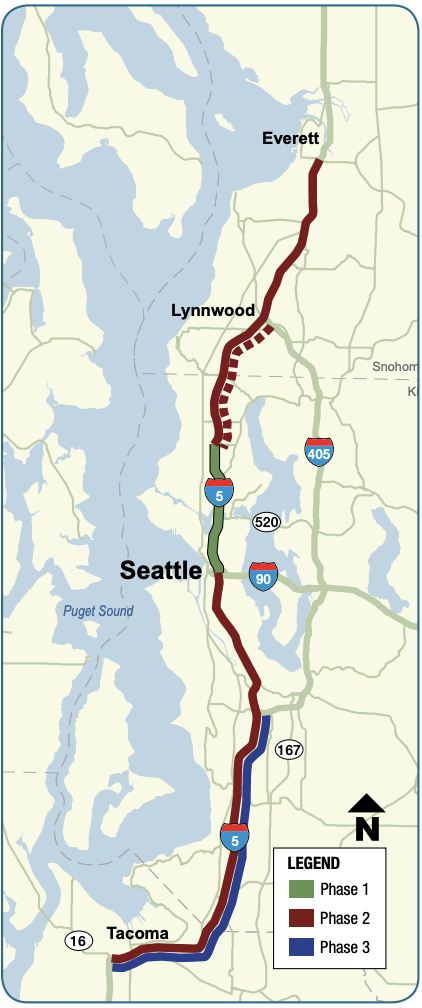

The second phase would then convert the existing I-5 HOV lane from Tacoma to downtown Seattle and from Northgate to Everett. This would be relatively easy to accomplish given the existing HOV lanes from Tacoma to Everett. The estimated cost from the study was $675 million (in 2012) dollars or around $939 million (in 2024) dollars.
The dotted section from Northgate to Lynnwood adds a second peak-direction only toll lane described more below.
Northgate to Lynnwood Second Peak-Direction Toll Lane
Currently the reversible express lanes from downtown Seattle to Northgate consists 3 lanes with 2 lanes merging into I-5 and 1 dropping off at the Northgate Transit Center. With the I-5 HOV to toll lane conversion there’d only be one toll lane from Northgate to Lynnwood. It’d be ideal if there were 2 tolled lanes in the peak-direction to maintain lane continuity.

Peak-direction operations on the right with 2 toll lanes, 3 general lanes and no shoulder
While adding a movable barrier in the median would be ideal, it’s impossible due to structures such as bridge piers in the way. Instead the dynamic lane assignment study (2012) proposed a second dynamic toll lane in the peak direction. The dynamic lane would convert the outer shoulder lane into a general lane during peak traffic periods.
Dynamic lanes in the peak direction are already used in some places such as northbound I-405 near Bothell (right side shoulder to general lane) or also at southbound I-5 near Mountlake Terrace (left/inner shoulder for bus only lane).
Tacoma to SeaTac/Tukwila Second Toll Lane
Various studies proposed for adding a second toll lane in both directions from Tacoma to SeaTac, Tukwila, or further north to Seattle near SODO.
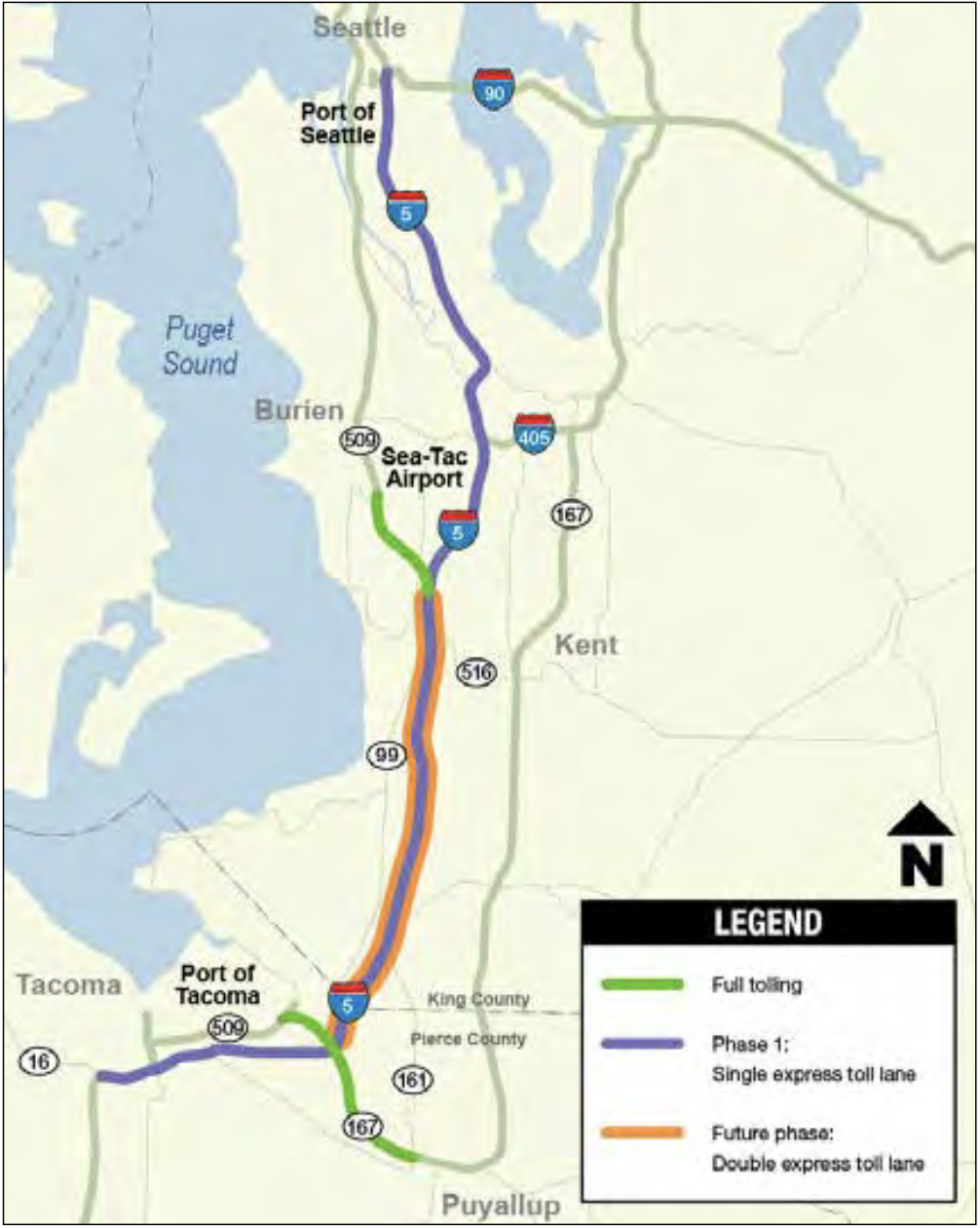
The Puget Sound Gateway Project (SR-509 and SR-167) study called for adding an additional toll lane on I-5 from Tacoma to SeaTac ending at the new SR-509 extension.


This would potentially happen after the SR-509 extension is built. The configuration of two express toll lanes would allow one express lane to continue onto the SR-509 while the other toll lane would continue onto I-5.
The previously mentioned I-5 Express Lanes Toll Study proposed adding the second toll lane on I-5 from Tacoma to SeaTac and then further north to Tukwila at I-405. The construction estimate was $501 million (in 2012) dollars or around $700 million (in 2024) dollars.
The I-405 from Tukwila via Renton to Bellevue project is currently adding toll lanes along I-405 from Renton to Bellevue. There are some existing HOV to HOV connections that could easily be converted for toll lane usage connecting the I-405 and I-5 HOV/toll lanes. The I-5 southbound to I-405 northbound has an existing direct HOV to HOV ramp underpass. The I-405 southbound to I-5 northbound has a partial HOV ramp but merges into general traffic on I-5. The I-5 northbound to I-405 northbound and vice versa direction does not have any HOV connections.
I-5 Second Express Toll Lane to SODO

Other plans in the Dynamic Lane Assignment (2012) call for extending the second toll lanes from Tacoma even further north to SODO district in Seattle. (Shown in solid orange above)

A I-5 direct access project was proposed in the Roads and Transit Package (2007). The HOV direct access ramp would go from the center I-5 HOV lane to South Industrial Way. The second HOV/toll lane would drop at Industrial Way connecting with the SODO busway. Originally the plan involved extending the SODO busway south of Spokane Street, but the SODO busway will be taken over by the West Seattle Link Extension. A future Industrial Way connection can still easily connect to 4th Ave S which potentially will have bus lanes.
Costs and Benefits – Everett
Below shows a chart of the costs adjusted to 2024 dollars and a suggested adjusted amount given construction cost overruns post covid. The I-5 single HOV lane to toll conversion has more recent estimates from the PSRC draft regional plan (2022).
| Project | Costs |
| Airport Way Direct Access Ramp | $83 million (2008) => $121 million (2024) adj $181 million (2024 w/ cost increases) |
| Reversible Express Toll Conversion | $128 million (2024) adj $192 million (2024 w/ cost increases) |
| I-5 Managed Lanes: US 2 (Everett) to I-405 (Tukwila) (northern half) | $356,928,335 (2022) ~= $178 million for half |
| Total | ~$500 million (2024) |
Converting the I-5 HOV lanes from Everett and Seattle’s reversible express lane portion cost in total around 500 million dollars. This would allow a quick ST Express bus running in toll lanes for around 40 minutes. In comparison the proposed Everett Link Extension would take 60 minutes to travel from Everett to Westlake.
| Mode | Time |
| ST Express 510 without traffic | 41 minutes (5th & Pine) |
| Link Light Rail Line 1 | 60 minutes (Westlake Station) |
| ST Express 510 with traffic | 60~70 minutes |
| ====================== | |
| ST Express 510 without traffic | 48 minutes (5th & Jackson) |
| Link Light Rail Line 1 | 65 minutes (CID Station) |
| Sounder N | 59 minutes (King Station) |
| ST Express 510 with traffic | 75~85 minutes (5th & Jackson) |
Extras
The next couple I-5 improvements projects described, while feasible, are unlikely to happen due to greater technical difficulty or lower benefits. The projects discussed are addressing the reversible express lane, extending the I-5 HOV/toll lanes further north and south, and connecting the I-5 HOV lanes with new direct access ramps in Tacoma.
Converting Reversible Express Lane to Bidirectional
Currently the reversible express lanes in Seattle provide a bit of unbalanced capacity. They are useful in the peak direction but can leave the opposite direction with insufficient lanes. During the PM peak when the reversible lanes are configured northbound the southbound direction encounters heavy traffic.

1~3 reversible lanes in purple, northbound entrance/exits in orange
One proposal is to convert one lane on the reversible express lane to permanently southbound from NE 65th Street to downtown. This would relieve congestion southbound at the I-5 Ship Canal Bridge. Unfortunately it comes at the expense of closing some ramps.
The downtown Seattle Pine/Pike St ramps as well as the Stewart ramps would only continue southbound off ramps because of the permanent southbound lane. The Columbia/Cherry St and 42nd St ramps would continue working in the peak direction since they enter from the east. The Lake City Way entrance/exit connects on the west but is north of NE 65th Street.
HOV Lanes to Olympia and Marysville
Currently the I-5 HOV lanes span from Tacoma via Seattle to Everett. There’s some HOV extensions (and potentially easy toll conversion) both south and north.


WSDOT is currently extending the HOV lanes. on I-5 from Tacoma south to JBLM as part of the I-5 Mounts Road to Thorne Lane (2023) project. The HOV lanes are planned in future projects to eventually reach Olympia.
In 2024, WSDOT just recently opened a northbound HOV lane on I-5 from Everett to Marysville as part of the I-5 NB Marine View Drive to SR 529 (2022) project. A future southbound HOV lane will complete the HOV connection between Everett and Marysville.
Missing HOV Ramps in Tacoma

The HOV lanes on I-5 in the Tacoma area are missing direct access ramps, forcing buses and carpool cars to weave through general lane traffic to get on and off the freeway. South of Seattle there is only the Federal Way direct access ramps. In contrast north of Seattle there exists the Mountlake Terrace Freeway Station, Lynnwood direct access ramps, Ash Way Park & Ride, South Everett (Median) Freeway Station, and Everett direct access ramps to Broadway.
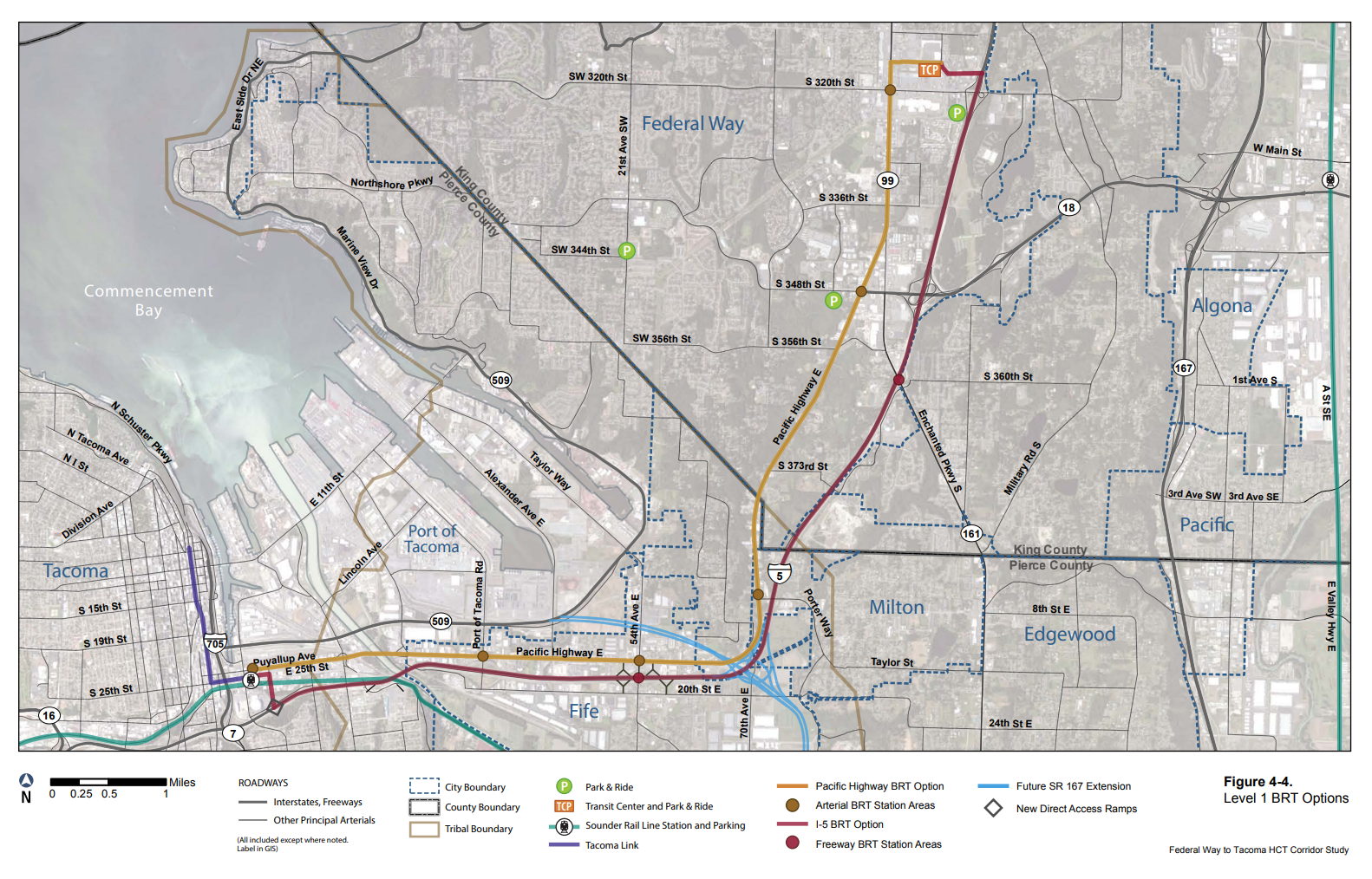
The Federal Way to Tacoma High Capacity Transit Corridor Study (2014) freeway BRT alternative shown above and the Sound Transit Long Range Plan Appendix A (2014) outlined possible I-5 direct access ramps and inline flyer stations around Tacoma.

The Tacoma Dome Link initial study proposed adding at South Federal Way Station and Fife Station inline flyer freeway stations. Assuming a Tacoma Dome Link extension is built, those two inline freeway stations would be pretty duplicative. A Tacoma Dome direct access ramp on the other hand would still be pretty useful for an express bus from Seattle.
E. J Street HOV/Transit Direct Access Interchange — From the center HOV lanes, the direct access ramps are configured beneath I‐5 and through a short tunnel at E. J Street to E. 25th Street and the Tacoma Dome Station (from the Federal Way Tacoma Way HCT Study)Costs and Benefits – Tacoma
The I-5 HOV to toll conversion projects from Seattle to Tacoma as well as direct access ramps would cost around $800 million dollars. The I-5 hov to toll conversion estimates are again from the PSRC draft regional plan (2022).
| Project | Costs |
| Airport Way Direct Access Ramp | $83 million (2008) => $121 million (2024) adj $181 million (2024 w/ cost increases) |
| I-5 Managed Lanes: US 2 (Everett) to I-405 (Tukwila) (southern half) | $356,928,335 (2022) / 2 for southern half ~= $178 million |
| I-5 Managed Lanes: I-405 (Tukwila) to Pierce/ King County Line | $255,112,240 (2022) |
| I-5 Managed Lanes: Pierce/ King County Line to SR 16 (Tacoma) | $32,032,030 (2022) |
| J Street HOV Direct Access Ramp | ~$150 million dollars (ballpark estimate from $600 million of building all four freeway stations) |
| Total | ~$800 million |
The Tacoma Dome direct access ramp, combined with previously described tolling of I-5, would allow a quick 45 minute travel time from Tacoma Dome to CID on the ST express route 590. In comparison the proposed Tacoma Dome Link would take 67 minutes to travel from Tacoma Dome to CID. While spending $800 million dollars would be a bit excessive, typically WSDOT would cover the toll conversion while Sound Transit only needs to build the direct access ramps.
| Mode | Estimated Travel Time Tacoma Dome to CID |
| ST 590 (no traffic) | 45 minutes (4th Ave S & Jackson St) |
| Sounder South | 62 minutes (King Street) |
| Link Light Rail Line 1 | 67 minutes (CID Station) |
| ST 590 (with traffic) | ~60 minutes (4th Ave S & Jackson St) |
Some further extensions south are possible as well. From the Sound Transit Long Range Plan, a direct access ramp was proposed for Lakewood P&R. The HOV ramp would likely be built offset from SR 512 to the south near or connecting to S Tacoma Way. This ramp would allow bus routes ST 574 and ST 594 from Lakewood P&R and heading north on I-5 to easily enter and exit the HOV lanes.
Conclusion
The I-5 tolling of HOV lanes has some moderate potential to speed up ST Express buses. Even with Link light rail extended to Everett and Tacoma, ST Express buses could offer a faster travel time as an intercity bus service for traveling between farther city pairs. The Everett to Seattle I-5 segments already have all of the direct access ramps built, but the Seattle to Northgate segment is complicated with the reversible express lanes. On the other hand, the Tacoma to Seattle I-5 segment can easily have all-day bidirectional toll lanes, but lacks direct access ramps both at Airport Way and at Tacoma Dome.
Citations
- Roads and Transit Package (2007)
- I-5 Express Lanes Toll Feasibility Study (2011)
- Dynamic Lane Assignment (2012)
- Puget Sound Gateway Project (2013)
- Sound Transit Long Range Plan Appendix A (2014)
- Federal Way to Tacoma High Capacity Transit Corridor Study (2014)
- Draft Regional Transportation Plan (2022)
- I-5 NB Marine View Drive to SR 529 (2022)
- I-5 Mounts Road to Thorne Lane (2023)
- I-5 Master Plan (2022-2029)
I think this is great; all limited-access highways in urban areas should be tolled to manage capacity. Politically it is difficult to fully toll a freeway that is current free, but the express toll lanes on 405/167 seem to be a politically effective compromise for this region, supporting transit speed & reliability, encouraging HOV ridership, and generating needed revenue, while maintaining significant capacity on free GP lanes. Implementing the 405/167 tolling framework onto I5 is a good next step for the region.
I agree.
I carpool around Everett frequently, and sometimes from Everett to Bellevue through 405. I highly appreciate that 2+ HOVs don’t have to pay tolls through 405. As long as what is now the HOV lane stays free for HOVs, I have no complaints.
“Existing HOV to Tolled Express Lane
The previous studies discussed converting the existing I-5 HOV lane to a tolled lane. However, between Lynnwood and downtown Seattle the (currently free) reversible express lanes complicates matters.”
Easy miss with so much information in the post but the current reversible lanes are between Northgate and downtown Seattle.
thanks ive corrected it
This is a great article, thank you for it. I was on a full run of the 594 on Wednesday. The midday travel times from the Dome were:
To Sodo Busway—35:03 mins
To 4th/Jackson—43:48 mins
To 4th/Seneca—48:05 mins
Including a transfer to the G Line:
To 17th/Madison—60:36 mins
The 594 run had many elderly passengers boarding at Sodo for a trip into the city. There was one bike, too, along with modest congestion at the West Seattle Bridge ramp near the busway (which, as this piece notes, requires the bus to crossover all the middle lanes to access).
Even with some extended dwell and travel times, Link cannot compete with regional bus trips along the interstate—tolled or otherwise. Such midday travel times are routine. If Pierce County residents are following transit at all, most are unaware that Pierce stands to lose these express bus services when/if Tacoma Dome Link opens. There are already discussions happening about how to retain some or all of this bus service after the railway opens—which, in a better world, would be a flashing red warning signal to reconsider the mission and worth of that $5 billion project.
My Sounder trip back from King Street Station was 55:08 minutes, which is also routine. I generally prefer to take Sounder home during the peak—not because of interstate reliability issues (although sometimes this is the case), but because the express buses to Tacoma are often packed. People like and need the speed, naturally.
if we had “clean” traffic lanes for transit…. why on earth invest in light rail between cities? Then there’s the heavy rail tracks we already have linking cities.
Let’s be perfectly clear here. The 7 +++ billon dollars for a second tunnel under Seattle and every inch of light rail outside the Seattle City limits. …. Why do it? Did Sound Transit ever offer a billion dollars to BN to upgrade regional heavy rail? 2 billion?
It’s always been boys playing with toy trains…..
if we had “clean” traffic lanes for transit…. why on earth invest in light rail between cities? Then there’s the heavy rail tracks we already have linking cities.
Because the folks in charge didn’t understand transit. If you think of a metro as similar to a freeway than “the spine” makes a lot of sense. If we didn’t have any freeways and focused only on automobile mobility than we would build freeways from Tacoma to Everett. If you think your metro should mimic a freeway then what we are building is great.
But metros don’t work that way. There is no “last mile” problem with freeways. Cars just drive that last mile without any delay. There is no issue with “stop spacing”. Cars don’t have to stop at every exit. Every trip is an express. It is this fundamental difference that the planners were either ignorant of or ignored. Then there is the cost. Brand new, largely built from scratch long-distance rail in a geologically challenging area like Puget Sound is bound to be expensive, even if you don’t have any
off-rampsstations.Then there is the network effect and the different demand patterns. There is a lot of demand between urban stations — there isn’t a lot of demand between suburban stations. The network effect is nonexistent. This goes back to the difference between a metro and a freeway. Notice how many people from Lynnwood complain about the 130th infill station. They wouldn’t complain about a new set of freeway ramps. The reason they complain is because they don’t want to stop there, on the way to some other place (to the south). Now imagine an infill station at First Hill. Would folks at Roosevelt complain because their trip to downtown was slower? No, of course not. They would be thrilled because they know plenty of people make that trip every day (even if they don’t). This would mean a lot more riders and just as importantly a lot more riders per mile (making it easier to run the trains more often and keep the system in good working order).
There are alternatives. Some agencies double-track their lines, which would allow a train from Tacoma to run express to Seattle. This makes sense for a city like New York but is ridiculously expensive given the number of people that travel between the two cities. It would also make way more sense to simply leverage the existing rail line (as you mentioned) and make it faster. That is the normal thing to do. Cities across the world connect places like Tacoma to Seattle via express bus service and/or trains running on tracks that were built decades ago.
What we are doing is unusual and will not be a good value because the folks who dreamed it up had no idea what they were doing.
Ross Bleakney,
I couldn’t agree more. How much would connecting all the Washington cities along I-5 with better heavy rail service? How many billions? Because nice things cost money. Same with adding transit lanes to freeways. How much?
If we’re going to build a stupid light rail line next to freeway for miles…. why not just a transit only traffic lane for buses? Yeah, I know buses get stuck in traffic, but there are ways to stop some of that. A subway from Capitol Hill to the U-District was a great idea. Light rail all the way to Tacoma? Not so much.
The reason this was never really explored has nothing to do with transit and everything to do with bad urban planning. According to the B.S. Sound Transit sales pitch, The Tacoma Dome Station should be this vibrant “urban village” by now with walkable retail and thousands of TOD propelled apartments around it. So what the Hell happened???
“Notice how many people from Lynnwood complain about the 130th infill station.”
Do they? I haven’t heard much complaining from Snohomish. There’s a little frustration that the train slows down for no apparent reason when there’s no station yet, but that doesn’t mean they’re opposed to the station long-term.
I think it’s mostly just Lazarus complaining. Though if we followed their ideal plain the link would only stop at lynnwood, westlake Bellevue and Redmond technology
“According to the B.S. Sound Transit sales pitch, The Tacoma Dome Station should be this vibrant “urban village” by now”
That was Tacoma, not Sound Transit. It was also Tacoma and Pierce County who pushed Sound Transit to extend Link to Tacoma to Tacoma Dome, and who created Sound Transit in the first place for that purpose.
Re why the Dome District is not a walkable village yet, that’s Tacoma’s responsibility. It has had thirty years to at least make visible progress but it hasn’t done so. It’s the same with downtown Lynnwood and Federal Way. Lynnwood is only now getting the walkable buildings it could have gotten in the 2000s with the real-esrate bubble money. That would have made the city a more walkable and transit-oriented place and they could have built in that momentum. But they missed the opportunity.
Give it time. Outside of Seattle, Private midrise development is focused on Shoreline plus Bellevue/Redmond/Kirkland. Midrise simply doesn’t pencil out yet in the rest of the region. After Shoreline is built out, developers will move north to MT & Lynnwood. Similarly, expect the KDM station area to get built out before FW, with Tacoma further down the timeline.
Same with highrise. Plenty of towers still being built in downtown Seattle, but U-District slow to get started and little action in Northgate.
The U-District already had a walkable urban neighborhood in the 1970s, and more density than Lynnwood or Federal Way or the Dome District.
The dome district is a thin slice of land squeezed between highway, rail and heavy industrial. It is simply not a great place for anything, much less a village. Yes, there are a few restaurants, and one or two apartment buildings, and a bunkrupt one that isn’t completed.
I mean you could make lemon juice from the lemons, but the area just isn’t sweet enough for lemonade.
The Dome District could be good but in my opinion Freighthouse Square is holding them back from it’s potential.
Freighthouse Square could actually be a good public market space if it was actually run by someome who actually genuinely cared about the building and their tenants. The current owner to me doesn’t really care from the fact that it’s still very dilapidated looking building from the outside as it hasn’t been repainted in over a decade I’ve been going through there and very outdated inside that feels very much like its seen better days.
Freighthouse Square is not bringing the area down—at least not by itself. The area is bringing the area down. It’s just not great for a variety of structural reasons that are very hard to overcome. Plopping a towering, concrete light rail station there for 80 minute trips to Seattle won’t change the dynamics either, I argue.
Anyways, there is a strong possibility that Sound Transit will tear the building down. So if it is an issue, it likely has a ticking clock associated with it.
Sorry for all the word mistakes; I was on mobile and its spelling correct can go amok.
The travel times match my observation that at least half of the total time spent on trips involving the 594 is not even I-5 at all, but slow slogs through the downtowns of Seattle and Tacoma itself.
It’s a lot of stop, a lot of lights, and the single-door buses used to operate the 594 are simply not optimized for getting passengers on and off the bus efficiently.
Of course, Link gets through downtown much faster than the 594 does, but that time savings is insufficient to justify the slower route all the way from Tacoma.
It is worth noting that Link will not go to Downtown Tacoma which means it won’t help with that section. It is also worth noting that riders can transfer to Link at SoDo. Thus for riders going from Downtown Tacoma to Downtown Seattle the only relevant section is between the Tacoma Dome and SoDo. Assume for a second that they build Tacoma Dome Link but the 594 is unchanged. If Link is faster between the Tacoma Dome and SoDo then riders are better off transferring at the Tacoma Dome. If not then it makes sense to either transfer at SoDo or just stay on the bus (making it a one-seat ride).
The only time Link will be faster is during rush hour. But this is when Sounder also runs. Sounder is always faster than Link. Thus Sounder should be considered the baseline service between Tacoma and Seattle, not Link. Sounder runs during peak while the buses should run midday. This is very common. It saves the agency money. You avoid having to run the buses during peak (when they are the slowest and most expensive to operate). It is cheaper to run the buses midday (especially since the trains are not electrified and we have to pay BNSF to use the tracks). The savings allow the agency to have more frequent service — fifteen minutes should be midday standard (and was going to be before the driver shortage). You also don’t need the extra capacity that a train provides in the middle of the day. The peak-only commuter rail/midday bus combination is common for a good reason. We should use it.
Federal Way Link should be seen as a connection point to a different system, not a substitute for the midday buses (or Sounder). The express buses from Tacoma should stop at Federal Way on their way to Seattle. This also saves money as we don’t need a separate Federal Way to Seattle bus. During peak the bus from Tacoma to Federal Way will end there (with the expectation that riders heading to Downtown Seattle will take Sounder). Outside of peak the bus should stop there and continue to Seattle (providing riders with a fast way to Downtown Seattle).
It gets a little bit more complicated with other Sounder stations (e. g. Auburn) but it is the same idea. Sounder runs peak and buses run midday.
It’s also helpful to look at Sounder as the baseline, because if a policy goal is “make Tacoma to Seattle trips faster,” then the investment should be on making Sounder, not Link, incrementally faster. There are three main options for investment: one, electrification of Sounder to shorter trip times on existing trips, two increase frequency (decrease wait times = faster trips), and three expand Sounder’s span of service (larger time window in which a rider can take Sounder in lieu of bus/Link). 2 & 3 entail adding trips, which ST3 will do.
Link, on the other head, will get steadily slower Tacoma-to-Seattle over time as there are several infill stations (BAR, Graham) still to be constructed, and Bus likely to continue to degrade as congestion becomes an all day thing (as asdf2 notes, often the key congestion isn’t even on the freeway itself).
I think it’s worth noting that Link has a 55 mph max design speed. Express buses can operate on I-5 at 60 mph and the buses have a design speed well above 80 mph. And the new Caltrain trains are on catenary wires that are to eventually be shared with California high speed rail and have a design speed of 110 mph (twice as fast as Link).
Meanwhile, the Trump appointee to lead transit programs has made his name as a congestion pricing opponent (of course, but not really of course because his libertarian friends like tolling)…
https://gothamist.com/news/trump-to-name-congestion-pricing-opponent-marc-molinaro-to-oversee-transit
It’s a bit of a muddled record. republicans somewhat like tolling freeways aka all the tolled expressways in texas. So maybe they’d be more pro or at least ambivalent towards i-5 hov tolling (also that’s more wsdot and fhwa than transit agency). for congestion pricing (cordon area) the new transit head is against it.
They like tolling freeways because it prevents them from having to increase gas tax rates. Drivers can avoid paying tolls for new freeways by driving around them, which makes libertarians happy.
Tolling is just half of the issue. The other half is allocating the toll revenue.
I’m hoping that the new FHWA allows for toll revenue to go towards parallel transit service. The we need to get WSDOT to promise some toll revenue to go towards transit operations. We aren’t doing that now like we should be.
Different Republicans support different things. Tolling and privatizing highways is a libertarian issue, not a drill-baby-drill issue.
As Al points out, allocating the revenue is half the battle. This is why “new” freeways (520 rebuild, 99 tunnel, 509 & 167 Gateway extensions, new HOT lanes on 167 & 405, Tacoma Narrows eastbound bridge) all are tolled, because the connection is clear to voters. A new toll on I5 will need to be explicitly connected to the corridor.
FWIW, I agree with the NJ politicians (left & right) that it is kinda of ridiculous that the current tolls to get into Manhattan (Lincoln Tunnel, Battery Tunnel) won’t “count” towards the congestion charge, so drivers entering from the west and south get charged twice vs drivers entering from the north & east, while the congestion charge revenue will be entirely spent on MTA & LIRR projects benefits riders coming from the north & east. Charging drivers to benefit transit is good policy, charging New Jersey drivers to benefit New York transit riders not so good policy or politics.
> As Al points out, allocating the revenue is half the battle.
I assume the money will just end up paying for other interchanges or widening along i5. Of course would prefer it went to transit improvements but either way the tolling should greatly help i5 express buses
Something has to fund I-5 maintenance. Why not have some if the burden shift to tolls? Even if they do more highway projects. They have to do maintenance or existing highways will close.
Given the age and condition of I5, there should be more than enough maintenance expense to consume all toll revenue. Wesley also highlighted a handful of “Extra” projects that could be funded if tolling revenue was robust.
Just so I understand, the plan is to make drivers pay to use freeways and highways so busses can get to their destinations faster? Sounds like transit needs to adjust their fares to pay to drive the roads like the rest of us.
As if roads aren’t incredibly subsidized by government at drivers’ benefit. Also, the toll serves as a disincentive for drivers to drive, with the goal of having more transit use replace the driving.
> Just so I understand, the plan is to make drivers pay to use freeways and highways so busses can get to their destinations faster?
The plan to toll the hov lanes is by WSDOT / FHWA. those funds are mostly used by the state agency to build more freeways.
> Sounds like transit needs to adjust their fares to pay to drive the roads like the rest of us.
the transit agency usually just builds the direct access ramps (well more accurately funds and it’s still wsdot building) . which can sometimes be used by hov drivers as well.
Anyways if you’re against tolling freeway lanes that’s not really much to do with transit in america. Generally whether or not a freeway is tolled in america it’s generally led by the freeway agencies who want more funds for maintenance/expansions, they aren’t really taking the lead from the transit agencies.
When I was on the I-405 Program committee, I actually proposed that question at the end of a meeting.
It was close to the end of the process, so I figured that they probably wouldn’t do a deep dive into the numbers.
I asked the question: “What would it cost if the lanes were fully tolled and how much would the bus riders have to pay?”
I still remember the look on the Washington Truckers Association representative wondering why I would be agreeing with him about tolling every vehicle.
No calculations were officially done, so there is no document.
A toll split amongst all the riders on the bus would have been interesting.
My back-of-the-napkin calculations came to around a 25 cent premium on top of a regular bus fare, if it were a full bus. (back then)
“Sounds like transit needs to adjust their fares to pay to drive the roads”
Transit is a basic mobility service to allow cities to function. If you take transit to work, you generate services and a paychecks for others and tax revenue. If you take transit to help a disabled relative, then the government doesn’t have to do it. You have a choice between tax-funded libraries or for-profit bookstores; it’s the same with transit vs driving. It’s the same government subsidizing transit and roads.
Philosophically, I have no objection if public transit vehicles had to pay the same toll as similarly sized vehicles (usually it is per axle). It would be a tiny fraction of the operating cost for Sound Transit.
As Link extends along I5 and most routes are truncated, the long distance ST Express buses perhaps should also have a premium fare. For example, ST could keep running the 590 after FW Link opens, but match the Sounder fare, which is +$2/trip, more than enough to “pay for” any I5 toll. (charging a premium northbound would be hard to implement, as Tacoma-FW riders shouldn’t pay a premium, but straightforward for the Seattle -> FW leg)
We’re not against premium fares for long-distance ST Express, especially where there’s a Link or Stride alternative. Community Transit long charged fare higher than ST for it’s Seattle expressed as far as Lynnwood, and even higher to Everett and further north.
However, all the transit agencies are going in the opposite direction. Metro, St Express, and Link will soon all have a $3 flat fare. They’ve raised the suburbanization of poverty as a reason not to have premium fares. Think of the medical assistant in Everett working in First Hill, or the early-education instructor in Lynnwood, or the single parent in Kent or Renton.
I think Link flat fare addresses the suburbanization of poverty argument. The premium would be limited to just ST Express that parallels an existing HCT line.
The premium service would probably need a distinct branding, as ST will continue to operate several ST Express routes in perpetuity that would not be “premium” services, mostly routes that shadow(ish) Sounder.
I could see the branding evolve, where in 2040 Sound Transit operates 3 bus brands:
– Stride: all day bus service, the 3 ST3 routes and perhaps a few other routes, like Redmond-Seattle or Sammmish-Issaquah.
– Sounder: shadow service for Sounder South, routes like Dupont-Tacoma or Tacoma-Puyallup-Federal Way. Frequency would focus outside the Sounder operating window.
– ST Express – long haul premium service; runs all day but frequency is peak oriented. Examples could be a Lakewood-Tacoma-FW-Seattle, Auburn-Bellevue (skip Renton TC), or Everett-Bellevue (skip Lynnwood TC)
At some point I suspect that reversible HOV lanes will fully disappear. They were great when there was a surge of traffic headed Downtown in the morning and back out in the afternoon.
But we now have major employment centers everywhere. Plus the more recent investment in high capacity transit to Downtown (first radial in 2010; second in 2021 and 2024; third in 2025 end of year; fourth planned to West Seattle and fifth planned to Ballard) means that the goal should be to move people onto Link or express buses rather than in reversible lanes.
They were taken from I-90 a decade ago. It’s really just I-5 in central and north Seattle that’s left along with some Downtown reversible exits.
I would think WSDOT has internal ideas on how to eliminate the remaining reversible sections. And Express lane revenue should help pay for its cost.
Every time I drive I-5 north of downtown Seattle and look at the reversible lanes I like to visualize Regional Rail (Sounder North) and Amtrak trains using it to bypass the Sound Shoreline route to Everett.
I think that’s the most likely outcome, or when I5 is rebuilt (notably the bridge over the Ship Canal), they simply shrink the footprint of the freeway.
It’s a possibility. For a future Cascadia hsr though the most technically feasible route is to use the express lanes. It’s both separated and tunnels below the city.
The other alternative is a very long deep tunnel but the cost would be enormous
The study won’t be finished for a couple more years though.
I’ve toyed with the idea of using the express lanes for DSTT2 between Mercer and James. I’m not a track designer so I’m not sure if it’s possible. I don’t think there is enough height to have both trains and catenary wire and going deeper looks structurally messy. Rail needs more ballast underneath too.
I’ve also wondered if the lanes could be closed to build a cut and cover tunnel under the roadbed for trains then reopened .
Cascadia HSR virions have included a station at the I-90/ I-5 interchange.
One of the more interesting strategies that has floated around is for SR 520 to connect to Mercer using the express lane level —- with it treated as a higher speed arterial rather than a full freeway. Of course, with the 520 project underway that concept seems unreasonable to consider now.
@Al
A very very long time ago actually one sketched out concept was to use those lanes for the link along i5 from slu to uw.
“I’ve toyed with the idea of using the express lanes for DSTT2 between Mercer and James. I’m not a track designer so I’m not sure if it’s possible.”
Full sized Amtrak electric trains operating on voltages much higher than Link are running through the tunnels under New York. Clearance wise, there should be no problem for Link in that space.
I’m not sure about getting stations put in though.
Maybe run the trains on the express lanes, then make it a surface light rail line for a few blocks in downtown?
“Clearance wise, there should be no problem for Link in that space.”
I get that the raw clearance is there. I’m just not sure what would have to be added to support the track. The Link LWB has ties added to the bridge with rails on top of that to support the concentrated weight of steel wheeled trains for example.
I’m not a rail civil engineer so I can’t speak from authority. I just see it as a design question.
One benefit from closing Downtown ramps is that it reduces all the crazy lane changing on I-5 through Downtown. It could really improve the freeway safety and speed and capacity if those short weaves went away. There may even be enough additional throughput that opens up so that the HOV lanes could be added on the inside of the freeway. After all, many Downtown ramps take up more width than a freeway lane does. Eliminating the express lane traffic would free up the entire deck for possible rail use.
Would closing some of downtown tunnel express lane entrances make it easier to build a second Link tunnel, by eliminating some of the obstacles?
Getting the southbound lanes at Northgate to not just dead end in the afternoon would sure help southbound longer distance buses get into Seattle. Amtrak’s bus has a real long slog of it through there.
I think this is great.
With combustion engine vehicles being more and more fuel-efficient on these days and truck % trending ridiculously high thanks to booming of logistic and e-commerce business, federal gas tax formula has been so broken and out dated.
But I don’t know how existing express or HOV lane can be converted to toll lane without legal battle. To my understanding, you can only make part of Interstate toll lane if that specific lane capacity is not funded by FHWA.
It can already be done legally. It’s how the i405 has toll lanes.
https://www.fhwa.dot.gov/ipd/tolling_and_pricing/tolling_pricing/section_166.aspx
> Under Section 166 of Title 23, existing HOV lanes may be converted to tolled operation provided that the local MPO endorses the use and amount of tolls on the converted lanes. All tolls on new lanes must be variably priced and collected electronically in order to manage travel demand
There’s more legalese but basically it just has to give a discount for hov drivers. The toll money generally has to be used for freeway projects or arterial adjacent ones (for example widen a road leading up to a freeway intersection)
> my understanding, you can only make part of Interstate toll lane if that specific lane capacity is not funded by FHWA.
A state cannot just convert general lanes and also it must be dynamic and actually improve the miles per hour.
Hi all hope everyone enjoyed the article. After this i5 tolling and the previous hov article will probably switch back to link light rail/ maybe center running bus articles.
But later on might write about i90 (issaquah), 520 or maybe sr 167 corridor. If there’s anything specific yall would prefer or have other ideas would be interesting to hear
@Wesley
Thanks for the article. It’s good to see all this info in one spot. Looking forward to the tolling study
Stop the tolls… quit ripping us all off.
Wow 30-40 years of not having tools on the US interstate system, then when dot’s across the country make stupid engineering decisions that make traffic worse and waste billions, then yeah let’s toll everything
That’s because someone else has been paying for your roads.
Up until around the year 2000, Washington state received more federal $ than we paid in. (Then we connected up the bridges to nowhere)
Other states that had completed their interstate highways paid more in federal gas tax and got less.
You do realize that the full expansion of I-405 was supposed to be completed around 2012, right?
When the I-405 FEIS was completed in 2002, there was no funding source identified.
No politician had the co/ova-rones to tell the public they’d have to raise the state gas tax.
And without a vote, they went and did it anyway around 2014.
Now I get to pay extra gas tax even though I rarely drive the I-405 corridor.
Tolls are the fairest way for the users to pay for expensive facility they want.
I am categorically opposed to ALL future and current tolls! WA is in the top 3 most regressive States in America and continues to coddle the wealthy at the expense of lower-income, poor, and homeless. It is SHAMEFUL! Instead, make Amazon, Microsoft, Wells Fargo, AT&T, Walmart, Google pay a CONGESTION tax for how their back-to-office policies have impacted everyone else.
I’ll admit I wasn’t too keen on the idea of a special toll lanes initially. It is almost a two-class system (the rich get to avoid congestion). But it appears to be the only way to get HOV improvements. If you are going to have tolls than it makes sense to toll the people willing to pay. Those are either wealthy people or lower income people who can’t afford to be late. The former means taxing the rich more (achieving your goal) while the latter benefits someone who really needs it (e. g. someone picking up their kick from daycare).
While it is easy to criticize the system for only providing congestion relief to a subset of people, that is the *only* way to provide congestion relief. If you simply added lanes it wouldn’t work. Even if you added multiple lanes they eventually just fill up. Think of it another way. For the most part we *are* taking the wealthy — it is just that they get a little bonus (the ability to get somewhere faster) — in exchange.
Of course in an ideal world there would only be HOV lanes (and fewer general purpose lanes). The tax system would not be so damn regressive and even low-income school districts would be fully funded. But we don’t live in that kind of world (or at least that kind of state).
RTO doesn’t mean back to their car 5-day a week especially for companies like Amazon and Microsoft. Amazon rolled out a larger shuttle operation as part of the RTO plan.
Big tech are just easy target for cable network. I honestly think Amazon’s part in worsen Seattle’s commute in 2025 has been exaggerated. Before 2025, many Amazon employees have been asked to work onsite three days a week, which is usually Tuesday through Thursday. Asking them to come every weekday might make Monday and Friday commute a lot worse, but it shouldn’t make the busiest weekday in 2024 (like Thursday) even worse. I think what happened was a lot of smaller companies whose office are located in much more car-oriented part of the region saw Amazon announcement as their signal to change their WFH policy and subsequently announced their own RTO. This might be what changed the commute in 2025, but local news won’t cover from this angle because nobody wants to hear about that.
There’s still a difference. If it’s 3 day rto some teams might do Monday Tuesday Thursday, or Tuesday Wednesday Friday. Even the three days in the middle wouldn’t have as much people as the current 5 day rto
I see no reason to charge HOVs or remove HOV lanes, or to have any untolled single-occupant or freight vehicles whatsoever. Keep the HOV lanes express only, and have the proposed toll plaza become an occupancy and speed enforcement gantry so violators get fined and points on their license. Use the revenue to pay for transit expansion, and to double-track and electrify the entire Amtrak Cascades corridor.
I see no reason to charge HOVs or remove HOV lanes
I don’t think they are doing that. HOT lanes are HOV lanes. In other words converting HOV to HOT means carpools can still use the lanes for free. The only difference is that drivers need to get a Good to Go Flex Pass (https://wsdot.wa.gov/sites/default/files/2022-05/Toll-Instructions-FlexPassInstallation.pdf) and they need to slide the little window to avoid being charged if they are driving in an HOT lane as a carpool. This is mentioned in a couple different places on the state website. Scroll down to the section entitled “Who can use an HOV, HOT lanes and express toll lanes” in this webpage: https://wsdot.wa.gov/travel/roads-bridges/hov-lanes/hov-policy:
To be eligible for a toll-exempt trip in the express toll lanes or HOT lanes, the vehicle must have the correct number of occupants and be equipped with the appropriate Good To Go! pass.
This is also found in the section titled “Express toll lanes and High Occupancy Toll (HOT) lanes” here: https://wsdot.wa.gov/travel/roads-bridges/hov-lanes:
The I-405 Express Toll Lanes and SR 167 HOT Lanes are a form of HOV lane …
Carpools with two or more people can always use the SR 167 HOT Lanes for free.
Carpools with enough passengers can use the express toll lanes for free with a Good To Go! Flex Pass. The carpool occupancy requirement depends on the time of day.
Maybe make a proper Metro first then that doesn’t take a century to build before you toll people to death
The tolling would be done by wsdot for freeway maintenance and expansions. Sound transit would just be building the direct access ramps