Biking the new Seattle waterfront and East Marginal Way with Greg Spotts, former SDOT director. (Best Side Cycling)
Biking the Vancouver Seawall Trail. (City Beautiful) It goes 28 km (17 miles) around Stanley Park, around False Creek, and along the Kitsilano shore to several beaches.
The Fall Service Change is upon us and most of the transit agencies in Puget Sound have updates to their network. These changes will take effect over the next few weeks, starting as soon as tomorrow, August 30. These agencies include King County Metro, Sound Transit, Community Transit, Pierce Transit, Everett Transit, and Intercity Transit. Click on an agency’s name below to view the official announcement.
Route 246 will be permanently deleted in this service change. (SolDuc Photography)
Starting August 30, Metro is implementing Phase 3 of the East Link Connections route restructure, adding Route 106 trips supported by the Seattle Transit Measure, and increasing adult fares to $3 ($0.25 increase). Phase 1 of the East Link Connections restructure started when the 2 Line extension to Downtown Redmond opened on May 10 and Phase 2 took effect earlier this summer. Additional East Link Connections changes will launch when the full 2 Line opens in 2026. The full slate of East Link Connection route revisions was outlined in a previous post.
New Routes:
Route 203 will provide service between Issaquah Highlands, north Issaquah, Issaquah Transit Center, Newport Way, Factoria and South Bellevue Station. Route 271’s service to Issaquah is unchanged at this time.
Route 222 will provide service between Overlake, Idylwood, downtown Redmond, Education Hill and Cottage Lake.
Route 223 will provide service between Eastgate, Lake Hills, Overlake and downtown Redmond.
Route 256 will provide peak-only service between Woodinville, Brickyard Park & Ride, Totem Lake, Kingsgate Park & Ride, Yarrow Point Freeway Station, Evergreen Point Freeway Station, South Lake Union and downtown Seattle.
Routes 893 and 895 are new contracted routes for the Lake Washington School District, starting on September 2, 2025.
Metro Flex launches in parts of Overlake, Crossroads, and northeast Bellevue on Monday, September 15. Click here to view a map of the Metro Flex region.
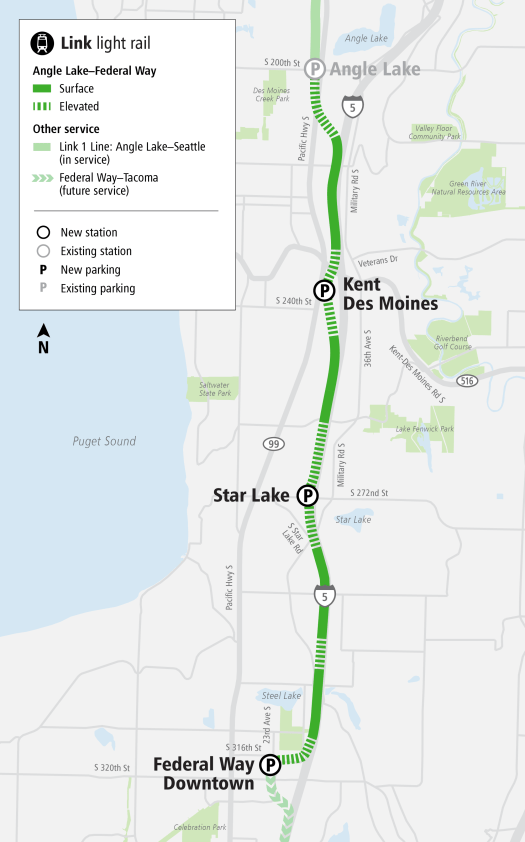
This morning, Sound Transit announced the official opening day of the Federal Way Link Extension, which will extend the 1 Line to three new stations beyond its current terminus at Angle Lake. An opening ceremony will be held across the extension on Saturday, December 6, 2025, kicking off full 1 Line service to the new terminus at Federal Way Downtown.
However, construction appears to have proceeded ahead of schedule. Earlier this summer, Sound Transit CEO Dow Constantine announced the agency would be making every effort to open the extension as soon as possible, even if it meant usurping the cross-lake connection of the 2 Line between Bellevue and Seattle as the next major expansion of the Link system. Opening of the cross-lake connection is now tracking toward next spring.
The Link 1 Line runs between Angle Lake in SeaTac and Lynnwood via Tukwila, Seattle, Shoreline, and Mountlake Terrace. In May 2025, the 1 Line had 105,586 average weekday boardings.
The 1 Line initially opened in July 2009 and ran between downtown Seattle (Westlake) and Tukwila. Since then, it has expanded north to the University of Washington in 2016, Northgate in 2021, Lynnwood in 2024, and south to SeaTac in December 2009 and Angle Lake in 2016. The Federal Way Link Extension is expected to open later this year.
The ridership data discussed in this article is just a snapshot of the current system. Link is still a growing system and many of the non-Link transit projects being built in Puget Sound will have a direct or indirect impact on ridership over the next few decades. The methodology behind the data shown below is discussed in the first comment below the post.
Average Weekday Boardings Per Station
The plot below shows the average weekday boarding count by station in each direction in May 2025. Southbound boarding counts are shown on the left and northbound boarding counts are shown to the right. The alighting count for a given station is similar to the boarding count in the opposite direction.
Average 1 Line Weekday Boarding Counts in May 2025
The 1 Line ridership patterns show that the highest ridership occurs between downtown Seattle and Northgate. U District has the higher number of southbound boardings and SeaTac/Airport has the highest number of northbound boardings. All stations north of the Montlake Cut (UW and above) have more southbound than northbound boardings. All stations south of UW have more northbound passengers.
California high-speed rail is good, is well under construction, is likely to survive federal grant loss, and could be improved with a conventional-speed interim extension. (Alan Fisher)
Los Angeles has big rail and BRT expansion plans. (Nick Andert (nandert) via RMTransit)
Correction: This article previously called this lane the first freight and bus lane in Seattle. The first freight and bus lane was installed on Broad St between sometime between December 2021 and September 2024. We regret this error.
Last week, Seattle Department of Transportation (SDOT) crews installed the first second Freight and Bus (FAB) lane in Seattle on 4th Ave S. The new lane runs northbound from S Walker St to under the Edgar Martinez Dr S overpass. Metro routes 131 and 132 serve stops along this segment of 4th Ave S.
The bus lane stops under Edgar Martinez Dr S overpass, leaving an 800ft gap before the existing northbound bus lane starts after S Royal Brougham Way. Traffic from the overpass merges onto 4th Ave from the right in this gap.
Last May, SDOT released a new fact sheet on its Harrison and Mercer Transit Access project, spanning the blue line in the map above. It’s at 30% design, and construction can begin “as early as” 2026 (although since the May update, that has slipped to 2027).
The plan is for, more or less, the usual recipe: road repaving, transit priority treatments, and pedestrian safety. The details are subject to the remaining 70% of the design.
Alert readers might notice what’s unique about this transit corridor work: there are no bus routes on the corridor! The new-ish Eastlake Layover Facility is at one end, so perhaps it’d be a little easier to start some routes on time. But SDOT and Metro confirmed to me that there is more in the works.
Redmond city planning led to massive TOD around Downtown Redmond and Overlake Village stations, and expedited the Link planning. (Yet Another Urbanist)
Kemper Freeman’s war on transit. (Yet Another Urbanist)