
This morning, Sound Transit announced the official opening day of the Federal Way Link Extension, which will extend the 1 Line to three new stations beyond its current terminus at Angle Lake. An opening ceremony will be held across the extension on Saturday, December 6, 2025, kicking off full 1 Line service to the new terminus at Federal Way Downtown.
When it broke ground in 2020, the extension was expected to open in 2024. Completion was eventually delayed to mid-2026 following due to impacts from the 2020 pandemic, a 140-day concrete truck driver strike (KUOW), and the discovery of unstable soils next to I-5 south of the Midway Landfill (Sound Transit).
However, construction appears to have proceeded ahead of schedule. Earlier this summer, Sound Transit CEO Dow Constantine announced the agency would be making every effort to open the extension as soon as possible, even if it meant usurping the cross-lake connection of the 2 Line between Bellevue and Seattle as the next major expansion of the Link system. Opening of the cross-lake connection is now tracking toward next spring.
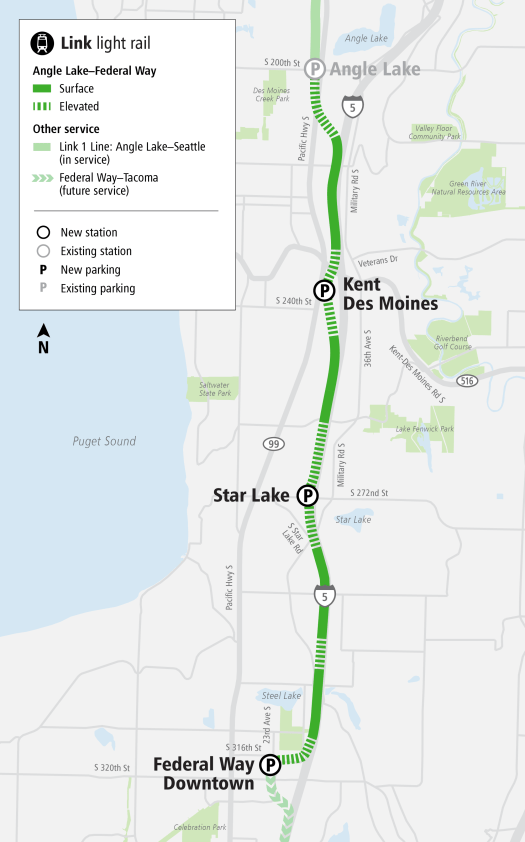
New Track, Stations, and Connections
Sound Transit has been posting drone videos showing construction progress over the last few years, with the latest video taken in July 2025 (above), showing the nearly-complete track and station areas.
Earlier this year, Wesley Lin did a deep dive on the station plans and how riders are expected to arrive at each.
The opening is expected to feature celebratory activities at each station, similar to previous extension openings, but details are still to come.
Im happy for eound transit 5hey were able to do this.i hope it all goes smoothly and is a success. Now we just need a real 2 line but with testing so far beh8nd that looks like more trouble coming.
@Good grief,
Coincidently enough, I just walked out onto the I-90 FB and then to IDS to see what was going on with the 2-Link connection. The answer is, “Not much”.
There was a crew of 8 people about a third of the way out onto the floating span. Seven of them were surfing their phones or messing around in their lunch box. Only one person was working, and this was at 10:00 am. Not even close to lunchtime!
The one guy who was working had his head in an electrical box. So that at least is something.
The rest of the line was similar. So I’m not super encouraged.
Hopefully they get this done by the World Cup, but they are going to need to get a little bit more serious about actually, you know, “working”.
And if the power needs to be turned on to do their calibration, is there any other testing at all the they could do while the power is on? Anything at all?
With all due respects… as an electrical engineer it is the apex of stupidity to read someone write that “Not much” work is getting done when clearly there is an electrician with “his head in an electrical box.” For fuck sake this IS the difficult work of getting the trains run reliably, to instrument the pontoons on I-90, to circuit vibration sensors to the tracks, to measure voltage drops, current, pressures, proximity switches, to circuit thousands of sensors to the control systems, to communicate all this information without error to the RTUs and PLCs, communicating that information to where it needs to go, and writing and testing the logic and code to bring it all together and enable ST staff to understand their system. The extraordinarily visible catenary, that’s the easy power shit that everyone sees (hat’s off to my IEEE PES friends :-). An electrician with his head in an electrical box terminating tens of thousands of instrumentation and control conductors perfectly, ensuring no ground loops or EMF or mismatched voltages, and testing every fucking last little IO point is the real work. (7) people “surfing their phones” are surely attempting to troubleshoot an electrical issue that is way too complicated for you to understand but it is absolutely what we need to happen. So next time you see an electrician with their head in the electrical panel with (7) people scratching their heads be assured that real work is being done right now by these rock stars.
@jmath,
Don’t get me wrong, I applaud the one guy who was working. The one guy.
And I’m an engineer too. I know how complicated these projects are and how many steps have to be cleared. But clearly the current situation isn’t defensible.
I have serious doubts that the latest “schedule” can be met. And now I am hearing statements from higher levels about how fragile and maintenance intensive this segment will be.
Hopefully that is just caution, but the statements are being made by people who are known for happy facing everything. And when people who happy face everything are concerned, we should all be concerned.
@ Lazarous, applaud the 7 people who are troubleshooting, that is where the thinking is happening, that is the work than needs doing. Your schedule concerns require that this work be done properly.
As for the happy-facing people concern… the front-facing ST people are the messengers hence be extra-attentive to the Engineers and Contractors who originate the messages (Kiewit-Hoffman for the I-90 Section). Reward Engineers and Contractors that provide quality products on time and on budget sans drama versus those that continually argue for change orders and delays.
Regarding maintenance and fragility concerns on the I-90 floating bridge alignment… this is the first train on a floating bridge in the world so expect surprises. ST may find out it was a great idea that performs well or they may find it was a learning experience as to why we don’t do that and we really should have routed north and south of Lake Washington to get to the eastside. Time will tell.
Only a year and four months later than promised. Before anyone says it, I know about the supposed reason for the delay. I just don’t believe it because they can’t be that stupid.
Which “supposed reason” is beyond your belief? The pandemic, the concrete strike, or the soils issue?
None of those things would have mattered if these were affecting a Seattle station. The soil problem should have been discovered years earlier.
The entire reason we don’t have a First Hill station (and they get a crappy streetcar instead) is because of a soils issue. The station literally didn’t get built because of it. Projects everywhere were delayed due to COVID and the drivers’ strike.
I get that you feel South King isn’t getting their due out of ST3 (however based in material reality that take may be), but these are real issues that have in the past affected construction. They’re real things, and there’s no magic wand we keep in a vault in Seattle that makes our projects run smoothly. God I wish there was though, I’d be waving that thing at the I-5 project so fast.
@ctishman,
I’m actually not negative about ST. In fact, I often get attacked on this blog for being too pro ST. And specifically, too pro rail.
But the word is out:
https://www.seattletimes.com/seattle-news/transportation/sound-transits-expansion-plans-balloon-by-up-to-30-billion/
The numbers I was provided were in terms of shortfall and not escalation, but the impact is the same.
And do you notice the pattern? Balducci/Dow always package bad news with a good new press event. The same exact thing happened when they dead towed the LRV across the I-90 FB three months ago. And since then? Absolutely nothing.
History repeats itself. But don’t blame me for that.
ctishman: in addition to the soils issue, the FHSC also required that Nickels and later McGinn became streetcar foamers. There already was electric trolleybus overhead between Pioneer Square and East Aloha Street.
As ST delays go, this one has seemed the most unavoidable. Sure they could have done a more thorough soils study but they knew all along that the initial design and timeline had risks.
Plus, the major revision was designed, material was ordered and made, and was installed pretty quickly.
As much razzing as I give ST over other (East Link) delays they’ve minimized this unexpected and unavoidable delay really well!
Here is what really makes me angry about all this. They said that there would be a two year delay. The delay is only going to take one year and four months. Sound Transit is now spinning this a ahead of schedule. It is not ahead of schedule. It is less delayed as originally advertised.
Yeah, that is the way they do things. They have done this repeatedly. It is annoying, but there isn’t much you can do about it.
Congrats to ST for getting this done. And I’ll actually be in town for opening day. I look forward to it!
Now on to Full ELE. That one will be huge.
Oh, and ST just dripped a bombshell about the ST3 budget. It looks bleak for ST3.
Is this Dow’s monorail moment? Can he save anything worthwhile from ST3?
This is going to be painful.
*dropped*
Where online is this bombshell?
@Al S,
Looks like they just snuffed the headline number. That was quick.
But the motion is up. Just a bunch of nothing talk. But you know that, when Dow and Balducci use language like that, something is up.
@Al S,
“ If the agency does not take proactive measures via this Enterprise Initiative, the ST3 program will
become unaffordable,……”
Oh baby. Here it comes.
@ Lazarus:
My greatest fear is that the Board will limit their solutions options. I suspect that they will not look at how they can change rail vehicles (automated vehicles with shorter stations and/or faster electric trains for the outer segments) or vertical profiles (surface versus aerial versus bored tunnels) in order to keep most of the stations promised in ST3.
Another fear is that the operational problems and solutions pointed out in the recent HNTB get ignored because the issue isn’t referenced in the ST3 measure.
Another ongoing but unmentioned issue is operations farebox recovery. The Board to date seems unmoved by seeing farebox recovery drop from 18 to 12 percent between 2022 and 2024 in the most recent revenue report.
I’m instead expecting the result to be focused mainly on raising more money rather than building a smarter project:
1. Opening year delays in order to raise more tax money over a longer life span.
2. More taxes in an ST4 ballot measure.
Then I expect deferred end stations if these strategies fail. That will put Ballard, Downtown Everett and South Kirkland off of a revised plan.
My greatest fear is that the Board will limit their solutions options.
I agree. Everything should be on the table. But there is this ridiculous notion that voters wanted everything exactly the way it was specified in ST3 with no significant changes. Even that becomes a contrarian argument as ST has been OK with making major changes as they see fit. They want to move the station from 15th to 14th in Ballard. This seems like a minor change until you see how far it is (and it means moving in the wrong direction). They have pretty much abandoned the grants to Metro (to run the C and D more often). They are seriously considering getting rid of one of the three stations with West Seattle Link (which would mean each station would cost over three billion instead of over two billion).
They should consider all options and recognize that people voted for transit — nothing more, nothing less. The vast majority of people that voted “Yes” would have voted for any transit project put to them. It was not as if they were given a half dozen options and this is the one that bubbled to the top. It was ST3 or start over. The vote was basically Transit: yes or no.
It is also worth noting that Seattle was key to the project passing. It passed by 70% in the city. Redmond was second, with 60% in favor. Third was Lynnwood, with 54%. While 70% in favor in Seattle was the key to victory it is not as many as supported additional Metro funding. In 2020 over 80% of the voters in Seattle supported additional Metro bus funding. It is quite likely that a different set of projects would have more support within Seattle as well as the region.
There is nothing special about the ST3 proposals. The board should consider all options.
Yeah, they posted something on Bluesky (https://bsky.app/profile/typewriteralley.bsky.social/post/3lxin5ghyzk2d) but then took it down. I assume they did the same thing on Twitter (and other places). People who referenced the notice wrote about “the very frighteningly large deficit Sound Transit is facing”. So basically really bad financial news.
“But there is this ridiculous notion that voters wanted everything exactly the way it was specified in ST3 with no significant changes. Even that becomes a contrarian argument as ST has been OK with making major changes as they see fit.”
One only has to point to the whole revised ID station interfaces to undermine any statement that ST has to tightly match ST3 consistency. And the current preferred alternative wasn’t even in the DEIS — yet was chosen by the Board before the Final EIS was published.
My greatest fear is that the Board will limit their solutions options.
I agree. Everything should be on the table. But there is this ridiculous notion that voters wanted everything exactly the way it was specified in ST3 with no significant changes.
The Sound Transit Board is primarily comprised of elected officials. Budget woes will make them more conservative, and will not free their minds to consider something out of the box like a SkyTrain technology for Ballard-Westlake and beyond… too “risky” even though it’s been running there since 1986, two decades longer than Link, with repeated expansions, low headways, and ridership of like 450K/day in a metro area smaller than ours.
The one glimmer of hope I see is Claudia Balducci, who has consistently been a creative force on the Board. Somehow, we need to shift the dynamic away from making bad alignments worse while pushing schedules further out.
Man, what is it with the comments sections of every STB post lately being full of transit haters/”skeptics”?
They announce good news, an opening ahead of schedule and people are tripping all over themselves to be all “Here’s why this could be trouble for SoundTransit”, like they’re a New York Times opinion columnist.
It’s mainly Lazarus, who comments on almost every post in some way how ST isn’t good enough (usually relating to the i90 segment), like the important and insightful observation that a group of workers were twiddling their thumbs at 10am (a few comments up). Another fail by ST!
Makes me wonder how Lazarus will spend his time after the full ELE opens.
I would say the remaining projects continue to grow more financially dubious and warrant increasingly more skepticism. We’re not here to be cheerleaders for bad ideas.
I’m as big a transit fan as you’ll find but I don’t want to spend a bunch of money we don’t have to make our current system WORSE.
Lazarus is usually criticizing Metro., with critiques that tend to also apply to ST.
He is not one of the ST3 opponents here. He seems pretty adamantly pro-ST3 from everything I have read here.
The quality of his posts is a matter of subjectivity.
Earlier today, the GREATTRAINSPEED YouTube channel released a video on ST expansion as well:
https://m.youtube.com/watch?v=GSHD3_N2DBY
It includes many of the recent ST items presented in over just the past few weeks.
Thoughts on this? Is someone on the blog involved with this channel? I’m curious.
Lol GTS kept showing Sumner Sounder station, I’m pretty sure that channel is just not AI slop (some notable words mispronounced.)
Great train speed is the biggest AI urbanist slop channel on YouTube now, after US railways went down. Banks Rail did a video on AI slip urbanism a few days ago that broke it down.
Agreed about the AI opinions. The curious thing though is how the script got written with so many recent items. AI seems to be getting pretty good.
I expect to see Pinehurst station open. before 2 line opens across the lake.
https://www.seattletimes.com/seattle-news/transportation/sound-transits-expansion-plans-balloon-by-up-to-30-billion/
I’m assuming that’s $30 B MORE, right?
At least half of the increase ($15 B more) seems attributable to West Seattle and Ballard alone.
The important context is that it’s the total shortfall from now through 2040. Last Fall, the total ST income/expenditure from 2017-2040 was estimated at $150.5B. Now they’re estimating a 20-26% shortfall through 2040 due to $22-30B (in year-of-expenditure $) in increased construction project costs, $5B in operational cost increases, and an “impact” of $4-5B between reduced revenues and increased financing costs due to increased interest rates.
Seems like the more extreme “fixes” we proposed in June (https://seattletransitblog.com/2025/06/23/brainstorming-fixes-for-st3/) are going to have to be on the table.
I would love to have seen the number of miles, the travel time, what travel time will be from the end to other places in the area. This would have been a much more useful news piece with that information.
Next, time to build high speed rail from Vancouver BC to Tulumn MX! Shouldn’t seem too far fetched since the sections from SF (or Sacramento) to LA (or Rancho Cucamonga) are underway. With the Brightline LA to Phoenix segment almost ready for an official announcement and Tren Maya about to expand over to Mexico City and up to Guadalajara and Puerto Vallarta it’ll just be time to fill some gaps.
The Urbanist article on it dropped an hour ago:
https://www.theurbanist.org/2025/08/28/sound-transit-plans-major-program-reset-in-face-of-30-to-40-billion-shortfall/
We’ve got an article in the works.
We should talk about the truncated version of Ballard more then
The BLE DEIS (supposedly due for release in the next few months) will be very interesting.
“A dual scissor blades of rising costs and falling tax revenues will force the agency to confront painful decisions, such as whether to shorten future lines, drop some stations, or make existing two- to five-year delays to open new stations even longer.”
Ready with my cost-cutting scissors:
* Sounder North: Cancel it. Pay CT to add 9xx runs on Mukilteo-Lynnwood and Edmonds-MT if they’d need more capacity or have too many turns/stops.
* Everett Link: Truncate at Ash Way or Mariner. Add 10-minute express buses to Everett, and some kind of feeder to Paine Field. Or revert Link to the I-5 alternative north of Mariner, and add a feeder bus to the Pine Field stops.
* Ballard, DSTT2, West Seattle: Cancel it, or switch to our single-tunnel alternative and automated Ballard line. West Seattle Link is unnecessary and the area would be better served with multi-line BRT. The long DSTT1-DSTT2 transfers will cripple the network’s usability and ridership potential for trips requiring a Link-to-Link transfer. The Ballard 14th station alternative won’t serve the Ballard village very well. Fall back to improvements on RapidRide C, D, H, and on the 21, 40, 55, and 56.
* Tacoma Dome: Cancel it, and provide frequent express buses instead. This may be harder to do than Everett since the project is further along.
* Issaquah-South Kirkland line: Reenvision it as BRT, and extend it to downtown Kirkland, central Issaquah, and the Issaquah Highlands.
All these should save more than the shortfall.
I don’t see any stations that could be deleted. ST tends to have too few stations rather than too many stations.
With the HNTB report, I think it would be worthwhile branching Link in Snohomish to have two end stations that are completely separate from each other (as opposed to a snake alignment where one line’s end has to squeeze in between the other). The Everett Link planning has been driven by local desires (“where do you thinks rations should be?”) rather than train operational realities and ridership forecasts.
And the HNTB report also calls for adding crossovers — which should be funded by ST3 because they’ll be more required as lines become operational. So I don’t think they’ve even reached the list of things that will be needed to operate anything close to the ST3 promise.
Branching halves the frequency on each branch. The 2 Line is planned to terminate at Mariner, so it would be 20-minute frequency to Everett. That’s below the 15-minute minimum of a good metro line, and raises the issue of why build it if it can’t be frequent enough to be real rapid transit. All those minutes add up if you have a multi-seat ride or use the line regularly, and 15 minutes is where people start thinking service is getting bad and it’s not a very effective transit network.
@ Mike:
It’s the train reversal at Mariner that I’m referring to. HNTB flagged having two lines reversing at the same station as a potential point of operational failure in their study.
I think ST would operate better if one train line headed to Paine Field and the other train line headed to the Everett Mall area.
Mariner as now planned would operate worse than Lynnwood where both lines will reverse in 2026 unless the siding has loads of reversing capability. That’s because the track crossover switches must slot reversing trains with trains already coming from further north.
Of course both lines could just end at Mariner and ST could really add more reversing capability. The next challenge would however be siting OMF North as it would have to be moved from near Paine Field if the tracks ended at Mariner.
On the headways, each branch would still have 10 minute service. Both combined would have 5 minute service. It wouldn’t be 10 and 20.
Northgate has switches on both ends of the station. Ridership plummets to the north of it. Could that be a more functional terminus for the shorter of the two lines?
I would table all the increased train capacity plans for Sounder South too. With ridership consistently about half of 2019, longer trains and platforms aren’t needed.
Tacoma Dome is what I would say is the most difficult to scope down. Because of promises to the tribe, it’s hard for ST to walk away from Fife or East Tacoma although the Fife Station area is so constrained by lehar soils and lehar risks that it seems that it wouldn’t attract lots of riders because there can’t be much built nearby.
ST is already pivoting away from longer trains and platforms. It did a survey last year, and the majority feedback was for more midday/evening/weekend runs instead of longer trains or more peak service. ST finally finished negotiating with BNSF on a rate for additional timeslots. So that’s what would probably be canceled.
“ST finally finished negotiating with BNSF on a rate for additional timeslots. So that’s what would probably be canceled.”
What was the rate?
“What was the rate?”
The reports didn’t say.
I spent an hour trying to find the reporting your are referring to, to no affect. I’m clearly not good at soundtransiting.
Any hints? An email I didn’t sign up for or something?
Because we are dealing with a poorly regulated monopoly (BNSF) the price tag for various things tends to be vague. Sound Transit can’t tell them “We want five more slots, how much is that gonna cost?” because BNSF will ask for a bundle. ST has to be able to basically walk away if the cost is too high. But both sides know they don’t want to do that. When they come to an agreement it is in the best interest of BNSF to keep the negotiations private. Otherwise some other agency might turn around and ask for the same deal. Since ST is a public agency they do eventually have to reveal how much they spent but I would expect the details to be vague.
It wasn’t an announcement, it was buried in news about the board or something said in a board meeting; I don’t remember where. I’d been waiting for the milestone for years, but I wasn’t interested in the amount because I have nothing to compare it to to say whether it’s good or bad. They didn’t say the amount, just that there was one, so now ST is in the next phase of deciding how many timeslots to buy and at what times. But all that probably won’t go anywhere until the mega-realignment is decided.
I can tell that you don’t live in the South Sound. The Tacoma Dome station would be used by us to get to Seattle and points north, not just for those in north to get to the Tacoma Dome. We are paying for this project as well.
Constance,
It doesn’t matter what you’re paying for, or what I’m paying for, or what anybody is paying for – there is a $30 to $40 BILLION shortfall. Sound Transit doesn’t have the money to build everything they want to build.
The problem is that Tacoma Dome Link is a terrible value. When Sounder is running, it is a faster way to get to Seattle. When it isn’t running, the buses are faster. If the goal is to get from Tacoma to Seattle, Link does a terrible job.
So that basically leaves the places in between that are served by Link. Those can be broken down into new stations (Portland Avenue, Fife, South Federal Way) and existing stations south of downtown (Federal Way, Star Lake, etc.). The biggest improvement would be for the new stations. It will be faster and easier than ever to get from the Tacoma Dome to Fife or from Portland Avenue to South Federal Way. But with express buses, it will be about as fast (and depending on traffic, faster) to get from the Tacoma Dome to Federal Way. From Federal Way, the existing stations will simply be a transfer away. Not only that, but the buses will serve Downtown Tacoma. This means that riders trying to get from Downtown Tacoma to SeaTac would transfer once — the same number of times they would transfer if Tacoma Dome Link is built.
Downtown Tacoma is not only the biggest destination in Tacoma but it is also a major transit hub. Consider someone who lives at the 6th & Alder Apartments. They can take the 1 into downtown. From there they can take an express bus to Seattle. It would stop at Federal Way along the way. Thus if they want to get to say, Highline College they would take the bus downtown, the other bus to Federal Way and then catch Link. If Link got to the Tacoma Dome, nothing much changes. They still have to transfer twice to get to Highline College. If they are headed to Seattle, things are worse. Not only is Link slower but they have to transfer twice just to get to the train. What is true for those at 6th & Alder is true for the vast majority of riders in Tacoma, let alone Pierce County. Not that many can walk to the Tacoma Dome Station. Those that take the bus are better off with an express that serves downtown. Those that park and ride can continue to do so.
There are bound to be trade-offs no matter what you do. But there just aren’t that many people headed to places like Fife and South Federal Way. Even SeaTac has a relatively small number of riders. Tacoma would be much better off just running the buses more often. Not only to Seattle, but within the city itself. In my example I picked a spot on the 1, the most frequent bus in the system. It runs every fifteen minutes midday. But other riders aren’t so lucky. They have to wait a half hour — often more — just to get to a local destination. What Tacoma (and the rest of Pierce County) needs more than anything is just decent bus service. Sound Transit could fund a lot of good bus service by shifting money from Tacoma Dome Link.
“Sound Transit doesn’t have the money to build everything they want to build.”
The shortfall is an average for Sound Transit as a whole. That doesn’t mean the Tacoma Dome project in particular has a large shortfall or risk. Most of the issues have been around Ballard, DSTT2, West Seattle, and Everett/Paine. I haven’t heard of any financial or construction problems in the Tacoma Dome project. It’s unlikely because it’s all in public highway right-of-ways that are flat and wide. So Tacoma Dome may be the cheapest to build and be the closest to on time.
However, the design is a bad fit for Tacoma’s or Pierce County’s needs. People like Constance may be eager to use it, but a different design or projects would have served Pierce’s total mobility needs a lot better. For instance, continuing to downtown Tacoma, which Troy Serad argues was the original mandate of the Link spine but it got forgotten in the late 2000s and 2010s due to confusion with the interim T-Line service, which is on a different voltage. That was just an expediency to get something built in ST1, not a permanent intention to force a transfer at Tacoma Dome to a less capable service.
Or Pierce could have spent a fraction of the Tacoma Dome money on some of several other things:
* Extending the lower-cost T Line to Federal Way, creating a one-seat ride throughout central and west Tacoma and to the Federal Way shopping district.
* More T Line service, like extensions to Tacoma Mall, Lakewood, and east Tacoma.
* Upgrading all the 1-digit routes to RapidRide level.
* 10-15 minute express buses full time from Federal Way to several parts of Tacoma and Pierce County.
* Anything else that subarea representatives could identify.
“ I haven’t heard of any financial or construction problems in the Tacoma Dome project.”
The project got delayed three years mainly because of the Fire segment, and the cost estimate went from $2.9 B to $4.6 B.
Maybe the tribe can kick in, in exchange for slot machines in connecting walkways? After all, the casinos are the busiest destinations near the stations.
https://www.everettpost.com/local-news/sound-transit-picks-preferred-alternative-for-tacoma-dome-link-extension
https://www.theurbanist.org/2023/03/02/fife-floodplain-fiasco-pushes-sound-transit-to-delay-tacoma-dome-light-rail/
I like your list, Mike. I agree. I would add some more projects in the way of replacements:
* System Wide:
1) Change HOV-2 to HOV-3 or HOT-3. There is no reason for buses to be stuck in traffic on the freeway.
2) Run the buses more often.
3) Make various surface level improvements. This could range from center running buses (as Wesley suggested — https://seattletransitblog.com/2025/07/22/beyond-the-freeway-edge-center-running-brt-for-seattles-suburbs/) to just adding a short BAT lane here and there. A lot of these projects are ready or could be accelerated (e. g. Swift) they just need the funding. For specific areas, these capital projects come to mind:
* Snohomish County:
1) Build HOV ramps from the north to Ash Way. This would speed up the 512 (and other buses) making Ash Way an even bigger transit hub then it is now. This would also be fairly cheap.
2) Loan money to WSDOT to build a new US-2 Trestle (https://wsdot.wa.gov/construction-planning/search-projects/us-2-trestle-capacity-improvements-westbound-trestle-replacement) that has HOV lanes (along with general-purpose lanes). This is bound to happen eventually but this would speed up the process. HOV lanes on the highway would dramatically improve travel time for bus riders which would likely result in a huge increase in transit ridership.
* North King
1) Replace West Seattle Link with better bus service and a ramp from the Spokane Street Viaduct to the SoDo Busway (https://seattletransitblog.com/2024/06/07/west-seattle-by-bus-instead-of-light-rail/).
2) Build a ramp from the HOV lanes of I-5 to the SoDo Busway. This would be one of the few projects that would actually benefit Renton (West Seattle Link would actually make travel from Renton worse as it would get rid of the SoDo Busway).
3) Run Ballard Link from the heart of Ballard (20th) to Westlake. The stations would be smaller and the trains would be automated. It would be designed to be extended to Mount Baker to the south (via First Hill and Judkins Park) and the UW to the north.
4) Bury the trains in Rainier Valley. This would lead to safer, faster, more reliable and potentially more frequent service from the south. This would benefit South King (and to a lesser extent Pierce County) but it is likely North King (i. e. Seattle) would pay for it. It would change the nature of the street as well. The roadway could be a lot narrower even after they add bike lanes.
* East King
1) Build HOV ramps from 405 to I-90 (Issaquah to Downtown Bellevue and vice versa).
2) Convert the CKC to handle buses.
The latter is bound to be more controversial and is thus less likely to happen. Even without it, there are a number of different options for buses. They wouldn’t have to be “BRT”, either. Any bus could take advantage of the improved infrastructure which is why it is so attractive. There are at least three areas in Issaquah (the Highlands, downtown/central, and north) which could have express bus service to Downtown Bellevue during peak (if not the rest of the day). Likewise if the buses continue towards Kirkland there a bunch of options. Some would run express to Totem Lake, others would use the 85th ramp to quickly get to Downtown Kirkland while other buses travel along the main north-south corridors. Any one of these could continue to Juanita. Likewise if the do run buses on the CKC they can leave the busway at various places and run to the main part of Downtown Kirkland (and Juanita). Unlike rail, bus infrastructure should be designed for maximum flexibility which means we don’t need to know what the routes will eventually look like (or expect them to be permanent).
* South King and Pierce County
1) Add HOV ramps or otherwise improve the connection from the Tacoma Dome to the I-5 HOV ramps.
2) Run Sounder more often, especially at the edge of rush hour (when it is faster than driving). I think it would be prohibitively expensive to operate like regional rail (i. e. regular service throughout the day) unless we bought out BNSF or added a bunch of track. That isn’t out of the question but it would likely be done by the state (as part of a project for improving travel between Seattle and Portland).
South King and Pierce County would likely gain the most with an influx of money for bus service. Pierce Transit recently released a report showing the gains from a modest tax increase. They would make a huge difference for travel within the county. For regional service I would like to see a Sounder bus equivalent when the train isn’t running. Tacoma will have express service to Seattle (with a stop at Federal Way) but in addition to that I could see an all-day express from Puyallup, Sumner, Auburn and Kent to Seattle. At the same time, you would continue to have express bus service from Puyallup, Sumner and Auburn to Federal Way.
WSDOT has repeatedly said their goal for Cascades is half hourly.
For the billions on Link, you could build a hell of a lot of regular railroad infrastructure that would benefit both Sounder and Cascades.
Yes. Who needs an infrequent Shinkansen when we can reduce average wait plus trip time just with more frequency?
I would love to see ST sell its N Line slots to Amtrak.
The national trend is to gradually convert HOV to HOT or toll lane. PSRC also assumes that I-5 HOV lane will eventually undergo a toll upgrade to become HOT lane.
Occupancy limit is not very good at precisely manage demand than dynamic pricing does. Occupancy is discrete variable and you cannot choose anything between 2 and 3 while toll rate is continuous variable.
Plus, the enforcement is always the problem. There are technology out there that can enforce occupancy, but I don’t think WA legislature will be among the first to ok that for electronic enforcement. Right now, HOV lane is enforced by police catching violator in the act. WA state patrol is clearly very short staffed in Seattle metro area. I barely see anyone get pulled over on freeway. So idea of changing HOV2 to HOV3 may not make the difference.
changing HOV2 to HOV3 may not make the difference.
That is absurd. The 520 HOV lanes (HOV-3) are rarely congested. Most of the HOV-2 lanes are. That includes nearby I-90 (and obvious substitute). Yes, some people cheat but most people don’t.
One issue that folks ignore is that these freeways are in violation of federal rules. High-Occupancy Vehicle (HOV) lanes that receive federal funding are required to maintain a minimum average speed of 45 mph during peak hours. If an HOV lane fails to meet this performance standard 90% of the time over a 180-day period, the state may face consequences, including a potential loss of federal aid. There are many ways to fix the problem, but the simplest is to just increase the number (e. g. go from HOV-2 to HOV-3).
The state may decide to go with HOT-3 as a way to increase funding. But that takes longer to install and costs more. It has the same issue with enforcement (someone can still cheat) so it really doesn’t get you anything but more funding (for drivers willing to pay the toll).
I think HZ’s point is that the state will always find more ways to degrade speed in bus lanes, which is what demand management does.
And then someone will always do an initiative to pre-empt any form of tolling.
I’m glad critics of Federal Way Link are finally accepting its opening. A peak-direction bus network was just no substitute for all-day trains that will also connect neighborhoods in Rainier Valley, the airport (a much-maligned destination among some north-enders), Highline College, and whatever “downtown” Federal Way is morphing into. Indeed, the peak bus network was such a fail that most of it is gone even before Federal Way Link opens.
Y’all are welcome to come celebrate the opening of a very useful transit hub that you’ve given up on opposing.
“That is absurd. The 520 HOV lanes (HOV-3) are rarely congested. Most of the HOV-2 lanes are. That includes nearby I-90 (and obvious substitute). Yes, some people cheat but most people don’t.”
520 is toll road, so it has already filtered out a lot of demand. Speed of HOV is highly dependent of speed of GP lanes during saturation condition because that’s when people start cheating which drives HOV lane to its capacity and drag down its speed. If everybody follow the rule, yeah I think HOV3 will be jam-proof most of the time.
“If an HOV lane fails to meet this performance standard 90% of the time over a 180-day period, the state may face consequences, including a potential loss of federal aid.”
I don’t think this rule is seriously enforced. Downtown Connector in Atlanta definitely fails this all the time. Nobody never talks about making it HOV3. In my experience, Seattle has more people following the HOV occupancy rule than many other cities in Sunbelt states. Personally, I don’t think updating HOV2 to HOV3 is guaranteed to improve speed unless there is better enforcement using infrared camera to automatically detect occupancy.
“It has the same issue with enforcement”
No it doesn’t. You need toll pass to use it. Toll lane is configured to have designated access, so there are strategic location where camera can catch violators unlike HOV lane with continuous access. The only thing current camera cannot tell is whether good-to-go pass holder comply the occupancy rule, but that’s a smaller portion of violators.
I’m glad critics of Federal Way Link are finally accepting its opening. A peak-direction bus network was just no substitute for all-day trains
For what it is worth, Federal Way has all-day express service to downtown (not just peak). There is also all-day service along the Link corridor (between Federal Way and TIBS).
But no one is criticizing Federal Way Link. It is quite similar to Lynnwood Link. In both cases it is adds what Link needs: A terminus that has great access to the HOV lanes of the freeway. This could have been done more cheaply but it isn’t extravagant to go all the way down to Federal Way. With the connection complete, it changes the nature of ST express service. There is no reason to run the 574 (when Link is operating). The 590 and 594 can stop at Federal Way (along the way). This is a huge cost savings and it comes with more frequent service from Federal Way to Downtown Seattle. It is easy to use that savings to go one step further and expand frequency from Downtown Tacoma to Downtown Seattle. So not only do a lot of riders get a faster ride to places like Highline College, but they get much better bus service to Downtown Seattle. Again, this could be done further north (Highline College seems like a good terminus) but the important thing is that there is this connection with the express buses to Link.
Now Tacoma Dome Link is different story. As many people have stated, it just isn’t worth it. You really don’t add much. None of the stations are significant destinations. Riders from Downtown Tacoma to SeaTac still have to transfer — they simply transfer at the Tacoma Dome instead of Federal Way. That is an improvement but not worth the billions it will cost.
First of all, the HOV-3 lanes were flowing great, even before there were tolls on 520. If they changed I-5 to HOV-3 it would flow in a similar manner.
“It has the same issue with enforcement”
You need toll pass to use it.
So what? You mean “Flex Pass” and they aren’t hard to get. A Flex Pass allows you to flip back and forth (as the name implies). Flip the switch and you pay the toll. Flip it to “Carpool mode” and you don’t. But if anything a driver is more likely to talk his way out of it. “Sorry officer, I usually carpool but I forgot to switch it. Can you just give me a warning this time?”
The only thing current camera cannot tell is whether good-to-go pass holder comply the occupancy rule, but that’s a smaller portion of violators.
But it is the same type of violators. If you are willing to violate the rules, you will get a Flex pass and flip it when you want to save a few bucks. The dynamic seems quite similar. If anything, it is easier. Imagine you want to cheat, but minimize the chances of getting caught. You move into the HOV lane only where it is most congested. But with HOT you stay in the HOT lanes and just flip the switch when the fares go up (and flip it back when they get cheaper).
I also think it is easy to focus on the violators but that isn’t the biggest problem. This is from a while ago, but WSDOT estimates between 1 and 7 percent of people are violating the rules (https://www.seattletimes.com/seattle-news/transportation/how-many-hov-lane-cheaters-are-there-and-how-many-get-caught/). That just isn’t that many. The problem is that there are way too many (legitimate) two person carpools. Put it this way. Imagine they retain the two-person carpool lanes and add a three-person carpool lane. Some people would cheat and use the three-person lane but it would still be smooth sailing.
Ross,
You made your point about violation, so I won’t debate that anymore.
“The problem is that there are way too many (legitimate) two person carpools.”
I agree that HOV2 might not work for I-5 anymore, but unlike SR 520, I-5 HOV lanes span 20 miles north of Northgate and 35 mile south of SODO. It will take some crazy analysis to justify HOV3 won’t have unacceptable level of adverse impact to GP lanes.
The distribution of vehicles under different occupancy category are not exactly even. HOV3 vehicles are a lot less than HOV2 vehicles and you don’t know how flexible drivers are to consider transitioning to 3-person carpool. Using occupancy as a tool to manage demand of managed lane is flawed because occupancy level is categorical, you need dynamic pricing that can adjust demand more granularly. It not all about raising revenue when it comes to toll lane. I think at least for I-5 south of I-405 (Tukwila) where there are way too many GP lanes, consider expanding HOV2 from 1 to 2 lanes may work better than HOV3. When it comes to highway capacity, 1+1>2.
Please ignore my last sentence from previous comment. I just realize that 1+1>2 analogy doesn’t make sense in this context.
What I am trying to say is single lane capacity is less than dual-lane capacity / 2. So if HOV2 demand is constantly over 1-lane capacity, it is time to consider dual-lane HOV2 configuration for super wide portion of I-5 in south King County and Pierce County.
It will take some crazy analysis to justify HOV3 won’t have unacceptable level of adverse impact to GP lanes.
It doesn’t matter. You have it backwards. The HOV lanes were added. They never took a GP lane. The federal government helped subsidize the cost of construction. They chipped in only if the lane could operate at sufficient speeds. If it can’t, then the HOV level needs to be upped.
Realistically, very little will happen. Oh, some people will be upset that they can no longer drive in a HOV 2 lane. But overall traffic will remain the same (bad) because of the concept of induced demand. The big difference is that a lot of people will be able to ride the buses (and real carpools) with less congestion.
[EDIT] This is another reason why the station is moving towards HOT. Take 167 for example. It is HOT-2. What if they change it to HOT-3? Will people be pissed? Some, but most will either live with the traffic or just pay a toll. In contrast, HOV-2 to HOV-3 means the two person drivers are just out of luck. It is as if they built it as HOV-3 to begin with (which would have been quite reasonable). So not only does the state make money from HOT but they have fewer upset drivers. I really have no problem with HOT. It just takes longer to implement. You have to install the expensive tolling mechanism. Eventually it pays off, but it takes longer than just looking at the traffic levels, doing the math, and changing the signs. They are legally obligated to do that, but as you’ve noted, states tend to ignore that law.
Anecdotal re 520 during the evening rush hour – I by necessity don’t have the opportunity to carpool, so I’m stuck in the westbound GP lanes during the afternoon/evening commute. This gives me the opportunity while sitting unmoving on the bridge to see how many cars in the carpool lane have a driver and passenger (I suppose every car could have kids in the back, but it’s probably not likely there’s more than a few of those). I don’t count the ones where I can’t tell including Uber/Lyft, but depending on the day between 70 and 90 percent of the cars in the carpool lane only have a driver visible. On the other hand, most drivers do follow the rules, meaning the carpool lanes are normally quite fast moving until the Montlake exit – certainly compared to the GP/SOV lanes. This probably is in overall agreement with the percentage of total drivers that may cheat per the Times article – but not the fact that of those actually using the lane, a high *percentage* of drivers are actually cheating so far as my observations can tell.
(Over the past several months, I’ve seen one day where a WSP officer had pulled someone over. Do it even a handful of times and some – not all – people will think twice.)
The 520 HOV lanes on the eastside way back in the day were HOV-3; they changed to HOV-2 a million years ago when I was at UW architecture school; we called them the “date pool” lanes after that. :)
The technology choices for much of Everett and Tacoma Dome Link extensions could be revisited. The 55 mph max speed combined with the distant station spacing make light rail an inferior rail technology for these corridor segments. It will make trips slower than express buses today unless there is significant congestion. A 79 mph max speed, battery electric train is going to get riders faster to their destinations at a cheaper capital and operating cost even with a cross platform transfer time penalty. It also would be easier and cheaper to extend.
Even so, it may not be enough. It appears that ST3 needs to be cut the shopping list by 30-40 percent in total. (The reports state dollar amounts but not percent reductions needed.) Of course, the percentages are different in each subarea.
The Board seems to still want to commit to “complete the spine”. (Technically, ST has already “completed the spine” decades ago but with express buses.) Finding a way to do it at much less cost (like a rail technology switch) would free up resources to fund other non-spine projects that are ultimately better value to riders. Regretfully, if the Spine as now planned (using Link technology) gets funded as the top priority, it appears that there will be little left over for anything else.
“ST has already “completed the spine” decades ago but with express buses.”
ST Express is not “high-capacity transit”. It’s an interim band-aid until HCT-level rail or Stride can be built.
LA operates their light rail cars at 65 mph. Other than station spacing and curves, I don’t see why ST can’t do the same.
ST Express would better resemble a completion of the spine if the 510 terminated at Lynnwood and ran all day, and all ST Express buses from Tacoma to Seattle were to serve Federal Way. Indeed, getting rid of those buses off-peak without some secret plan to run a fast express between Boeing Access and downtown Seattle, by the time Tacoma Dome Link opens, would actually weaken the spine.
The lack of a quick transfer between the eventual Tacoma and Everett lines would really weaken the spine.
As a reminder: some of us live between downtown Seattle and downtown Tacoma, and will benefit from being able to travel much faster to other places between the downtowns, with a train line that serves the major destinations along the way, without having to wait an hour for a local bus at Federal Way. And we pay taxes, just like all the north-enders.
ST Express would better resemble a completion of the spine if the 510 terminated at Lynnwood and ran all day, and all ST Express buses from Tacoma to Seattle were to serve Federal Way.
The 512 runs all day. I agree that all ST Express buses from Tacoma to Seattle should serve Federal Way. That has the makings of a decent system for both the urban care (where a subway makes sense) and regional rail (between cities).
I wouldn’t say that this completes the spine but I also think the spine is a really silly idea. High quality transit from Tacoma and Everett to Seattle? Sure. A subway line (with stops every half mile or so) from the north and south end of the urban core? Sure. Extend the subway line from Everett to Tacoma? Silly. There is just too little between the urban core and Everett (or Tacoma) to justify the cost. Fife is not Capitol Hill. It isn’t even Othello.
I think the spine concept could have worked, but it would have needed something like Berlin’s Regiobahn trains on the BNSF main line at half hourly time slots all day (15 minute peak), averaging 70 mph including reasonably spaced station stops that are located at commercial centers with good transit connections.
Obviously, there’s no way to do that under the current circumstances (eg, BNSF, FRA restrictions, etc), but that creates something that connects a bunch of transit routes plus is faster than I-5 no matter the time of day, despite the station stops and routing.
Yes, an S-Bahn concept could definitely work. This means leveraging existing railways outside the city. But we would need to own the rail lines. We would also need to build an additional subway line (a U-Bahn if you will) in various places to complement it.
I hope to see sound transit increase fares to at least 6 dollars and use the money to install LA style full fare gates. It won’t fully fix the budget issues but there’s no reason transit fares shouldn’t be pegged to inflation and strick fare enforcement European style become the norm.
There’s a maximum fares can rise before you start losing ridership as people think the price is unreasonable. New York and London had fares approaching $5 the last time I was there, but you get ten times more transit options for it: subways running every 2-3 minutes that go almost everywhere, express and local lines with cross-platform transfers, widespread 24-hour bus routes. So you’re getting a lot of value for your money. We don’t have that level of service to justify a high fare. Also, there’s a benefit to society if the most people use transit, because it reduces pollution and energy use and infrastructure footprint compared to if everybody drove. So you want fares at the sweet spot where people think it’s reasonable and are willing to pay it.
$3 is a level everybody seems to be comfortable with. I don’t think they’d be comfortable with $6 or $10: that’s getting close to the price of a taxi. And remember it’s twice that for a round trip. And people with monthly passes aren’t really paying that much if they make more than 36 trips in a month, so you aren’t really getting $6 from them.
The strict European fare enforcement with $100 fines is in a context of a better social safety net and more walkability. So you aren’t as SOL if you can’t take that train/bus, you have more alternatives you can walk to, and you aren’t spending as much of your income on housing, food, healthcare, and education, so it’s not as big a deal if transit fares are higher.
Plus when Link isn’t working right half the time, it’s not a good time to raise fares. People would get angry paying $6 for a train that never comes or is a half hour late.
Set the basic fare for 100% recovery of operating costs, the same as WSF does for ferry riders. Then offer discounted fares for those that can show need, e.g. the poor, the disabled, etc. It’s the moral and “progressive” thing to do. Currently there are a lot of software engineers riding transit basically for free (their employers buy them Orca cards). $30 a trip would not phase them since there’s no parking DT for them anyway. Since many of them are making $200 to $300/hour, if they can setup a hotspot and work on their laptop while traveling it becomes a paying proposition! If they handle even one email during the trip their employer is probably ahead of the game even if they have to pay $30 for each subsidized ride. I would say that for $30, they *should* probably get a reserved seat so that they can use that laptop. Optionally, you could charge even a bit more in return for a reserved parking spot at the park-n-ride of their choice.
I actually think that it might be possible to even go beyond 100% cost recovery of operating costs and start to recover some of the capital costs at the farebox via offering “premium” services at an ultra-premium price. For example, private Microsoft cars on line 2?
Set the basic fare for 100% recovery of operating costs
That can’t be done. Very few systems have 100% fare recovery. Link gets a lot less. Right now the goal is 17% (and they haven’t met that goal). But assume for a second that it gets to 20%. To reach the goal they would have to charge $15 and hope they retain all the existing ridership. But if they charge $15 to ride the train, they lose most of their riders. So they charge $30 but again, they lose riders. You just can’t do it. Not only is it a bizarre plan (no agency anywhere charges that much to ride the subway or bus) but it just won’t work.
I missed when the Legislature raised the ferry fare recovery rate from 60% to 100%.
@Brent White,
Last year the ferry system farebox recovery rate has about 50%. It was not 100%.
And the highways don’t pay for themselves with user fees and gas taxes either. Same as it ever was.
A huge portion of Europe uses proof of payment rather than faregates.
So your answer to a major budget crisis is to spend a bunch of money on fare gates to increase fare revenue by a tiny bit? Sorry, but that is a really bad plan.
As for the cost of fares they have been going up. Our fares are not particularly cheap. This was a little while ago (agencies are raising their fares) but we are towards the high end: https://www.reddit.com/r/transit/comments/1dqnzlx/metro_fares_around_the_us/#lightbox.
Double the fare, just to put fare gates in the way? That is the biggest boondoggle I have ever heard proposed.
This is good news.
I should probably take this opportunity to ride the 1 the whole way. I have yet to ride it south of Seatac or north of Northgate.
I’m excited for this long-awaited opening! Less excited about station locations whose walkshed is severely constrained by being sited immediately adjacent to a major I-5 interchange. Shoreline is making the most of that with major upzones, the 148th St. bridge, Trail Along the Rail. Mountlake Terrace is making a similar (and I think succeeding) effort to integrate the nascent town center with Link. Northgate Station is also next to I-5, but it is an “urban center”; everything but I-5 itself is pretty built up already.
In contrast, Star Lake is boxed in by a greenbelt in addition to an I-5 interchange and what little activity there is around there, is off to the west on SR 99. The interchange and greenbelt mean that this area is unlikely to see significant development in our lifetime. But hey, there’s a parking garage, so there’s that.
ST3 alignments such as Everett Link and Issaquah Link (which shouldn’t exist! even though I/we did vote for it) are still being decided. Hope springs eternal that the next generation of leadership will be more enlightened about the integration of transit and land use. The cheapest alignment is rarely the best.
Issaquah link should be built.
$5 billion for 5,000 passengers per day?
@Jonathan Dubman,
“Star Lake is boxed in by a greenbelt…”
Are you sure about that? Because I thought all that land to the NW of the station was developable. And it certainly is privately owned.
In addition, the area to the NW of the Star Lake Station has very large parcels, so lot consolidation would not be a hindrance to development like it is in Shoreline.
That said, the City of Kent would still need to rezone it, and aggressively at that. So it might not happen.
“Star Lake is boxed in by a greenbelt…”
Are you sure about that?
Yes. It is essentially wetlands (as you would expect). Here is a map showing the creek running through it. I guess it is the headwaters of McSorley Creek. You can also look at who owns the property: The City of Kent. There is good reason for that. They want to restore the creek and its salmon.
Just look around it. There aren’t a lot of empty spaces that aren’t parks or wetlands. Everything in the area has been developed. Of course it has. It is very close to the freeway and between Seattle and Tacoma. It is the land of sprawl. If you can’t build an apartment or a mall you build a bunch of houses. That has already been done.
Star Lake station is also a long walk to Pacific Highway and whatever future density is there.
Yeah, I think that Star Lake will have pretty low ridership. It doesn’t have a lot going for it. Like most of the freeway stations there won’t be much development nearby. It is a long walk from SR 99. This means that riders who board the bus somewhere north of Federal Way Station will likely just stay on the bus until Kent Des Moines, where they will have a much shorter walk. It will be dependent on other bus service and there won’t be much. It will have the 183 which is a coverage bus that runs between Downtown Kent and the Federal Way Transit Center. The bus gets less than 100 riders at Star Lake (most riders are heading to Kent or Federal Way). Obviously that number will go up, but there really isn’t much in any direction from there. Metro could run an east-west bus on 272nd itself but it probably wouldn’t get many riders.
It looks like it will be highly dependent on the park and ride. Even then I don’t see it being a huge success. It already has a park & ride along with express service to downtown and the airport and not that many people use it (only a few dozen). Link will offer better frequency and a faster ride to the airport but I just don’t see it getting many riders, even in the distant future. Maybe during big events when the other lots are full, but that is about it.
I predict Star Lake will be the lowest-ridership station. Sam, put that in your detective’s notebook with a little star next to it.
@Mike Orr,
The point of the original ST analysis of 130th St Station ridership was that the station would generate no (as in zero) net new riders to the system. Basically that whatever ridership showed up 130th St would consist of existing Link riders who were simply being poached from existing Link stations.
In that sense Star Lake will clearly outperform 130th St, since the ridership at Star Lake will mainly consist of new Link riders.
As to your previous comment that it’s OK to have no parking at 130th St because those drivers are already in their cars and can just as easily drive to 148th or Northgate, well the same thing can also be said of bus riders who are already on pre-existing buses and already going to Link at Northgate or 148th.
Bus riders can also just as easily head to 148th or Northgate, and those stations already have the bus infrastructure to support them. 130th St will not.
“As to your previous comment that it’s OK to have no parking at 130th St because those drivers are already in their cars and can just as easily drive to 148th or Northgate, well the same thing can also be said of bus riders who are already on pre-existing buses and already going to Link at Northgate or 148th.”
They don’t start in their bus or car; they start at their house or origin. Bus riders prefer the shortest bus segment and longest train segment, and a straight uncongested segment vs one with several turns and congestion. These are what make Pinehurst station attractive for non-drivers east and west of it.
Drivers can aim their car in any direction, don’t have to follow bus route corridors, and can get to either Northgate or Shoreline South faster than a ped+bus traveler can. So they don’t experience as much overhead going from the 125th/130th area to either Northgate or Shoreline South as non-drivers do.
My prediction is based on station boardings, not on what they might have done if the station weren’t there.
130th had a lot of good potential for bus connections, without the tangle at Northgate. I’ve been on 40s that took 20 minutes to extract themselves from the transit center and make the loop up to 105th.
Unfortunately, with the decision to put the station in an awkward location (ie, not directly over 130th, like you might see as an adaptation of SkyTrain Main Street/Science World station) ,
and with the decision by Metro and SoundTransit to apparently ignore it as part of their bus plans, makes taking advantage of it somewhat difficult.
There’s a halfway decent amount of housing around the Star Lake station, but both it and 130th really should have a pedestrian walkway bolted to the side of the Link line (see MAX Foster Road station and crossing of Foster Road) to allow better station access. Ideally, there’d also be a safe way to get across I-5 as well due to the dangers of trying to cross freeway ramps on foot (see grade school just north of Foster Road MAX station and its pedestrian bridge over I-205). It would have helped had they built some sort of pedestrian route as part of Link by Star Lake to connect the station to the surrounding housing (see bike path running along I-205, connecting the Foster Road MAX station to areas north and south of Foster Road). They built a construction road to get material to Link, but sadly that road is between Link and I-5, so no way for it to be converted to maintenance access + ped/bike infrastructure.
Anyway, seems like a lot of missed opportunities at both stations.
I predict that Star Lake won’t do great but it will be much higher than Pinehurst. It will be lower than the other two FW Link stations. The Star Lake garage has 1,100 spaces — more than both Shoreline station garages combined. Plus, the Federal Way TC garage apparently fills up pretty early so Star Lake will start getting the overflow (even with the modest expansion at the Federal Way garage).
Star Lake may get drop offs and some walking to get to the station too. If both Shoreline stations are each getting 1,000 boardings with half of the spaces available and similar station are character (like nearby open space), I can’t see Star Lake boardings being lower than them. And that garage will be the biggest reason why; without the garage it would hardly get any.
Both Shoreline stations have vastly better bus connections than what is planned for Star Lake. Swift Blue alone should be delivering ≈1,000 per weekday.
The point of the original ST analysis of 130th St Station ridership was that the station would generate no (as in zero) net new riders to the system.
Citation please! Seriously, you have repeatedly made claims that aren’t true and this one is bizarre.
As to your previous comment that it’s OK to have no parking at 130th St because those drivers are already in their cars and can just as easily drive to 148th or Northgate, well the same thing can also be said of bus riders who are already on pre-existing buses and already going to Link at Northgate or 148th.
What an absurd idea. “Oh bus driver, I’m in a hurry. Can you just skip all these stops and drive me straight to the station please.”
Yeah, good luck with that. The routes follow certain pathways. They are inflexible. In contrast a driver can go anywhere they want. A driver in Bitter Lake can drive up to 148th Station instead of driving to Northgate. It is much faster and more direct. They also don’t have to wait. They just get in their car and drive. In contrast someone in Bitter Lake can either take two buses to get to 148th (which means waiting twice) or take the infrequent 345 that takes the slow route to Northgate Station. This is not fundamentally flawed routing, either. There are not that many stations nearby and it would be very difficult to properly serve Bitter Lake as well the other areas in the north end.
This is just basic stuff. You have commented on this blog for years and yet you don’t seem to understand basic transit fundamentals. Please, read a book or two about transit. Go to the library and get Jarrett Walker’s book (Human Transit). It is well written. While he references technical information (there are hundreds of footnotes to scientific studies backing up his ideas) it is designed for average readers. The idea that taking transit involves waiting is rather obvious when you think about it and yet he mentions that clearly in the book. Yet you seem oblivious to that concept (and many others) when writing comments. You could save us all a lot of typing and correcting is you simply educating yourself about transit fundamentals.
Of course another option would be to just double check your ideas. Is taking a bus just like driving? Do all the buses take the fastest route to the station? The obvious answer is no (to both).
@ Ross:
Page S-33 of the Lynnwood EIS Summary has a paragraph discussing it :
https://www.soundtransit.org/sites/default/files/documents/pdf/projects/north_hct/lynnwoodeis/_frontmatter_summary.pdf
Bus riders can also just as easily head to 148th or Northgate, and those stations already have the bus infrastructure to support them. 130th St will not.
Yes, but they will be giving away free pizza and beer to everyone who takes Link at 130th Station. Not just on opening day. Every day — every moment Link runs — free pizza and beer.
See — it isn’t too hard to make up stuff about the stations.
Just for the record (in case anyone is mislead by your lies): Pinehurst will have bus infrastructure. There will be bus stops on both sides of 130th. There will be some BAT lanes along the main corridor (where the buses will run). I am tired of continuing to write this correction. Please stop.
Back to your ridiculous comment:
Bus riders can also just as easily head to 148th or Northgate
It sounds to me like you oppose 185th Station. The 348 serves both 185th Station and Northgate. It might take longer to get to the station, but who cares, right? Of course there are also Swift Blue riders. But again, they can just transfer to the 348. It is, as you put it, “just as easy”.
For that matter, why build Link at all? It is just as easy to ride buses. Sure, they are slower and less frequent but you don’t seem to care. According to you, spending extra time on the bus or waiting for the bus doesn’t matter. It is all the same. I can’t say that I agree you but hey, you be you.
@Al — According to that document:
While three stations would slightly increase ridership in Segment A, they would lengthen travel time
Even “slight” is more than zero.
In general the document is sloppy. For example it calls for ” reconstruction of
the NE 130th Street interchange, overpass, and 5th Avenue NE” (with or without a station). Obviously this isn’t happening, nor should it.
It fails do an analysis of what is most important: bus service. This is where *most* of the Link ridership comes from. They just assumed riders would walk (or drive) to different stations, which is absurd. No wonder they came to such a ridiculous conclusion.
Most to the point, it is quite clear it is where most of the value of Lynnwood Link comes from. Not the park and rides, but the network. Swift Blue no longer ends at Aurora Village. Not only is this an important Link-bus connection but riders can make important bus-bus connections as well. You yourself pointed that out. You can’t assume that everyone who gets off the bus by a station then gets on Link. Many are getting on another bus. Thus they ignore the two most important parts of Lynnwood Link: Feeder buses and the overall bus network. In terms of measuring ridership or evaluating the merits of options it is clearly flawed.
But that isn’t the point of the document. It is an Environmental Impact Statement.
If both Shoreline stations are each getting 1,000 boardings with half of the spaces available and similar station are character (like nearby open space), I can’t see Star Lake boardings being lower than them.
As folks have pointed out before, the parking garage accounts for a tiny portion of the ridership at the Lynnwood Link stations. It mostly comes from feeder buses. Star Lake won’t really have that (as I pointed out before). Thus it becomes a very unusual station in that it will be highly dependent on a parking lot. No other station is like that.
It really doesn’t make sense to park there if you are headed to Highline College or anywhere in Tukwila or Federal Way. Even if you are headed to Rainier Valley it is probably a lot easier to drive. There are really only a couple destinations for park and ride users: the airport and downtown. For the airport there is the 574 but not many ride that from Star Lake. Some will switch from driving to Angle Lake or Federal Way. I just don’t think that many will. Federal Way covers everything to the south. It offers express buses to downtown. Angle Lake is the opposite. It gets you closer to where you are headed. I’m not saying the station won’t have any riders but my guess is it will only get a lot of riders when there is a big event (like a Seahawks game) and the other parking lots are full.
Anyway, time will tell.
When I do a Google map search for bus stops (zoom out far enough to show the station and 99E, then do a search for “bus stop”) around Star Lake station, it does show some bus stops nearby, but clicking on them doesn’t show any bus routes serving any of the points it finds.
Did there used to be bus service here that got cut?
@Al S,
Please don’t confuse this debate with actual data and real analysis. Someone might become enlightened! LOL.
But you can find reference to the “zero” level of net new riders in various ST docs from the era. And some City of Shoreline documents also reflect the zero level, although Shoreline didn’t do their own ridership analysis. They are just reflecting what is in the ST documents.
But hey, I was raised in an education and technically oriented family, and I was taught early to “follow the data”. And that is the way I approach issues like this.
Unfortunately we live in a society where data, analysis, and technical expertise are increasingly under attack. One need only look at what is happening on the national level to understand how bad things have become.
But I intend to keep following the data.
Oh, and I can guarantee you that, when ST decided to delete the parking garage and bus infrastructure from 130th St Station, the ridership estimates did not go up!
I intend to keep following the data.
Except when it is more convenient for you to lie. Even on this thread you claimed that there will be no bus infrastructure next to the station even though we have repeatedly pointed out that there will be. Is that lying or do you just not remember all the times we have corrected you? Either way it certainly isn’t “following the data”.
Speaking of which, it is great to follow the data but it is a terrible idea to stick to outdated reports. The CDC once suggested that masks wouldn’t help against COVID-19. They were wrong. They corrected themselves. Likewise ST revised their estimates. This is a more recent report: https://www.soundtransit.org/st_sharepoint/download/sites/PRDA/FinalRecords/2021/Realignment%20Board%20Briefing%20Book-Revised%20Jan%202021.pdf. 3,300-3,700 daily riders. That is quite a bit more than the Shoreline stations or Mountlake Terrace. Are you saying we shouldn’t follow the data?
Did there used to be bus service here that got cut?
Where exactly? I think some of the freeway based routes have been suspended indefinitely (and some will officially be gone with this restructure). There used to be a lot of buses that stopped at Star Lake Freeway Station. This means they might used to different bus stops. I found this (https://www.kingcounty.gov/~/media/depts/metro/schedules/pdf/03212020/rt-179.pdf) which lists some of the other old routes as well.
I don’t really have a good place to share photos right now, but I’ll try putting what I see into a Tweet. It’s the best I can do for now:
In a few places along 272nd and Military Road (image 1), and also along Star Lake Road (image 2), but no bus data at the stops (image 3) :
https://x.com/LeftCoastLeftst/status/1962310626950467650/photo/1
I think those are active. Here is what I do (on Google Maps). Select the “Transit” layer. Zoom in. You should be able to see all those bus stops as little bus-stop icons. As you select them they show the route. The bus on the surface street is the 183. It zig-zags between Star Lake Road, 272nd and Military Road through there. The stops on the freeway ramps are served by the 177, 193 and 574. I think it is all accurate.
By the way, I’ve seen plenty of “phantom bus stops”. I just don’t see them there.
I attempted to do that, but it comes up as a blank “no departures” on my version of the map. I was at least able to get a bus route number for it by switching to “details” view, which I’ve not had to do on prior versions of their map.
So at least they’ve got one bus route that could feed the Star Lake station anyway,
That’s strange. I can hover over the bus stop icons and they will show me the route number. If I select the icon it brings up a panel showing what it looks like, when it popular, etc. In any event, the 183 will serve it, as I mentioned earlier. As I wrote earlier (https://seattletransitblog.com/2025/08/28/federal-way-link-to-open-on-dec-6/#comment-964437) I wouldn’t expect many riders from that. The buses that serve the freeway stations (574 and 193) will have little impact on ridership (since they both serve Federal Way). I just don’t see people taking Link south and then taking the 193 to First Hill. The only bus that contributes ridership to the station will be the 183 and it probably won’t contribute much. It will be the most park-and-ride dependent station in our system when it opens.
I’m looking forward to commuting from Federal Way to Seattle for work! I believe it’s essential to advocate for more investment in public transportation in our area in the coming years. It would be a great use of our tax dollars. Generation Z is enthusiastic about light rail, and it’s important that we work towards expanding this system to meet our needs.
What do you think about Federal Way-Westlake on Link taking 55 minutes? The 578 takes 33 minutes at noon. Will Link’s higher frequency (8-10 minutes) and a one-seat ride to south Seattle and the U-District make up for the longer travel time?
The express buses are planned to remain until at least Fall 2026, so you’ll have a choice of either for a while, but maybe not for more than a year. We’re still waiting for ST’s first proposal on the restructure.
Mike, I have to ask you, is anyone commuting to work at noon? Not many. I wish it were faster as well but comparing a peak commute trip time to a noon trip time and saying they’re equivalent is silly.
Transit isn’t only for rush-hour commuters.
But this commenter specifically said they were commuting via the train…
Saying it will take 33 minutes at noon is another way of saying 33 minutes without traffic. The HOV-2 lanes experience less traffic than the regular lanes. HOV-3 lanes would experience even less traffic. Thus the bus may be competitive with Link for a trip into Seattle now and it is highly likely it would be better if they simply changed HOV-2 to HOV-3.
What Link really offers is trips along the way. For example Northgate to Capitol Hill (instead of Northgate to Downtown). Link really is faster than a bus at noon. That is part of the reason Capitol Hill Station has so much ridership. For many people, riding the train is faster, even at noon.
I’m asking the question that we have wondered for a long time: do Federal Way and Pierce County residents understand South Link’s tradeoffs and are they still satisfied with Link if all the express buses are truncated?
The south end is in an unusual position because usually light rail is as fast or faster than parallel express buses, or at least in the midrange of their travel time. That’s the case for the U-District, Lynnwood, Bellevue, and Redmond. But it’s not the case for SeaTac, Federal Way, or Tacoma Dome.
The south end has three unique disadvantages:
1. The surface segments in Rainier Valley and SODO slow down trains from 55 mph to 35 mph. And there’s a threat of further slowdowns to 30 or 25 if Seattle imposes its full Vision Zero policy on MLK.
2. The alignment detours east to Rainier Valley and back west to TIB.
3. The longer distances between cities in the south end makes Link’s 55 mph maximum more apparent against I-5’s 65 mph maximum.
People think Lynnwood and Federal Way are equidistant, and Everett and Tacoma are equidistant. But Lynnwood is the distance of north Kent (240th Street). Everett is a bit further than Federal Way. Tacoma is further still, maybe like Marysville. Those longer distances make Link perform relatively worse and raise travel time to almost an hour to Federal Way, or around 75 minutes when Link reaches Tacoma Dome.
So it’s important to ask whether south end residents and politicians understand these tradeoffs, and if they still think Link is worth it, and if it’s OK to truncate the express buses. And if the buses must remain, then South King and Pierce will be paying for both Link and express buses in parallel beyond next year.
Most of the STB authors are in Seattle or the Eastside or the north end, so we can only make theoretical judgments about South Link; we won’t experience the tradeoffs regularly. So it’s important to hear from those who will experience the tradeoffs whether they understand them, how they feel about them, whether they still think Link is worth it, and whether they’re OK with all the express buses being truncated after next year if ST still intends to do that. And if it doesn’t truncate the buses, then South King and Pierce will be paying for both Link and express buses in parallel long-term.
I would add:
4. A huge part of Tacoma will have worse connections to Seattle because everyone will have to transfer at least once at Tacoma Dome, and depending on which bus route you need you may have to transfer twice: once in downtown Tacoma and again at Tacoma Dome.
The south end is in an unusual position because usually light rail is as fast or faster than parallel express buses, or at least in the midrange of their travel time.
Yes. Just to back up here, a lot of riders have faced a similar trade-off. There are a few things to consider:
1) Travel time to downtown. This may vary depending on the time of day.
2) Transfers to get downtown.
3) Places served along the way.
Consider the Northgate neighborhood. As it turns out, a lot of riders heading downtown were better off with the old 41. They avoided a transfer and the bus was faster to downtown when the express lanes were in its favor. However it was extremely slow when it wasn’t. But the big benefit to Northgate Link is that it serves places along the way extremely well. Trips to Capitol Hill or the UW were much faster, even if the rider had to transfer. This more than made up for the relatively small amount of extra time spent getting downtown during peak.
In the case of Tacoma Dome Link there is another issue: Sounder. It runs during peak and is faster than Tacoma Dome Link will be. Now consider the various trade-offs:
1) When Sounder is running, it is faster (and a lot more comfortable). Most of the time Sounder isn’t running, the buses are considerably faster than Link. Link will be the slowest option for most riders and quite often it will be considerably slower (over fifteen minutes slower). If they run the buses every fifteen minutes midday (and I think they should) this means that the frequency advantage of Link is meaningless. Even if you just miss the bus and Link is about to leave it is faster to wait for the next bus.
2) The Tacoma Dome is not in Downtown Tacoma. Downtown Tacoma is a major transit hub — the Tacoma Dome is not. As a result, many riders in Tacoma will have to transfer twice just to get on Link. Very few will be able to walk to the station.
3) There aren’t many destinations between Tacoma and Seattle. The biggest is SeaTac. The second biggest is probably Highline Community College. It is also a very long ride to places like Columbia City. Someone who lives in the Roosevelt neighborhood may very well hop on the train and head down to see a band in Columbia City — it is highly likely that someone in Tacoma will do that. Unlike inside Seattle, it is unlikely that service to Link destinations along the way will make up for the degradation in travel to Downtown Seattle. There just aren’t that many people headed to places along the way.
Of course the Tacoma Dome is not the only stop in Tacoma Dome Link. But the other stops are minor. Of course the extension adds value. But unless Sound Transit just keeps the existing buses (which seems unlikely) a lot of people will be worse off. Overall it is just a terrible value for the money.
“There aren’t many destinations between Tacoma and Seattle.”
I should have mentioned that, and I have mentioned it on other occasions. The south end has nothing between Tacoma and downtown comparable to the U-District, Capitol Hill, Roosevelt, or Northgate. That’s a huge range of destination types that have no counterpart south of downtown, and that south-enders have to go through downtown to get to. North Seattle also has east-west transfers to even more destination types that don’t exist in the south end, and the destinations that do exist in South King County east of Link are harder to get to from Link because of the incomplete street grid and longer distances.
The original reason for this was South King County was an industrial area, so it was designed with more north-south highways and a coarse street grid. Tukwila and Kent grew in the 1960s and 70s when the US was at its nadir of car-dependent, low-density, coarse-grid design. Then in the 90s came the Walmart/category-killer big-box wave and new large-lot industrial buildings that didn’t even try to be compact or walkable. All that makes it harder to get around without a car or to get to a Link station from east of I-5 (or west of it in Des Moines).
Yes, Link will be faster than a 577 transfer to get from Federal Way to southeast Seattle, Capitol Hill, or the U-District, so there is that.
“I’m asking the question that we have wondered for a long time: do Federal Way and Pierce County residents understand South Link’s tradeoffs and are they still satisfied with Link if all the express buses are truncated?”
There are lots of nuances to switching to light rail transit that people don’t understand until they actually use it on a daily basis. That’s true for the region as a whole. Because Angle Lake opened in 2016 and SeaTac + TIBS opened in 2010, I think many get what they’re getting in South King. Pierce may be different but they’ve had T Link a long time.
The times of travel, travel directions and ways people use transit in these subareas are probably more varied than other parts of the region. In particular, these areas seem less reliant on Central Seattle for jobs and hospitals and such when compared to the Eastside or SW Snohomish.
I will add that traffic congestion is more than a peak hour thing there. Going south from Seattle has bottlenecks (lots of 167, I-5 hill above Southcenter, Fife, JBLM) that are horrible much of the day, especially between 2 and 7 pm. It’s why peak direction services to and from Downtown Seattle don’t fully meet their needs. Plus buses even get slowed in congested HOV lanes.
Link will be faster than a 577 transfer to get from Federal Way to southeast Seattle, Capitol Hill, or the U-District, so there is that.
Southeast Seattle for sure but my guess is Capitol Hill and the U-District is at best a wash. Imagine a bus and train both leave Federal Way at the same time. You take the bus. Can you arrive at SoDo faster on the bus? Probably. Fast enough to take an earlier train? Maybe. At worst you end up catching the same train that left Federal Way. It may save you a transfer but it is highly unlikely it will save you any time. More often it will be the opposite.
Because Angle Lake opened in 2016 and SeaTac + TIBS opened in 2010, I think many get what they’re getting in South King.
I’m not so sure.
Pierce may be different but they’ve had T Link a long time.
T Link is a completely different system. It is a streetcar and it didn’t come with truncation. What Mike is getting at is that it takes a very long time for Link to get to Federal Way. This is normal. People just assume that a subway is faster but that is not the case if you are going a long distance. I was just reading about express buses from Queens (https://www.amny.com/news/queens-express-buses-to-manhattan/). Even though the subway runs to Queens, folks prefer the express buses and are willing to pay extra to ride them.
The issue is the truncation. In New York you can take the express bus or take the subway. But if they truncate the buses then a lot of riders will be worse off. Imagine you have ridden the 594 before. Now that bus ends at Federal Way and you are forced to transfer. It is easy to assume that it will be faster but most of the time it will be quite a bit slower. What then? Take Sounder? Sure, except my guess is you took the 594 for a reason. You liked the one-seat ride from Downtown Tacoma. You liked the fact that it ran in the middle of the day (and was actually fairly fast compared to Sounder). If your goal was to get to Seattle then you are worse off then you were before.
In particular, these areas seem less reliant on Central Seattle for jobs and hospitals and such when compared to the Eastside or SW Snohomish.
Yes, absolutely, but Link doesn’t serve many of those areas either. SeaTac is the only major employment center served by Link between Tacoma and Seattle. You can see this via OnTheMap (which is focused on employment). SeaTac is pretty much it, and even SeaTac is relatively small compared to everything in Seattle. If you look at where people in Tacoma work, Tacoma itself is by far the most popular choice (23%). The next three are in Pierce County (as you would expect) and none of them are over 4%. Seattle comes in at a measly 3.1%. But that still dwarfs SeaTac, which has only 0.3%. Tukwila is 0.2% (and probably most of the the jobs are nowhere near the stations). If you look at other amenities (hospitals, schools, etc.) it is the same thing. The only big destination is SeaTac (and it really isn’t that big). The only other significant along the way is Highline and again, it isn’t that big. Everything else (in Seattle) is a really long ways away.
But this shouldn’t be surprising. The folks who came up with this idea didn’t analyze everything in the region and come up with this approach. Instead they wanted a “spine”, meaning a train from somewhere in Tacoma to Seattle. It didn’t really matter what was in between because the choice of the end points was just as arbitrary. It really didn’t matter that there was so little in between that it became hard to justify stations, let alone the line itself. Why is Star Lake a station? Because there is literally nothing else for miles. That’s how desolate it is. Might as well add something along the way so it at least looks like we know what we are doing.
At 6:15 weekdays, the 577 is scheduled from Federal Way to Seneca St in 41 minutes.
Link is scheduled to take this same amount of time between Angle Lake and Symphony.
The Federal Way extension adds 8 miles and 3 stations, so probably adds what? 12 to 15 minutes to that?
I don’t even live in Seattle, and am annoyed at the express bus speed from Everett to Seattle. It’s really annoying to be stuck on I-5 going 30 mph for mile after mile.
I’ve had to take the A a few times, and Link will be a nice alternative to those trying to travel the highway 99 corridor over longer distances because the A is quite slow, and it’s a busy route that makes a lot of stops.
However, adding 10-15 minutes over the existing express bus for Federal Way to Seattle trips doesn’t seem like it would be a popular option.
@Glenn — Yes, most of the value of Federal Way Link comes from people who currently take the RapidRide A and the 574. So trips like Federal Way to Highline College or SeaTac. Or Rainier Valley to Highline College or Federal Way. But it really adds little for trips from Federal Way to Downtown Seattle.
Do you guys think 177 and 577 will be gone after Line 1 extend to Fed way
Yes and no. Here are Metro’s plans: https://kingcounty.gov/en/dept/metro/programs-and-projects/south-link-connections. The 177 is on the list for buses they are going to remove. Sound Transit has written that they won’t make any changes. I find that very surprising (I assumed that the ST Express buses from Tacoma would at least stop at Federal Way along the way) but that is the plan. The 577 will be retained as is.