PubliCola beat me to this point by a couple of days, but the internet sales tax bill making its way through Congress — it just passed the filibuster-happy Senate 69-27 , with your two Senators voting yes — has large implications for any local agency that largely funds itself with sales tax, which of course includes transit agencies across Washington.
For this bill, the Department of Revenue says that FY 2015, the first full year of implementation, the State would receive $113m in additional revenue. By 2017, projections expect compliance rates to stabilize so that revenues increase by $333m per year. Using my estimate that Metro revenues are 5.6%* of the state total, that amounts to $6.3m escalating to $18.6m annually for Metro.
Metro’s total 2015 budget gap is $60m, so this doesn’t come close to solving the problem. But it does mean they’d cut a little less core service, and if a tax package does pass it’d be a little more new service and a little less backfilling old service. And of course it’s the same story for Sound Transit, Pierce Transit, Community Transit, and so on.
The bill is S.743, the Marketplace Fairness Act of 2013. In the House, where the bill awaits action, the equivalent is H.R. 684. Letting your Representative know this is important to you always helps. In particular, Washington’s Suzan DelBene is on the subcommittee currently reviewing this legislation, and she is also a cosponsor of the bill.
*Goldy’s back-of-the-envelope estimate has slightly higher numbers. I based my 5.6% number on the 2012 state sales tax estimate of $7.241 billion and 2013-14 Metro budget’s 2012 sales tax estimate of $402.9m. His Sound Transit numbers don’t include the Snohomish and Pierce County contributions, and they count areas of King County not in the district.
One of the stranger proposals that came out of last month’s joint meetings between Sound Transit and Puyallup was the idea of a new “transit station” on Shaw Road, just less than two miles east of downtown. Although I’m still trying to figure out what “transit station” actually means, it sounds like Puyallup officials are referring to a brand new Sounder station– which would mean new platforms and presumably new parking.
So far, the Puyallup City Council hasn’t bought into proposals for more parking at the existing station or anything that would put more pressure on the downtown core. According to the Puyallup Patch, many on the council have warmed up to the idea of a new station, an idea which Sound Transit has balked at:
Most on the Puyallup City Council agreed with the idea that adding more pressure on the historic downtown core is not a feasible option and that a Sound Transit center on Shaw Road could help ease traffic, for both Puyallup and Sumner.
During a joint planning meeting on April 30, Sound Transit CEO Joni Earl said that a full service station at Shaw Road isn’t possible and is “a much more expensive scenario” than Sound Transit can commit to.
While I’m no railroad expert, I’d suspect that BNSF and the FRA wouldn’t be too pleased with a new mainline station, especially given the already short distance between Puyallup and Sumner. I’m also wary of the bad precedent this could set– a new Shaw Road station planned solely for park-and-ride customers would be the first not to serve a downtown core or activity center. That’s hardly the kind of regional planning investment we want to be making.
PubliCola’s detailed, insightful writeup of last week’s Mayoral forum is worth your time if you’re interested in this race. A few transportation-related answers stood out:
Q: Do you support tolling on I-90?
Yes: Burgess, Martin, Murray, and Steinbrueck
No: Harrell and Staadecker.
Maybe: McGinn.
McGinn’s equivocation here is less surprising than it seems. McGinn spokesman Aaron Pickus says “The mayor supports tolling on I-90 only if some portion is dedicated to supporting transit. We need to support options for those that cannot afford tolls.”
Q: The city of London charges a congestion fee for cars to enter downtown. Do you support a similar charge or fee for downtown Seattle?
No: Burgess, Harrell, Martin, McGinn, Murray, and Staadecker.
Maybe: Steinbrueck.
Afterwards Peter Steinbrueck told me that by “maybe,” he meant “we should have access to all the available transportation demand management tools, and leave the door open for possible use of a congestion pricing mechanism or user fee in the future, should SOV-related traffic congestion downtown worsen to the point of total gridlock.”
Whatever you think of its immediate political feasibility, good for Mr. Steinbrueck for speaking well of a solution that reduces congestion, encourages alternative transportation, and raises useful revenue in the process.
Disembarking onto a sprinkler head is one of the many premium experiences King County Metro offers.
Over the last few months, I’ve been on a tear of complaining, both directly to Metro and on the blog, about substandard Metro facilities, perhaps originally motivated by the number of them on Metro’s Route 40, which is one of my new neighborhood’s core bus routes. I’ve had some success with this, but I’m sure the problems which affect my routes affect others too, so I want to share some examples, and get a list of suggestions from readers about where else such facilities exist.
By substandard, I don’t mean lacking premium features like bus bulbs and realtime arrival signs — desirable as those are, they’re expensive, and aren’t going to make sense at every stop — nor even shelters and benches, which are desirable and cheap and thus shouldbe standard everywhere there’s room in the right-of-way. Rather I’m talking about basic functionality like signs which have the correct route numbers printed on them, an absence of overgrown hedges that render riders invisible, and concrete landing pads, so riders can board without walking through roadside landscaping, and wheelchair users can safely board at all.
Here are a few improvements in the works for Ballard and Fremont:
In June, the notorious Hedge Stop (#18140) on Leary at Ione will be relocated a block north on Leary to a sane location outside Ballard Landmark.
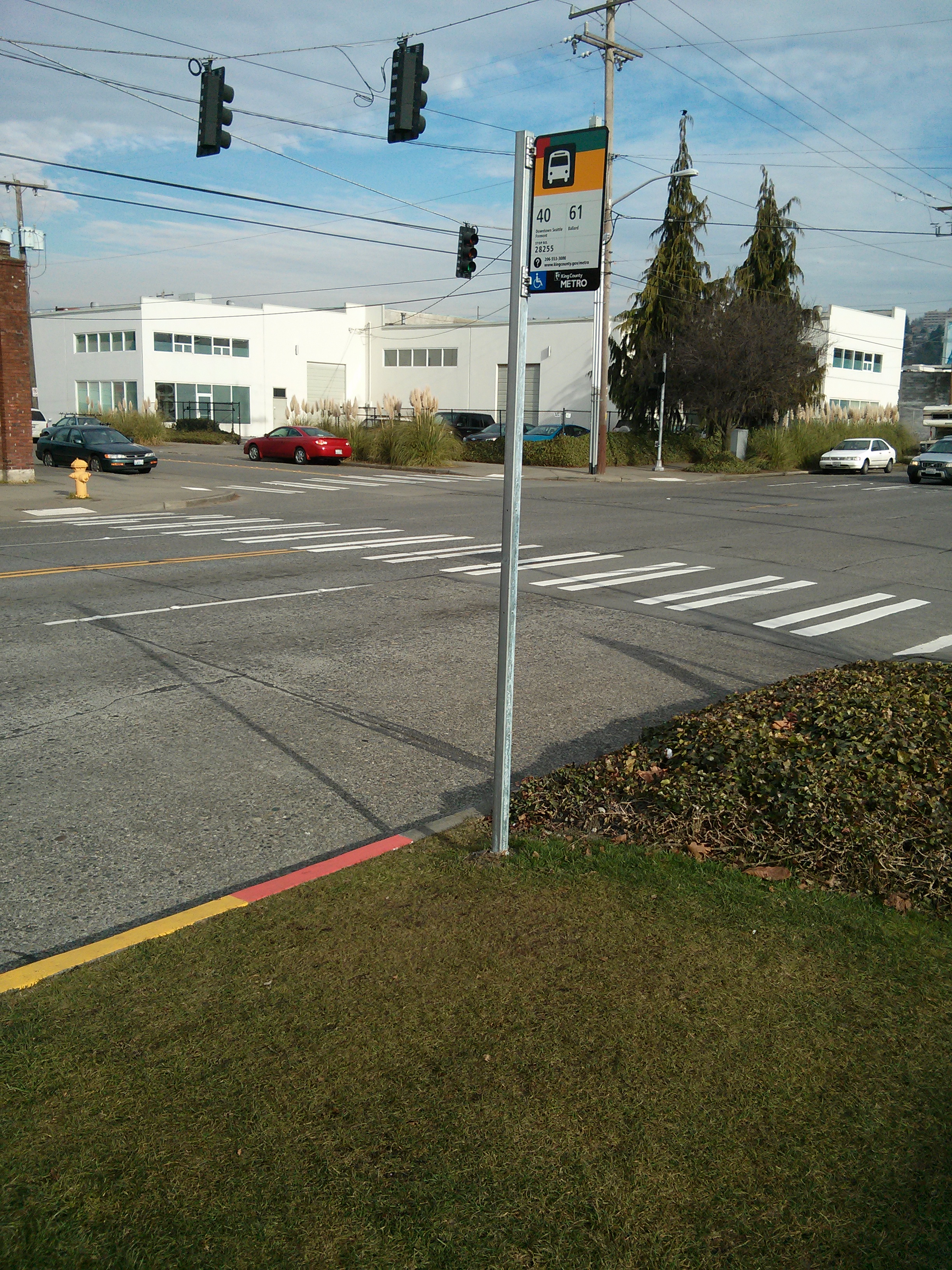
The new Route 40 stop eastbound on Leary at 11th Ave NW (#28255), currently just a post in a wet, grassy verge, will be properly reconstructed this summer. We’ve previously reported that a new stop is in the works eastbound at 8th Ave NW.
The “mulch and sprinkler head” stop on Westlake, just south of the Fremont bridge (#26850), pictured above, has also been put on the list for repaving, but may not make it through the design process in time for this summer’s paving season.
Stops #29217 and #28415 are going to get proper Metro bus signs, not the blank ones they have now.
I’m also told that the new Route 21 stop at 3rd & Lander (#99232), currently a post in a grass verge, is also in line to be upgraded.
Metro staff have been extremely responsive and informative when I have complained about these things, and I sincerely thank them for their work, but I can’t completely let the agency off the hook here. Some of these stops are new, so it’s understandable that they’re still a work in progress, but some of them should have been taken care of years if not decades ago, and it’s really kind of an outrage that they weren’t. What was the agency doing with its money back when it wasn’t broke and understaffed?
Lack of basic comforts and dignity at bus stops perpetuate the corrosive notion that transit riders — bus riders in particular — are second-class citizens. If our local and regional governments are to stand a chance at achieving the mode-share goals they have set themselves, if we are serious about providing an alternative to universal car ownership, this kind of prejudice needs to die, which implies that this kind of substandard facility must precede it in death.
Enough about the past; let’s find things to complain about today. I’m taking suggestions in the comments for other stops that have problems such as those described above, and I will take them up with Metro. I’ll put only one condition on suggestions: they need to be in places with existing sidewalk infrastructure, because adding proper new stops in areas without sidewalks is likely to be very expensive. Every urbanized part of the county should have sidewalks, but there’s no way they’re going to get built out of Metro’s stop improvement budget, that infrastructure needs to come from the responsible municipality.
In attempt to call attention to the human suffering that the legislature’s failure to authorize more transit taxes will cause, the King County Council is accepting testimony about that subject on May 14th:
A potential 17 percent reduction in Metro transit service due to a lack of sustainable revenue will be the topic of a special meeting of the Metropolitan King County Council’s Transportation, Economy and Environment Committee:
Tuesday, May 14
3:30 p.m. open house
4:00 p.m. public testimony
Union Station
401 South Jackson Street, Seattle
When discussing political tactics, it’s tempting to discuss “starving the beast” to force efficiencies through a round of steep cuts. While there are times that may be appropriate, it’s important not to lose sight of the impact on actual people cuts of this magnitude will have.
If you were unable to make the first meeting, there’s another public forum, this time on Capitol Hill and at an hour more amenable to those working a 9-5. It’s tonight, May 6, at 6PM. Details via Capitol Hill Seattle:
Micro-housing development discussion
Monday, May 6, 6:00 p.m. – 8:00 p.m.
Seattle First Baptist Church
Fellowship Hall, 1111 Harvard Ave. (map)
Attending:
Seattle City Councilmembers and Council staff
Representatives from communities and neighborhoods
Representatives of micro-housing developers
With organizations like Seattle Transit Hikers out there, it may only have been a matter of time. The massive National Forest to the east is seeking ways to provide non-car access to its recreation areas, and they’re hearing from focus groups on Wednesday and Thursday. Here’s the flyer if you’re interested.
A few weeks ago in an interview with Publicola mayoral candidate Sen. Ed Murray expressed support for a proposal that periodically comes into fashion with some transit observers: just combine anything that is related to transit into one big super agency. No more different fare structures, schedule books, or rules, no more route duplication, the end to one agency starving while another rakes in money. Transit Utopia.
As Martin argued years ago, merging the transit agencies of our region would be a horrible idea. All of those points still stand, but number 5 more than any other. The political landscape of our region means that instead of more investments being made in the core area, such a reorganization would result in money being siphoned away from our productive core services to prop up unproductive geographic/political coverage ones. It would also result in years of added delay while we build a new agency that we don’t need instead of the transit network we do. That is not to say that all the critiques of our current situation aren’t valid, or that we are in the best of all possible transit worlds, but that a merger would in no way build us the transit system we all want.
Below the fold is an example of a third way, suggested as a starting point for more discussion.
Looking for a transit adventure this Saturday? The Seattle Transit Hikers are organizing a cheap, fun 8 AM — 6 PM loop around Whidbey Island, starting and ending in Seattle, and stopping at the pleasant and scenic Deception Pass State Park. Our own Zach Shaner wrote up a similar transit trip a couple of years ago, although note that his itinerary and direction are different (and might be out of date!). RSVP on the meetup page by 8 PM tonight.
The group has done some great-looking trips recently, and has more coming up. To name a few: