Link Yearly Ridership Trends

2010 Average Daily Link Ridership by Month

Sound Transit has released updated ridership numbers for Link.

Since the SeaTac Station opened in mid December 2009 this is the first month that we can compare ridership numbers for a full year. The figure above shows average ridership and the figure below shows total ridership aggregated by month over the last year. To me the thing that jumps out most is the large variation of Saturday ridership. I’m not a sports person so someone please tell me how this relates to events at Safeco and Quest.

Total ridership graph after the jump. Continue reading “Link Yearly Ridership Trends”

| 51 comments

Open House for Bel-Red’s New Arterial

177 feet - this is not TOD

For anyone interested in the Bel-Red redevelopment, there’s an open house coming up that will primarily address the new NE 15/16th street arterial that will be built along the corridor.  Some of the right-of-way design options that have already been reviewed by the city council range up to 177 feet, widths that tend to be horrendously bad for successful and walkable transit-oriented development.

From the City’s press release (PDF):

The new street is being designed for a variety of transportation users, including motorists, pedestrians, bicyclists, light-rail passengers and bus and vanpool riders. Attendees can learn about, and comment upon, roadway options intended to accommodate future growth in the area and integrate with the planned East Link light rail route. Two light rail stations are proposed along the new thoroughfare – at 120th Avenue Northeast and at 130th Avenue Northeast, with a park-and-ride proposed at the 130th Avenue station.

The open house is from 5 to 7pm on the first-floor concourse at Bellevue City Hall this Wednesday, February 2nd.

38 comments

Bellevue College and Eastgate

Map by Oran (dotted black is existing routing)

One really interesting component of Metro’s proposed Eastside service revision is the huge amount of service between Bellevue College and the Eastgate Park and Ride. Like many colleges, BC is a big all-day traffic generator, and Eastgate is of course the main access point to I-90 buses for a wide swath of Bellevue. There is a much better way to serve these nodes, but to date none of the involved parties has stepped up with the leadership and capital funding to make it happen.

Currently, four routes of varying quality shuttle between these nodes, and revised service would also have four routes, three with 30 minute headways and one with 15.

These two major transit hubs are less than a half mile apart as the crow flies. Unfortunately, terrain and the road network make this a very bad connection. Coaches go all the way out to 148th Ave and turn onto Eastgate Way; this amounts to three signalized left turns in the northbound direction, in addition to a lot of added distance. Google pegs this as a 5-minute drive; add time for a bus taking this route. More after the jump.

Continue reading “Bellevue College and Eastgate”

| 30 comments

The Decline of Carpools

This post originally appeared on Orphan Road.

Fascinating article in the NYT on the decline of carpooling, as Americans get wealthier and more spread out.  I hadn’t heard this statistic before:

Car ownership has outstripped even population growth, as the number of cars parked in American driveways has risen by nearly 60 percent since 1980, while the number of Americans has grown by a third.

It makes sense.  We’re getting wealthier as a country, and more spread out, so more people are going to own cars.   Plus, the cost of a 30-mile commute has gone down by half since 1980.  And cars themselves seem to have gotten less expensive.

But what I find remarkable is how much pain people are willing to put up with in order to drive themselves to work:

“Books on tape, music, it doesn’t help,” she said about the daily trip (most of the commuters interviewed here asked that their names not be used). “All I’m thinking is, ‘Oh, God, this is going to hurt.’ ”

The grind of the drive provokes such frustration that commuters do odd things to stay calm. One commuter waiting for a ride at a meeting point here said that one driver had become notorious among the regulars — “the puppet guy,” who apparently used hand puppets to act out arguments to manage his anger over being stuck in traffic.

Puppets. I’ve seen some crazy things on Metro buses.  I’ve seen plenty of people talking to themselves.  But never have I seen someone so angry as to use puppets as an anger management tool.

1 comments

Transportation Barriers Survey

Photo by eastcolfax

An Afternoon Jolt this week mentioned a TCC/Onebusaway survey, recently briefed to the Seattle City Council, of Southeast Seattle residents. It contained this very discouraging tidbit:

Just seven percent of respondents said that if they need to go downtown they would use the light rail.

This may very well be an accurate report of how it was briefed, but I obtained a copy of the survey results (.doc), and this is the actual question:

25.       And now please finish this sentence; I would use light rail more often if…
(multiple responses; n=187)
It were closer to me/convenient  21%
It went more places I wanted to go 14%
I needed it/Had someplace to go 9%
Better parking situation 9%
I needed to go downtown 7%
Offered more routes 6%
Had more stations 6%
It were cheaper 5%
I didn’t have a car 3%
There were a bus/service to take me directly to the station 3%
I were more familiar with it 2%
I felt safer on it 1%
It were faster 0%
Other 6%

The syntax of the blurb suggests, at least to me, that only 7% of people in SE Seattle use light rail when they go downtown. That may or may not be the case, but that’s not what the question is asking.

Wordplay aside, there’s a lot of information in this December 2009 survey on what the true barriers to higher ridership are, aside from the empty pits around most stations, for both bus and rail. Details after the jump.

Continue reading “Transportation Barriers Survey”

| 64 comments

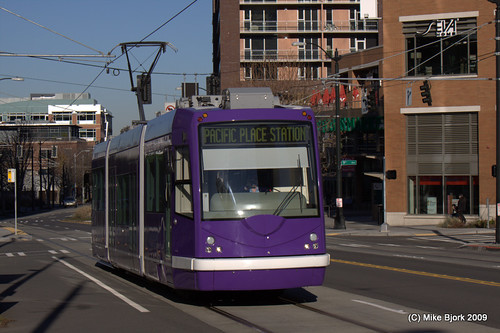
SLU Employers Chip In for More Streetcar Trips

Photo by Mike Bjork

A number of South Lake Union employers have offered to contribute $65,000 to Seattle to fund additional peak service for one year.

Ethan Melone of SDOT says that this will fund a third streetcar operating between 4-6 pm on weekdays, reducing headways from 15 to 10 minutes. “With several thousand additional employees moving into SLU this year, the employers are concerned that the cars are already pretty full during this timeframe and they want to be able to encourage as many employees as possible to take transit,” Melone said.

According to Vulcan spokesman David Postman, the funding comes from Amazon, Fred Hutch, UW Medicine, and Group Health. “For us, it’s really great news that companies whose employees are using the streetcar are helping to pay for additional service in the neighborhood.”

Melone also explained that enacting the change requires a resolution by the City Council, which he hopes to have in place by March.

117 comments

Brooklyn Station Open House Report

by TIM BOND

Photo by the Author

Sound Transit held an open house for Brooklyn Station last night. This station is the southernmost station of North Link, and one of three that is planned to open in 2021 (Roosevelt and Northgate are the others). The main purpose for this open house was to gather public feedback about two options for the station. Both options are underground center-platform underground stations in the 4300 block of Brooklyn Avenue NE, immediately east of the UW Tower (formerly Safeco Tower). These two options are the final choices of the many locations Sound Transit has evaluated throughout the University District, including some north of NE 45th. This location was selected by the Sound Transit board due to its proximity and (lack of) risks.

Option 1
Option 1 is an in-street station that would be located directly underneath the current Brooklyn Ave NE. The station would have two entrances—one on NE 45th and one on NE 43rd, and will be accessed via elevators and escalators. The station will have a mezzanine and separate elevators will take riders between the mezzanine and the surface/platform. The station box—the area excavated and later partially filled in to construct the station—is only a few feet narrower than the space available between the UW Tower and the Neptune Theater. This narrow buffer equates to a higher cost and higher risk than Option 2.

Option 2
Option 2 is similar to Option 1 but is shifted slightly east. The station would be located half under Brooklyn and half under the Chase Bank and parking lots located on the east side of Brooklyn. It would extend to the south end of NE 43rd, coming close to the University Manor Apartments, which may have historic significance. Sound Transit would acquire Chase and both parking lots, which would later be ripe for TOD. This station would also be underground, accessed by elevators and escalators, but would have only one entrance. The elevators would go directly to the platform, whereas the escalators would switchback at the mezzanine level. This option would require about half as much special shoring due to the extended buffer on all sides. During construction, NE 43rd would be closed between Brooklyn Ave and University Way (“The Ave”) but the sidewalk on the south side would remain open.

More after the jump… Continue reading “Brooklyn Station Open House Report”

| 241 comments

News Roundup: Deeply Flawed

First U-Link Car Arrives (Sound Transit)

This is an open thread.

125 comments