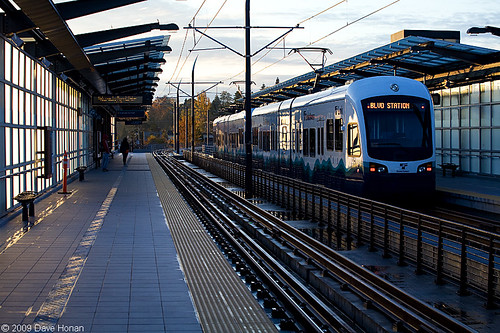
I get asked occasionally why I blog, and why I blog about transit. I’m not going to bore you with self-analysis on whatever psychic rewards I get out of this, so instead, here’s a brief Boxing Day summary of why I think transit, and rail transit in particular, is important:
Cost effectiveness: A 4-car light rail line running (800 passengers) at 7.5 minute frequencies can carry 6400 people in each direction. At 2.5 minutes, it’s 19,200. According to FHWA, highway lane of traffic at capacity can carry 2,200 people in single occupancy vehiclesunder ideal conditions. Given that regional growth will continue, what’s a more plausible way to expand capacity in, say, the I-5 corridor? North Link, or 16 new lanes on I-5?
Positive Societal Effects: There are a bunch of societal drawbacks to driving, some well-understood and others not: air pollution, water pollution, trade deficits from oil imports, sedentary lifestyles, traffic deaths, hideous parking-lot-oriented architecture, sprawl, personal transportation costs, and congestion. Widely available transit is a partial antidote to all of these.
Quality of Life: We usually talk about the other things because they’re more quantifiable, but ultimately it comes down to quality of life. In major cities around the world, rail is simply the best way to get around. As Seattle enters that class of metropolis, residents shouldn’t tolerate the lack of such an important amenity any more than they would tolerate the absence of parks and libraries.
Yes, and it’s already happening. Here’s a little Christmas gift for high-speed rail (HSR) fans. I just pulled this Guardian UK article from August (via The Infrastructurist) about how the demand for HSR in Germany is really starting to crowd out the airline market. For an option that was once better than taking the car, but not as good as flying, rail is becoming the predominant mode in the intercity travel market. Many short-haul train trips are now faster than comparable plane trips. According to Pierre-Stephane Austi, CEO of Rail Europe, trains are, on average, a quicker ride than planes for distances up to 1500km (932 miles– for comparison, roughly the distance from Seattle to Fresno) when factoring in check-in, security, and recommended buffer time for air travelers.
It’s a phenomenon that’s beginning to be realized across Europe, where 90% of travelers between London and Paris are now taking the Eurostar over any airline. For a train to beat a car in the States is quite a feat, but winning over air travel is pretty unthinkable, at least for now. From the Guardian:
The journey considered to be the nearest modern equivalent to magic carpet rides is the Cologne-Frankfurt route, which used to take over two hours but has been cut to just over an hour. Taking the car is hardly an alternative, when even whizzing in your BMW on the speed limit-free autobahn would take twice as long as the train. Berlin to Hamburg by rail now takes about 90 minutes, whereas a few years ago a flight would have taken at least two hours, taking check-in time into account.
Okay, Secretary LaHood and America, let’s get on it!
[UPDATE: This isn’t exclusive to just Europe. The China Post reports that a Wuhan-Guangzhou HSR line will hit the airline industry hard there (H/T: Gordon Werner).]
First, all King County Metro fares (except for the ages 6-18 fare) will go up 25 cents. For most of us that means $2.00 off-peak, $2.25 one-zone peak, $2.50 $2.75 two-zone peak.
More confusingly, there will be a dramatic reduction in the media with which you can legally board a bus. The rules below apply to Metro, Sound, Everett, Snohomish, Pierce, and Kitsap Transit buses only:
Cash always works.
An ORCA card loaded with either E-purse money or a monthly pass of sufficient value.
Although they are increasingly hard to get, if you have a physical PugetPass or FlexPass of sufficient value that’s still valid.
On Metro buses only, a valid Metro bus transfer. This does not include Sound Transit buses operated by Metro: 522, 540, 545, 550, 554, 555, 556, 560, 564, 565, 577.
[Update 1/4/10] On Metro buses only and only on weekends and holidays, Metro drivers sell a $4.50 day pass that is a valid fare. This does not include any Sound Transit buses. [Updated 8/24/11]
On Metro buses only, a valid Metro bus ticket. This does include Sound Transit buses operated by Metro.
On Pierce Transit buses only, a valid Pierce bus ticket (which are hard to get). This does include Sound Transit buses operated by Pierce Transit, (574, 578, 582, 586, 590, 592, 593, 594, 595) but only as a one-zone fare.
On Pierce Transit buses only, a valid Pierce bus transfer. This does not include Sound Transit buses operated by Metro Pierce Transit.
On trains it’s simpler: either buy a ticket at the machine, use an ORCA card, or walk on with the scarce PugetPass or FlexPass card.
ORCA is a step forward but it’s clear we’re not really going to get the complexity down till we get rid of paper media entirely.
The Slog reports that Mayor-Elect McGinn is considering putting Seattle-only light rail extension on the ballot as early as 2010 — that’s 11 months from now.
I think McGinn is basically right that Seattle voters (as opposed to Sound Transit district voters) will vote for transit anytime and anyplace*, so my only concern with timing is that the plan be mature enough to not have a revenue or cost meltdown in two years’ time. That probably means getting some ST staff involved that now has some experience with financing, building, and opening light rail.
I’ve speculated in the past that this project will consist of an all-surface alignment from West Seattle to SODO station, combined with a souped-up Ballard/Fremont Streetcar to connect those neighborhoods with Westlake Center. This would cost relatively little and punt the very expensive issue of how to get through downtown until ST3.
I have a call in to the McGinn team asking what the reasoning behind this is, besides it being awesome to have everything happen a year earlier.
*Except for the final blow to the monorail, but that I don’t think that example applies.
After we reported the largely meaningless Link ridership numbers last week, the American Public Transportation Association (APTA) just released numbers from Q3 of 2009 (pdf), revealing a continuing trend in dropping transit ridership this year. This comes a year after surging oil prices resulted in record ridership in 2008. The primary contributing factor is the unemployment rate and the economic downturn, as nearly 60% of transit rides are commute trips. According to Warren Millar, President of APTA, both public transit and unemployment rate correlate as lagging economic indicators.
Funnily enough, it should be no surprise that Seattle had an infinite increase in light rail ridership over last year (marked as a >100 percent change). Here is the APTA’s breakdown of the numbers:
Paratransit (demand response) and trolleybus were the only two modes that saw increases in ridership. Paratransit ridership increased by 3.7 percent and trolleybus ridership increased by 0.7 percent from January through September 2009.
Light rail (streetcars, trolleys) had a slight decrease less than one percent (-0.7). Light rail systems in seven cities reported an increase in the first nine months. They are as follows: Philadelphia, PA (17.5%); Oceanside, CA (17.3%); Baltimore, MD (13.9%); Memphis, TN (11.6%); Tampa, FL (7.0 %); San Francisco, CA (1.1%). A new line on the light rail system in Seattle, WA has led to more than 100% growth in the first nine months of 2009.
Heavy rail (subways) declined by 3.0 percent. Los Angeles Metro heavy rail continued its trend of increased ridership with an increase of 6.0 percent for the first nine months. Ridership on the Washington Metropolitan Transportation Authority (WMATA) increased by 0.6 percent for the same time period.
Commuter rail ridership decreased by 5.1 percent. Commuter rail ridership increases were recorded in the following cities: Boston, MA (2.4%); New Haven, CT (1.4%); and Alexandria, VA (1.3%). A major extension of commuter rail in New Mexico from Albuquerque to Santa Fe led to more than a 100 percent increase from January through September 2009.
Bus ridership declined by 5.0 percent in the first nine months of 2009. In the largest bus ridership report, bus trips increased in San Francisco, CA by 1.1 percent. Bus travel in the smallest population area (below 100,000) decreased by only 1.0 percent — the smallest percent decrease of all population groups.
Nationwide transit ridership from 1999 to 2009 (click to enlarge)
Even with the recent dip, transit ridership is still historically higher than it was in the mid 2000s (when unemployment rate was at its lowest), indicating that the slumping labor markets have still been unable to offset the trips gained in 2008.
With an actual net gain in ridership since Q1 of 2007, the numbers aren’t as bad as news media like USA Today are making them sound. It’s likely that falling oil prices may have had as much to do with diminishing transit use as unemployment did.
[UPDATE bySherwin: Here’s the full report (pdf) detailing the incident.]
Sound Transit’s preliminary report on last month’s Link derailment is complete. The train derailed while leaving the O&M facility, blocking one track and thus severely impairing the evening’s service.
According to the report, the operator ran a red light (involving a whole set of violated protocols), which was immediately detected at the operations center. He or she? She was instructed to physically check the switch and then move the train back off the mainline, but did not perform the physical check. That derailed the train.
A number of cold weather American states are reporting their dismay at finding out that LED traffic lights are so energy efficient that they do not produce enough excess heat to dissipate any snow that covers them.