
Joyce Eleanor on CT Cuts, Fare Increases

Community Transit CEO Joyce Eleanor made this video to explain directly to riders what the service cuts and fare increases are going to be. She focuses specifically on the reasoning behind “suspending” all Sunday and holiday service rather than spreading it over all days.  Unsurprisingly, Sunday is the weakest ridership day, and by eliminating almost all overhead on Sunday the system loses significantly fewer aggregate service hours than the alternatives.

The annual shortfall is about $11m.  $500,000 will be made up by the 25 cent DART and local service fare increase.   CT spokesman Tom Pearce says a rise to the commuter fare (already $3.50-$4.50 for adults) was not seriously considered because

Our commuter fares [are] among the highest in the region. Many riders choose to use Sound Transit service instead of ours because it is cheaper*. We decided that raising commuter fares again could price us out of the market and reduce ridership further.

The remainder of the shortfall is equivalent to 100,000 service hours out of CT’s total of 610,000 (including vanpools and paratransit).  This would amount to a cut in bus service of well over 17%.  However, the equivalent of 20,000 hours will be saved by shutting down all support operations on Sunday.  Therfore, 80,000 hours of actual bus service is going away, of which 28,000 hours are Sunday and Holiday “suspensions.”  Those suspensions will be restored as soon as the revenue situation allows, although Pearce declined to speculate on when that might occur. The other 52,000 hours are deep weekday and Saturday cuts that are unlikely to be restored for the forseeable future.

Community Transit essentially has no additional revenue options, although they continue to scrounge for grants.  They levy the maximum 0.9% sales tax, and the property tax authority that King County recently exploited derives from a statute that specifically applies only to King County.

It’s worth pointing out that CT’s actual cuts are proportional to the 20% armageddon that threatened King County last year before Kurt Triplett cobbled together a plan to minimize them.

Part 1 of this video, which sets up the general revenue situation and will be familiar to readers of this blog, is below the jump.

H/T: “Community Transit Operator”

Continue reading “Joyce Eleanor on CT Cuts, Fare Increases”

Community Transit Proposing Fare Increases & Service Cuts

To plug a $11 million budget gap, Community Transit is proposing a 25-cent fare increase along with service cuts and suspensions.  The biggest blow to riders is a proposal that would effectively suspend Sunday and holiday service. For the past two years, the agency has been limiting budget cuts in non-service related areas with the exception of a 75-cent fare increase back during the summer of 2008 when fuel prices peaked.  If approved by the CT Board, the changes will go in effect in June.

Nearly all of Community Transit’s 64 local and commuter bus routes would be affected in an effort to eliminate service that is duplicated by other providers, streamline routes and make existing service more efficient. The agency is also proposing to suspend all service on Sundays and major holidays, including DART paratransit service and Swift bus rapid transit. By closing its base on these lower ridership days, the agency achieves 47 percent of the proposal’s savings with only 35 percent of total service hours cut and an impact to fewer customers.

The proposed fare increase would raise local bus and DART fares by 25 cents for all fare categories: youth, adult and reduced fare (senior/disabled/Medicare). Even with the proposed fare increase, Community Transit’s local bus fares would be comparable with other local transit fares in the region. The proposed fare increase would raise about $250,000 in the second half of 2010 and $500,000 in 2011.

Community Transit has a page up for exact route-to-route cuts and suspensions as well as more information on the fare changes.  The agency is also holding five public meetings over the course of January to keep its riders informed about the changes.

Jan. 12, 5:30-7 p.m.
Snohomish County South County PUD office, 21018 Highway 99, Edmonds

Jan. 14, 6:30-8 p.m.
Marysville Library, 6120 Grove St., Marysville

Jan. 19, 10 a.m.-noon
Everett Station Weyerhaeuser Room, 3201 Smith Ave., Everett, on the fourth floor
This meeting will focus on impacts to DART paratransit customers.

Jan. 20, 5:30-7 p.m.
Monroe School District Administration Building, 200 E. Fremont St., Monroe

Jan. 26, 6:30-8 p.m.
Mountlake Terrace Library, 23300 58th Ave. W., Mountlake Terrace

McGinn Nominates New Head for SDOT

Seattle Mayor Mike McGinn has nominated a replacement to head the city’s Department of Transportation. Peter Hahn, currently deputy public works administrator for the city of Renton, faces confirmation by the city council.

This blog previously editorialized that the new Mayor should keep Grace Crunican, who has done an excellent job moving the city’s transportation department toward a sustainable, urbanist agency. She was a hot potato during the Mayoral election for her department’s troubles in responding to the 2008 snowstorms and announced her decision to resign last week. She will stay on board for three weeks after Hahn begins work at SDOT on January 19th to help transition the agency to its new leadership. Hahn is expected to actually head the agency beginning February 5th.

The scale of Snohomish County’s public works department — which Hahn used to administer — isn’t much less than SDOT, The Stranger reports. While SDOT has 750 employees and a $310 million budget, Hahn’s current group has about 650 employees and a budget of $200 million. Still, we don’t know much about Hahn’s views on public transit, complete streets, and other policy positions that are important to us. We for now safely assume that he will take his policy direction from the Mayor, who is no slouch on sustainable transportation.

A good sign is Hahn’s taste in women. The P-I reports that Hahn’s wife, Mary McCumber, is a board member of Futurewise — a progressive group focused on TOD and sustainable growth — supported the Surface/Transit Alaskan Way Viaduct replacement option when she was a stakeholder on that project and was executive director of PSRC for 12 years.

Meeting Roundup: Meet Your New ST Board Chair

aaronreardon.com
aaronreardon.com (he now has a goatee)

Several notable things happened at the December 10th Sound Transit Board of Directors meeting, Greg Nickels’s 378th(!) and last.  You can watch the video or check out the motions online.

  • Snohomish County Executive Aaron Reardon is the new Sound Transit Board Chair through the end of 2011.  Reardon has been County Executive since 2004 and may be best known to STB readers as someone who bargained hard with Nickels to get light rail to Snohomish County included in ST2.  Andrew Austin has much, much more on this.  Lakewood’s Claudia Thomas and Issaquah’s Fred Butler are the Vice Chairs.
  • The staff briefly discussed the three new, post-DEIS, downtown Bellevue options: C9T, a tunnel under 110th Ave.; C9A, a surface route on 110th; and C11A, an at-grade alignment on 108th Ave.  The cost and ridership estimates are supposed to be done by the end of January, with Board discussion in February and a decision on this segment on March 11th.  The Board allocated $15,000 for the staff to include Kevin Wallace’s 114th Avenue elevated alignment in this work.
  • The Bellevue City Council, while not changing their preferred alignment, asked the Board to study the Wallace proposal, and also asked for an one-month extension of their expiring six-month deadline to come up with a funding plan for a downtown tunnel.
  • The Seatac ceremony, according to ST CEO Joni Earl, starts around 8:45 am on December 19th.  The first train from downtown to go all the way to Seatac with passengers will arrive right around 10am.
  • Issaquah Councilmember Fred Butler sponsored an amendment to the budget directing the ST Staff to study the introduction of fares to Tacoma Link and report to the Board by June 30, 2010.  ORCA n0w provides an infrastructure that would reduce the cost of collecting fares; up to now, staff has estimated that fare collection would cost more than the revenue collected.
  • The board adopted a scope control policy which states that the primary project objectives are “cost control, ridership and operational efficiency.”  In other words, Sound Transit isn’t going to gold-plate stations just because a City asks for it, especially if it isn’t in the EIS.
  • According to Joni Earl, government agencies have right of first refusal to buy the rest of the BNSF Eastside corridor should they be put up for sale.
  • The last hour or so of the video is a tribute to Mayor Nickels, winner of the American Public Transportation Association’s Outstanding Public Transportation Board Member for 2009.  We’ll comment more on this later, but it’s a useful reminder of everything he has done for the region, going back to 1988.

First Swift Ridership Numbers

Photo by Wings777
Photo by Wings777

When talking about Link ridership, I’ve said time and time again that monthly ridership totals are basically meaningless.  We won’t have meaningful information till the end of 2010 at the earliest, and preliminary conclusions about the line’s “success” or “failure” can’t be made for at least a decade, when development has had a chance to occur.

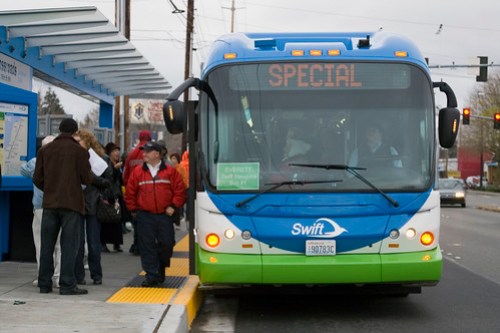
But people love the horse race, so for entertainment purposes only, 1,526 people rode Swift on Monday.  That’s compared to a daily SR99 corridor bus ridership of about 4,500.  Ridership probably wasn’t helped by the fact that there are no paper transfers between Swift and regular CT service — it’s ORCA, or pay twice.  Regardless, CT spokesman Martin Munguia says “street teams are reporting more people riding Swift than at the same time yesterday.”

As always, the real test will be what kind of construction occurs in the coming years.  The land use in this corridor is a total disaster — think strip malls behind massive parking lots, all the way up*.  Will Snohomish County residents and developers accept a different principle on which to organize their communities?  Is a BRT line enough to spur that?  We’ll get to find out.

*with apologies to Central Everett, which isn’t like that.

BRT Primer

This morning I looked into my crystal ball and I foresaw an epic, week-long discussion about all things BRT. I could be wrong, but if I’m right I think it would benefit all of us to take a bit of time to refresh our knowledge. In this vein I created a list of articles I have been reading relating to BRT over the last few weeks as well as some scholarly reports and practitioner guides. Please share info you have as well but only if it relates to BRT, and is not a comparison of whether BRT or rail is better. Comments along those lines are off-topic. We can have that discussion later this week but please not in this post. Thanks.

So here is my list.

Transit Cooperative Research Program (TCRP) is probably the most authoritative source on transit related research. Its mission is to aid practitioners in making informed and fact based decisions. TCRP has 3 relevant reports on this subject, all of which are worth a quick skim over. At the very least take a look at the tables.

More after the jump

Continue reading “BRT Primer”

Snohomish County Service Change

[UPDATE: Commenters are referring to the same Everett transit site that I linked to below, as if I didn’t know about it.  However, it is NOT a list of changes, unless someone wants to go through each schedule route by route and compile the differences.]

On Sunday we’ll be tweeting from the Swift Opening, which we’ve already discussed.  However, Nov. 29th will also be the day of the next service change for Community Transit and Everett Transit.  Big changes:

  • Route 114 eliminated, with the trips moved to the 116.
  • Route 100 eliminated, cuts to the 101 (to be replaced by Swift)
  • Elimination of the downtown Everett loop.
  • CT 177 becomes ET 70X.
  • ET adds other routes, renumbers everything.  I wish they’d published a summary of changes somewhere.

Curb the Congestion Club

I’m sure that everyone that reads here takes transit (right?), but if you have a friend or family member that commutes by car in Snohomish County you might be able to enroll them in the Curb the Congestion Club, a Community Transit program that chips in $54 in a bus pass or vanpool voucher in December.

By referring a driver, you yourself can receive a $25 reward.  The eligibility is kind of complicated so click over to the website to check it out.

Metro’s Low-Income Programs

While interviewing Metro GM Kevin Desmond for last week’s Metro budget crisis series, I had an opportunity to ask him for details about the low-income fare assistance program that I’d always heard hints about.

For many years, Metro has sold ticketbooks to over 100 human services agencies for 20% of their face value.  Metro depends on these agencies to get them in the hands of the needy.

The other 80% is budgeted as “lost revenue” for Metro, though of course there’s no telling how many of those would have turned into fare-paying rides.  In 2008 this “subsidy” amounted to $1.3m, or $1.6m in total ticket value.  According to Desmond, this funded 79,000 ticket books containing 1.2m tickets of mixed denominations.

A full list of those receiving human services agencies is below the jump, copied directly from a Metro-provided spreadsheet.
Continue reading “Metro’s Low-Income Programs”