

This week is all RapidRide as we review the Candidate Corridors analyzed in Metro’s recently published RapidRide Prioritization Plan.
King County Metro Corridor 1993, a potential RapidRide conversion of Route 40 — traveling between Northgate, Ballard, Fremont, SLU, and Downtown Seattle — was recently set as a Tier 2 priority corridor for future RapidRide expansion.
The proposed RapidRide conversion adds BAT (business access & transit) lanes, provides time savings, and extends it to First Hill. Originally proposed as a RapidRide Fremont in the 2015 Levy to Move Seattle, the line was delayed after a lack of funding. Metro’s RapidRide Prioritization Plan investigated minor alignment changes, and possible transit speed and reliability improvements for the route.
Re-Routing Route 40
First, Metro reviewed potential refinements to Route 40’s alignment. The main alignment options investigated were around the northern and southern terminus, with some minor changes in Ballard.
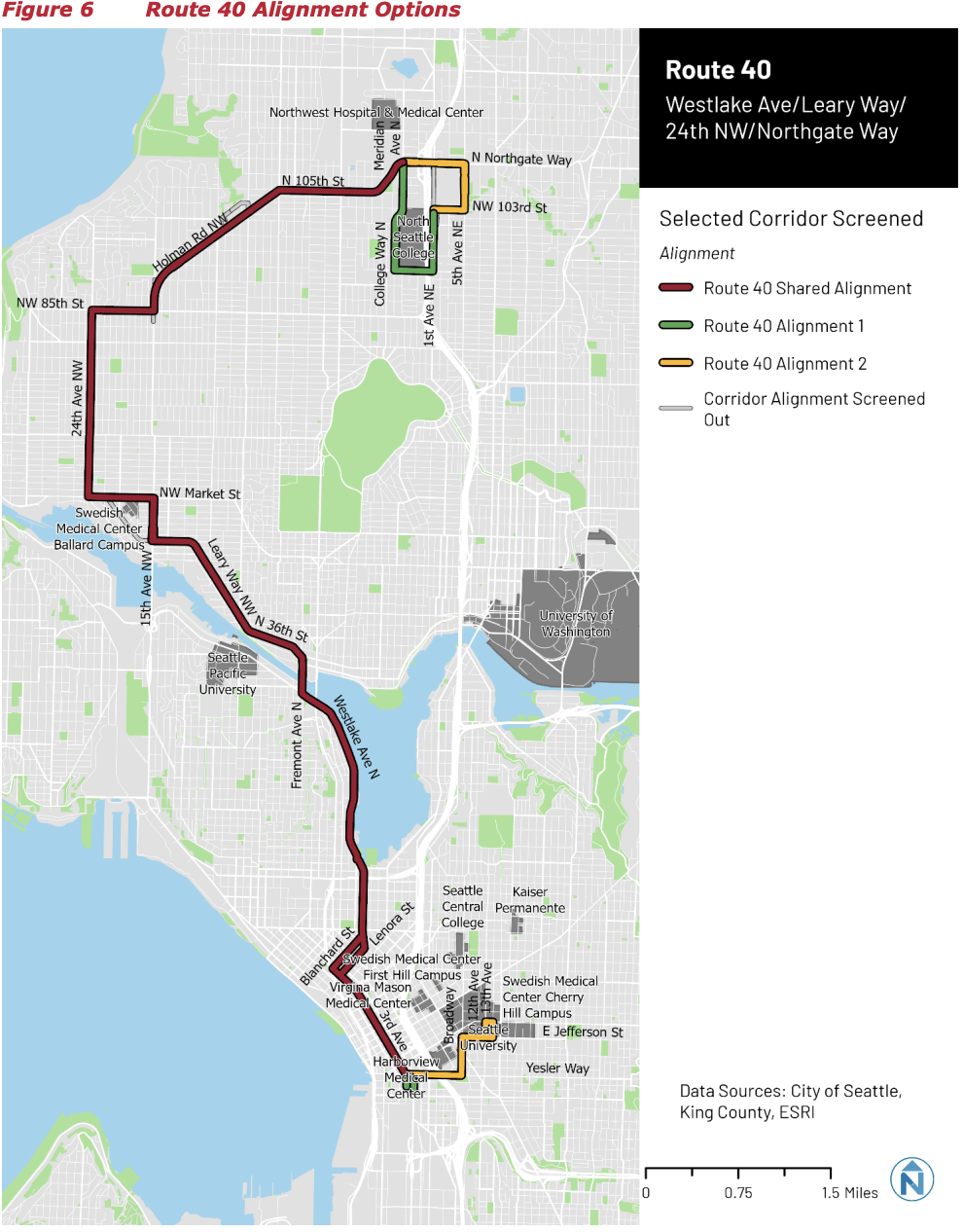
For the northern terminus around Northgate the issue was whether to: (A) continue the existing Meridian Avenue detour to North Seattle College, or (B) route down Northgate Way. Both alignments would experience similar travel delays, but the latter has slightly higher potential ridership, so Metro chose the Northgate route as the representative alignment. Other ideas were rejected, including truncating the 40 on Holman Road NW, or extending RapidRide D to Northgate.
For the southern terminus, the Route 40 bus currently terminates in Pioneer Square. There’s a unique opportunity to extend it to First Hill as the bus already travels partially there as “out-of-service portions” (shown in yellow above). As an additional note if the RapidRide Route 36+49 alignment 1 is chosen, this would create a new transfer point at Broadway and Boren slightly alleviating the loss of a downtown connection for that line.
For Ballard, one small reroute is to run on 15th Ave NW instead of Leary Way for closer connections to future Link Ballard station.
Bottlenecks and Improvements
For Route 40 transit improvements currently underway, the Route 40 Transit-Plus Multimodal Corridor project will implement some BAT lanes in Fremont and FAB (Freight and Bus lanes) along Westlake Avenue, as shown above with the dashed light pink line on the map below. The Ballard Bridge repaving will add a new short southbound BAT lane just north of the bridge.

Despite SDOT focusing the FAB lanes on Westlake, Metro’s map of delays experienced by Route 40 during typical traffic (below) show multi-minute delays throughout its run. The existing major delays are on N 105th St west of Northgate, on Leary Way in Ballard, the Fremont Bridge, and finally 3rd Avenue in downtown Seattle.

To address these delays, Metros’ proposed RapidRide improvements include additional bus priority in the form of “Bus or BAT” lanes along much of the route. This, combined with with the currently planned improvements, would create a continuous transit-priority lane almost along the entire corridor except 24th Ave NW.
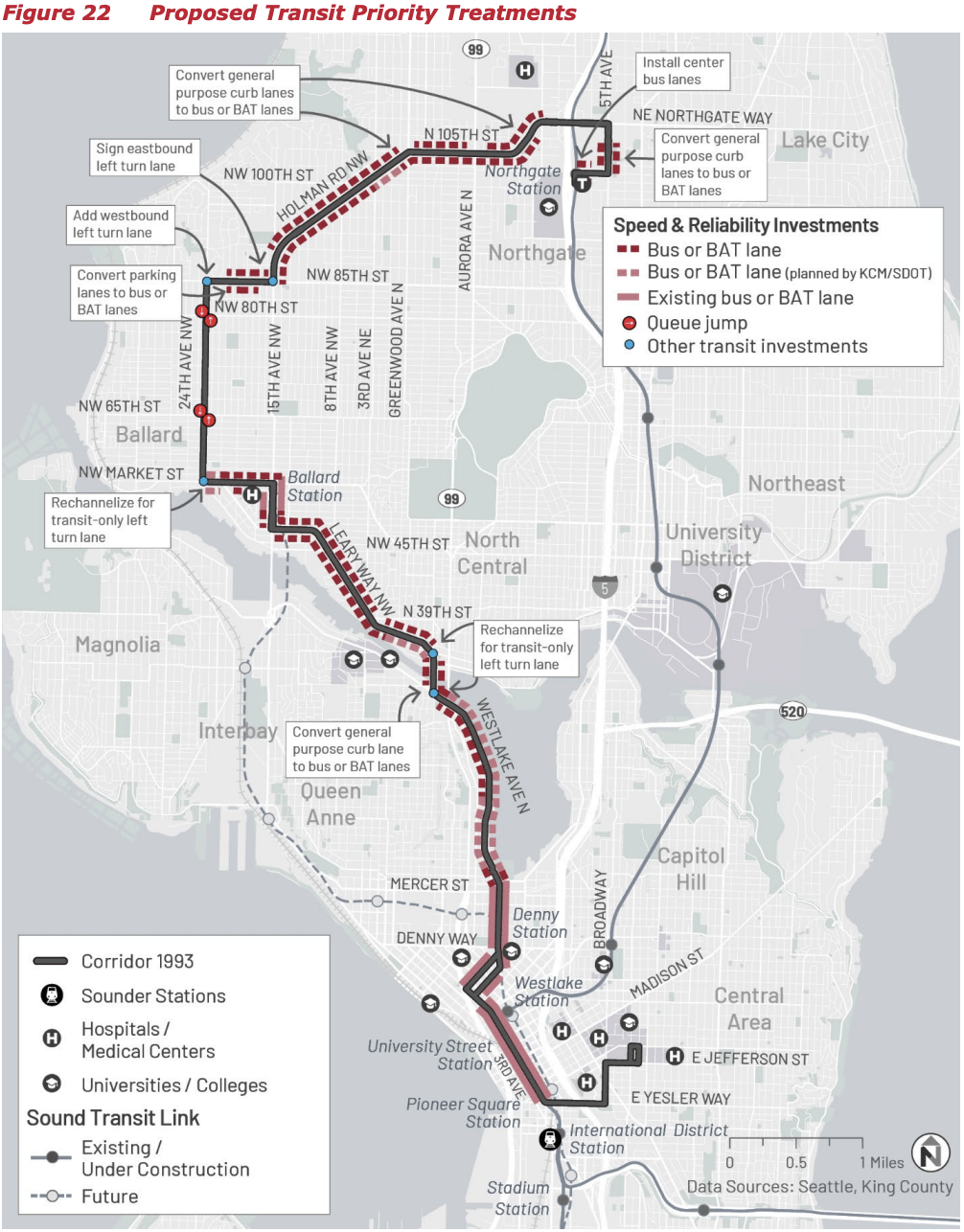
Highlighting the main improvements:
- Around Northgate: Narrow lanes along NE 103rd for a center bus lane, and convert a general-purpose curb lane for a BAT lane on 5th Avenue.
- From Northgate to Crownhill: On N 105th St/Holman Rd N add bus lanes in each direction. On NW 85th St & 15th Ave NW convert shared through/left lane to left-turn only lane.
- From Crown Hill to Ballard: On NW 85th St., convert street parking to BAT lane. Queue Jumps at 24th NW NW 80th St and NW 65 St by removing parking.
- Around Fremont: Add north/west bound bus lanes on Fremont Ave, Leary Way and Market Street, complementing the currently planned south/east bound bus lanes.
- From Fremont to Downtown: Fill in bus/BAT lane gaps along Westlake Ave N from Nickerson (Fremont Bridge) to Mercer Street and down to 9th Avenue.
Seattle’s SDOT has generally been supportive of implementing BAT lanes throughout the city, though some business pushback is expected. Further extensions of the bus lanes on Westlake will partially depend on how well the FAB pilot is received.
Time Savings and Stop Spacing

With the above changes, Metro estimates the route would be around 20% faster. However, that’s compared to projected future delays expected on an otherwise unchanged route in 2035, so it would only be around 13% faster than the current bus route.
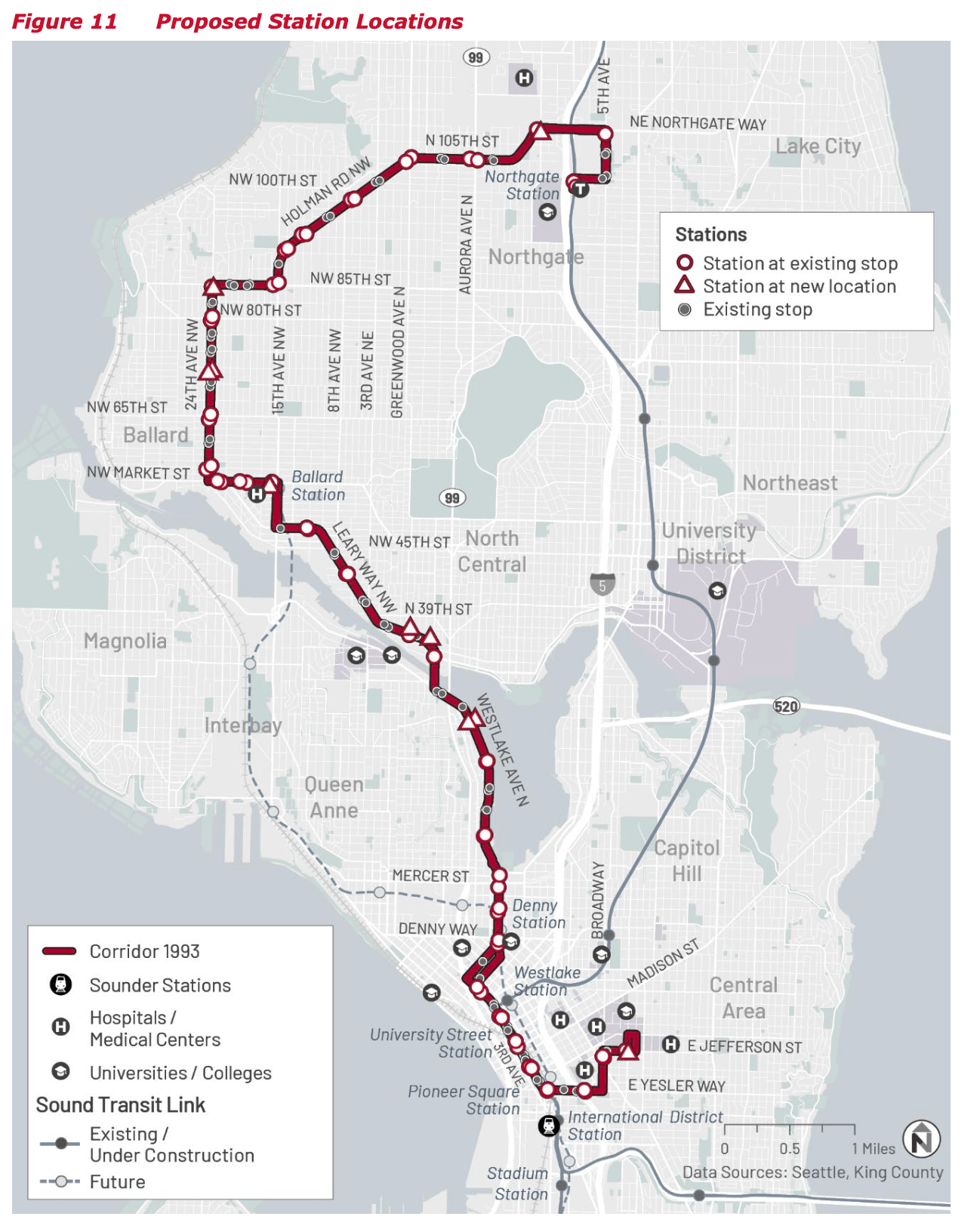
Currently Route 40 has 50 stops, and 68% of them are less than a quarter mile apart. The RapidRide would instead have 32 stops, increasing the average spacing from 1,300 feet to 2,030 feet (0.38 miles). Notably, the section from SLU to Ballard has much farther stop spacing, with the RapidRide version keeping only 1 for every existing 3 bus stops in that segment, while the rest of the sections generally keep 1 out of 2 bus stops.
Costs and Gains
Metro estimates that the total cost for the improvements would be approximately $96 million dollars, with 54% for transit speed and reliability, 37% for new bus stations, and finally 9% for charging infrastructure extending to First Hill. Given the transit improvements, there would be estimated “a net increase of 2,200 riders per weekday”.
As a Tier 2 priority route, this line would be prioritized for construction as part of Metro’s “Interim Network” — to be implemented prior to the opening of the Ballard Link Extension in 2039 — if or when additional funding is allocated to RapidRide expansion.
That’s just an amazing amount of money for such small value. That’s almost what it cost to install ART, Albuquerque’s BRT, as a completely new, center-running 10 mile route, with it’s own lane. Especially with this route being served by a largely parallel rail route not too much after 2039. Maybe just remove 18 stops tomorrow, get probably half the gains, and spend the 100 million elsewhere.
Link and RapidRide are not interchangeable! Link is limited-stop; RapidRide is full-stop. Some people will ride the 40 because Link won’t go to Real Ballard, only 15th. The 40 is one of Metro’s top ten highest-ridership routes. It’s the only route connecting Real Ballard to Fremont and the Leary/36th corridor, Real/Northwest Ballard to SLU, Ballard to Northgate, and Ballard to almost-Greenwood. So it’s one of the best RapidRide corridors, and there’s some belief that it should have been RapidRide originally instead of the D.
Having transit-priority lanes throughout the entire route except 24th is a major deal. That’s what’s missing in Pugetopolis transit, and what keeps our RapidRides from being higher quality. That’s worth a large investment, as an example for other projects.
I’ve never been between Reno and Dallas except on Greyhound so I don’t know what Albuquerque’s like. But I imagine it’s wider arterials and lower density. So plenty of room for center lanes, and not as many people or destinations for high ridership. The density of the corridor argues for investing more on infrastructure, as does the proven high ridership throughout Ballard.
Yeah, you really can’t compare costs with a city like Albuquerque. It is also silly to suggest that Link serves this corridor, when it would serve such a tiny portion of it. A lot of that doesn’t involve the 40 now anyway. If you are trying to get from 15th & Market to downtown you take the D now and will take Link in the future. The 40 does a lot more than that.
I have issue with the routing (the 40 should be split) but regardless of what routes go where, these corridors will still have lots of riders in the future. Investing in them is worth it.
That doesn’t mean I agree with the approach. If you look at the cost breakdown, it is clear that a lot of money is going to be spent trying to make the project big enough that the feds will chip in. I think the approach they took with the 40 is much better, and it is pretty easy to see how an iterative approach could work well. Start by swapping the northern tails of the D and 40. This means extending the D, which means borrowing all the initial planning done here. Meanwhile, SDOT is already in the process of doing a lot of the work that is specified on this document. This means the cost estimates for the rest of it are probably significantly lower now. It makes sense to do another round of right-of-way improvements a few years after the current ones are done (as traffic patterns change). At that point the only thing left is converting it to RapidRide, and I would wait until they do a restructure. Even then I’m not sure it is necessary. If we have all of the right-of-way and stop diets on the 40, is it really more important to convert this to RapidRide, or it is better to focus on adding more right-of-way? I would say the latter.
Also, investing in Holman Road/105th/College Way/Northgate Way doesn’t preclude later splitting the 40 or turning over those segments to other routes.
“Start by swapping the northern tails of the D and 40.”
When Metro has enough red buses for the Northgate tail, the financial limitation against extending the D (replacing the 40’s tail) goes away.
“If we have all of the right-of-way and stop diets on the 40, is it really more important to convert this to RapidRide, or it is better to focus on adding more right-of-way? I would say the latter.”
Yes, that’s the argument against the “No more RapidRides” movement. But this series is analyzing Metro’s plans in case RapidRide happens anyway. Even if these are later downgraded to Less-Than-RapidRide, much of the analysis results can still be carried over anyway. The 40 has already been through this cycle. First it wasn’t RapidRide, then it was going to be, then it was going to be just some street improvements, and now it’s in the queue for RapidRide again.
I prefer the term ‘more transit plus’ corridors than ‘no more rapidrides’ as the latter sounds like no more bus improvements.
For most of these proposals around 40/60% of the cost is in the station construction so if you leave those out it can cut around half the cost
I prefer the term ‘more transit plus’ corridors than ‘no more rapidrides’ as the latter sounds like no more bus improvements.
Agreed. More transit plus. For the 3, 7 and 44. On Denny, 85th and near every drawbridge. More transit plus!
Yep, I can definitely get behind that.
I should add that “more transit plus” and “more RapidRide” are not mutually exclusive. I certainly wouldn’t get rid of RapidRide (I’m more ambivalent about the streetcars). I would also add and extend some RapidRide. But in general I would add transit-plus first.
There are exceptions, and this contains one. I would have no qualms at all if the first thing that Metro did in the area was swap the tails of the 40 and D which basically means “more RapidRide”. But after that I would focus on restructures and “more transit plus”.
RossB: do you mean extend the D Line to Northgate via the current Route 40 pathway and use the future Route 61 pathway for Route 40? Lake City? Route 45?
do you mean extend the D Line to Northgate via the current Route 40 pathway and use the future Route 61 pathway for Route 40?
Yes. There are other comments of mine here saying basically the same thing:
1) Extend the D to Northgate via the current pathway of the 40.
2) Combine the 40 and 61. Since this is too long …
3) Split 40/61 bus in Ballard. There are numerous options for this. Here is one:
A) Have an outbound 40 turn west on 64th at 24th, then go north on 32nd (replacing the 17).
B) Have the 61 from Lake City continue on 85th to 24th, then head south to Market, then west to the locks (laying over with the 44).
The split in Ballard has several advantages. It is the westernmost point of the 40. This means that riders who would have to transfer at least gain a shortcut. For example if I’m 85th & 15th and heading to Fremont I would regret that I can’t just just take the 40. Instead I am forced to take the D, then the 40. But this actually saves me travel time, somewhat making up for the transfer penalty.
Ballard also has a lot of density. So overlapping there (as in this example) is quite reasonable. Because of the density, you probably gain more one-seat rides than you lose (gaining trips like Lake City/Northgate to Crown Hill/Ballard).
The length of both buses is good. Not too short, not too long. Both look like they would get a ton of riders.
Cost of labor in Seattle in 2025 is easily triple that of Albuquerque in 2015.
It only has 19 stations, so this project with 32 is substantially higher.
Their “center running” pathing is already at capacity, as there are segments where buses going both ways on a single lane.
Finally, similar to this project, there were already bus routes there, so both projects are “brt” improvements on existing routes. (Ironically, their system on this street before ART was called Rapid Ride).
There are lots of other ways to nitpick the differences between the projects, but that is enough to be getting on with.
This is the kind of project I whine about when y’all say that there is no money for metro to serve, un-served and under-served parts of S. King County.
Massive amounts of money planned to be spent on already very well served neighborhood, offering tiny improvements value. Gold-plated bullshit.
The first seven lines were spread throughout the county. Equity areas include the A and F, the middle part of the E, the recent H, the I (Renton-Auburn) which starts construction next year, and two in the prioritization (GRCC-Kent-KDM, and GRCC-Auburn-Federal Way). Crossroads is also an equity area, where splitting the B is proposed.
These “well-served areas” are many of the major corridors where high-quality transit is needed to connect the city/neighborhood centers and to colleges, and where ridership is highest. It’s the areas you’d do first to improve transit because they have the most bang for the buck and have cascading impacts that spread beyond their specific corridors. They’re the kinds of places that transit agencies throughout the world focus on investing in.
It’s not a “tiny improvement”. Practically all the corridors went from 30-60 minute evenings and Sundays to 15 minutes. That greatly improves transit access over a longer span, and makes it feasible to go to; e.g., West Seattle or Aurora in the evening. The street improvements are less than international peers do (i.e., no full transit-priority lanes for the entire route), but they offer a 10-30% speed improvement. The public votes with their feet and increases ridership — all of them get robust year-over-year growth (the F being the least, followed by the B). Metro couldn’t do anything else to get the same amount of ridership increase except to do the same street improvements, next-arrival displays, stop diets, off-board payment, and fat red lines on the map it’s doing for RapidRide.
Part of the money is coming from Metro’s regular capital budget, which ebbs and flows with the economy. Part is federal grants. And part is unfunded: it’s just making them planning-ready in case the county decides to raise funds for them, otherwise they’ll take years longer to implement.
What other “unserved or underserved parts of King County” are you thinking of? Military Road, Boulevard Park, Lakeland Heights, Juanita, Magnolia, NW 65th Street, eastern Renton? Those should all get more service, but not at the expense of upgrading the corridors in the prioritization.
Re which ones serve equity areas:
Tier 1: 150 (yes), 36 (yes)
Tier 2: 44 (no), 40 (no to mixed–Holman Road/105th?), B+271 (no)
Tier 3: 181 (yes), 165 (yes), B+226 (no to mixed–Crossroads)
We’re doing the articles in the order we can write them, not in the order they’ll be implemented in.
You could say that Metro should do these as less-than-RapidRide improvements (just street and frequency upgrades) for half the money, and spend the other half on other routes throughout the county, but these are still more or less the ones that should get the most investment: that’s why they were elevated to RapidRide candidates in the first place, and then further elevated into the prioritization.
We’re also living in a long limbo period where Link extensions are opening three years late, and the staffing/parts shortage has delayed improvements. That’s what’s making us so impatient and discontent now. It wasn’t supposed to be like this. It’s not just Link and RapidRide. The 535, 550, and 594 were supposed to get more frequency. The 10 and 11 weren’t supposed to lose service. The 45, 48, 65, and 67 were supposed to still be running 10-minute service. There’s probably other service expansion on regular Metro routes I can’t think of offhand that have been postponed or not proposed.
If you look at the metrics they are using to develop the tiers, the system is completely rigged towards those who currently have good transit, and have historically had good transit.
The rich in transit get richer.
The poor just suck it up and drive.
Honest questions for you, Cam:
1) Which route(s) in South King County would you like to see upgraded to RapidRide?
2) Do you think Metro’s equity analysis is insufficient?
If you look at the metrics they are using to develop the tiers, the system is completely rigged towards those who currently have good transit, and have historically had good transit.
That’s because it is where the people are! Come on Cam. Think about it. Why does the 7 run so often, and the 24 runs so rarely? Because the 7 picks up so many people! It carries way more riders per hour. You seem to have cause and effect mixed up.
Here is a little thought experiment for you. Imagine they run every bus in the system every fifteen minutes. So that means the 7 runs every fifteen minutes, as does the 24. Which one gets more riders after they do this? Not even close. The 7 is overflowing. There are capacity problems. The 24 gets a few more riders (but fewer per bus). What then? What bus would you run more often? Once you do that, which bus should you focus on when it comes to speed? Obviously the 7. This is how the system evolved. The reason why buses like the 40 run so often — or are slated to run so often — is because they get so many riders. The reason why so many buses in the south end run infrequently is the opposite. The south end lags everything else because it lacks significant destinations of its own, and is really far from the much bigger destinations in Seattle. Basically it sprawls. It extends for miles and miles, with density just big enough that it shouldn’t be ignored, but not big enough to generate ridership.
There is no conspiracy. If places like Auburn, Kent and Tukwila were real cities (instead of towns with surrounding sprawl) then we wouldn’t be having this conversation. Buses within these cities would carry a lot of riders within the city, and many could walk to the buses (or trains) that run to the big city. But they don’t.
The reason why areas with decent service now are slated for RapidRide is pretty obvious: it is where the potential riders are.
> If you look at the metrics they are using to develop the tiers, the system is completely rigged towards those who currently have good transit, and have historically had good transit.
Uhh they’ve literally been trying to modify the metrics in favor of equity areas. If anything metro’s been consistently modifying the metrics away from just pure ridership numbers and adding more weight for equity purposes.
Cam, we need examples of routes or neighborhoods and what kind of upgrades you think they should get instead of this. Otherwise your argument doesn’t make sense and you’re just throwing grenades at the RapidRide corridors.
I’ve already said RapidRide I (Renton-Auburn) starts construction next year, and the 150, 165, and 181 are in the prioritization. If those aren’t the right corridors/neighborhoods for the most service improvements, what are?
Maybe I am just throwing grenades at RR. Because I think the best RRs have already been installed, for the most part.
I think decreasing stop spacing and and adding some paint for BAT lanes is great. But 100 million dollars for taking out a few poles and adding paint? That’s absurd.
And if that’s how RR is now defined, maybe it has ceased to be a great idea.
I just think this feels like the trap the engineers have fallen into with roads and highways for decades; vastly over-engineering something far beyond what it takes to get the job done.
Just focus on what’s important to improve reliability. That seems like it can be done at a fraction of these cost estimates.
That solves the 2039 problem as well. Buy me an angle grinder and some reflective road tape, and I could get this done in a month.
I used to live and work on the 40, and basically never took it (I would climb to the 5). Not because of lack of BAT lanes. But, because the Fremont Bridge openings added an unacceptable level of variability to my day. This does nothing to fix it.
Only because SDOT has fixed it in the meantime. A lot of the BAT/FAB lanes are being added as we speak. The delay caused by the bridge opening is not so much the time it takes for the bridge to open and close, but the backup it creates. The changes that are being implemented will allows the buses to go around the backups.
It seems to me to have made sense to have proposed a north of Ship Canal only route immune from not only the draw bridges but the Downtown congestion too. After all, this route crosses by Link and RapidRides D and E which all head Downtown. I don’t see why a rider north of Ballard would ride this all the way to Downtown, for example.
Of course that means a transfer. In the case of D and E, the transfer setups aren’t exactly great. In particular, Aurora and 105th looks like a scary place to transfer, and it’s not possible to transfer to RapidRide E in Fremont.
If a northern route began in Ballard it could then be short enough to extend to Lake City/ 522 and end at Stride 3. Then a different southern route could be proposed and that could more easily extend into First Hill and the CD.
I don’t see why a rider north of Ballard would ride this all the way to Downtown, for example.
Agreed, but it is more than that. The bus goes from Fremont to 85th & Greenwood. So does the 5 (but more directly). The bus goes from Leary and 8th to Holman Road and 8th. So does the 28 (but more directly). If SDOT could figure out a way to add a stop above Fremont, then riders from 105th & Aurora would take the E instead as well.
The 40 is basically two routes cobbled into one. From 85th & 24th to downtown it is outstanding. One of the core routes in our system. But north of there it overlaps other routes, and doesn’t connect well with the southern half. It is begging for a split, like the one I proposed down below: https://seattletransitblog.com/2024/07/29/rapidride-route-40-corridor-1993/#comment-936895
I live in Crown Hill and a few times a month ride some 80% of the length of the 40 to get to the last stop near Chinatown. Selfishly I love that the same route that gets me to Ballard and Fremont can also take me to SLU, Westlake and to Chinatown. But I don’t have a good sense even anecdotally of whether the people who board before/around when I do are staying on past the Ship Canal.
With more housing density coming in Crown Hill and convenient drop-off to SLU in particular the long route may be further justified. This could be different in a post Ballard light rail world.
I live at 92/6th NW. Why do I take the SB 40 sometimes? Because it’s a 3 block waddle to work rather than a brisk 15 minute trot from 7th and Harrison, where the 5/28/E would drop me.
What I can’t stand is how long it takes to get to or from Northgate.
Of course there are people who take a bus for any number of reasons. That isn’t the issue. The issue is whether there are good alternatives. Just to back up here, transfers are inevitable. Through-routing is great, but there is a limit to that. Imagine the E extended to become the H, then the F for a little section (Burien to Tukwila) then the A. This would be a fantastic bus. So many trips that now require a transfer would be one-seat rides. But obviously that is unrealistic. The buses can’t be that long.
Now consider the 40 again. Ending the 40 at Northgate is less than ideal. It makes more sense to keep going and end in Lake City. That way riders would have a nice one-way trip from Lake City and the north part of Northgate to places like Holman Road, Crown Hill and the heart of Ballard. But that is way too long. The 40 is stretching its limit as it is. So where then, does this bus get split?
Ballard. No matter where you split a route — downtown, U-district or a Link station like Northgate — some riders are hurt. Riders who wished the bus would just keep going have to transfer. But Ballard is the westernmost part of the route. Splitting a bus there means fewer are hurt. A lot of the riders have alternatives (other than transferring to the other half of the route). For example the 40 goes from Crown Hill to 15th & Market. So does the D. The 28 also crosses the 40 twice. The 5 comes very close to crossing it twice. These alternatives make the split far less painful that if it were split somewhere else.
Will the Fremont Bridge improvements help the 62 substantially? It’s notoriously unrelable: by 10-15 minutes every day all afternoon. I discovered why last week, as we got caught in three southbound backups between the Fremont Library and Dexter Avenue. Part of that was because the bridge was actually open; part of it was probably peak congestion.
Will the Fremont Bridge improvements help the 62 substantially?
Hard to say. Northbound the work was done on Westlake. This is basically a queue jump for most of the bridge-related backup. This will have a small “throttling effect” on traffic. Fewer cars from Westlake will get close to the bridge. But I think the effect will be minor (compared to similar changes on the RapidRide J).
Southbound things appear to be better. You also have a throttling effect, but you also have changes to more streets. There is extra space on 35th for buses to turn left (regular cars can’t turn left). There will be southbound BAT and bus lanes from Leary all the way to 34th. This means that regular drivers heading southbound on Leary can not hug the curb — they are pushed to the other lane. Same goes for those heading southbound on Fremont Avenue. They are forced to that center lane. The curbside lane is reserved for buses (at least initially). Those wanting to turn right on 34th can use that lane, but only after the bus-lane section. That means any cars in that right lane have to turn right before the bridge, which in turn means cars won’t backup any farther than 34th. Thus the curbside lane may be filled with buses, but it won’t be filled with cars. Once the bridge closes (and vehicles can cross) the buses should be able to move pretty quickly.
At least that is the idea. Whether it works that way or not is another story. I think it helps quite a bit, but I would go further. To help southbound buses I would:
1) Have one turn lane from westbound 34th to southbound Fremont (bridge).
2) Extend the southbound bus lane on Fremont Avenue all the way to the bridge opening.
That way buses build up next to the bridge, not north of 34th. This would extend the backup on 34th, but probably not horribly so. Besides, the buses don’t run there, so no real harm done. I would go even further:
3) Ban the right turn from Fremont to 34th, or make it freight only. If you are headed to the PCC you access it from Evanston, or by going straight along 34th.
Northbound would require similar work:
4) Extend the BAT lanes from Westlake to the bridge. Now the 40 goes right to the bridge when it is open, even if it shows up a couple minutes after.
5) Add BAT lanes for Dexter (from where it expands to two lanes). That should go all the way to Westlake/Nickerson, while the other lane splits into two. The curbside lane is then for people making a hairpin turn or buses. This means that those in that curbside lane aren’t waiting for the bridge.
6) Add a eastbound BAT lane on Nickerson, starting where it goes from one to two lanes (at Warren) to where it goes from two lanes to three (3rd).
7) The lanes on Nickerson between 3rd and Dexter get rearranged. The curbside lane is for those heading straight (on Nickerson) or taking a right on Dexter. The middle of the three lanes becomes a bus lane. The leftmost of the three lanes is for people heading to Fremont. Since there is only one lane of traffic heading east at this point this becomes fairly intuitive for drivers — they have to cross two lanes to get to the right, or stay in that lane to cross the bridge. Since there won’t be a backup in the right lane (or at least not one due to the bridge opening up) I wouldn’t expect any backup in the bus lane.
This would help the 31/32, 40 and 62. It would probably be a bigger improvement in overall mobility than this (or several other) RapidRide projects. It wouldn’t involve fancy bus stops or fancy buses — just paint.
Do the Fremont and Ballard bridge tenders hold openings for buses to get across first?
There aren’t any queue jumps for buses on either bridge, so there’s (currently) no way for bridge openings to prioritize buses.
Bridge operators have quite a bit of leeway when it comes to opening and closing bridges. So a bridge operator could see a bus approaching and then decide to keep the bridge closed for a few more seconds so the bus can pass. I’m not sure if they do, since there are a lot of other considerations. One is traffic. They tend to force a boat (or boats) to wait if there was an opening a couple minutes ago and the traffic hasn’t dissipated. They also like to let a cluster of boats go across, so they may make a boat wait a little bit if they can see another boat coming. They also like to time it so the big boats don’t have to come to a complete stop (since it takes a while to get moving again). With all that going on they probably don’t pay much attention to whether a bus is approaching.
I hope with this post the comments don’t devolve into discussions of through-routing or extension ideas that aren’t even on the table, and have no chance of ever happening.
Why are they sending the route up to Swedish Cherry Hill? That will make it much more unreliable. Dump everyone off downtown, and let them transfer, like everyone else has to.
I hope with this post the comments don’t devolve into discussions of through-routing or extension ideas that aren’t even on the table, and have no chance of ever happening. [then proceeds to discuss changing the line]
A lot of things that “have no chance of happening” actually happen. Not too long ago, the 372 was slated for RapidRide. In a couple months it will be eliminated. A few years back the long range plan was to send the 75 to Bitter Lake. More recently — with a concrete Metro restructure proposal — the plan was to send the 65 to Bitter Lake. Then a few months later they decided neither bus would go that way — a new bus would do that instead.
The point is, restructures are fluid. These proposals should carry more weight than a lot of others, but keep in mind, they want to implement this in 2039 Holy cow, that is an eternity when it comes to transit. Fifteen years ago the plan was to continue to send the 522 to Roosevelt. Now, of course, it is being sent to 145th. Things change. There is nothing wrong with discussing variations of these proposals — which is exactly what you are doing.
“[then proceeds to discuss changing the line]” Wrong. There’s a difference. The Cherry Hill an option on the table. But, if I suggested through-routing the 40 route with the R Line, that wouldn’t be discussing a variation of this proposal.
And my point is: so what? You consider Cherry Hill “on the table”. Great. A few years from now there will be something else “on the table”. This is nowhere near being decided. This is slated for 2039! The network could look completely different by then. The 40 could be split into two (as I suggested below). Do you really think that after splitting the 40 into two that they would then try and put it back together just because they wrote this document way back in 2024?
There is just no way to predict the future. At the timeline of this document, damn near everything is on the table.
Just to clarify slightly it’s not “slated for 2039” but just all rapidride prioritized for after the existing ones planned and before Ballard is built. Aka it could be 2032/2033 after rapidride r and k are done
I didn’t realize this was a 2039 opening year.
Good grief! This proposal is rather academic. Fred Meyer could close. Swedish Cherry Hill could close. Buses could be driverless and running at frequently in a hub and spike system. Ballard Link may be shortened due to lack of funds.
I’m reminded of how Westlake was THE main retail hub just 10 years ago and that’s certainly changed.
I get how important long-range planning is to major capital I vestments like subways and bridges. But RapidRide pads are in the same league. The only reason RapidRide G has taken so long is that it was an excuse (and a funding tool) to rebuild Madison Street.
Sorry this is tier 2 so after rapidride route 36 and rapidride route 150.
Technically it could also be funded quicker by dropping some of the high cost items.
Yeah, you made it clear that this could happen quicker (if funding occurs). But the greater point remains. It is quite possible that by the time they have funding for this, the city and the network would have changed dramatically.
I realize that a some of our projects take a long time, and yet end up not that different than what they planned. For example the RapidRide J. It has been scaled down several times, but it is still a bus on Eastlake and (at least part of Roosevelt). They have gone out of their way to leave open the possibility of an extension up Roosevelt past 65th. I think it is quite likely this will happen. But an extension to Northgate (as originally suggested)? I doubt it. In other words, part of it is quite intuitive and highly likely. But other parts are not.
The same goes for the 40. As I wrote elsewhere, it is two routes in one. It suffers from big delays as a result. These changes would greatly mitigate those delays, but an estimated travel time over an hour after all these major improvements is not good. It would be more prone to bus bunching. But even without that, there is the fact that various trips are faster with other buses. Not express buses, but ordinary buses making ordinary stops. The overall route is an anti-pattern in that respect. It should be split into two.
Most routes are not like that. No one is begging to move the E in any meaningful way. Not because it is RapidRide, but because it is so linear. The 40, in contrast, is not.
“keep in mind, they want to implement this in 2039”
If the countywide Metro Connects levy ever happens, it could be sooner. It could also be sooner if the economy booms and sales-tax revenue pours in.
“if I suggested through-routing the 40 route with the R Line, that wouldn’t be discussing a variation of this proposal.”
Sam, do you sincerely believe a 40/R through-route would be a strategic improvement, and better than any other RapidRide through-route or general restructure of the areas would be? Or are you just throwing it out as a troll, something you don’t believe in but it’s a tool to generate opposition and controversy. That’s why people might not take it seriously. If you sincerely believe it would be a good route, there’s a comment box at the end of this article where you can state your reasons.
“As a Tier 2 priority route, this line would be prioritized for construction as part of Metro’s “Interim Network” — to be implemented prior to the opening of the Ballard Link Extension in 2039.” (emphasis added)
The “interim network” means “alongside ST2”. The “2050/final network” means “alongside ST3”. It’s not targeting specific years but Link development phases.
The prioritization is specifically about the order that corridors will be considered, not that the exact alignments are pinned down now. The K changed during planning from Redmond-Kirkland-Eastgate to Totem Lake-Kirkland-Eastgate. RapidRide 40 will go through an alternatives analysis when the project is launched — presumably in 5-10 years — and then there will be a feedback process where we can suggest truncating it at 85th, rerouting it via 85th to Greenwood and Northgate, through-routing it with the R (Sam, get your arguments ready) or anything else.
And I think this prioritization is just a recommendation report, not a binding rule. I’m sure Metro execs or the county council can override it if they someday want to advance a particular corridor earlier.
Having both the H and R Lines through-route with the E Line would be the best ridership match. I’m not seriously suggesting doing that.
Why are they sending the route up to Swedish Cherry Hill?
Agreed. It would make much more sense to alter the 3/4 so that it goes via Yesler. It is quite likely that would be the case before this is scheduled to be RapidRide. Once that happens extending this becomes pretty silly. The 3/4 runs every 7.5 minutes, which means it could easily run as often as this bus, and provide almost the same functionality. There would be a few new one-seat rides with the extension (Westlake to Cherry Hill) but not enough to justify overlapping two very frequent buses (and the 27).
This is another example of how you can’t ignore the rest of the network with these proposals.
Why are they sending the route up to Swedish Cherry Hill? That will make it much more unreliable. Dump everyone off downtown, and let them transfer, like everyone else has to.
It’s because it already travels like 50/70% there when traveling to the layover spots.
> There’s a unique opportunity to extend it to First Hill as the bus already travels partially there as “out-of-service portions”
There are many potential riders on the Route 40 First Hill extension; see Yesler Terrace, Harborview, Swedish, SU, and Juvenile Justice. There could be a stop pair on 9th Avenue at the Harborview main entrance. It could serve a stop pair at 6th Avenue South next to an SHA project.
Metro is very late in executing this extension. It was promised during the Juvenile Justice center construction when their parking was disrupted.
I do not understand why the turnaround loop is north of East Jefferson Street. The layover is northbound on 12th Avenue. The loop should be clockwise using 14th Avenue south of East Jefferson Street.
Routes 3 and 4 have been overloaded for decades. They are stuck in traffic congestion on James Street; James Street feeds an I-5 interchange; Yesler Way does not feed an interchange. (See the great cost of the SDOT G Line to get through I-5 related congestion).
Consider the north end of Route 40. Service guideline eight suggests that Metro should avoid known congestion such as that encountered in the Northgate Way interchange. Service guideline five considers deviation; the deviation to North Seattle College is well worthwhile; it attracts many riders. The North 92nd Street overcrossing also has no congestion; it does not feed an I-5 interchange.
To be clear, Metro proposes looping the route at 13th with the actual stop at 12th. Cherry Hill medical buildings begin at 16th and run to 18th. So it’s not actually reaching Cherry Hill. Of course, 13th is also at the bottom of the hill even though it’s not a particularly difficult one as Seattle hills go.
While we can debate the bigger merits of both crossing I-5 and Broadway, if it goes to 13th Metro should just add those three short blocks and one more stop to actually reach Cherry Hill. It’s almost there!
Oddly, the proposed stops near Harborview are either down on Yesler or on the other side of Broadway — rather than at the Harborview main entrance.
Good point. I just assumed that it followed the proposed routing for the 3/4 (https://seattletransitblog.com/2017/06/22/metro-wants-out-of-james-street-gridlock/). The routing isn’t bad (there are plenty of potential riders there). It goes back to what Wesley mentioned — the reason they are doing this is because the bus has to layover there anyway. That being said, it is hard to see how layover options won’t change in the next fifteen years.
“Why are they sending the route up to Swedish Cherry Hill?”
Because Metro has layover space there.
It could become a way to gradually replace express routes to SLU/First Hill/Cherry Hill with enhanced local routes.
Just send it down 1st Ave NE from Northgate Way to Northgate Station? That would do the most to reduce delay by avoiding the college way deviation, and the area on 5th already has transit service as frequent as this route would be all day.
Some said the building of a pedestrian bridge would allow Metro to skip the College Way detour.
The bridge allows people to get from the neighborhood (or Link) to places on the other side. But it doesn’t connect those places to Ballard (like the bus).
There are trade-offs with every approach:
1) Current routing: There are a lot of clinics and other destinations along College Way (not just the college). There are quite a few people who go between College Way and Ballard.
2) Going across the freeway and then down 5th plugs a small (but dense) coverage gap on Northgate Way. The bus would pass by a lot of riders on Fifth. It would significantly reduce the time it takes to get from the 40 to Lake City (and similar places to the east). The BAT lanes in that area would benefit several buses (not just this one).
3) Likely the fastest route, but also the one with the fewest riders. It also means running by the freeway ramps, where improvements would be difficult (the same is true to a lesser extent with option 2 as well).
Hard to say which approach is best.
One interesting benefit of the 5th Ave. route is that it allows for transfers to/from other bus routes at 5th/Northgate Way, such as the 67, 347, or 348, without needing to detour to the transit center. Of course, such a transfer would not be seamless – you’d still have to wait for a long light to cross the street, but probably still quite a bit faster than sitting through the button hook.
This routing is also good for people who live within walking distance of 5th and Northgate, as they will finally have a direct bus west, without needing to detour to the transit center, plus switch buses, or walk under I-5 to Meridian.
The tradeoff is that the bus ride for people transferring from Link becomes slightly longer.
The delay is on Northgate Way at the freeway entrances, and it backs up between Meridian and Roosevelt. The College Way deviation is partly to avoid it.
Right, but the deviation has costs. In particular, for someone coming from 5th and Northgate (either on foot, or on another bus), it is much faster to just to straight west along Northgate Way than to detour to the transit center. After all, if detouring to 92nd Ave. were faster than staying on Northgate Way, people driving cars would be doing it left and right, yet nobody does. I also like the fact that 5th just serves the Northgate area better, offering simple one seat rides to parts of Northgate that would otherwise require either a long walk with an ugly freeway crossing or a transfer.
However, there’s another wrinkle in this, which is that if the 40 did take 5th, the unpredictability in how bad the traffic is on Northgate Way would impact the punctuality of the bus for the entire rest of the route. This would likely cause a lot of bus bunching, which would make for frustrating experiences for people trying to get on the bus in Ballard or Fremont. Without bus lanes on Northgate Way, I think one could make a good argument that switching to 5th would hurt Fremont/Ballard residents more than it would help Northgate residents, even though the impacted Fremont/Ballard trips go nowhere near Northgate.
Unfortunately, this is a problem with no good answers, and reminds me a lot of southbound Montlake. Because, traffic is sometimes bad, maintaining reliable service on the rest of the route requires that all trips detour to avoid the “sometimes bad” area, which makes for a lot of trips that take 4X the time by transit vs. driving when traffic isn’t bad and cars get to zoom through on the direct route, while transit still has to detour.
Mike Orr: correct. Route 16 used Northgate Way before U Link; it was among the least reliable routes. In fall 2003, Route 317 was taken off Northgate Way. Route 40 used the North 92nd Street pathway of routes 5 and 75 before it.
Is Ballard Fred Meyer access a main reason for this project? It’s a great store — but is Metro making it too important? The corridor already has RapidRides D and E to connect north-south but they don’t go by this destination.
I think it is just one RapidRide proposal ignoring another. It is what I’m getting at with my comment below. They didn’t look at the big picture here. The assumption was that the 40 should be converted to RapidRide, and that’s that. Make a few tweaks here or there, but keep it more or less the same.
It is backwards. Even if we did nothing else we should have the 40 use the D layover and extend the D to Northgate. There are better alternatives for the 40 (such as those I suggested below) but just doing that would be a big improvement over this plan.
The entire Leary-36th corridor has robust ridership. Fred Meyer is just one part of it. The whole corridor between 15th and Fremont Ave finally got a route with the 40, and there’s business/housing growth along it. I take the 40 to Big 5 for instance, and an excellent cafe used to be on it, and other things might appear in the future.
“The assumption was that the 40 should be converted to RapidRide”
That’s because there’s been clamor ever since the D was created that the 40 should have been RapidRide instead. Move Seattle/Metro Connects addressed it in the mid 2010s by elevating the 40 to RapidRide too. And it’s one of Metro’s most successful routes. The Holman Road/Northgate tail just came along with elevating the core part of the route.
I wonder how much savings come from the stop diet and right-of-way improvements versus off-board payment. It is clear (with work on the 40) the former can happen with RapidRide, while the latter largely depends on it. There is a big advantage to focusing on improved right-of-way and stop diets: flexibility. Assume for a second that the minute the green paint is dry on the excellent improvements for the 40 they decide to do a major restructure in the area. The 40 no longer exists, but there is a different bus along the corridor, going somewhere else. Does it matter? No. All that work was still worth it. Some other bus benefits.
The RapidRide approach creates a certain amount of permanence. Not a huge amount — nothing close to rail — but far more than regular buses. In some cases this doesn’t matter. The RapidRide E might as well be set in stone. It is so intuitive a kid could draw it on map with a crayon.
I don’t feel that way about the 40 (or the D for that matter). There are aspects of it that are excellent. From 85th & 24th to downtown it is intuitive. It is an excellent approach, and complements the D quite well. But north of there it is not. Consider an outbound bus. After leaving downtown it follows a fairly central corridor (Westlake) and then works its way far to the west, only to head back east. It overlaps the D and inexplicably it is the D that ends, not the 40. The D got there sooner (which means it has more time to spare). The D crossed Ballard Bridge (not Fremont) which means an extension of the D creates unique one-seat rides, while the 40 competes with buses like the 28, 5 and E. One way or another the 40 detours to Northgate Transit Center and just ends there. By no means it is intuitive. It is pretty easy to think of alternatives, such as:
1) Have the 40 end in Ballard. For example: turn left on 65th and then go north on 32nd and end at 85th (replacing the 17).
2) Have the future 61 continue to Ballard. From 85th it would turn south on 24th, then west on Market, ending by the locks (with the 44).
3) Have the D take over the northern tail of the 40.
Now just about every trip pair (on every route) makes sense. You’ve reduced the number of turns. The routes are a far more reasonable length. I’m sure there are a bunch of alternatives, but my point is this: For routes that are not intuitive (like the 40) we should focus on stop diets and right-of-way, because those are easily transferable. We shouldn’t lock ourselves into the notion that the 40 is an ideal and obvious routing. It isn’t.
Agreed. Things north of the Ship Canal should be built only after some bigger restructuring issues are considered.
In particular, RapidRide D serns better to extend rather than this route north of Ballard as it will get bogged down with Fremont and SLU traffic that RapidRide D skips. I also note Sam’s concern that some routes are just too long and going through too many congested areas to be reliable.
In particular, RapidRide D seems better to extend
Agreed. If Metro/SDOT is looking to do some RapidRide work, that is the first thing I would do. Swap the tails of the 40 and D, which means adding RapidRide infrastructure between the QFC (on Holman Road) and Northgate Transit Center. I would still want to do everything else, but that would be a good placeholder.
Extending the D to Northgate and improving its priority really is a no brainer.
It would be so much cheaper and faster to simply extend RapidRide D to Northgate Link in the next few years anyway, adding maybe 2-3 more stops in each direction. It may not fit into some pretty FTA package for federal funding but it sure looks like the better project than this snaky route that crosses other direct routes twice north of the Ship Canal.
Since Northgate will soon have 5 minute Link service, the fact that RapidRide D isn’t already terminating at Link is a route structure flaw to me. And the argument that it would make that RapidRide D too long flies directly in the face with this more curcuitous proposal.
Extending the D to Northgate and improving its priority really is a no brainer.
Agreed. Consider it this way. Imagine both buses end at the QFC on Holman Road. Which one do you extend? It is not even close — it is the D.
Once you do that, reroutes follow. Does it really make sense to have the 40 overlap on Holman Road and end there? Of course not. So send the 40 to Northgate Transit Center via 85th. Now it overlaps the 61 (in the same place that it overlaps the 45). Rather than overlap there, truncate the 40, extend the 61 and overlap in Ballard. That is pretty much it. The network is a lot better for so many reasons.
“It would be so much cheaper and faster to simply extend RapidRide D to Northgate Link in the next few years anyway, adding maybe 2-3 more stops in each direction. It may not fit into some pretty FTA package for federal funding but it sure looks like the better project than this snaky route that crosses other direct routes twice north of the Ship Canal.”
What is your goal? Do I really have to point out that RapidRide D and Ballard Link don’t serve 24th, the center of Ballard, the businesses along Leary Way-36th, the large and growing Fremont village, or Westlake Avenue beyond two Link station? This “snaky route” serves all those transit markets, which is large in aggregate, as is proven by the 40’s ridership, and its instant popularity when it was created. And I haven’t even mentioned the area north of 85th. Even if it’s an unnecessary add-on, the rest of the route makes the whole project worth it.
One problem with extending the D is that the crossing of Aurora would add a lot of unpredictability to the bus’s travel time, which would likely lead to bus bunching down the line when people board the bus to go from Ballard to downtown. This is already a big problem with the #40, and swapping tails would simply shift the problem to the D line, rather than actually solve it.
Bus-only curb lanes on Northgate Way would solve the problem, but would have a major impact on traffic flow, and likely generate considerable pushback. And it’s hard to ask people to “just ride the bus” when the bus takes 20 minutes to get from 5th/Northgate to Meridian/Northgate (see my other thread), while a car takes 3.
Having two RapidRide lines terminating at Northgate Station could actually improve headway control for both lines, *and* provide ample space for the buses to recharge their batteries during layover.
A supervisor could be on site to observe buses for both routes departing on time, and making sure no driver is pulling the jackass move of waiting until the next bus pulls out, and trailing behind them without having to pick up passengers.
If they aren’t getting enough break/recovery time, the supervisor would notice, and if really needed could take over the run.
“ Do I really have to point out that RapidRide D and Ballard Link don’t serve 24th, the center of Ballard, the businesses along Leary Way-36th, the large and growing Fremont village, or Westlake Avenue beyond two Link station? ”
I never said that other parts of Route 40 between Ballard and Downtown aren’t worthy of another RapidRide connection. I only said that there isn’t a need to connect the entire 40 route with one.
Look man. I live in Southeast Seattle. The nearest RapidRide isn’t a six block walk to RapidRide D from a cute Ballard business district or a RapidRide E from a modest Fremont business district. It’s about four frickin’ miles away!
It’s time that northwest Seattle interests quit whining about walking a few more blocks so they want three more RapidRide routes that cross-criss the ones already there for 10 years — while Lake City and SE Seattle still don’t have a single RapidRide route with the earliest first one promised in 2030 but more likely won’t open until after that and it still only connects to Downtown.
Add to that the fact that the main north-south buses in SE Seattle all just connect to Downtown — and skip the nearest emergency rooms and hospitals to SE Seattle on First Hill and Cherry Hill.
And with a Link line soon running at double the frequency in North Seattle than in SE Seattle, Link can no longer be an excuse to not get one built there.
Do I really have to point out that RapidRide D and Ballard Link don’t serve 24th, the center of Ballard, the businesses along Leary Way-36th, the large and growing Fremont village, or Westlake Avenue beyond two Link station?
So what? The D serves Ballard High School and Lower Queen Anne — areas the 40 does not. They are both worthy routes. But again, imagine the two routes ended at the QFC on Holman Road (where the D ends now). Which one would you extend?
The D, and it isn’t even close for a couple reasons:
1) It takes less time for the D to get there than it does the 40. The D has more time to spare.
2) The geometry is better. It gets complicated, but basically there are more trip pairs added.
So now that you’ve swapped tails, it begs the question: Should either bus end at the QFC? The short answer is no. It makes no sense to double up service on Holman Road, while simultaneously missing the connection with the 5 and the E. Right now it is a three-seat ride to get from Ballard High School to Bitter Lake or Licton Springs. Both buses should continue east.
The 40 — now freed from its current northern tail — should go east along 85th then north on 92nd to Northgate. At that point it overlaps the 61, which is wasteful and forces extra transfers. For example Lake City to Crown Hill requires a transfer even though it isn’t that far. Since the two routes overlap so much, is there a better place for the two to split?
Yes, in Ballard. Ballard is a major destination along the route, a good midpoint and the point where the bus essentially changes directions. This goes back to the geometry of routes. Not only in the context of the routes individually but collectively as a network. Transfers are inevitable. But the type of transfer matters. Same direction transfers are bad because it is quite likely a lot of people are headed that direction. Worse yet, it often leads to people transferring twice, even for fairly simple and common trips. In contrast, reverse direction transfers (like those this would create) are unlikely to be as big of a problem, for the same reasons.
If the 40 or 61 extend across 85th, where would the 45 go? It seems wasteful to double-serve that corridor
Maybe the 61 could cut south and serve 65th instead. It could then head down to Market St sometime after it passes Ballard High
https://imgur.com/O64HxGt
Or perhaps the 61 could connect to Greenwood instead of passing around Green Lake:
https://imgur.com/ScdmAsB
“If the 40 or 61 extend across 85th, where would the 45 go? It seems wasteful to double-serve that corridor”
They don’t go to Greenlake or the U-District. The overlap is only about two miles.
The bigger issue for me is that the 45 and 61 don’t go to central Ballard; they fizzle out on 85th. That’s a flaw in the transit network: you need to connect all the large villages to each other, and one side of north Seattle to the other. Otherwise it takes a ridiculous amount of time to get from Lake City to Ballard, or Lake City to Fremont, or Lake City to Greenlake. Frequency could make up for extending the 45 or 71, but only if all the routes are running every 5-10 minutes, and Metro is nowhere near close to that. There’s a difference between transfering at a large village to go five miles further, and transfering in the middle of nowhere to get another mile or two to the village. Or you could upzone the areas in between and add more retail there so it’s not the middle of nowhere, but that contradicts Seattle’s zoning strategy so it’s not being done.
If the 40 or 61 extend across 85th, where would the 45 go? It seems wasteful to double-serve that corridor
At worst it is a bit wasteful, but 85th has got a lot of people. It is a straight shot, and should (eventually) get BAT lanes. There is a lot to be said for adding frequency on east-west routes, since north-south routes are so fast. It makes for great two-seat rides.
There are a lot of alternatives. If you wanted to save money, you could truncate the 45 in Greenwood. Better yet, extend to Holman Road & 8th, where the 28 lays over. That way it connects to the D and 61.
Having the 61 dogleg to Ballard via 65th would be great, but there are trade-offs. It becomes a two-seat ride from 85th & 15th to 24th in Ballard. You can’t have the 40 dogleg on 65th to serve 32nd (otherwise you have no service on 24th between 65th and 85th). That means you continue to have no service on that part of 65th as well as 32nd. That might be worth it though — it would be great to have some kind of crossing service along 65th around the high school.
There are technical issues though. The intersection of Phinney and 65th is fairly narrow — I’m not sure if a bus can get through there. You could certainly dogleg via 8th. Unfortunately you can’t easily turnaround where the 44 turns around if you are approaching from the north. So you can’t go across on 65th to 32nd. This means the east-west portion of the route might be fairly small — basically this: https://maps.app.goo.gl/tzkFk6mAViU5fSRTA. That works, but it isn’t clearly better than some of the alternatives.
The major improvements are street upgrades and guaranteed full-time frequency. And next-arrival displays are a significant convenience for riders and make them feel better about Metro.
Off-board payment is not that big a deal, because most of the time only 1-2 people are getting on at any stop. Only one or two stops along it get large crowds part of the time. Increasingly Metro buses are getting rear-door ORCA readers, so that diminishes the need for off-board readers.
I could be wrong, but I think the ridership pattern doesn’t matter when it comes to off-board payment. It is more about overall ridership (how many people board) and how fast it is to board. In other words, two seconds here (for one person boarding) and ten seconds there (for five) is basically the same.
I have not noticed any RapidRide buses without rear-door readers this year.
The time savings from getting rid of paper transfers, and, really, on-board cash payment at all, is no longer about which payment method is faster, but about making efficient use of all the doors.
That said, more and more drivers are not even opening the front door, unless someone needs the ramp or the kneel.
Fyi for the costs I simplified the explanation a bit. The exact costs is:
+ 12 million for stops and stations
+ 17 million for the transit speed improvements
+ 3 million for charging
33 million construction base
Then due to government rules/contracts
+ 6 million added on for stormwater changes, traffic control, mobilization
39 million construction subtotal
10% sales tax
10% construction contingency
40% design contingency
+ 27 million
66 million construction cost
+ 6 million for project management
+ 3 million for planning
+ 9 million for engineering
+ 6 million for construction management
+ 2 million for environment review
+ 1 million for permitting
96 million project total
(Page 455 of 592 in appendix D)
What is the link for that?
https://mkcclegisearch.kingcounty.gov/LegislationDetail.aspx?ID=6740351&GUID=33C253C4-003C-4102-B4F5-804724C3C435&Options=&Search=
What does “mobilization” mean?
In my experience on construction projects, “mobilization” is generally in reference to the effort to start/finish a construction project, primarily associated with renting/delivering necessary equipment and materials.
Here’s a pretty thorough explanation: https://www.procore.com/library/managing-construction-mobilization-costs
Mobilization and traffic control is significant on public works projects
When calculating the costs of a RapidRide project, does Metro subtract out the savings in operator hours from making the line faster?
What’s wrong with having both the D Line and route 40 serving Northgate Station?
Doubling up service on Holman/Northgate from 85th all the way to I-5. It’s >3 miles, and 15-20 minutes, which is rather sizeable. There’re other 20-minute additions which would be much more important for the network.
Exactly. To be clear, there is nothing wrong with both buses serving Northgate Station. But that corridor is not worthy of that much extra service. Not if it can be avoided (and it can).
Perhaps the d could be extended along 85th to northgate?
That would be backwards, as it would require extra turns. Right now the D goes straight along 15th until it become Holman Road. All it has to do is keep going. The 40 can then just keep going on 85th. (But again, at that point the 40 should be combined with the 61 and split.)
I think providing *frequent* service from most of N 85th to North Seattle College outweighs turn count, and is still faster than using Northgate Way to approach the station. I don’t think new route 61 will get good ridership without frequency, or last more than a couple years.
The study work on the Northgate Way approach would still be useful for the D Line extension to Northgate, which ought to have been part of the upcoming restructure, IMHO.
Oh, and route 40 only needs three turns to get to Northgate from N 85th St (Wallingford, N 92nd, and 1st Ave NE).
It currently uses four turns from NW 85th, and would still need four turns if it continued on Northgate Way under I-5, including the red light at NE 103rd.
Please don’t make both the D Line and 40 turn at NW 85th and 15th NW. Ross is right that that would be backward.
> Please don’t make both the D Line and 40 turn at NW 85th and 15th NW. Ross is right that that would be backward.
The other solution would be for the D to continue to northgate on northgate way and have the 40 continue on NW 85th. Of course one large problem is crossing i5 or going up wallingford avenue and then n92nd
Northgate will be less important in less than a month. It was popular when Northgate was a major regional mall, I-5 express buses using reversible special lanes stopped there, and then Link stopped there. It’s badly sited from access west of I-5.
To me, a RapidRide on Lake City Way makes sense if it crosses at Roosevelt and reaches Aurora. Maybe this new route can go to Roosevelt and on to Lake City — from a starting point in Ballard (splitting the Route 40 corridor).
Would love to see a reconstructed Westlake Ave N between Mercer and Fremont Bridge into a new tree-lined boulevard with center-running transit lanes and vastly improved protected cycle track… combine the existing street ROW and the linear parking strip ROW together.
I don’t understand the thinking behind converting the 40 into a RapidRide route. I always thought the route could benefit from being split into two route because it’s so dang long. And as a somewhat regular rider of the 40, the segment between Northgate and Ballard is not nearly as busy as Ballard to Downtown.
The reason is to get RapidRide to the center of Ballard, to Fremont, to Leary Way, to 24th, to the FAB lanes on Westlake Metro is piloting, and between Ballard and SLU. All these are south of 85th, so you could split the route there. Many people thought the 18 should have been upgraded to RapidRide instead of the 15; that’s the Leary/24th corridor.
The reason the D doesn’t go to Northgate was the RapidRide D budget didn’t have enough money for it, and it wasn’t in the representative alignment in the levy. Since then there’s been a pandemic, a reduction in Seattle’s TBD, and a staff/parts shortage, so Metro is just trying to keep up with regular service.
Splitting the 40 would disconnect Northgate from the center of Ballard. That’s the problem the D doesn’t address, and no other route does. Even if the D went to Northgate, it doesn’t go to central Ballard, so it would be like half serving Ballard rather than fully serving it. That hinders travel from the north-central part of north Seattle to the southwest part, or between Seattle’s third and fourth largest urban villages.
Perhaps the agencies should get away from the RR branding altogether and implement longer stop spacing and all-door boarding and alighting without changing the color of the buses?
Note that SDOT just implemented a good project for Route 44 (the third in 30 years) and the Route 40 project is underway. Note that SDOT is studying the Strauss concept to place the BGT extension on Leary and Market. There must be some conflicts between the Strauss concept and the earlier projects. The Move Seattle levy funds the Strauss concept. I hope a better way of using the funds is found.
Note that the SDOT Route 40 project degrades the great northbound bus stop and transfer point on Fremont Avenue North between North 34th and 35th streets. All riders transferring to/from northbound Route 40 trips will have a long walk and cross two legs of the intersection. Did the Seattle Transportation Plan resolve the competition for scarce ROW?
Perhaps the agencies should get away from the RR branding altogether and implement longer stop spacing and all-door boarding and alighting without changing the color of the buses?
This gets to the whole “More transit plus” instead of “More RapidRide idea” mentioned above (https://seattletransitblog.com/2024/07/29/rapidride-route-40-corridor-1993/#comment-936949).
I will make a distinction with off-board payment though. “Transit Plus” basically means everything we did for the 40: stop spacing and right-of-way improvements. All-door boarding is trickier. Riders need to know if the bus that arrives will have all-door boarding or they have to pay in front. Branding solves that issue. I know I can get on a RapidRide bus at any door. I also know that if it is not a RapidRide bus, I have to pay at the front.
There are alternatives. One is to have the entire system be all-door boarding. This requires a huge investment, but it is easy to understand (San Fransisco does it). Another is to have particular stops allow all-door boarding. We do that downtown (at least I think we do — we did it before the pandemic). I could see doing that around the various stations. But it would be rather confusing if it was based on the buses but they were the same color. Imagine I’m standing at 12th & Jackson when a bus arrives and I wonder “do I pay at the front or not? I think I do with the 7 and 36, but not the 14 or 106.”
I think there is something to be said for continuing the RapidRide as symbolizing all-board payment. If we end up adopting that for the entire network then we will at worse have to deal with buses with two different colors (for no apparent reason). In the meantime, I think we should focus on having more transit plus. Proof of payment is great, but I don’t think it is our biggest weakness. For so many of our routes — including the routes that carry the most riders per service hour — all-door boarding is just bonus. Right now the most cost effective thing we could do in the entire system when it comes to capital spending is probably just to add paint on Denny. That doesn’t mean we should abandon RapidRide (or abandon extensions or new routes) but we shouldn’t prioritize it over the far more productive “transit plus” approach.
“Riders need to know if the bus that arrives will have all-door boarding or they have to pay in front.”
Do they? If one door doesn’t open, people go to another. People don’t even know where the front of the bus will be when it stops. The biggest problem is if the bus leaves while somebody is waiting for the rear door to open or when they’re running to the front door.
The biggest problem is if the bus leaves while somebody is waiting for the rear door to open or when they’re running to the front door.
Exactly. Someone has been waiting a couple minutes for the bus. They have already tapped their ORCA card on the kiosk. The bus arrives and they stand next to the rear door. The doors don’t open. The bus starts to pull away and they start yelling, but the driver is already running late. That happens once and the rider abandons the idea of boarding in the rear. No matter what the bus, they board in front, and you lose some of the advantages of all-door boarding.
The point is, this doesn’t happen in San Fransisco. All the buses work the same way. It doesn’t happen with RapidRide, because RapidRide buses are distinctive.