
Edit, September 10, 7pm: the original article has been updated to correct errors and clarify statements with input from Sound Transit. We regret the errors.

Sound Transit’s Stride S1 Line, the bus rapid transit (BRT) project approved under ST3 to connect Bellevue to Burien via South Renton in 2028, has been updated over the last year to include support for full electrification, temporary route changes around the Tukwila International Boulevard Station due to issues with fish water culvert requirements, and consideration of potential station location swap in South Renton.
While some of these changes are being spun to imply better connectivity for future riders, the real impact is in making the line slower and likely less useful for future riders, compromising the S1 Line’s original goals of prioritizing speed as a compromise for skipping major destinations in South King County. For the S1 Line to represent a real improvement in transit service worth the capital investment, Sound Transit must find ways to make up for these potential degradations in future service.
South Renton Station and Electrification
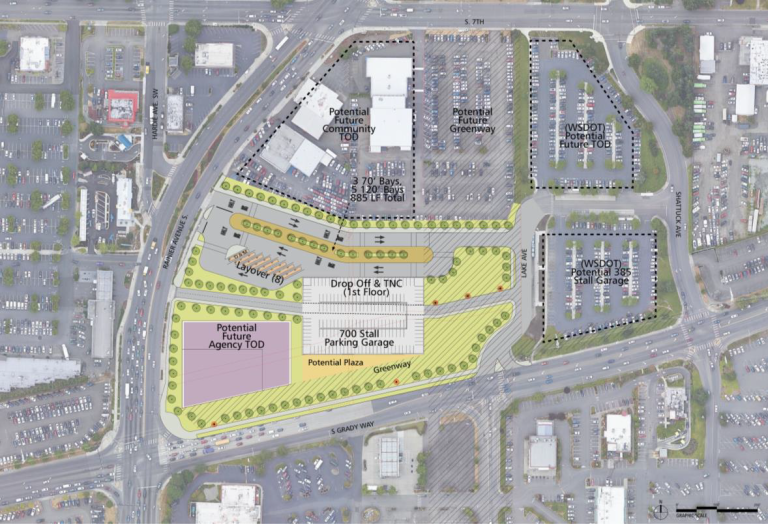
Originally, Sound Transit’s proposed South Renton Transit Center project focused on building lots of parking with the centerpiece being a new 700-stall multi-story parking garage next to transit-oriented development. However, construction of the parking garage was delayed to at least 2034 during the Sound Transit Board’s Realignment of its major capital projects.

Changes to the transit center are reflected in Sound Transit’s SEPA checklist addendum published in June 2024, showing a near-complete redesign of the station area. As part of Sound Transit’s 2023 updates to Stride to support all-electric battery-bus service, the now-deferred parking garage has been replaced by a larger layover facility with chargers, and the TOD plot has been replaced by a large interim surface parking lot. Rachelle Cunningham, a Sound Transit Public Information Officer, told the Seattle Transit Blog the “layovers and electrification are for King County Metro’s use, as the transit center will be a major hub for KCM and ST service”.
Meanwhile, ST’s design documents indicate the parking area could eventually be redeveloped with TOD. Rachelle Cunningham stated that “surface parking is interim, rather than leaving the site fenced off and unusable until the garage is built” but affirmed that transfer of that land to a TOD developer would follow completion of the parking garage in 2034, or later.
South Renton Land Swap?

As Sound Transit has been moving forward with remediation and design of the planned Transit Center on the north side of Grady Way, the City of Renton seems to have other plans in mind. As revealed in a May 14, 2024 Sound Transit Memo obtained by The Urbanist, Renton has proposed swapping the South Renton Transit Center and the Red Lion property owned by King county.
The supposed benefits of this location include placing the station closer to the S1 Line’s route on I-405, but travel time benefits are unquantified. Conversely, this would place the transit center even farther from downtown Renton and force most transit riders to cross the busy, 6-lane South Grady Way.
Rachelle Cunningham affirmed that Sound Transit is committed to the original station location, telling the Blog “construction at the original station location is expected to begin in 2025”.
Salmon Problems
As reviewed in a January 25th 2024 board meeting, WSDOT unfortunately found that the construction of the planned S1 Line station in SR-518 next to the Tukwila International Boulevard Station, or TIBS, would trigger rebuilding a major water culvert to be fish-passable. This would greatly increase the station project costs to an unaffordable level. Based on this determination, Sound Transit has decided to move forward with a new route using the existing freeway ramps to reach TIBS instead. This project isn’t the only facing cost issues associated with fish passage requirements; earlier this year, the Seattle Times ($) dove into the expectedly high costs associated with meeting the decade-old landmark ruling requiring rehabilitation of culverts and other barriers between critical salmon habitats.
TIBS S1 Re-Route: Westbound

TIBS S1 Re-Route: Eastbound

Although sending the S1 Line to the existing Tukwila International Boulevard Station would save on culvert replacement and slightly shorten transfer times between the BRT line and Link, the new route would add roughly six minutes of travel time to the line. For a line meant to cut travel time between Bellevue and Burien from 55 minutes to 38-42 minutes, a 6-minute travel time increase is a serious hit to the expected time savings.
Although it appears an in-line station is out of the cards for now, Sound Transit will continue design of the in-line station in case funding to pay for the fish passage project becomes available in the future.
Update, 9/10: Rachelle Cunningham informed the Blog the culvert failed in June and emergency repairs are underway by WSDOT, but “ST remains committed to the in-line station” and the route deviation to serve TIBS directly “is an interim solution until the in-line station is built”. The Blog has asked for clarification on the potential schedule for construction of the in-line station, and will provide readers with any updates.
Bellevue to Renton Express Lane Construction
WSDOT also recently presented an update on its construction of new express lanes as part of its I-405 Renton to Bellevue Toll Lanes project. The project is adding one new express lane and converting the existing HOV lanes for a total of two express lanes in both directions from Renton to Bellevue. The Stride S1 Line is expecting to utilize these new lanes to bypass traffic on the congested interstate.
Sound Transit is also working with WSDOT on a few major in-line station construction projects for its Stride lines. Between Renton and Bellevue, WSDOT recently highlighted a pair of direct access ramps which are under way: one at Northeast 44th street in May Creek which will be served by Stride with a bus station, and the other at 112th Ave Southeast serving the Newport Hills Park and Ride, which will not be served by Stride.

The new 44th Street interchange will feature direct bus access ramps and a transit station as shown in WSDOT’s rendering, above. The transit stop is near the Seahawks training facility, but besides that the only nearby destinations are single family homes.

The Newport Hills Park and Ride is currently served by Sound Transit’s Route 560, which is expected to be replaced by the Stride S1 Line. Although WSDOT is designing a whole new interchange featuring direct access ramp, space for a potential transit stop, and expanded parking, Sound Transit perplexingly has no plans to have the S1 make use this new infrastructure.
S1 Losing Speed and Still Weak on Service
While the Stride S2 Line (Lynnwood to Bellevue) is being enhanced with more center-running freeway stations, the S1 Line is on a slippery slope to being no faster than the 560 it plans to replace while serving far fewer destinations. The route of the S1 Line originally skipped Renton Landing, downtown Renton, the Tukwila Sounder Station, and Southcenter to provide much faster travel times between Bellevue and Burien by serving only a few freeway stations. With the “temporary” loss of the freeway station in Tukwila, an undecided station location in Renton, and still-poor network connectivity elsewhere, the S1 Line is losing speed and still missing many important destinations.
Unless Sound Transit can find a way to get the S1 to serve more (or better) destinations or recover some of these loses in speed, it seem that it might need to go back to the drawing board to deliver useful BRT service between the South King and East King subareas. They might consider additional enhancements to Metro’s RapidRide F and the existing Route 560, which currently cover the S1 Line’s service area. If the S1 Line can’t deliver on its promise of faster travel at the cost of very few stations, the best use of transit dollars might be toward less-flashy but more reliable projects such as more BRT-like improvements for these existing lines.
What do you think Sound Transit could do to make up for these potential impacts to the S1 Line’s service?
Update, September 17, 5pm: Rachelle Cunningham at Sound Transit confirmed the agency is ” working with WSDOT to see how their culvert repair and any associated permit conditions could impact the delivery of the in-line station to identify the best path forward.” Regarding the TOD plot at the South Renton Transit Center, she confirmed that construction of TOD is still planned to happen after construction of the parking garage, which has been set as a Tier 4 project and expected to be completed in the 2030’s.
Smh…I have stated many times that the earlier SR 518 proposal for TIBS is a lousy place to stop.
Oh… the road is SR 518 there, not 405.
Long sections of high-speed running, as will be true of S2, is the wrong place for battery-electric-buses. There is too little opportunity for regenerative braking to keep the batteries charged.
Thus the dedication of a large area as a Tesla lot on the station plot.
Why would ST put the charging station in the middle of the route? This means that buses will regularly leave service for recharging there, forcing riders destined beyond South Renton in either direction to change vehicles. Perhaps that’s not the worst thing in the world, but it will introduce yet one more unpredictability for riders. Will there ALWAYS be a charged bus waiting in the adjacent bay for through-riders every time a bus leaves service? Of course not.
This is just another example of ST choosing priorities other than service to its riders to guide its capital program.
I was wondering about mid-route charging too. Shouldn’t it be in Burien?
I’m hoping the chargers in Renton are intended to be for other bus routes that actually end there. If it actually is the plan to make passengers sit on the bus for 10 minutes while the batteries charge in the middle of the trip, it’s time to go back to the drawing board.
This also begs a question of why overhead wire isn’t possible for this route. If Link can go 55 mph under overhead wire, why can’t a bus?
To clarify for Stride 1 and 2 there will be other induction charging spots as well, I’m guessing added at the inline stations.
https://www.soundtransit.org/blog/platform/supercharged-battery-electric-buses-will-power-stride-program
They’ll probably be electric chargers at Burien as well.
This also begs a question of why overhead wire isn’t possible for this route. If Link can go 55 mph under overhead wire, why can’t a bus??
I’m sure it could but it would be extremely expensive and you would need to guarantee it stays in the same lane the whole time. Doesn’t seem worth it. Best option is to charge where there are layovers and give a little extra charge in local spots. That appears to be the plan. But getting to Tom’s point, I agree, this route doesn’t seem appropriate for electrification at all. Not much bang for the buck.
The chargers at Renton are for KCM routes. S1 will only charge at Burien and Bellevue during layovers.
“The chargers at Renton are for KCM routes. ”
Why should ST3 sacrifice valuable property so KCM can have chargers? Why can’t those chargers be on a special deck with higher security?
@ST3ABC
Thanks for the clarification. I’ll edit and correct the article.
Though that is definitely non-trivial to figure out, wish sound transit would clarify more in the documents that theses chargers are not for the stride buses
https://www.soundtransit.org/get-to-know-us/documents-reports/stride-s1-line-i-405-brt-south-renton-transit-center-sepa-0
I had mistakenly thought they were installing the wireless bus chargers to allow recharging at the stations in the middle, but I guess it’s just at the terminal stations. Though then why aren’t they just using normal overhead chargers if there’s only two spots to recharge the buses?
I guess I’ll have to dig into that king county electrification document sometime and double check what in the world they are planning.
Trolleybuses don’t work at freeway speeds because the poles won’t stay on the wires, and you can’t use a single pantograph the way rail does because there’s no return path (trains use the rails as ground/return).
There’s an experimental system Scania is putting in production with DHL that uses dual pantographs and automated steering to keep the truck under the wires. There are only a few of them though, and they’re expensive to install.
Thanks for the correction, Al – I’ve updated the post.
If MTR Western can run a battery bus from Bellingham to Seattle and back, SoundTransit should be able to get from Burien to Bellevue on a charge.
There is an all-electric bus that runs from Bellingham to Seattle? Well, indeed, that is a very long way. I guess it would be OK to use them for S2.
Yes, MTR Western bought a few for use on the Amtrak thruway connection from King Street Station to Bellingham. So far, 100% of the trips I’ve taken on that route this year (albeit that’s not too many) have been on battery electric buses.
Bad news is that they had to buy them from Europe because USA production just isn’t there yet.
https://mtrwestern.com/sustainability/mtrwestern-launches-first-intercity-electric-bus/
One big difference between the S1 bus and the Seattle->Bellingham bus is a term that the industry likes to refer to as “duty cycle”. In this case, the Seattle->Bellingham bus runs just one 180-mile round trip per day. Even with chargers only at the Seattle end, that still allows for some 18 hours of charging per 180 miles of driving, so as long as the bus gains 10 miles of range per hour of charging (a level which isn’t too difficult to do with modern electronics), there are no issues operating the route with a battery bus (so long as the batteries have enough range to be able to reliably complete the 180-mile round trip under all traffic/weather conditions).
A bus used for route S1, on the other hand, is likely to have a much heavier duty cycle. While each individual trip is short (~18 miles one-way), the bus is expected to be able to go back and forth, back and forth, all day long, for however many hours per day the route is expected to run, plus additional driving to deadhead to/from the base at the beginning and end of the service day. If we assume that the bus operates with passengers on board from 5 AM-Midnight, this translates into a roughly 20-hour workday for the bus, including deadheading, leaving, at best, just 4 hours to charge at night at the base (if the bus is able to be charged and cleaned at the same time, which I’m hoping to be the case). Assuming that the bus’s 20-hour workday alternates between 45 minutes of service, followed by 15 minutes of layover, this means that each round trip is 36 miles/2 hours. This equates to a daily duty cycle of 360 miles of driving, more than double the daily mileage of the Seattle->Bellingham bus, with less than one quarter the nightly charge time.
So, to make it work with battery buses, there are essentially three options, all of which have big challenges:
1) Find a battery bus that can make it through the entire service day one one charge, recharge the buses nightly at the base.
2) At some point in the middle of the service day, have the bus deadhead back to base and be swapped out with another bus that has fresh batteries.
3) Charge the bus as much as possible nightly at the bus, plus some additional charging during layover periods between trips.
To implement S1 with Option 1, you’d need a battery bus with over 500 miles of range to be able to reliable do 360 miles/charge under all possible weather conditions, with a reasonable energy reserve leftover. I don’t believe there are any such buses currently available on the market, so this option is easy to cross out, at least for now.
Option 2) is probably the simplest of the three options, as it places the lowest power demands on the buses and chargers, and doesn’t require the installation of any bus chargers except for the bus base. The big catch is that option 2) requires at least double the fleet size compared to option 1 (or diesel buses), since, for every bus that’s running, you need another bus that’s charging. Needing to buy all these extra buses (plus land to store them all, plus hire extra drivers to pay for all those deadhead miles to swap them in and out during the day) would make for a route that is extremely expensive to operate.
That leaves option 3), which avoids both the battery demands of option 1 and the fleet explosion of option 2) by partially recharging buses during layover periods throughout the service day. However, even this option does involve some significant tradeoffs. First, you’ve got the capital cost of installing chargers at the layover points, and you were to ever decide to extend the bus route in the future, you would have to pay that capital cost all over again to install chargers at the new layover point. Second, in order to preserve the ability to use layover time to get back on schedule when running late, while still ensuring that the buses receive the minimum required amount of charge time, option 3) probably requires lengthening the layover period beyond what a diesel bus would require, which in turn, increases the number of buses and bus drivers required to operate the route (and, hence, the route’s operational cost), although, probably, to a much lesser degree than option 2.
So, putting everything together, I can see why option 3) is necessary to run S1 with battery buses at acceptable costs, even while option 1) is sufficient for the Bellingham bus.
There is another factor for the agency to consider with option 3, which is, what’s the contingency plan if the charger at the layover point were to go down? I assume this means switching the route to diesel buses until the charger is fixed, but are there enough spare diesel buses to be able to swap in for every battery bus across the entire route, without impacting the ability to deliver reliable service on other routes?
It’s absurd that there is a budget for a complete interchange rebuild at 44th, but no enough money for a fish culvert at TIBS. the WALeg should just direct WSDOT to replace the fish culvert, as that is ultimately their responsibility.
But even more absurd is how process driven this decision is. If the fish culvert replacement was known earlier in the process, then it would have been included in the budget, but since it was caught later in the process, it is “not in the budget,” even though this incremental capital cost is a rounding error in a context of any Link project.
Exactly. The Skycastle Construction Consortium can be headshakingly obtuse and self-serving on the simplest problems.
To clarify while no number was given jt sounded like a an extra two or three hundred million to fix not an easy fix.
Most like it’ll have to rebuild the entire freeway section and also keep portions of sr 518 semi open for travelers to and from seatac
> It’s absurd that there is a budget for a complete interchange rebuild at 44th
Sorry to clarify secondly, the 44th interchange money came from WSDOT. Sound Transit is only funding the inline bus stops
Are you sure? The work was done by WSDOT (aka they executed the contracts with the private contractors), but my understanding from my time working at ST is the entire interchange rebuilds (both 44th & 85th) were paid for by ST3.
WSDOT is responsible for ongoing SOGR, so ST won’t be on the hook for any major maintenance events.
@AJ
As far as I know WSDOT was planning on building the direct access ramps at 44 and 112 even without Sound Transit. Though I am not completely sure of the funding breakdown for 44th.
https://bellevuewa.gov/sites/default/files/media/pdf_document/2022/wsdot-renton-to-bellevue-map_0.pdf
This entire project should be cancelled. Bus rapid transit is an appropriate compromise when the cost of labor is low, but that stopped describing Seattle and Bellevue a long time ago. And we can already see that the stations are going to be placed where nobody will use this but peak commuters. Build a train from Renton to Bellevue or Renton to Seattle, or build nothing.
I agree. This is costing way too much. Bit unfortunately I’m sure it’ll continue full steam ahead.
It does seem like they should go back to the drawing board on this. To a large extent it was based on the assumption that a freeway station for TIBS would be cheap and that serving Renton would be straightforward. Neither appear to be the case. While the issues involving the TIBS station are at least fairly simple (we have to wait for WSDOT to do the work) that isn’t the case with Renton.
Renton is a major destination on this corridor (second only to Bellevue) so it is essential that you make the connection. But if it takes a really long time to serve it then the plan falls apart. On the other hand a freeway station at the edge of town doesn’t provide much service (and is much worse than today). It is hard to accomplish both. Downtown Bellevue is lucky — it has HOV lanes connecting right to downtown. A bus that serves it (and keeps going) would experience a fairly small delay. Renton has no such luck.
At some point you have to wonder if it makes sense as one route. The 41 was one of the most productive, most successful express buses in our system. It carried way more riders than this will ever carry. The bus ran through the Lake City/Pinehurst/Northgate neighborhood before getting on the freeway and running very quickly to downtown. Despite the UW being a major destination it didn’t detour to serve it. If you wanted to get from Lake City/Pinehurst/Northgate you took a different bus (or buses).
If you are willing to spend a bunch of capital trying to make this route better then it makes sense to spend a decent amount of money on service. One option:
1) Keep the 560 but run it more often (every 15 minutes midday).
2) Run a second express (at similar frequencies) that goes from Burien to Bellevue but stays on the freeway. For now this just skips TIBS, but eventually have it serve the TIBS freeway station (once WSDOT does the work).
Depending on existing ridership data, it might make sense to swap the western tails of these routes. If folks in White Center are taking more trips to Bellevue than to SeaTac/Renton then the Stride bus can extend to Westwood Village, while the 560 could be truncated in Burien.
Either way this gives people from Burien an express to Bellevue. At the same time trips from Bellevue to SeaTac or Renton are better than the Stride plan. When the freeway station for TIBS is built it gets even better. Federal Way to Bellevue becomes a two-seat express (that avoids going all the way into Seattle).
When the freeway station for TIBS is built you could have the 560 skip SeaTac (but serve TIBS). You lose your express to SeaTac, but that was the plan all along. But I also see nothing wrong with keeping them both long term. Sure, that is a lot of extra service. Maybe the express only runs peak (as more of a commuter run to both Renton and Downtown Bellevue). But I just don’t see this working out as a single route.
The biggest problem with the 560 today is not speed, but service. The route doesn’t run often enough to be useful, especially weekends, when it runs just once per hour. All of the capital improvements spent on S1 would probably be better spent just running the current route 560 more frequently.
Great update!
But losing the inline station at TIBS is a disaster for this line, and the changes at the Renton Transit Center are disheartening.
The whole point is that this line is supposed to be ‘trainlike’ – if not in appearance, at least in service level and timing, and that is not what is happening. It is NOT what voters voted for.
I think a big part of the problem is that ST tries too hard to make the bus routes “train like”. To be clear, sometimes it works just fine. Stride 3 (running down SR 522) is train like. If a lot more people lived along the corridor it would make sense for light rail. Same goes for Aurora and many of our corridors. Sometimes this works for freeways as well. Downtown Bellevue has an outstanding freeway interchange. It is similar to Lynnwood Transit Center — a bus can easily serve it, turn around and keep going. (Ironically the buses will layover there instead — not that I would do anything different.) But not every place works like that. Renton doesn’t. You could create something like that for Renton but it would cost a fortune. Still a lot cheaper than running a train but probably not worth. While this may be billed as “train like” it is a fairly minor corridor. There just aren’t that many people trying to get along the various destinations close to the freeway.
Instead of focusing on one line, they should look at the network. At a minimum there should be two lines along 405 — probably several. Because that is how people are using it. Someone from Renton Technical College is trying to get to Bellevue College. Someone from White Center is trying to get to Boeing Renton.
That doesn’t mean that people shouldn’t expect to transfer, but in general it should be one transfer, not two. A series of overlapping express routes is much easier to develop. The drawback with this approach is that it costs more to operate. You have multiple buses on the freeway. But buses running on the freeway for relatively short sections is not that expensive. For example the future 111 will spend about 40 minutes getting to the freeway, then another 5 minutes on the freeway before exiting to serve South Bellevue. That is a tiny amount of overlap.
Of course this doesn’t work unless the routes are frequent enough (fifteen minutes if not better). For a lot of areas this would be a big step up. Fair enough. But it is hard to see this working if you don’t have demand like that. Furthermore, the service that is off the freeway works for other trips. The 560 works for trips within Renton just as the 41 used to work very well for trips from Lake City to Northgate Transit Center (and those in between).
“Instead of focusing on one line, they should look at the network. At a minimum there should be two lines along 405 — probably several. ”
I agree that rather than dig their heels in on this alignment, ST should instead revisit the system assumptions. Unfortunately, it seemingly takes a vocal roadblock along with a persuasive property owner that gains by helping ST find a different solution for this to happen.
The problem with the current alignment is that it mostly requires skipping so much. Not only are buses forced off 405 to serve South Renton, but it skips Southcenter (including RapidRide F and Route 150 there) as well as Sounder Tukwila and Factoria. Southcenter and Factoria have so much going on!
If I could play master planner, I would have not put South Renton and TIBS stops where they did. For Renton, some have suggested the former Sam’s Club site (now a Home Depot ?) next to Renton City Hall — with elevators up to a 405 median station (admittedly a 3D challenge to build).
For TIBS, I would suggest looking at HOV off ramps to/from 405 north at Southcenter and running Stride on Southcenter Blvd from there to TIBS and then to Burien instead — plus it would add a Southcenter area stop to Stride 1. 518 can get congested (thus unreliable) between TIBS and I-5. Of course, the wrench in that is having to pull off to the right in South Renton rather than the HOV lane so it would take both project changes to work together to happen. But I would think that the two changes combined would do everything that Stride 1 intended but faster (no Renton pull off) and with more riders (Southcenter connectivity).
As for a second 405 S line from Bellevue, I see that a “Stride 4” line extended down SR 167. It could be awesome! Of course that’s so far beyond the ST3 program that it would have to follow its own approval timeline and funding strategy.
In perusing how to add a Southcenter Stride stop to/ from 405, I conceptually see a pretty clever way to do it. Extend Macadam Road over 405 to Southcenter Parkway near Bahama Breeze as a bus and maybe HOV overpass with direct access ramps to and from 405 north. The HOV lane northbound begins there so that’s a perfect place for an entry ramp. there appears room to add the HOV off ramp off of the HOV lane to I-5.
The move the Southcenter TC to be adjacent to this. With some localized routing changes it could benefit other transit as well. RapidRide G, Route 150, Route 128, Route 156, Route 906 and maybe any express bus on 405 could also use the new overpass — providing both easy transfers to Stride 1 there and a bypass to the congested other overpasses in the Southcenter area. It would require moving the Southcenter TC to the opposite side of the mall but where the TC is now is not particularly user friendly.
@Jas and @Ross
Yeah I’ve been considering alternatives, but it is not easy. The destinations all alternate north and south of SR 518/i-405. Perhaps the bus should follow partly more of 460 and exit at n southport to at least reach renton landing.
For larger changes maybe some throughrunning of rapidride F might somewhat work. For a split branch there were some older ideas of bellevue to downtown renton / southcetner and a separate line from bellevue to burien as the stride 1 currently is. But it of course it would split the frequency
Another idea is perhaps dropping the idea of using the center toll lanes for Stride 1 — it is somewhat of faustian bargain. Perhaps use shoulder transit lanes instead as it’d allow entering and exiting the right side ramps much more easier. That’s how vancouver implemented it on their highway 99. or how minneapolis does it for their freeway bus.
I think it mainly needs more service money. There are enough freeway stations with these projects (likely more than enough). The TIBS one is crucial — but it can wait. If service money is tight I would just run the 560 more often (as asdf2 suggested). You still benefit from the 44th station (assuming it is built first). When TIBS is done you have tough decisions to make. I see several possibilities. But I start first with the ideal:
Run the full 560, but also run a bus (Stride) that only stops at the freeway stations (TIBS and 44th). You could try to add some BAT lanes in Renton (or leverage what the F has (what does the F have?).
At that point there are a number of different ways to reduce service cost. The 560 could just skip SeaTac (once the TIBS station is done). That would give Burien an express to Bellevue as well as Renton (and two express buses to TIBS) while saving some money. I would probably do that at a minimum. The 560 could end at Renton. Riders from Burien to Renton could take the F or take Stride and then backtrack via the 44th station. Or the 560 extends to Burien, but only during peak.
It is interesting to think what they could build if they just threw some service money at it (but didn’t get too crazy). Use the 560 + Stride as the starting point. Assume they run every fifteen minutes and are timed from Bellevue to 44th (each direction). That means that from there you have a bus every 7.5 minute to Downtown Bellevue.
Now run the 567 during peak (again). Run the 566 every fifteen minutes, but don’t go to Downtown Bellevue. Instead get off at Coal Creek Park, run through Factoria and end at Bellevue College. This gives riders from Renton an express version of the 240. Riders from Kent and Auburn headed to Downtown Bellevue can transfer at 44th to those express buses running every 7.5 minutes. Likewise riders headed from Burien or TIBS to Eastgate/Bellevue College can transfer there as well. Even a really long trip — Highline College to TIBS to 44th to Bellevue College — is fairly manageable. 44th becomes a transit hub — as it should be (even if there is nothing really there).
I’ve made the pitch before, but now it seems appropriate to do that again: Give up on a TIBS stop and move it to SeaTac Airport station. If the built a bus only U-turn under the station with a stop, it would connect to 1 Line and RapidRide A, take a similar amount of time looping into and out of TIBS and not be redundant with RapidRide F.
It would take working with the Port to change how some of the roads connect under the station but it appears to be doable.
That way, it’s a non-stop airport connection from Renton (RapidRide I) and Burien (RspidRide H) as well as a direct Stride connection to Bellevue.
I think that would make sense until WSDOT fixes the TIBS situation. It is still a detour for trips from Burien (to Renton or Bellevue) but so too now is serving TIBS.
That doesn’t fix the Renton issue though, which I see as bigger than the station issues. I don’t think you can have it both ways in Renton. Either you serve a decent amount of Renton (as the 560 and F currently do) or you stop close to the freeway. The former means a significant delay for through riders (Bellevue to the south end Link or Burien). The latter requires everyone heading to or from Renton to make another transfer. I don’t see anyway of avoiding that with only one line.
Which is why I would have (at least) two, as I wrote above (https://seattletransitblog.com/2024/09/06/stride-s1-line-updates/#comment-940024). I just don’t see any way of providing a short delay for through-riders while also providing decent service from Renton to Bellevue without having two (or more) lines.
Edit: Either you serve a decent amount of Renton (as the 560 and F currently do) or you don’t leave the freeway at all. The Renton station(s), if they aren’t going to follow something like the F or 560, need to be inline freeway stations like the rest of the 405 Stride stations.
Either you serve a decent amount of Renton (as the 560 and F currently do) or you don’t leave the freeway at all.
Yeah. By “close to the freeway” I meant freeway stations, but those can be considered just part of the freeway. I should have put it that way.
I could see something like what Lynnwood Link has for the 512 (HOV ramps both directions — no traffic lights) but I don’t see that working for Renton. That would make more sense for TIBS (especially if they were there already). Since they aren’t, the pedestrian bridge is much cheaper (and in some ways better).
If the amount of detour time required to serve TIBS vs. SeaTac is similar, then serving SeaTac is clearly better, as far more people are going to the airport than going to TIBS. The problem is how to serve SeaTac without the bus getting stuck in all that private car pick-up-and-drop-off traffic at the airport.
Looking I think the route would involve something like SR-518->SR-99 westbound and SR-518->Airport Expressway->170th St.->SR-99 eastbound, with the S1 bus serving the southbound RapidRide A bus stop beside the Link station in both directions. After serving the stop, the bus would return to SR-518 via the airport expressway, but this would be the uncongested part, since it’s after the airport terminal, rather than before.
To make this approach work well for airport travelers, I think you’d want to have a second elevator installed connecting the southbound SR-99 bus stop to the airport Link station without needing to cross SR-99 on foot to reach the elevator for the northbound bus stop. Space is tight there, but it does look doable, possibly at the expense of a tree or two. This elevator would also, of course, be quite useful for RapidRide A passengers transferring to Link at SeaTac station as well.
There is an extra option SeaTac for the second terminal will build a busway (for passengers outside security) between the two terminals. The new terminal is pretty close to the rental car facility.
It probably involves a bit too much coordination between WSDOT, port of seattle and sound transit, but if this was say Japan or some other european nation having stride use that busway to directly access both terminals might be possible
The Renton situation is really just reducing the ST3 specified number of spaces at the site by eliminating the parking garage.
Does the lot fill up now? Could a few decks of parking be built above the new surface lot?
I’m also wondering if a bus can actually turn around inside the transit center. The turn-around pavement is shown but the turn may be too tight.
1.27 Billion? Am I reading that right?
https://www.soundtransit.org/sites/default/files/documents/stride-program-FAQ-july-2023.pdf
Strike a match.
Completely agree with those who suggest just jacking the frequency of the 560. Maybe straighten out the F and call it a day.
1.27 billion is for both the Stride 1 and Stride 2 segments with the latter costing more. I’ll have to dig through documents for the Stride 1 segment (renton to bellevue) but I don’t think it is more than a couple hundred million considering there is no TIB station.
The other costs of adding a toll lane in each direction is under WSDOT’s funding not sound transit
Or still launch it as Stride, but follow 560 through Renton and invest in some bus priority here & there, and skip building the TC & parking.
But this would require a mindshift by Renton political leaders. A frequent bus is something that should run through the urban core (560 does a pretty good job
doing this), not something to be shoved off to the urban fringe and leveraged to achieve unrelated public works.
Agreed. I think we are all basically saying the same thing. (https://seattletransitblog.com/2024/09/06/stride-s1-line-updates/#comment-940067).
Maybe also delete the 560 diversion to SeaTac? Or make it 2 different routes, one of which skips SeaTac? Say, Burien to Bellevue, and SeaTac to West Seattle?
Once the TIBS pedestrian station is done it makes sense to skip SeaTac. Until then you might as well serve SeaTac. It doesn’t take much longer to serve SeaTac and it is a much bigger destination.
I do use the 560 to get to West Seattle, but connect with it on the 574 at SeaTac. If you lost the diversion, how would that connection look?
It is highly unlikely that the 574 exists after Federal Way Link. So at a minimum you would have to transfer to Link (at Federal Way). The plan is for the 560 to end in Burien — I don’t think it should. Assuming it does you would do the following:
1) Bus to Federal Way
2) Link to TIBS
3) Stride to Burien
4) H Line
5) Another bus (assuming your destination is not on the H).
If Stride is extended to West Seattle then it would eliminate step 4. It is possible Metro extends the H to TIBS but is is pretty long as it is. It is also possible Metro runs a different bus to TIBS but I doubt it. What makes the most sense (for various reasons) is for Stride to run to Westlake Village (on the same pathway as the H). We have a tendency around here to isolate all of the RapidRide buses. There is nothing fundamentally wrong with overlapping — it offers some advantages. It allows bus stations to be reused. This in turn makes it easier for riders (they can tap their ORCA card at the station and then board the first bus that arrives). At worst it is a bit excessive for this corridor, but ST can afford it.
Yeah, that appears to be the way things are headed.
That is not a reasonable choice that anyone who has any alternative would make. Going across Vashon might become the fastest transit route if you time the ferries right.
Which is if course absurd. But there you are. But certainly spend a few billion for two redundent routes from Bellevue to Burien. Or s100 million to speed up crown Hill to downtown by 13%. Priorities straight.
Given the what I’m seeing as cost of buses that only marginally improve, or in some cases degrade service for this stride line. I think we need to rethink this whole network.
What I would like to see is a build-out of a transit hub in South King. Probably Tukwila makes the most sense. A central location that feeds N, S, E, W, NW, NE.
Go to that central hub, and you can catch an hourly sounder to the south, you can catch a RR to the West to Burien, you can catch an express to the NW to West Seattle, you can catch a RR to the East to Renton and on the the NE to Bellevue.
It would be a huge investment, but this piece-meal bullshit that always seems to spend vast amounts of money making rich communities with already decent service ever so slightly better, while degrading service for the poor who actually need it is really, really getting old.
To be fair, my guess is very few people go that way. That doesn’t excuse the routing though.
I’m not saying it is easy. Regional service is difficult. You can’t possibly create a decent grid and you have multiple potential transit hubs. There are no major destinations between Downtown Tacoma and Downtown Seattle. There are places like Renton, Kent and SeaTac that are all about the same. Not huge, but not tiny either — with none of them standing well above the others.
There is nothing fundamentally wrong with treating Burien as a hub until you look at the rest of the network. All the major bus routes in West Seattle go through Westwood Village. Even the 60 manages to go there. The H goes to Burien, but is the exception. It is just too far for the other buses, and just not worth it go to Burien.
Nor is it feasible for the H to go farther. In contrast the Stride bus is capable of going to Westwood Village, since it does that today. That means overlap, but overlap is inevitable if you want a decent network. There is decent ridership on the 560 between Burien and Westwood Village. I see no harm with doubling up service there. This isn’t cheap, but it isn’t horribly expensive either. ST needs to realize that at some point it just isn’t worth focusing on infrastructure — you just need to run more buses.
I don’t think there is anything wrong with moving the Link connection from SeaTac to TIBS. For anyone headed to Bellevue this is a big times savings. The same is true for anyone headed to Rainier Valley. I really think there are only a few things they need to do with this section:
1) Complete the 405 connection to TIBS. This will take a while, but WSDOT will do it.
2) Have the Stride bus skip Renton.
3) Run other service to Renton. I’ve gone back and forth. The cheapest option is to just run the 566 more often. But there is a lot to be said for just running the 560 every fifteen minutes, but have it serve TIBS instead of SeaTac.
4) Extend one of the two buses to Westwood Village. I’m not sure which one. For the West Seattle-Link connection it wouldn’t matter.
I never understood Stride 1. Who are all these people travelling between Burien, Tukwila, Renton and Bellevue. Totally different cultures, and today office work has declined steeply in Bellevue. Microsoft employees, even if they work on campus, can afford to live in the Redmond/Kirkland/Bellevue/Issaquah square.
This new plan looks like the stakeholders are using Stride 1 to solve other issues. For example, the notorious Renton Red Lion was King Co.’s pilot program for a low barrier shelter. After just four years of use it became uninhabitable, and the cost to refurbish it was $18 million. But King Co. was obligated to a $4 million/year lease, on an empty building that is a huge eyesore in Renton, so ended up paying something like $30 million for the property and building although it is uninhabitable.
Meanwhile commercial development in Renton has hit some snags. After $338 million the Southport Office Campus is mostly empty. So Renton needs to do something with the derelict Red Lion property, but no private developer wants it. So make it a Stride stop.
As The Times noted, “Overall, WSDOT has spent or committed nearly $4 billion in removing barriers as part of a federal court order, and asked the Legislature last year for an additional $3.5 billion to $4 billion more to finish its list”. A lot of that money is coming from the carbon tax. I can understand ST not wanting to inherit part of that cost.
The final issue some have raised is the increasing cost. But what is new with ST. Yes, inflation is much higher than in 2008, but these “bus lines” were always underestimated, even when using 405 and WSDOT upgrades. Anyone familar with the stretch from basically Main st. In Bellevue to Burien knew first/last mile access was always going to be a problem, let alone a demographic that either works at home or drives a truck for work. There is a reason Link won’t serve this region. Nothing has changed.
If ridership on East Link between Seattle/Bellevue/Redmond looks like it will be weak and much less than anticipated, with the perfect demographic and two dense downtowns, what is the chance Stride 1 will have strong ridership.
Anyone on this blog actually tried to walk downtown Renton, let alone at night? None of the stations will be near anything in poor cities. I believe has the highest gun violence rate in the state. “Tukwila is one of the most dangerous cities in America with a violent crime rate of 773 per 100,000 people – this ranks in the bottom 10% of all U.S. cities that reported crime. Your chance of being a victim of violent crime in Tukwila is 1 in 130”. This is from Google.
All you read on Renton social media these days is anger over the HOT lanes for the “rich”. They will not be happy with dedicated bus lanes with no one on the buses. Stride 1 is overkill transit for the route, and more transit capacity is not what this route needs. It needs more car capacity, although some on this blog think that is heresy and better to spend billions on worthless Stride Line than admit transit isn’t always the best mode.
At least Stride 1 is making Issaquah Link look better all the time. Or calling into question uniform tax rates among subareas that has to be spent someplace.
A Stride route should either be a freeway express like S2, maximizing speed & reliability, or be Arterial Bus Rapid Transit like S3. S2 won’t commit to one or the other.
The Burien-TIBS segment was going to be a useful high speed bypass of RR-F to connect Burien to Link, but without the inline freeway station the improvement over the F is greatly reduced.
The Renton alignment is broken, which is why the S1 was also going to be suspect. Stride should either stay on the freeway and invest in some sort of freeway station on 405 connecting to local bus service, or it should fully exit the freeway and follow 560’s route through Renton, sacrificing end-to-end speed but actually serve Renton. The current plan does neither and is therefore worse.
The freeway station at 44th can still be served by other freeway express routes, so that won’t be wasted, but otherwise S2 project work has gone so poorly I do think it even be worthwhile to launch the service.
To clarify even with the TIBS inline freeway station, the stride bus would still need to enter the right side lanes to enter and exit the south renton transit center
@ WL:
This is true and it’s what I would describe as the fundamental problem with Stride 1. The other issues are minor compared to this. This is where the big bucks need to be spent!
It’s why I suggested that ST broaden its vision to build a South Renton stop reachable from the 405 median above. ST should study its feasibility anywhere between Renton Landing and the South Sounder track overcrossing before going any further.
> It’s why I suggested that ST broaden its vision to build a South Renton stop reachable from the 405 median above. ST should study its feasibility anywhere between Renton Landing and the South Sounder track overcrossing before going any further.
WSDOT will eventually build it but it is the full build out of the i-405/SR-167 interchange. aka it’ll cost a couple billion if I recall correctly. Perhaps if there’s enough interest I can post about it.
It’s why I suggested that ST broaden its vision to build a South Renton stop reachable from the 405 median above.
That still wouldn’t serve Renton. That is the fundamental problem. There are really only a couple reasonable choices:
1) Have the Stride bus run through Renton on the way to Bellevue. I have no idea what the ideal routing is. You’ll probably need to add a lot in the way of BAT lanes to make it work. If we really want to treat this like BRT we have to have a lot of right-of-way (e. g. a busway — maybe even a tunnel). Obviously that is overkill, which is why I would go with the following:
2) Run two buses (or more). One bus runs through Renton, while Stride skips it (and only stops at freeway stations). There are several options for the bus serving Renton:
A) The 560, running every fifteen minutes. Eventually this could skip SeaTac and use the TIBS pedestrian station instead.
B) Run the 566 every 15 minutes during the day. Maybe run an express from Burien to Renton (with the stop at TIBS) during peak. That bus would be focused more on Boeing Renton.
C) Same idea, but run the shorter version of the 566 opposite the long version. Half the time the bus goes to Kent, the other half it keeps going to Auburn. Riders who miss the long version can take the short one and transfer to the 160. Thus you get fifteen minute service from Kent/Renton/Bellevue without spending a fortune.
It is worth noting that we aren’t trying to serve the other destinations in this manner. Burien is a transit center that is not located on the freeway. It is not that far, but even if it was, it doesn’t matter because it is an endpoint. Same goes for Downtown Bellevue. Renton is too big a destination to try and serve with just a freeway stop. Just run another bus.
If you move the Stride station in Renton to have a clean transfer to the F, then Stride will serve Renton well, as the F can provide the last mile service.
One good option is the shift the Stride station 1 block over and built an inline station a Lind Ave, but I would prefer to move the Stride station to north Renton, where an infill freeway station can be built within WSDOT’s long term plan for an HOV exit at Southport (405’s exit 5), and just ditch the south Renton station location. The proposed S Renton station is a place where route pass by but not a good place for a route to end, which is why it’s a bad spot for a off street transit center. In this case, the 560 can terminate at Burien or TIBS, as the F fully covers Renton itself.
Longer term, have a Stride station at both Lind and Southport, giving the F three transfers to Stride (TIBS, Lind, Southport) and therefore most riders only need to ride the F a sort distance to connect to HCT. The squiggles of the F then becomes an asset (good coverage for last mile connections), with Stride as the express overlay for that corridor.
Not everyone is a tech office worker that can work from home. Microsoft employs a lot of support staff, there’s quite a lot of retail/manufacturing on the way, and of course there are the obvious employment hubs at SeaTac and the Renton Boeing factory.
And I have white collar coworkers in downtown Bellevue that bus in from Burien and Auburn because the commute is hellish if you have to drive. They only make the commute a few times a week at most, but they certainly appreciate the bus. The bus takes just as long, but it certainly beats sitting at the wheel for an hour+.
That’s not to say that Stride S1 looks promising. It looks like it misses all the important destinations, without being all that fast.
What an ignorant statement. Drive I-405 from Renton to Bellevue on weekday mornings. Plenty of people make this commute. This BRT can also connect places like Kent, Auburn, and more to the Eastside. Issaquah residents with a nice clear I-90 commute should be the last to receive transit, but instead they’re getting light rail AND complaining that South King County is finally getting something while we’ve been paying for your useless light rail for the last several decades.
Whoa there S. King,
No area more than Issaquah has paid more toward ST and Link and got nothing in return. We are the sales tax juggernaut of East King Co.
I don’t know if you understand subarea equity but if you live in S. King you haven’t paid a dime toward ST transit in East KC. I can only imagine how much Issaquah has paid in sales tax for Metro in S. KC, the new poster child for “equity”. The only reason E KC is wasting money on S1 is because uniform tax rates mean we have too much ST tax revenue to spend wisely. If you mean S King runs Stride to the subarea border and that is it I am fine with that.
Yes I have driven 405 a zillion times. It is all trucks and chew cans. Do you really think Bellevue, Kirkland and Redmond want the BARK folks. It’s why Link doesn’t run there. It’s why we have Southcenter Mall.
Burien from Kent to Tukwila to frickin Auburn needs some transit but not the cost of Stride which is white collar commuter quasi rail (don’t forget the massively subsidized Sounder S,) but not north of Renton. If you are really from S. KC you know more car lanes on 405 are what the residents really want, and not $15 HOT lanes.
Just like N KC got suckered into running Link to S. KC now E. KC is being asked to run Link on the east side of the lake like S. KC. Have you seen ridership on Sounder S. lately. The Eastside is twice as tech/work from home as Seattle.
The fundamental issue for all ST is it runs along freeways because they are built and cheaper public right of way, but every city has built its core away from a freeway because a car doesn’t have issues with first/last like access to a freeway. How does someone in the BARK cities even get to Stride?
This idea some like John have that cities like Bellevue or Redmond need hoards of janitors and Mexican landscapers coming from BARK on HCT at a cost of several billion dollars is ridiculous. What we need is an army of skilled tradesmen who all live south on 167 and drive trucks and earn more than I do.
Maybe the real solution is that transit riders pay a fare that completely covers the cost of their trip, both capital costs and operations and maintenance, so we can identify the free loaders.
If the BARK folks actually knew BEFORE hand what their fare would be on STRIDE to cover all capital and O&M costs I doubt they would opt for it.
Look I think the Issaquah region has paid for its Link. But if others disagree then refund us our ST taxes, because like S King notes ST hasn’t benefitted us at all, and no way Metro provides service even close to the taxes we pay.
No more free loaders. Each subarea — Metro and ST — and each transit rider pays 100% of the cost of their trip. Then S King won’t have any complaints.
“No area more than Issaquah has paid more toward ST and Link and got nothing in return. ”
Are you aware the Renton is grouped into ST’s East King Subarea? Between IKEA, Renton Landing. Walmart and Fred Meyer Renton kicks in a ton. It’s almost three times more populous than Issaquah is. The South Renton garage and transit center along with the NE 44th project is all the ST3 Capitol investment that Renton gets. Contrast that with a rail line and big new station for Issaquah in ST3.
@Issaquah Resident
Bellevue is almost certainly the “sales tax juggernaut of East King Co”, and I doubt it is even close. I’d also expect Kirkland and Renton to be quite a bit above Issaquah.
Also, do you really think there aren’t tons of people commuting into Bellevue from Renton and further out? Outside of I-5 through Seattle, the stretch of 405 from Renton to Bellevue has got to be the most congested freeway in the whole area.
Yes, Bellevue produces the most sales tax on the Eastside. A lot comes from construction. But Bellevue has East Link and I think 6 stations. Even if Issaquah Link is built, in my life time, Issaquah will have one station decades after paying for it.
To Al, yes I am aware Renton is in the East King Co. subarea and has more residents than Issaquah. I am guessing I know Renton better than you do. The reason Issaquah with 26,000 residents has such a massive town center is because it draws shoppers from Mercer Island to Eastgate to Sammamish to Northbend to Redmond and from Bellevue. It is an excellent car oriented shopping area with easy access and tons of parking. . Some of these cities like Sammamish which has 80,000 residents have almost no retail of its own. They shop in Issaquah (not Renton whose retail sucks unless you want to pawn a gun).
As far as S. King Co. they can do what they like with their ST subarea revenue although the rub is it isn’t much. . I am not trying to tell them what to do or where to spend it although Seattle spent a fortune of its subarea revenue running rail to S. King rather than in its urban core or to areas north like Aurora. Sweet deal for S King. I live in the East KC subarea where I pay ST taxes so that is where I have a right to opine.
I don’t think running S1 from Bellevue to the county border is a good use of those funds, and I agree with those who think this design is not good. I believe there should be transit along this “spine” but not Stride, and understand Issaquah pays way more to Metro than it gets. . I would connect Kirkland, the Issaquah area, and areas north before spending on Stride 1 to the south and then to S. king Co.
The way East King and N. King subareas were formed means they are long and skinny north to south so running rail north to south is very expensive. But East King is also long east to west. Ideally both subareas would have more east/west rail. Don’t forget Sounder, so this north/south line actually has two rail lines. It is like S. King is the hub with rail to it (but not paid by it) on both sides of the lake. Couldn’t they take Line 1 to Seatttle and transfer to East Link? That is what residents in south Seattle do.
There is no doubt congestion on 405 from Renton to Bellevue and to I-90 is terrible. Part of that is the growth south on 167, some is too few lanes. Do I think S1 will do anything to reduce that congestion. No, in part because of the work demographic (which is why in part I-90 is less crowded than 405 and 18: more work from home), and in part lack of first/last mile access. .
What Renton has always wanted it is getting. A very expensive widening of 405 (and now redevelopment of the vacant Red Lion to refund King Co. for its purchase of the Red Lion with my ST tax dollars).
We can certainly debate S1, but I think the decision what happens in the East KC subarea should be up to those taxpayers, and S. King can decide what to do there. I don’t like S1, especially the new design, and don’t think it will get many riders or accomplish its main goal: relieving congestion on 405, not making someone’s commute from Auburn or Burien to downtown Bellevue marginally faster while costing East KC over a billion dollars, or making Renton or Burien an urban oasis. I think in the long run S. King will question the wisdom of spending its wad on the spine with nothing for east/west, especially when Sounder S. ends.
I am a big believer in the urban village concept. Live closer to where you work and work and shop closer to where you live. In many ways Link and Stride are the opposite of that concept because they were designed pre pandemic.
They shop in Issaquah (not Renton whose retail sucks unless you want to pawn a gun).
Renton has about twice as much in retail sales as Issaquah. Do you think that is all guns?
https://dor.wa.gov/sites/default/files/2024-07/AllQ12024.pdf
I guess BARK means Burien, Auburn, Renton, Kent.
“Yes I have driven 405 a zillion times. It is all trucks and chew cans. Do you really think Bellevue, Kirkland and Redmond want the BARK folks.”
We can’t make public policy based on overgeneralized stereotypes.
“Mexican landscapers”
Ethnic stereotypes are especially unwelcome and can lead to moderation or banning.
“Stride which is white collar commuter quasi rail”
Stride fulfills ST’s mission to connect all the largest cities and regional centers to each other. Some of that is 9-5 commuting, other is shift work, shopping, family ties, recreation, and going to the airport, for all economic levels and professions. Once the service is in place, and when its station/city center access and frequency eventually improves, people will start using it en masse for all these, as they do in other countries that have similar transit.
“Maybe the real solution is that transit riders pay a fare that completely covers the cost of their trip, both capital costs and operations and maintenance, so we can identify the free loaders.”
Only if drivers pay all the externalized costs and subsidies of their driving and parking. If they did, they’d hesitate to live in a low-density car-dependent area or use their car for everything.
But that gets into why we subsidize transportation (all modes). It’s because there’s a public interest in everybody having the ability to get to work and shop and recreate and not having cost as a barrier. So since we must subsidize some kind of transit, we should subsidize the most efficient kind, mass transit routes.
Stride 1 is half in East King, and I thought East King wanted it as much as South King did. So that the center (downtown Bellevue) would have BRT both north to Lynnwood and south to Renton. That’s what any metro area would want.
“ They shop in Issaquah (not Renton whose retail sucks unless you want to pawn a gun).”
I am certain that you cannot pawn a gun at IKEA. Plus Renton gets lots of retail from residents in Skyway and SE Seattle — especially Renton Landing, Fred Neyer and Walmart.
“ I guess BARK means Burien, Auburn, Renton, Kent.”
Gee I guess we can call the Puyallup, Auburn, Renton and Kent 167 corridor PARK! Given its growing collection of potentially low-use Sounder garage projects it seems appropriate.
“Issaquah with 26,000 residents has such a massive town center is because it draws shoppers from Mercer Island to Eastgate to Sammamish to Northbend to Redmond and from Bellevue. ”
Issaquah has a massive town center? Where is it? The city hall area looks small like it always did. If you mean the unwalable big-box hell in northwest Issaquah, that’s hardly a town center. It’s not even like those shopping centers that purport to be town centers or commons like Redmond or Kent.
What it’s most like is… drum roll… Renton or Southcenter.
Issaquah is clearly the draw for Sammamish and Snoqualmie because they don’t have their own large shopping centers. I’d say it’s less of a draw for Bellevue or Mercer Island, who have closer shopping alternatives. The Issaquah office headquarters like Costco get people from all over, but that’s only work, not the full range of trips. And some people go to Swedish Issaquah because it’s closer than Swedish’s other campuses or for certain doctors or appointment-scheduling issues.
No area more than Issaquah has paid more toward ST and Link and got nothing in return. We are the sales tax juggernaut of East King Co.
That is ludicrous on both counts. First, Issaquah is nothing special when it comes to sales tax (https://dor.wa.gov/sites/default/files/2024-07/AllQ12024.pdf). Far from it. Second, ST has run express buses to Issaquah for decades. With East Link the bus service from Issaquah will be outstanding. There will be frequent buses to Downtown Bellevue and Mercer Island, which means there will be two sets of frequent buses to Link. Because of this, folks in Issaquah will be able to quite easily get to Downtown Seattle, the UW and various places on the East Side. Issaquah also got a commitment from ST to build Issaquah Link. This project is highly dubious — but it clearly benefits Issaquah.
In contrast Renton has gotten very little out of Sound Transit. You’ve got the 560 and 566 — both infrequent buses. Metro does all the heavy lifting, with the frequent express to Seattle and frequent local service as well. The 105 could be more frequent, but Metro only has so much money (and ST isn’t saving them much money in Renton — unlike in Issaquah).
I want to be clear. Of course everyone in the region benefits from Link. Everett benefits greatly as Link gets closer. It has never been easier to get from Everett to the UW. Not some pathetic freeway stop, but the heart of the UW with two stations bracketing campus. Tacoma will benefit from Federal Way Link (unless they screw up the buses). But Tacoma, Sumner, Puyallup, Auburn, Kent and Tukwila benefit from Sounder. For the most part, Renton doesn’t. Maybe someone drives to Tukwila and takes Sounder to Tacoma, but if someone in Renton is headed to Seattle they just take a (Metro) bus.
I think you can make a really good argument that Renton is getting the least out of Sound Transit. I don’t think this is a conspiracy. I don’t think it is class related (although your tone suggests it is). I think it is just bad luck. That, and ST building stupid things. The idea that a bus should leave 405, go visit one stop at the south end of Renton and then get back on the freeway is just silly. It is almost as stupid as building a massively expensive rail line to Issaquah.
“Yes I have driven 405 a zillion times. It is all trucks and chew cans. Do you really think Bellevue, Kirkland and Redmond want the BARK folks.”
Even if some residents of Bellevue, Kirkland, and Redmond have such narrow and inaccurate stereotypes, the city governments can’t afford to not have a broader view. They need to solve the real problems of emerging large cities, not imaginary problems or ignoring what half the real population do.
Thanks Ross, that is an interesting chart although pretty much what I would have guessed with a few surprises.
BARK has long been an acronym for Burien, Auburn , Renton and Kent because they are located in S. King Co. (except Auburn that is on the border) and because they are similar. I think Almost Live invented the term as a form of satire and their skits were quite funny like their satire of Ballard, so BARK is a term invented by Seattle progressives. both of which are funny because there is some truth to them. But that was a time in which progressives still had a sense of humor.
Whether BARK is an insult depends on your personal views of the cities and their residents who tend to have fewer college degrees and be less wealthy than in Seattle. More like the stereotypes of New Jersey or Long Island in Manhattan. Less about race because the cities are pretty white and more about sophistication. Not surprisingly those residents don’t like being lumped in with the other cities, but of course have their stereotypes of Seattleites that have some truth to them.
I shop regularly in Issaquah because it has good big box stores like Costco, Fred Meyer and Home Depot, and good freeway access, but not in Renton in large part due to the congestion on 405. I do sometimes shop at IKEA that is well outside the Renton downtown. Renton really does not provide a dense or great retail experience so I am surprised by its sales tax receipts.
Issaquah’s town center is huge but car oriented. Whether you like that or not is a personal choice. A lot of people do like it, which is why Issaquah’s sales tax receipts are high for its small population. Old Front St. is nice because it has facade density and one story buildings and is zoned retail only.
Two others factors to consider regarding sales tax receipts are a large chunk is from construction, and another large chunk is from business. A Vibrant urban business environment produces significant sales tax revenue although many employees may live outside that city. I think pre-pandemic something like 2/3 of Seattle’s sales tax came from downtown businesses.
Another factor is online sales tax from online purchases which is credited to where the order is made. That is why Mercer Island has surprisingly high sales tax receipts because its brick and mortar businesses are not strong except for two large grocery stores that attract shoppers from Seattle. I think some of these smaller Eastside suburban cities have benefitted from work from home and online sales tax. Nothing else in the town center is something someone would travel to Mercer Island for.
Interestingly Bellevue saw a significant decline in YOY sales tax receipts due to cooling construction projects, and Seattle shows a decline despite the economy rebounding.
Issaquah on the other hand doesn’t have much of a commercial core so historically those workers commuted to Bellevue or Seattle, but less so today. What is interesting in the chart Ross links to is the change in sales tax receipts, away from urban cores. I would like to see Issaquah’s sales tax receipts over the last ten years because its population hasn’t exploded but my guess is its sales tax receipts have although there was a 6% decline YOY. Algona on the other hand saw a 67% increase, almost all to do with single family home construction. Same with Beaux Arts. Neither of these cities built new brick and mortar retail. Most of the increases are in smaller cities in King Co. mostly due to new construction and online shopping and less commuting.
Getting back on topic, I also have reservations about Stride 1, and even more with the new design. I agree with Issaquah Resident that the switch to using the Red Lion site looks like a way for Dow to use ST money to recoup the county’s investment in that now derelict building.
I also have the same reservations as Issaquah Resident about first/last mile access, and whether S1 will relieve congestion on 405, the main goal of S1 and the widening of 405 on this stretch (405 north of Bellevue has already been widened). Despite Mike’s concerns the demographic in this area from Renton to Burien to Kent to Auburn is not transit focused, at least for work commuters unless they work in downtown Seattle or Bellevue although ridership on Sounder S. has plummeted, although they still mostly work 5 days/week like before the pandemic. Commuting may be down but not work just less in an office. I would be interested to know how many from the BARK areas can commute to Bellevue by transit, and how many do today. A lot of those jobs are now work from home 2-5 days/week. The others require tools. I just don’t see a big increase in transit use from S1, and I would hope that is the goal if my subarea is going to spend over $1 billion.
Stride 1-3 were promised in ST 3 as was Issaquah Link. That doesn’t make them wise transit projects. The big issues for East King County are it is very large and dispersed, both north to south and east to west (which Seattle is not due to the lake and Puget Sound) and because of its economy and uniform tax rates it has too much ST revenue it has to spend.
If Issaquah was not 15 miles to the east with not much in between it and the 405 intersection it could be a good prospect for Link, but the irony for Issaquah Resident is Issaquah is an excellent candidate for Stride because I-90 is an excellent freeway and Issaquah residents will probably make fewer and fewer trips outside Issaquah. Plus like the BARK cities there isn’t really a “center” to put a Link station.
But I don’t think S1 is a good use of east King Co. subarea funds for all the reasons Issaquah Residents and others mention, or S2 or S3. I have my doubts about East Link post pandemic. But if the levies collect so much ST revenue from East King Co. and it must be spent in a very large and undense (by choice) area the options are going to be projects that range from wasteful to awful.
Just some facts here: Over 6,000 people commute from Renton to Bellevue. Another 1,200 commute from Burien to Bellevue. Federal Way has another 1,500. The idea that no one from these areas is commuting to Bellevue is just incorrect.
This is the second time you’ve got your facts wrong. It is worth researching these things before making pronouncement like these. If you don’t know how to do the research, ask. But making claims that simply aren’t true — and then making your argument based on them — is just a waste of time.
I also have the same reservations as Issaquah Resident about first/last mile access
I would think so, given you use the same email address. Just because you change your handle doesn’t make you a different person. I get it — you want to disavow your previous comments. But at least put some effort into it. The email address you use “fyatguopcjvpqijewe” is clearly just a random set of letters (using a disposable email server) why not do it again?
I don’t know, maybe it is a bot. Maybe there is no Issaquah Resident Bill. It is bizarre to think that someone would write several paragraphs about sales taxes with no real train of thought (all because I cited information that proved his previous claim was incorrect). At the same time this same person also changed his handle and pretended to be a different person than the one who made the original claim.
Or maybe there really are two different people, but they are sharing the same email address. No matter what is going on, it is definitely weird.
Thanks for this information Ross. I assume your figures are commuting by transit and come from bus routes. You use the term “commute”. Are these figures for peak hours or for the whole day, and does the data state what the trip was for.
I don’t think anyone, certainly not me, suggested no one traveled from these cities to Bellevue, whether in a car or by bus. After all WSDOT is spending a billion dollars to widen 405 from Renton to Bellevue, and widened Hwy 18.
The questions I have are:
1. Will these figures you list likely increase or decrease in the future without Stride 1. (How do they compare for example to pre-pandemic).
2. Will these figures increase, decrease of stay the same with Stride.
3. Depending on the answers to questions 1 and 2 is the cost of Stride 1 a wise investment. It is the same question I have about Issaquah Link.
Personally I think the Seattle subarea made some unfortunate decisions to spend all its ST money running Link so far north and south while building so little Link in the urban core. I don’t know if East King Co. will ever have the density of some of Seattle, but I would like to avoid that mistake on the Eastside, I just don’t think spending over $1 billion on S 1 to cities you list that are pretty far away with these commute numbers is a wise investment for East King Co., or that Stride 1 will increase these numbers much, certainly based on the new design.
Some on this blog seem to think Stride 1 is a good project if with a better design. I am not sure. Or maybe they are resigned to building S1 because it was in the levy and hope to make lemonade out of lemons. I don’t think the project is worth the money, but if we have to spend it and it was in the levy what can you do.
Funny that three out of four of the “BARK” cities have more sales tax revenue than Issaquah.
Bellevue and Redmond are obviously huge draws for employment, and Renton also has many more jobs and residents than Issaquah. The entire I-405 corridor clearly has enough demand to support transit service given the congestion every single weekday. Most companies don’t share your prejudices, and are more than happy to expand their pool of potential employees/customers to other cities.
Also, I don’t know where you are getting the idea that East Link is not dense. It passes through one of the densest jobs/housing corridors in the Puget Sound region. On top of that, Redmond and Bellevue are currently aggressively building dense housing and employment along the light rail corridor. If you’re curious, you can look at their comprehensive plan updates, or just take a look at all the cranes around the East Link stations.
The Stride decision was made in 2016 during the Dotcom 2 boom and before the pandemic. Things have changed somewhat, but you can’t go turning projects on and off on a dime due to short-term fluctuations.
The 405 corridor needs frequent express transit: that’s just a fact given the population sizes around it. Stride is it. Whatever you think of S1’s cost, it’s much less than a light rail line would be, which would be the other alternative. ST determined that Renton-Bellevue doesn’t have enough of a ridership base but might some decades in the future. S1 is partly to test that concept, prebuild ridership, and address current needs in the meantime.
I assume your figures are commuting by transit and come from bus routes.
I didn’t cite any transit numbers. I cited employment numbers (from the US Census). You can find them here: https://onthemap.ces.census.gov/. Note: There is no way to link to a particular page (unfortunately) so you have to fill out the forms and select the buttons yourself. For this particular information:
1) Select the “Start” Tab in the left hand corner.
2) Search for “Bellevue” and select the city.
3) Select “Perform Analysis on Selection Area”.
4) Select “Work” (to the left).
5) Select “Destination” (leave the drop down alone).
6) Select “All Jobs” and then “Go!”.
It lists the top ten cities for Bellevue jobs (Renton is 4th). For more cities there is a drop down to the top left (after you’ve done all this) for “Number of Results”. Just change that from “Top Ten” to “Top 100” or “All”.
@Issaquah Resident,
1. Renton is part of the East King sub area. Renton received almost nothing from Sound Transit and this is the first project they’re getting. It is just a bus, chill dude. Their population and retail revenue is far higher than Issaquah and that is not even question. I commute and work in Issaquah from Burien, and Issaquah is not even close to a major city.
2. This BRT system will connect hundreds of thousands of people to the light rail system. Many tech people live in East Renton Highlands, East Hill Kent, and Fairwood parts of Renton. They can take advantage of the South Renton P&R and NE 44th station. I don’t think some parts of Fairwood are paying, but the others are. As more people are forced to move further South due to the absurd cost of living in the Eastside, Stride 1 is necessary to bring more people into the transit system and relieve traffic.
3. I’m still confused what is the point of Issaquah light rail. I-90 experiences little to no congestion during peak hours because…surprise, the only people commuting is from Issaquah (a small city in itself) and smaller cities/suburbs around (North Bend, Snoqualmie, Sammamish, Lakemont, etc.). If you want to join the transit spine, you can take the existing express bus or just drive. Renton/Burien still needs solutions because 405 is a complete mess and the current buses are too slow. I-405 takes the capacity of most of South King trying to commute to the Eastside. People who commute to Bellevue/Redmond need relief through a bus that quickly brings it to TIBS/Bellevue TC.
Again, I’m not really complaining about Issaquah light rail. You guys can have it and I think it is a fine idea as communities along I-90 grow. I just want to convey that Stride 1 should happen and that people in Renton have been paying and deserve it. Stride BRT is a good plan and will connect the whole I-405 corridor to light rail… there are some issues but it will still relieve traffic for many residents who will still choose to drive (such as me until Issaquah get light rail or I get a new job…).
“I’m still confused what is the point of Issaquah light rail.”
It was a hobby horse of Issaquah’s mayor when he was on the ST board in the early 2010s before ST3. He pushed hard to make Issaquah the next Link service in East King after the East Link spine. No other city pushed for it, so when ST3 came around, Issaquah was at the top of the list.
The ultimate reason Issaquah and other outlying cities want Link is they don’t want to be left behind in future prosperity. If affluent residents and shoppers gravitate to cities with Link and avoid cities without Link, then the non-Link cities could become the future depressed areas.
There is one caveat with “no other city pushed for it”. Both South King and East King wanted the West Seattle – Burien – Renton Link extension. But when it was studied, the results said it would have high cost and low ridership. The cities became quiet about it after that, and it wasn’t included in ST3; instead they pursued Stride S1. It’s unclear whether they’ll still want the Link line when the opportunity comes up again.
Renton is fine even though it has its nice and sketchy areas, and honestly the shade towards Renton just reminds me of the Eastside Lady in the Almost Live Area Code skit
https://youtu.be/V9jlo4Ht2YA?si=cqzjybk_TnUYKYaa
Renton does bring in a lot tax revenue tho because of IKEA and all.
The only thing of note about Issaquah is that it’s the HQ for Costco, being one of its main employers and all. And will benefit to having a station nearby when Issaquah Link is finished.
Just a comment about the 44th St roundabouts. Three is just excessive! The one in the median can be handled by a ramp signal exactly like what’s at Eastgate/ I-90.
I wouldn’t want to be a pedestrian/ rider crossing near HOV ramps with buses and cars slingshotting on and off 405! A signal would seemingly better protect someone crossing there.
What ever happened to the N 8th St HOV exit/transit center proposal? I take it that is no longer being considered?
WSDOT might? still build the N 8th street hov exit.
I emailed Sound transit about using the ramps for Stride 1, they said as of now there are no plans to use the ramps for an inline station or adding a stop on N 8th street by exiting.
It seems to me like it would be a great spot for a transit center? I’m imagining the southeast corner of 8th and Park. It’s not particularly dense but The Landing is Renton’s biggest destination, there’s a bunch of manufacturing plants to serve, and a lot of developable land. Plus it’s on the way for a lot of lines (F, 560, 566, 240), and there’s the potential to reuse the gigantic Boeing lot as a park-and-ride
Oops, meant to reply to @WL above
It is a semi decent one. That was the original older plan actually.
Renton had a lot of missed opportunities with their hov ramps
As far as I can tell there’s no way to have a decent Renton stop without an HOV ramp. It doesn’t really make sense that 44th/Lake Washington are both getting HOV ramps and Renton is getting nothing.
@john 3
The original candidate project e-02 and e-04 projects had the stride bus going to the 8th street hov ramp and a separate one for the oakesdale ave hov ramp.
There were very old plans for hov ramps at possibly Lind ave or Talbots ave but they were never done unlike how totem lake/ federal way/lynnwood had theirs built.
The other hov ramps at 44th and 112th are really created by wsdot for cars to enter the toll lanes.
But in any case I just can’t really see a scenario where someone chooses to use this bus line and honestly I’d rather just have route 560 more frequently or eapidride f with some more bat lanes
As a planning nerd and longtime reader, the S1 segment is utterly useless if these redesigns are proposed. South Renton is not much of a destination. There is practically no walkshed to anything other than like Walmart and some other strip mall retail. It’s not close to downtown Renton like at all. The NE 44th station is useless. Thus you’re left with only three useful stations that are destinations. It makes more sense just to use light rail once it’s connected across the lake. It probably wouldn’t take that much more time depending on traffic. Just increase the bus frequencies on the existing express buses and call it good.
Hi andre,
I definitely agree. At this point I’d rather just have improvements to route 560 and have it use the 8th street hov exit when it exists.
The current stride 1 proposal of skipping factoria, the landing, southcenter mall and SeaTac just ends up only going to burien and tibs — basically one has to transfer to the rapidride f to reach anywhere useful.
This is almost as big a waste of money as the proposed Boeing Access Road station. That location isn’t bad walkshed. Its pretty much NO walkshed and could only theoretically function as a bus transfer point. A looney way to spend $250,000,000.
@Andre
> A looney way to spend $250,000,000.
To be clear I’m not advocating sound transit spend money on that hov ramp, it’s more of if WSDOT’s going to fund and build it might as well use it.
> That location isn’t bad walkshed. Its pretty much NO walkshed and could only theoretically function as a bus transfer point
The bus could travel west along N 8th street and it’d be a small walk to the Renton Landing from there. It’s from the E-02 candidate project idea.
The NE 44th station is useless.
That is not entirely true, but it is close to useless. The main value of a freeway station is as a transfer point. The only transfer I see that makes any sense is the 111 to 44th, then from there to Stride (or the 560). That is still not very good, given the 111 is infrequent.
The main problem is Renton (as I wrote up above). You need two routes. One that runs through it, and another that skips it (stopping only at 44th). Maybe we don’t even need the second one (or we only need it during peak, when lots of people are headed to Downtown Bellevue). But the current plans to serve Renton are the worst of both worlds. It doesn’t really serve Renton and yet riders from Burien and TIBS headed to Downtown Bellevue are significantly delayed anyway.
There is another possibility:
1) Have Stride skip Renton (but stop at 44th).
2) Run the 566 every 15 minutes (all day long)*.
That way Renton has their frequent express to Downtown Bellevue. Riders from Burien or TIBS have an express to Downtown Bellevue and can backtrack to Renton using 44th (or take the F). This requires a little bit more service funding, but not a lot. The Stride bus is faster. So you are just running the 566 more often. If you can’t afford to go to Auburn every half hour, just go to Kent.
I would wait until the TIBS pedestrian ramps were done though. Until then I would just run the 560 more often.
* Truncate the 566 at Downtown Bellevue. It shouldn’t go to Redmond now, let alone at the next restructure.
South Renton isn’t a useless destination. It is basically the converging point of all the major highways in South King County.
People in Puyallup, Sumner, and Bonney Lake take 167 up to Renton. People in Maple Valley take 169 up to Renton. People in Covington take 132nd to Renton. Renton is the perfect P&R location for all commuters to access a Seattle area transit spine using BRT to get to the best light rail. For people taking Sounder train however, I feel a Southcenter transfer is needed.
If a Renton P&R and Tukwila Sounder transfer to BRT is available, virtually all major populations in South King County will be able to take transit (or drive to Renton and transfer) to Bellevue, Redmond, Issaquah, Seattle, and even places like UW Bothell (a popular commuter college)…saving them time waiting on the 405.
I think everyone agrees that Renton is a destination. It is not as big as Bellevue (which is not as big as Seattle) but it is still pretty big. But that doesn’t mean that every bus needs to go through Renton. Some should, some should skip it. Express buses from the north routinely skipped the UW. They just ran different buses. The same approach can work for Renton.
Renton is not highly centralized (few cities are). Boeing is the biggest employment center, but there is fairly big employment west of 167 (more or less balanced equally around 405). Renton is not very dense, and the pockets of density tend to be spread out. The only college is a fair ways from the employment centers (but in one of the higher-density areas). In short, this is not an area where a single route — let alone a single stop — is going to do the area justice.
In contrast I think it is interesting that no one has suggested extending Stride 1 (or 2) into Bellevue to cover more of that city. There is a case for that. It doesn’t hurt through riders. There are some very dense areas in Bellevue that could be covered. But everyone figures serve the station is good enough. You are within walking distance of most of the skyscrapers. You can take Link to places like Redmond. One station is good enough.
I just don’t think you are going to do that with a station in Renton. I think the strongest route through Renton is probably what the F takes. But I don’t think it is essential for every bus to run that way.
I would suggest something slightly different if the N 8th Street ramp is built as it was an original ST1 item to provide more coverage within Renton. Serve the new South Renton Transit Center, then proceed on Grady to Main; then Bronson to Park Ave N and then cut over to I-405 on N 8th Street. The very sharp turns in downtown Renton are minimized and yet stops could be selected to serve downtown Renton and Renton Landing would still be served.
If the new ramp at N 8th isn’t built, the bus could just as easily enter I-405 from Sunset as the 560 does today.
Ross, I explained in my original comment why South Renton is an important stop. It is quite a centralized location. If Sound Transit is expanded to areas like Maple Valley and Covington (which it will be as there areas are growing rapidly), it will be important for South Renton to act as a transfer location.
Tukwila is also a good transfer location if you are going to Seattle, while Renton is more convenient for those heading up to Bellevue and the Eastside.
If you look at I-405 traffic, a lot of it goes through Renton (the SR-167, SR-169, and SR-900 intersections are busy), leading it to becoming one of the most congested areas in the state. So I’m not sure why people think it is a poor location. We want to relief congestion on the highways as much as possible by offering transit alternatives.
Ross, I explained in my original comment why South Renton is an important stop. It is quite a centralized location.
Right, but that could be completely irrelevant depending on the network. Imagine the 560 skips SeaTac and serves the new TIBS station. Now imagine we run it every fifteen minutes and commit to that for the next twenty years. At that point there is no reason to have the Stride line serve South Renton. It can skip Renton entirely. If you want to go from Burien or Bellevue to Renton you just take the 560. It doesn’t matter if you are trying to transfer (to the 566) or just going to Renton. That’s because the 560 serves much of Renton.
It is worth noting that as a regional hub, the intersection of 167 and 405 is significant, but not huge. The buses along 167 run infrequently. For this part of 405 there is only the 560, which is also infrequent. There is local service (which carries way more people) but again that is an argument for just running the 560 through Renton (while having Stride skip Renton). A single stop (close to the freeway) would either force several of the buses in Renton to detour or be extended to South Renton. But if the 560 continues to run through town, it connects to the all buses.
Ultimately, the stop in South Renton doesn’t really matter. It doesn’t make sense for an express bus to get off the freeway and serve it, only to get back on the freeway. If you get off the freeway you might as well serve a lot more of Renton (whether you get back on the freeway or not).
Ross, The intersection IS huge. It is one of the most congested areas in the entire state. How is it not huge? If you’re talking about existing bus ridership, of course it isn’t good, because the routes are complete garbage. No one is going to take a bus to Bellevue from Renton if it is slower than the already miserably slow 405 commute…
I don’t use transit because it isn’t there for us. It isn’t reliable. If BRT is available, many people would use it because it would be a fast way to get to the Eastside. Currently, our only way up to Seattle through the light rail is TIBS and the parking there is atrocious. Stride BRT and the new stations it brings would add bunch of new parking and relieve that stress from TIBS. It will also connect so many places to the 1 line, 2 line, and future 4 line. Ridership should be good if it is marketed as a faster alternative to sitting in 405.
Ross, The intersection IS huge.
Right, and I’m saying that doesn’t matter. Certainly not when it comes to transit. Just because that is where the roadway splits doesn’t mean that is where the riders should transfer. Even if they do transfer there, that doesn’t mean that *every bus* has to serve that stop.
@ SKR:
“The intersection IS huge. It is one of the most congested areas in the entire state. ”
If I’m a driver, wouldn’t I want to get on transit BEFORE I reached “the most congested areas in the entire state”?
Why would I want to experience 15 or 20 minutes of congestion just to park my car and board a bus? Why would I want to ride a bus that has to cross over multiple freeway lanes at such an intense congestion point?
It seems to me that the Stride design objective should instead be for buses to not leave the Express lanes in a highly congested area and promote station development a mile or two away instead.
If you’ve ever driven there, the worst of the traffic is after South Renton (the S curves), so they’d escape much of the traffic. Most people who would access South Renton can use a bus (if available) or drive from a nearby locality. Many communities pointing South and East from Renton (this is a substantial population) will be best served by a South Renton station and bussing should be available to it. The 560 does not serve nearly enough spots to be relevant. Instead local buses should serve a BRT stop. It is more convenient for everybody.
I’m simply reiterating the obvious logic that ST has used for picking these stops.
South Renton will serve… South Renton and areas in the downtown area.
NE 44th will serve highlands.
If you want more people to use it, King County should route local buses to those BRT stations.
I imagine this is ST’s plan. The choices are obviously made to do this.
And as for the challenges with the Renton station location… That is unfortunate but it shouldn’t be too problematic.
To get to the station, the exit is pretty straightforward both directions. Grady way congestion can be fixed using signal priority and bus lanes. To head northbound from Renton, this would be the only problematic part. I’m sure they can create a bus only shoulder or something to fix the issue…. And lane changes shouldn’t waste more than a minute to get to the express lanes. ST is certainly thinking of and will come up with a solution to avoid too much delay.
Many are claiming that the NE 44th station is pointless. However this is not true.
1. This place has space for development. BRT can lead to new apartments and housing in the Exit 7 area.
2. People forget that there are many people who’d drive and park to use transit. This demographic can make use of transit and less advertised to. People living in Renton Highlands can drive to this station, park, and then take BRT to Bellevue (then to Seattle, Redmond, Kirkland, Bothell, Lynnwood…) or TIBS (to SeaTac, Tacoma)
I think some sort of local bus system. that provides reliable access between Stride 1, Factoria, Eastgate, and 2 line would be nice… But seems challenging to figure out how. The going all the way to Bellevue TC just to come back south to I-90 on the 2 line seems pointless.
The main flaw is the lack of connections to anything else throughout the area. Missing factoria, the landing, southcenter, seatac and tukwila sounder station is just too much. Sure it might be fast on the freeway a bit but then what even is the point if it skips everything.
Sure it has 44th but then why does it skip the 112th then?
Is that just an error in the map? I can’t see why it would skip 112th
The 245 could potentially extend to the Newport Hills P+R via 405 to provide service to Factoria and Bellevue College
@John
I’ve emailed and asked sound transit staff directly, stride 1 brt will be skipping 112
Though wsdot will build the ramps and a spot for the bus. Thats why in the image above the area where the bus will stop is just painted white with no parking stripes instead of an actual bus stop
The main flaw is the lack of connections to anything else throughout the area.
Agreed, but that is not a weakness with the 44th station. If additional service is added, the 44th Station could serve as a hub. The problem with plans like these is that the people in charge are focused on a line, not the network. Once they’ve committed to the line, they want to add as much there as possible to improve it. In this case though there is a fundamental conflict that is not easy to solve without spending a lot of money: serving Renton in a meaningful way without delaying through-riders. This sort of issue is common. They need to take a step back and look at the overall network and realize that a single line just doesn’t make sense.
As I wrote up above, the 41 was one the greatest bus routes in our system. It carried more riders than the entire East Link line. It saved those riders a tremendous amount of time. But it did not serve the UW! It basically just skipped right past the second biggest transit destination in the state. So instead they simply ran a different buses from Northgate/Pinehurst/Lake City to the UW. Sometimes a single bus can’t do everything. The same is true here.
It seems kind of silly to not serve a freeway station that is on the way if somebody else builds it on their dime and doesn’t require much of a deviation from the route.
WL,
Yes, that is the flaw of Stride 1 which I hope they would address. I believe I mentioned that at the end of my comment. Some sort of South Bellevue hub (for Factoria and Eastgate) is a good idea to connect those areas who have most certainly been paying for transit.
As the 2 line and 4 line gets built, Stride 1 should reliably connect to those light rail lines without having to go all the way up to Bellevue TC.
Maybe a fast shuttle bus that goes between a few places..?
1. Newport Hills / Factoria (to connect these communities in Exit 9 / 10)
2. Eastgate (future station for 4 line for folks heading to Kirkland / Issaquah)
3. Stride 1 BRT (not sure how this would play out…maybe an inline station somewhere around Exit 10 or 11 on I-405)
4. South Bellevue (station for 2 line for folks heading to Seattle)
Perhaps Ross’ suggestion about multiple buses along 405 can be good too. One to pick up additional locations (Benson Hill, Highlands, Factoria, Eastgate) and eventually drop them to BRT (or Link), while BRT can help get people starting from (or transferring from) Renton / Tukwila / Burien / Kent through 405 quicker.
Just because something is a huge highway interchange doesn’t necessarily make it a good transit hub.
Witness Everett station: it’s close to the freeway interchange between I-5 and 2, buses take time to serve it, and it has a park and ride lot. However, considering how much is actually in Everett, it really doesn’t generate that much ridership. Outside peak, the 512 only arrives or departs with about 3-5 passengers, which is hardly enough to justify the huge investment in all day service.
Suppose instead it continued further north and/or west, and also served places where people actually want to go? Far, far more destinations would be served, and ridership would be much better.
Putting a Renton station at this location creates another Everett: ok-ish for the handful of people that use it every hour, and ok for peak periods several hours a day, but mostly not a particularly great spot if you want service to be convenient for a large number of people.
It seems to me the passengers you want to serve would be better off served by peak express buses going closer to where people want to go, from park and ride lots closer to where they live. See Community Transit 400 series buses as an example.
This whole project is an expensive half measure. What this region truly needs is a north/south light rail spine on the east side that goes directly to the neighborhoods people want to go to. Cancel this overpay on incrementalism, increase existing route frequency, and get to work on the thing we know we need.
We always talk about how we needed rail in Seattle 50 years ago. The east side is rapidly densifying and the time to get started on a dedicated transit route connecting everything is now.
Something similar with rail would have the same basic problem, but cost a lot more. Consider the options for Renton:
1) Serve via a freeway station. Could be done with rail or via a bus. Either way it doesn’t really serve Renton.
2) Leave the freeway envelope and go along the surface. Again, this could be done with a bus or rail. Either way it would off the same advantages and disadvantages. It would be slower for through-riders, but much better for folks in Renton.
3) Leave the freeway envelope but build a grade-separated path through Renton. This could be a tunnel or an elevated pathway. It would cost roughly the same if it was rail or bus.
The difference is that for everything else a train is much, much more expensive. It also offers a lot less flexibility. For example what if you want to run the 566 every 15 minutes? Are you going to replace that with a train as well? Or expect everyone to transfer?
The solution is fairly obvious: Just run more buses. Run the 560 and Stride 1, but have the latter just skip Renton. That is much cheaper than building any rail, and likely to be a lot better.
The pre-ST3 studies really only focused on using the existing east side rail track — notoriously constrained into a single track and running near expensive homes.
The lost opportunity was with the massive 405 rebuild and Express Lane expansion project. There was never the foresight to reserve median space for rail nor dig under the northbound lanes or elevate the lanes to reserve room for a future rail corridor.
An aerial track in the 405 median now looks potentially very problematic as there are several steeper slopes and not much land available after the 405 widening project finishes for piers to support the track.
As a result, the only way I ever see a rail corridor here is with a bored tunnel at least five miles long. That’s hard enough to do for Seattle costwise but looks really expensive for this corridor for less benefit.
405 does not have to be literally followed to make a rail tunnel connection. The area between Factoria and Renton landing is mostly single-family residential without a strong regional attraction. So the corridor could be mostly served by jogging into SE Seattle (a replacement for MLK surface segment would be needed) or jogging west under Newcastle or something further east like under Cougar Mountain to connect to the 4 Line in Issaquah but likely with 0 to 1 station provided for the tunneled stretch.
And once the tracks get to Renton, laying things out there get tough too. Renton destinations are spread out and the hills just east of the historic core are very steep and there isn’t an open corridor wide enough to easily use.
A final option would be to have some sort of rubber tired train line. ST never studied whether it makes sense for our region. It can have some advantages but without study one can’t really make a convincing argument for it. And even if they did, I don’t see the involved governments willing to sacrifice the money and maybe the needed highway capacity reduction to make that happen.
It would be a cool connection to have — but I don’t see it.
@AI S. I don’t understand why people think Renton is so hard to build rail along. Why can’t they just do it in the median of 405? I get it is curvy up for a couple miles, but the train can just run a bit slower in those segments. There is plenty of space.
Wasn’t there rail along Lake Washington already, but instead they chose to rip it out? They could’ve replaced the tracks with new ones for light rail. Imagine tourists coming to Seattle and being able to experience a lake side light rail ride…but oh yeah, the affluent lakefront homeowner NIMBYs don’t want light rail through their neighborhoods.
“ I don’t understand why people think Renton is so hard to build rail along. Why can’t they just do it in the median of 405? “
I’m not rail engineer but I have learned enough to learn the more obvious things.
There isn’t enough room in the median to even build the piers to hold the tracks. Because rail wheels are thinner than rubber tires, they must carry heavier loads too so it’s has to be stronger than a street over crossing too underground. And no one wants to risk some freak car accident that would same the overcrossing.
And that’s not even getting into the issues of slopes and stations.
There was an opportunity to build rail along erc though that was dropped.
I405 can build rail as we’ll — though the space is going to being used for the express toll lane expansion
“I don’t understand why people think Renton is so hard to build rail along. Why can’t they just do it in the median of 405?”
Then you wind up with the same problem this BRT has: it’s on I-405, and doesn’t really go that close to where people want to go. Or, you divert to places in Renton, at more expense and more travel time.
“I don’t understand why people think Renton is so hard to build rail along. Why can’t they just do it in the median of 405?”
Then you wind up with the same problem this BRT has: it’s on I-405, and doesn’t really go that close to where people want to go. Or, you divert to places in Renton, at more expense and more travel time.
Yes, and it is much more expensive than doing the same thing with buses (no matter which approach we took). If we simply replaced the freeway bus stations with rail stations it would cost a fortune. Same is true if we tried to make it useful and ran it outside the freeway. You have the expense of that section *and* the added expense of just running rail along 405.
If we want to spend a huge amount of money, then build a bus tunnel in Renton. It would not only serve this bus, but it would serve the F, 160 and 566. It would start somewhere in South Renton (close to the interchange) and then go all the way to the Landing (with several stops along the way). It would connect to HOV ramps on both ends (like the old Seattle bus tunnel. It would provide more value than one single line.
But again, that is overkill. Unlike Downtown Seattle, there aren’t that many buses that run through here. It is bizarre to me that people are looking at what is obviously a service problem (infrequent buses) and think the solution is more capital spending. It’s not. Just run more buses.
Good thing we pissed away the Eastside Rail Corridor for transit, could have had a traffic free corridor from Tukwila station to Wilburton station via Renton
This is really what we all want. We have to put up with BRT until that happens…and that might be a long time. Stride 1 and 2 should really be two different light rail lines. Light rail can also be automated easily in the future which would reduce the need for operator labor. Just need some security on board.
We have less than 2,000 people a day riding along an 18-mile freeway corridor. Let’s build a ten billion dollar train!
I-405 BRT has always been a political creation without much transit sense. The ST3 formulation had too much parking. It will always be difficult to get transit riders to/from the center of freeways. Renton and ST are attempting to provide frequent service where there are very few pedestrians and take it from downtown Renton with is pre WWII street grid.
Imagine variable tolling on all the lanes. Then WSDOT and ST would not need to provide special center access ramps.
“I-405 BRT has always been a political creation without much transit sense”
How else can you connect Lynnwood, Bothell, Kirkland, Bellevue, and Renton together? The idea that hundreds of thousands of people can’t have fast/frequent transit because there’s no corridor better than 405 and the population centers aren’t right on it doesn’t make sense. That just creates more car dependence and hinderances to mobility. Ideally the whole area should have been designed much differently with pedestrian-friendly land uses, but now that hundreds of thousands of people are there, it needs north-south transit.
@Mike Orr,
Everyone here, “transit for me, not for thee”
Whenever Renton or any city in this region is mentioned for transit, people will point any flaw and then say it doesn’t need transit because of that flaw.
There are so many similar flaws I can identify with existing 1 line and 2 line, future light rail plans and even Stride 2 but nobody cares to bother about that… probably because most commenters here live in that area.
A transit network can serve those centers well without spending so much. None of the pedestrian centers are in the center of the freeway; the freeway is congested; it is a difficult project. ST is chasing few potential riders with big bucks. Service frequency is key; that mitigates transfers.
“Whenever Renton or any city in this region is mentioned for transit, people will point any flaw and then say it doesn’t need transit because of that flaw.”
There is a difference between not needing any transit and getting the wrong transit. I don’t think any regular commenter is saying that Renton doesn’t need transit. The comments are more that Stride 1 was poor to mediocre to begin with and the new design changes are making it so bad that the corridor plan needs substantial revisions.
In fact, the tenor of many comments is that East King should be spending more to have things better through the Renton area as they seem pretty shortchanged compared to other ST investments. A less populous Kirkland is getting a brand new interchange with Stride for example. The Downtown Redmond extension was ST3 dollars. Bellevue and Issaquah are getting miles if light rail tracks with stations in the 4 Line project.
I think most people are aware that 405 crawls many hours a week. It’s just that the Stride 1 project connects so poorly that it doesn’t provide an alternative — even at a high frequency.
“Whenever Renton or any city in this region is mentioned for transit, people will point any flaw and then say it doesn’t need transit because of that flaw.”
Under this plan, Renton gets transit that is difficult to access. TriMet built an entire suburb to suburb rail line along a freeway like this, with stations near freeway interchanges. It operating costs are $86.10 per rider because so few people use it. There is a very good chance it will get completely eliminated at some point as it just consumes so many resources.
I’ve been to downtown Renton on the 560 and F a few times. I understand the problems. I’d love to see a solution to those problems. This plan doesn’t solve those problems very well. If the transit solution doesn’t solve the problems very well, then people don’e use it. If people don’t use it, then it eventually gets cut.
Let’s admit that most of the time, the people who use park and ride lots are driving to other locations. When they use the park and ride, lot, they are traveling at peak periods.
Along highway 169, you already have the NL Church with a park and ride lot in its huge lot just off the highway. This is a decent spot for a park and ride, as it is already a parking lot. It is also walking distance to several apartment complexes. It sucks they have to cross highway 169 to get to the park and ride lot, but this could be solved with far less money than the freeway station by building decent pedestrian infrastructure here. It’s much closer to where people actually live than a highway intersection park and ride lot. This one park and ride lot by the way, is about 4 TIMES the size of any available land near the I-405 and highway 169 interchange.
The bad news is that the 907 starts service to Renton at this stop only starts at 8:17 am. That’s a span of service problem. This could be solved by increasing bus service here, not increasing bus service way out on I-405. This is very much in line with the 400 series express buses operated by Community Transit to various locations. Sure, now they feed Link at Lynnwood, but at one time they went to downtown Seattle, or Bellevue, or UW.
Those are the types of problems that need to be straightened out before Link or even Stride gets to the point where it will be effective.
@South King
> There are so many similar flaws I can identify with existing 1 line and 2 line, future light rail plans and even Stride 2 but nobody cares to bother about that… probably because most commenters here live in that area.
The problem is I do not see this line helping many people. If I or a renton resident is at the landing or downtown renton, you’d have ride the rapidride F first to the south renton transit center and then transfer heading to TIBS and then transfer again onto light rail to reach seattle. I guess to head to bellevue it’d only be one transfer there.
But still it just seems like a very odd line to build. Or say one is at 44th heading to the landing. Would it really be better to take stride 1 brt to south renton transit center then take the rapidride F back up north. the route 560 with even 20 minute frequency might be more convenient.
* “It sucks they have to cross highway 169 to get to the park and ride lot,”
This is in reference to having to cross 169 on foot to access the bus stop from the park and ride lot. The apartment buildings can access the park and ride lot on foot just fine. Invest in some better transit and pedestrian infrastructure here, like some of the Community Transit park and ride lots have, rather than add infrastructure at the huge highway interchange, and it would probably be more effective.
Whenever Renton or any city in this region is mentioned for transit, people will point any flaw and then say it doesn’t need transit because of that flaw.
Except in this case people are arguing for better transit for Renton. Consider two options:
1) Stride stops once in Renton, very close to the freeway.
2) Stride skips Renton but there is a another bus that runs just as often that also goes from Burien/TIBS to Bellevue but runs through Renton, making several stops along the way.
The second option is much better than the first. Burien/TIBS still get a faster one-seat express to Bellevue. But now Renton gets a much better connection to those places as well.
This also helps justify the cost of the TIBS pedestrian station as well as the 44th station. The more buses serve these areas the less crazy these costs seem. The Mountlake Terrace Freeway Station was expensive. Imagine if the only bus serving it was the 512. Sure, it is a good addition, but it still isn’t great. But that isn’t what they did. ST also connected it to the 511 (and eventually the 512) and Community Transit ran a half dozen buses there. So instead of a couple hundred riders it probably got well over a thousand. Instead of riders waiting fifteen minutes for a bus, the buses ran every couple minutes during peak. Who knows how much time was saved, but given that Mountlake Terrace is a transit hub, probably quite a lot.
Speaking of Snohomish County it is worth noting that Lynnwood Transit Center is by far the biggest transit hub in South Snohomish County. It is very easy to serve it — even during peak. A bus can leave the HOV lanes and use HOV ramps to serve the station and then get right back on the freeway. No traffic — no traffic lights. But the 510 does not serve it! Riders have to take a different bus to get to Lynnwood. The same approach can be taken here. You have an express that skips Renton and a regular bus that runs through it. Run them both all day long (if you have the money). If we can only run the express during peak, then just do that.
The stop off the freeway is the worst of both worlds. It isn’t like the Mountlake Terrace stop (or the future TIBS stop). Nor it is even as good as the Lynnwood Link stop. It requires leaving the HOV lanes and mixing with the general purpose lanes (and traffic). Then you have to do the reverse. There are no HOV ramps either direction. This means that it is worse than the Ash Way stop (which at least has them going south). This results in a considerable delay during peak.
At the same time, it doesn’t serve much of Renton. It is worth considering existing ridership of the 560 in Renton. The stop at 7th — similar to the South Renton Station — got 90 riders. Ridership was split evenly by direction. Renton Transit Center got over 250 riders. Most of these riders were headed to Bellevue (not Burien or SeaTac) but it still had more riders heading to Burien/SeaTac than the stop at 7th. The stops on Park did reasonably well. More people used those bus stops (combined) than the one at 7th. The one stop close to the future transit center was used by less than 1/5 of the riders in Renton. It doesn’t make sense to focus all of the effort (and potentially hundreds of millions of dollars) on an area that underperformed the rest of Renton. Especially since it would still be quite slow for through-riders.
Yes, Metro can reroute a bunch of buses so that people in Renton can get to this bus, but that would mean that Metro is spending a bunch of money on service because ST (which has much bigger coffers) will not. And it is still worse for riders! It is quite likely that a lot of the people who use the Renton Transit Center bus stop just walk to or from that stop, given its central location. It is highly likely that is the case with the stops on Park. These riders would be forced to transfer. In contrast, if the bus simply followed the existing 560 route, no one would.
The focus on a “south Renton transit center” is a mistake. Buses should go through Renton and then get back on the freeway. Other buses should skip Renton entirely. I don’t know what the best combination is, but spending a bunch of money on a transit center in the middle of nowhere is not a good idea.
The problem is I do not see this line helping many people. If I or a renton resident is at the landing or downtown renton, you’d have ride the rapidride F first to the south renton transit center and then transfer heading to TIBS and then transfer again onto light rail to reach seattle.
The big weakness with the plans is Renton. You have two-seat rides to Burien and Bellevue (although I guess you still have the 566 for the latter). You have three-seat rides to SeaTac. Of course it doesn’t make sense to use this to go from Renton to Seattle — it never did. Riders just take the 101 (to downtown) or the 106 (to Rainier Valley).
The TIBS connection is for everyone else. For example Federal Way to Bellevue or Burien to Rainier Valley. If done right, this could work really well for Federal Way or Burien to Renton. The problem is they aren’t doing it right. The Renton Station is kind of like flying cars. They don’t do either thing well. Just get a plane and a car. In this case just run two routes — one that goes through Renton, one that skips it.
“If I or a renton resident is at the landing or downtown renton, you’d have ride the rapidride F first to the south renton transit center and then transfer heading to TIBS and then transfer again onto light rail to reach seattle.”
You’d take the F and transfer to the 101. The 101 takes 45 minutes from Renton to Seattle. Link takes 37 minutes from TIB to Seattle. That leaves only 7 minutes to get from Renton to TIB. All of Metro’s long-range scenarios keep the 101. Link is too far west to effectively serve Renton. Stride 1 is for trips like Bellevue-Renton, Bellevue-Burien, and Renton-Burien, not as part of a 3-seat ride to Seattle. (Unless you’re a foamer, in which case you can take the 106 to Rainier Beach station and catch Link there.)
Ross’s Stride that bypasses downtown Renton is similar to Stride 1 bypassing downtown Kirkland. At present there’s no express route to downtown Kirkland, but that could be addressed.
Ross, if this second bus you propose runs through multiple stops in Renton, then it’s going to be very slow for Renton residents who are unlucky to be one of the first picked up. Instead if we have buses that serve South Renton or NE 44th (whichever makes more sense), people will be able to get to where they need to go quicker. Renton is a very spread out city, you can’t have a fast bus route through it. People will just continue to opt to drive. This is why Renton needs a BRT station with many local bus routes running to it (primarily for those heading to and from Bellevue and Redmond). It could probably also use more routes heading straight to TIBS.
” “I-405 BRT has always been a political creation without much transit sense”
How else can you connect Lynnwood, Bothell, Kirkland, Bellevue, and Renton together?’
It could have been done 20 years ago with rail on the ERC, and a stub line down the Birke-Gilman ROW to serve Bothell.
And apparently cheaper than the figures coming out of the current STRide projects.
Politics indeed.
yes, the Woodinville subdivision was the lost opportunity. There were folks asking it be used for commuter rail; that was very flawed due to the negative externalities of the nearby houses. What should have been suggested was quiet electric transit (bus or train). It will be devoted to cycling and other recreational uses.
But since we didn’t do that then, we have to do something now. Twenty years ago people were saying the Spine is highest priority, we couldn’t do both at the same time because it would cost too much, the population was smaller, and TOD like Totem Lake and Bothell wasn’t proven yet.
yes, the ST board is focused on its spine; Renton is off the spine.
The lynnwood to Bellevue portion I think will be successful. Lynnwood and totem lake already had existing hov ramps. And they’ll build new hov in line stations at canyon park, Kirkland and the sr 522/405 interchange.
Renton/tukwila suffers from the fact that sound transit never actually built their 2000/2010s hov ramps in the first place. And then the two that wsdot are building are near single family homes only.
Certainly Stride 2 has awesome speeds thanks to the median stop design.
I’m not particularly convinced that it will translate into heavy ridership though. Most of the intermediate stops are not easy to walk to destinations from. Plus, longer distance commuting is way down from 2016 when the system was planned. Finally, even though Lynnwood to Downtown Bellevue will supposedly be 54 minutes on Link 2 Line when opened but only 33-38 minutes on Stride, the time advantage erodes if a Lynnwood rider is going to a different Link station on the Eastside (transfer walking and waiting for a second transit vehicle can add up to 14 minutes).
I see it doing well at weekday commute times but not getting so much ridership through the other times of day or on weekends.
Another problem is just how scattered the places are that need service.
There’s a lot of transit use around Southcenter. Do you divert Stride to serve it too, or stay on the freeway? TIBS is a major transit hub, but diverting to it is going to be very time consuming because it’s off the highway. So is SeaTac. What about the big office park south of Tukwila Sounder station?
Pretty soon, you’ve just got the F with a few freeway segments. But if you skip too many places that need service and concentrate only on the freeway, you get TriMet WES, with a bunch of freeway proximate stations that only attracts 103,000 riders per year at $86.10 per passenger.
@Al
Stride 2 will still connect up some retail at lynnwood and totem lake. And there’s apartments at totem lake as well. the sr 522/i405 is next to cascadia college. canyon park and brickyard are definitely office focused so perhaps that won’t garner the most ridership.
@Glenn
I’m thinking for stride s1 it should just leave the freeway to serve renton. for southcenter it is complicated perhaps some hov interchange there would allow a moderate walk to the mall and minimize detours from southcenter boulevard/i-405.
If not the only other way to serve renton and southcenter easily would be a branching route as Ross suggested though I’m more hesitant to suggest that as a solution given it’d halve frequency on both legs.
@ WL:
“Stride 2 will still connect up some retail at lynnwood and totem lake. ”
Retail near the Lynnwood TC an ld the Totem Lake stop? There isn’t that much unless you’re walking at least 1/3 of a mile (at least a 10 minute walk). And the stores are mostly serving the local market areas and not long-distance regional ones.
I don’t see it as a very strong factor in generating shopping riders. It will be good for employees though.
“Renton/tukwila suffers from the fact that sound transit never actually built their 2000/2010s hov ramps in the first place.”
I don’t think Sound Transit paid for most of the HOV freeway ramps or stops that we do have, right? Did ST pay for Eastgate, Downtown Bellevue, Lynnwood, Totem Lake, Mountlake Terrace, Yarrow Point, Montlake, the original 90 Rainier stop, Mercer Island and Federal Way?
I agree that the 405 South corridor is deficient in planning HOV direct access — but it’s not really ST that should be primarily faulted about that. ST has a lousy deck of cards to design Stride around that were produced by other agencies, especially WSDOT.
I’m thinking for stride s1 it should just leave the freeway to serve renton.
So basically just a more frequent 560 (with a TIBS stop replacing SeaTac when the finally build it). I think that is quite reasonable. It means slower speeds from Burien/Link to Bellevue, but it isn’t that expensive.
I would prefer having both (that and an express that skipped Renton) but they may not want to run that many buses. What I really don’t like is getting off the freeway and then serving Renton in a half-ass way (which is the proposal). That is worst of all worlds. You delay through riders while also providing very little for the people in Renton.
I do think you have to set a minimum bar for frequency (I would go with 15-minute midday) and work from there. I wouldn’t be happy with two half-hour runs.
@Al
They were paid as part of Sound Move 1. Unfortunately this pdf doesn’t list it quite clearly which are center median bus ones versus flyer stops. https://www.soundtransit.org/sites/default/files/documents/199605-sound-move-appendix-a-facilities-cost.pdf
For page 4 snohomish county they listed ash way, lynnwood an swamp creek which were built. There’s also silver lake which weren’t built.
Page 5 and 6 lists the one for south king and east king county
hov direct access ramps:
* i5 @ 320th built
* i5 @ 272 (star lake) not built
* i-405 @ southcenter not built as found to be infeasible (I think these were flyer stops?)
* kirkland i-405 totem lake one built
* i405 @ bellevue built
* i405 @ park ave (renton). converted to the N 8th street one but has been delayed by 30 years
* i405 @ talbot road (renton) not built either.
* i-90 @ eastgate built
* i90 @ sunset (issasquah) changed into hov lane on existing ramps and hov lane on 17th ave nw
But regardless of the final rationale, the three bus hov improvements in tukwila and renton were never built
> Did ST pay for Eastgate, Downtown Bellevue, Lynnwood, Totem Lake, Mountlake Terrace, Yarrow Point, Montlake, the original 90 Rainier stop,
The ones along SR-520 were paid by WSDOT (as part of environmental reasons? )
I see a line item for i-90 two way operations in sound move but I think it was also wsdot project for the two way operations, I am not sure who funded the rainier bus stop.
Retail near the Lynnwood TC an ld the Totem Lake stop? There isn’t that much unless you’re walking at least 1/3 of a mile (at least a 10 minute walk)
This goes back to the fundamental problem with trying to serve these corridors with one bus. Think of the destinations *in between* Lynnwood and Bellevue:
1) UW Bothell. A pretty long walk from the freeway station. It would make sense to serve it, but then you are delaying through-riders.
2) Totem Lake. Same story. The apartments and retail are all quite a walk from the freeway.
3) Downtown Kirkland. Same story.
None of these places are terribly far from the freeway, but far enough that serving them and then getting back on the freeway would delay folks going to and from Downtown Bellevue (which is where most riders are likely to be headed). In contrast a series of relatively frequent (e. g. 15-minute) buses can achieve the same thing by overlapping on the freeway and serving the freeway stations. We could have something like this:
1) UW Bothell to UW Seattle.
2) Lake Washington Institute of Technology to Downtown Bellevue (via Totem Lake and 405).
3) Lynnwood to Downtown Kirkland. You wouldn’t even need the new interchange — just HOV ramps for NE 85th.
That isn’t the only option (of course). Nor do I think this is as challenging an area as to the south. Most of the freeway stations work well as crossing transfer points as well (not just same/reverse direction transfer points). A bus will run from Juanita to Totem Lake (the neighborhood) and connect to the freeway bus. Likewise, a bus will run from Woodinville to UW Bothell. A bus will no doubt run from Kirkland to Redmond via 85th — it is just that it required a massively expensive interchange.
You could do something similar to the south but it would require a huge amount of money and I don’t think it works as well. For example:
1) Add a freeway station at 3rd (in Renton). Run the 105 more often.
2) Add another freeway station for the 150.
That (and TIBS) would do it. I still think you would be much better off with a set of overlapping routes.
> Retail near the Lynnwood TC an ld the Totem Lake stop? There isn’t that much unless you’re walking at least 1/3 of a mile (at least a 10 minute walk)
I mean isn’t that the same for the lynnwood link extension stations or say the bel red station? For totem lake it is actually only a 5 minute walk to reach 120th ave ne. granted it is more like 7 minute for the core of the mall or 10 minutes to reach say qfc.
The future kirkland (85th) stations potential is definitely a bit more hamstrung and maybe could be improved
@ WL:
Interesting that Sound Moves originally promised a direct HOV ramp at South Center! It’s also interesting how Sound Move diagrams show three diamonds (indicating direct access ramps or median freeway flyer stops for express bus service) along 405 (Tukwila Sounder and two in central Renton).
https://www.soundtransit.org/sites/default/files/documents/199605-sound-move-ten-year-regional-transit-system-plan.pdf
Of course there seems to be inconsistencies between the map and the program in the Appendix.
Regardless, I can’t imagine that the modest millions promised in 1996 could provide the funding for the bulk of the project costs — even back then. I can’t find a reference to the actual final costs and funding though.
@Al
The plan for hov ramps there are kind of a mess. The i-5 south center one was going to be flyer stops. I cannot find the pdf at the moment.
Then there are various proposals for hov ramps at SR 181/i405 or oakesdale ave/i405, or Lind avenue or talbot avenue or even sw 27th street / sr 167. park ave to sunset blvd to n 8th st.
But for whatever reason none of them were actually built. well the hillside definitely doesn’t make it easy to build near renton. And then closer to tukwila the river is difficult as well.
It’s clear from all these past documents that 405 HOV direct access in Renton and Tukwila has a history that’s at least 30 years old. There must be concept drawings somewhere that have been done. It’s not a novel concept.
ST should summarize these things and determine if they had any valuable solutions that were somehow screened out.
Of course that’s not how ST plans. The instead fixate on only one solution and develop it through in secret until it’s ready for prime time. Then it’s too late and too disruptive to challenge what they’re thinking.
@AI S. That is the issue with Stride. It should do good during commute times, not so well otherwise.
Maybe they should reduce frequency on non-peak commute times to 30 mins. If someone is taking BRT outside of commute times, it’s likely planned (e.g. going to the airport)
If Stride was more like Denver RTDs Flatiron Flyer, I’d probably not hate it tho ambivalent towards it.
But it’s the problem of the hands and feet not talking with each other to move in sync i.e. WSDOT, City Leaders, ST, KCM, etc. A lot of problems witb Stride could’ve been avoided had stakeholders in Stride been collaborative instead of siloed. Siloing definitely leads to problems like this.
Tho just making service 15 minutes headways without fancy paint would also do wonders as well. That 550 service hours have to go somewhere once Line 2 is linked up with the rest of the system.
If you’re wondering what RTDs Flatiron Flyer is, here’s a primer on it.
https://youtu.be/FV2xaFL_edQ?si=fPx15_GaziSxt4_e
Tho just making service 15 minutes headways without fancy paint would also do wonders as well.
Exactly. Most of this comes down to the lack of service. Yes, I get why you want to invest in infrastructure to make the buses faster. But the cost to actually fix the problem would be massive for what you actually get. A Renton Bus tunnel would be great — but ridiculously expensive. You would maybe have two buses using it (the F and Stride). There is no way that is justified.
Just run two buses from Burien to Bellevue every fifteen minutes. One stops in Renton, the other doesn’t. Both stop at the freeway stations along the way (including the one for TIBS when it is done). Renton and ST can stop fixating on the Renton Station.
That 550 service hours have to go somewhere once Line 2 is linked up with the rest of the system.”
They’re going into Link.
Population of Shoreline : 58k -> and two link stations
Population of Renton: 107k-> and zero link stations
what renton should have at a minimum are link stops near downtown renton, because that is where it would make sense to zone for increased density; and a stop near the landing that serves the area of the landing, the Boeing factory and office buildings that are just south of the Landing. Too there is that massive new office building at southport that eventually, I presume, will be occupied.
That also sets up nicely mass transit to the area if Boeing ever were to divest of that factory.
Where link goes in either direction from there isn’t obvious to me. Given they haven’t left much room (any?) in the 405 footprint for rail, maybe from the landing it heads up to Renton Technical College and turns north through Newcastle on Coal Creek Parkway to T-=Mobile and Factoria where it could interline with the Issaquah line and head into Bellevue that way. . Newcastle could even increase zoning in its downtown area. (Well, downtown is a stretch. Call it Newcastle’s major intersection..)
To the west it could drop to this new transit center they are going to build near Grady, and then dip farther south to the Amtrak/Sounder station (network! but also the new soccer facility and several office buildings Federal Reserve Bank, Kaiser, etc), and over to Southcenter Mall before heading up the hill to meet up with the One Line at TIBS, and then on to Burien.
Renton lost their Link stations when ST decided to send the trains to SeaTac instead. You could have a branch there, but ST made a few other decisions that made that difficult. First they went down MLK instead of Rainier. They also didn’t add that many station in Rainier Valley and third, they ran on the surface. There is nothing fundamentally wrong with running on the surface, but in this case it limits the headways. Having a branch means that the trunk (in this case trains in Rainier Valley) would run twice as often as each branch. We can’t do that unless each branch runs infrequently — and that just doesn’t work.
If the train was completely grade separated (and automated) then it could run down Rainier Avenue frequently and serve half a dozen cut-and-cover stations. Riders in Rainier Valley would be much higher (because of the better frequency, better stations and more stations). The train would then have one branch to SeaTac and one to Renton. Renton would be connected to the rest of Rainier Valley (where there is a strong cultural connection).
There are issues with that though. There isn’t that much in SkyWay. Like the line to SeaTac, you would likely have a big gap between Rainier Beach and Renton. I don’t think there is an inexpensive pathway to leverage, so it would cost quite a bit.
In any event, that didn’t happen. That is the only train connection to Renton that makes sense and even that is a stretch. The 101 is very effective and Link would be a slower way to go downtown. The 106 and 107 connect Renton and Rainier Valley fairly well.
But to your point there is simply not enough ridership just within the East Side to justify a new rail line. It would be massively expensive and not carry that many riders. We could spend a lot less and get the same thing with a decent amount of bus infrastructure. To make the train idea work you have to cover the bulk of Renton (like the F does). So do the same thing you would do with a train. Build above or below ground. If you can build it for trains you can built it for buses. The difference being that the buses can leverage 405 quite easily, which means the overall cost would be much, much lower. You don’t need the capacity of rail.
But you don’t really need any of that. It is bizarre that folks are saying we can’t afford both a frequent 560 and this new Stride line (that skips Renton) yet somehow we can afford a massively expensive brand new subway line. The best option for Renton is fairly simple: Run more buses.
Of course there isn’t enough ridership now. Yet in the expectation that things would change even Forward Thrust had stations and lines going to places where there wasn’t enough ‘ridership’ to justify a subway at the time.
Too, why bring Rainier Ave into it? No one is saying anything about Rainier Ave, or branching off of that line. That ship has long sailed. Maybe it was a public service history lesson. Oh well.
Anyway, there will eventually be a line – probably after we’re all dead – and it’s fun to talk about. right? Why else are we here?
The reason I brought up Rainier is because that was part of the reason why Renton doesn’t have rail service and mostly likely will never have rail service. A line from Renton to Seattle is quite reasonable, especially if it leveraged the biggest destinations along the way — which are on Rainer. Since it doesn’t (and since it runs on the surface) it is tough to make it work. Renton already has express service to Downtown Seattle. While that performs well it is not big enough to justify replacing with rail unless it is part of a route that carries a lot more people. The best chance of that was to run under Rainier (with lots of stops).
Consider Northgate. Running a train from Northgate to Downtown (with no stops along the way) just doesn’t make sense, despite the fact that they used to run a ton of buses with a lot of riders between there. It only makes sense to extend to Northgate because you can also serve the major destinations along the way. Link does that. Not as well as it should be, but adequately. Places like the UW and Capitol Hill are big enough destinations that an extension to Northgate is quite reasonable.
But there is nothing like that within the East Side. Bellevue is the only significant destination and it is tiny compared to Downtown Seattle. People keep mentioning the fact that the 560 is infrequent. What they don’t mention is that it carries less than 1,500 a day. The same was true before the pandemic. It has never carried that many people. The 566 carries less than 600 people a day and the 240 carries around 2,000. That just isn’t that many people, especially since the coverage or those various routes far exceeds what one train line could cover.
In contrast, the buses that were replaced with Link (e. g. the 70-series) carried a huge number of people before they were truncated. Tens of thousands of people took the express buses from UW to Downtown. Over ten thousand riders went from the UW to Capitol Hill or from Capitol Hill to downtown. Likewise well over ten thousand took the 41 and thousands more took buses to the UW. There is simply nothing close to that on the East Side, let alone something that involves Renton.
The current East Link is probably the most productive East-Side-only line you could build (especially as it extends to Downtown Renton). But as of now it carries less than 6,000 riders a day. This is great. It was definitely worth opening early. Kudos to everyone who pushed for that. But that doesn’t mean that it would make sense to build it if it didn’t someday go to Seattle. There just aren’t enough riders to justify the high cost. A line from Renton to Bellevue would get a lot fewer riders and probably cost just as much (if not more) to build. It would be different if we could leverage an old railway, but we can’t. Folks are talking about leveraging the freeway but buses are much better at that! It is just a lot cheaper to run a bus on the freeway than run a train next to it.
Furthermore, for many if not most of the riders you could accomplish the same thing by just running the buses more often. Most of the riders are just trying to get to Downtown Bellevue. A bus can do that quite well. Of course there are other places people are headed, but folks can transfer. As I suggested above, one option would be to run the 566 to Factoria/Eastgate/Bellevue College along with Stride and the 560. Run them all every fifteen minutes. That means that someone from Renton would have an express to Downtown Bellevue every fifteen minutes as well as an express to Bellevue College every fifteen minutes. It also means that someone from Kent could transfer at the freeway station (to buses running an average of every 7.5 minutes) to Downtown Bellevue.
We don’t need a sledgehammer. We don’t need a nail gun. We just need a few more tacks.
Of course there isn’t enough ridership now. Yet in the expectation that things would change even Forward Thrust had stations and lines going to places where there wasn’t enough ‘ridership’ to justify a subway at the time.
Forward Thrust had a station or two that was aspirational (e. g. Issaquah). In this case the entire line is aspirational. Forward Thrust was also designed at a time when building rail was relatively cheap. Now it is not. Even extensions that are built as cheaply as possible are extremely expensive. Lynnwood Link has only four stations and stays close to the freeway (to keep costs down) and yet it still costs over 3 billion dollars.
It is also quite unusual to build something like this. It largely ignores the urban core (barely touching some of the inner suburbs) and yet it doesn’t leverage existing rail lines. You’ll have a hard time finding anything like it outside the US, for very good reason. It doesn’t work. These sorts of projects are similar to Issaquah Link — a symbolic and ultimately not very effective project. It is much better to just leverage the freeways and run buses.
Perhaps they could build the “rapidride f” portion as a busway for the stride 1 brt in the interim and convert it to a light rail later if it connects to west seattle/extended up to bellevue.
The two Link stations in Shoreline aren’t there because of those 58k residents, though. Those two stations are there primarily because there’s a huge population and jobs center north of Shoreline.
Witness this map:
https://seattletransitblog.com/2019/01/30/link-riders-2040/
This is quite clear the estimate is for far more ridership going through Shoreline than through Renton. It’s also very clear that Shoreline itself isn’t adding that much, but just happens to be a convenient place for Lake City, Edmonds, and many others.
Also, those 107K people in Renton are spread out over a huge area, with many apartment buildings and other density very far from any of the really good corridors that could be readily adopted to light rail.
I’m not saying it shouldn’t get service, but this particular plan isn’t solving the problems leading to the decision of where Link should go.
Population of Shoreline : 58k -> and two link stations”
Shoreline is on the way between Lynnwood and north Seattle. There’s nothing comparable to those in the south end. Rainier Valley does not have a large university, a huge number of business destinations and attractions, or flat east-west streets facilitating a full bus grid. Federal Way is further away (almost as far as Everett) and is in one corner of the population area. A comparable central location to Lynnwood would be Kent (large and with cities all around it), but the Link track doesn’t go to downtown Kent.
A bus tunnel in downtown Renton is a good idea. This region hasn’t really explored where dowtown tunnels in other cities would be beneficial. In the Rhine-Ruhr video we saw that downtown tunnels are widespread, not just in the largest city but in most cities in the metro region.
The reason for a Renton downtown tunnel is to compensate for the congestion between South Renton P&R, historic renton, and The Landing/Boeing. It can take ten minutes just to get from South Renton P&R to Renton TC to make a particular transfer. And that would solve the travel-time problem for the 560.
The reason Renton wants to move the TC is to get through buses out of downtown Renton. The city feels downtown is overwhelmed with buses and that detracts from pedestrians’ experience there. That may or may not be a valid reason (why isn’t the city more concerned about the overwhelming number of cars?), but putting the buses underground would erase Renton’s concern while still giving passengers convenient access to destinations.
This should be Renton’s responsibility, not Sound Transit’s. Renton should prioritize it. If it had spent some of the resources it spent on arterials and big-box parking on a downtown bus tunnel, it could have been done years ago, and then ST and Metro would just have to route buses into it. If Renton doesn’t have the financial resources, King County could have a fund to help cities do it. And if King County doesn’t have the money, it should ask the legislature for the appropriate tax authority or grants, and structure its budget to prioritize it. We might as well get effective transit rather than continually going around in circles because we don’t. Downtown bus tunnels could be a strategy toward that.
It is an interesting solution. However it would take a few decades of planning and funding .
A related but possibly cheaper solution would be a bus lane viaduct or “skyway” with stations on it running above Grady Way and other Renton streets or maybe next to 405. Again it would take years to get designed and decades to get funded and built.
The thing is that the Renton Stride freeway stop could function just about anywhere between the Sounder tracks and Renton Landing. It doesn’t have to be right at the Rainier/ Grady intersection. Local feeder and RapidRide buses could be rerouted to serve it no matter where it is. And while Downtown Renton is a nice walkable village, it’s pretty low density and has plenty of local parking.
To me, ST should step back and determine how to create a Stride stop directly from the express lanes. They instead are designing a site without trying to improve transit operating to/ from 405 — which I think many of us would agree should be the most strategic project component.
Why can’t Stride S-1 line be a bundle of branded bus lines, each branching off to serve destinations or being expresses? One to Burien, one to SeaTac Airport, one to and thru Renton, one to South Center, etc. Kind of like the Silver Line in Boston?
I think I like that idea. But really the goal is to get everyone to and from the following places quickly:
1. TIBS
2. SeaTac
3. Bellevue
Any solution that does this most efficiently would be preferred. I certainly think different buses could be a possibility as it’s unlikely someone would want to go between South Renton and NE 44th for example.
However, since Renton is still somewhat of a destination for people I believe it’s still worth having it as a stop. And NE 44th is not really a destination, but it’s just one additional stop and shouldn’t add that much more time and avoids having to run an additional bus just for that area. So instead I think it’s fine to keep BRT as it is, but there needs to be a way identified to get buses through Renton and TIBs quicker. These are vital stops but are slowing down the route.
Also having these stops should effectively serve all nearby areas in the Renton area and they can make local buses serve these stops. Without Renton or NE 44th, the buses would be forced to go directly to TIBS or Bellevue, and we lose parking for people without good bus service.
(For places like the Landing, a future BRT stop could be delivered or we can have buses bring people to either South Renton, Tukwila Sounder, or NE 44th based on where they need to go)
I work in the Environmental Engineering sector where we have stuff like LEED certification. I really think that the United States could use something similar with BRT implementation, where specific standards must be met to label yourself as a full-quality BRT. I’m about to fly out to Bogota and it’s reminding me how much of a farce many of the American BRT systems are… they’re way closer to traditional bus lines than they are to the amazing systems in Bogota or Curitiba.
I think it’s been getting better recently though. in the bay area, the van ness brt and oakland’s international boulevard brt had center bus lanes.
> I really think that the United States could use something similar with BRT implementation
That’s already been somewhat happening. it’s why we just call the other one’s rapidride or usually people will call it ‘arterial brt’ if it’s just transit signal priority/queue jumps.
More importantly the FTA requires some minimum amount of transit lanes to qualify for higher amounts of funding.
the transit industry has such grading of BRT. https://itdp.org/library/standards-and-guides/the-bus-rapid-transit-standard/
I think it could be useful to review what was written on STB 10 years ago about the Burien-Renton connection:
https://seattletransitblog.com/2014/05/10/sound-transit-presents-some-options-for-west-seattle-south-king/
https://seattletransitblog.com/2014/05/14/st-south-king-study/
The 2014 study focused heavily on multiple destinations between Burien and Renton. It appears that the decision to include Stride 1 in ST3 was a political creation in 2016 that largely ignored the concept and details of the study.
The corridor concept before ST3 was to not use 405 between Burien. It followed arterials like Strander Blvd. it ended at Renton Landing. Basically it follows what we know as RapidRide F.
There is an earlier I-405 Master Plan prepared around 2000-2002 but I can’t seem to find anything but a reference to the FHWA Record of Decision. That may have other concepts for express buses in the corridor.
You have to look at ST projects in East King Co. differently. Most of them are the product of uniform tax rates that were set to make sure the four other subareas could complete the spine, and subarea equity . So the question isn’t is this a good transit project when the money has to be spent but whether there is any better way to spend the money in East King Co. If you use traditional metrics like cost per rider or per rider mile these projects don’t really make sense, but the money has to be spent.
Both Stride 1 and Issaquah Link will get built because they are in the levy and the subarea has the money. In 2016 ST and the stakeholders in East KC decided S1 and Issaquah Link were better (not necessarily good) projects than other alternatives and the subarea would be able to afford them, and has to spend the money.
The case for Issaquah Link is although a very long route, on paper it will run above ground on public ROW, and will connect the greater Issaquah area (100,000+ residents), Eastgate, hopefully Factoria, downtown Bellevue, East Link, and Kirkland. It is entirely within the East KC subarea. Issaquah is very savvy politically. These areas are suppose to grow although probably less than estimated, and transit ridership along this route has declined. But that’s true everywhere on the Eastside. I hope the money is there for two stations in Issaquah and continuing Link to downtown Kirkland but I think Kirkland will want that section underground. Like West Seattle. Issaquah is so spread out and there is so much land in the town center I think the stations could be above ground and access current very large park and rides.
The case for S1 is it will better connect Renton (107,000 residents) to Bellevue, maybe Factoria, S2, East Link, and to S. King Co. (which also has access to Line 1). But mostly because 405 is so congested. These areas are also suppose to grow but have also seen transit ridership decline or stay flat, but may have a demographic less likely to work from home but who can’t take transit for work The cost savings over Link probably also contributed to Renton’s primary demand, widening 405.
Like Issaquah Link, S1 is a long run in a fairly undense subarea in public ROW with stops or stations not really near where the folks live or work because like Issaquah Link (and East Link) people generally don’t live and work right next to a freeway because the first/last mile access in a car is easy for 1/2 to 1 mile which is too far on foot for transit. But it is also above ground.
For me personally, S1 from Bellevue to South Renton makes more sense than S. Renton to Burien and Auburn for East KC, but if that is what those subareas want and can afford it ok. S. King Co. although not a wealthy subarea has benefitted from other subareas paying to run Link or Stride most of the way from Seattle, Bellevue and Tacoma (Dome). On paper S. King which may be the poorest subarea will end up with Line 1, Sounder, and Stride. Look at Shoreline: it got two stations with park and rides because it is “on the way” to Everett. I don’t blame Shoreline for being on the way, but I don’t understand why very expensive Link is on the way to Everett. Or Tacoma Dome.
Some of the proposed changes to S1 don’t surprise me, like changing the route to repurpose the Red Lion (I am not sure if King Co. will donate the land or sell it). I don’t think this long route will get a lot of riders over transit ridership today, especially between Renton and the cities south, but I have doubts about ridership on Issaquah Link — and understand those who think the part of the route that doesn’t make sense is the long run to Issaquah, but that debate was decided in ST 3 and no one came up with a better place to spend the subarea revenue.
2016 was a different time. I guess it is ironic that the two places Link makes the most sense — downtown Kirkland and downtown Bellevue — are the least accommodating of allowing Link to reach their downtown cores
I am not sure that today even East Link makes a lot of sense, including a 1500 stall park and ride at S. Bellevue that is empty, or running Link all the way to Redmond with Microsoft work from home and STB estimating in 2016 3000 daily boardings in downtown Redmond. Some on this blog think denser housing will automatically lead to more transit ridership but I am not so sure, especially the more expensive the units are, and the decline in office construction along East Link. Office buildings if full are very dense and in the past had very high transit ridership among the workers who had to travel there five days/week. Today someone like me can go a week without leaving the house.
So the debate on this blog although valid is a bit irrelevant. S1 will get built. Since I don’t think it will have great ridership I don’t really care if the cities along the route want to change the route to achieve other purposes with ST money, although traffic congestion on 405 and the interchange with I-90 have to be fixed. I am sure we will have this debate when it is time to build Issaquah Link that today only has one station in a very large Issaquah downtown with little dense housing or retail and a final stop at S. Kirkland park and ride which are two significant flaws.
But if the subarea didn’t have so much ST revenue it has to spend I’m not sure if any of these very expensive projects make transit sense except Link from downtown Bellevue (110th) to Seattle, and even then that ridership on buses is declining pretty dramatically. Some think Link will attract more riders because it is rail, which means riders taking trips for fun and not because they have to, but we will have to see.
What I see re S1 (and ST 3) is traditional transit experts suspending what they know about where to run transit and mode and ACTUAL ridership and instead debating the details, like the design of two stations in Shoreline because it is on the way or whether to put a station in South Renton because it is “on the way” although fewer than 2000 transit riders use this route each day. Why that is with congestion so bad on 405 no one seems to ask while predicting large increases in ridership on S1.
As much as they try, they really can’t meld two competing factors: mass transit that is fast enough (segregation and limited number of stops)to cover these long distances through undense areas, and cheap enough for the long distances, which usually means along freeways but with stops and station locations that are not remotely close to where people live and work. So far the solution seems to be massive park and rides because the people built their town centers too far from the freeway to walk, with the hope in the future of TOD that has the same flaw: it is next to a freeway.
I use to commute M-F to downtown Seattle and then downtown Bellevue. Now I work from home. Regional planning agencies like the PSRC have two competing goals: 1. TOD; and 2. Self contained urban villages that ideally require many fewer trips by car or transit. I can tell you I much prefer the urban village model which wasn’t an option before work from home, and wonder if a 132 mile Link/Stride system will be obsolete before Issaquah Link gets built, although they will build it anyway because what else can they do with the money.
When it comes to the design that is up to the cities and stakeholders along the route, and comments on this blog will have no impact because these projects are not good traditional transit projects. Just better than the alternatives, and that debate closed in 2016.
“whether there is any better way to spend the money in East King Co”
North-south BRT or light rail has been a priority in East King since long before ST3. East Link is providing east-west service; it needs a north-south counterpart. Otherwise we could dismantle 405 if north-south travel is unimportant and nobody wants to do it.
If you think the equivalent amount of money would be better spent on other projects in East King, where?
“I am not sure that today even East Link makes a lot of sense”
It makes no sense to relegate people to cars and arterial buses and nothing beyond that; that was the 20th century mistake we’re correcting. East Link is important long-term. Forward Thrust was important in the 1970s.
I would have Issaquah Link deviate quite a bit out of the I-90 ROW to serve nearby destinations like Factoria, Bellevue College, redeveloped Eastgate office parks (most are empty) as TOD, two stations in Issaquah. Also tie in at South Bellevue and avoid a wasteful circuitous route that picks up no additional stations while making Issaquah-Seattle trips unattractive.
I agree with the South Bellevue part. It seems pointless to send the train all the way up to Bellevue TC just to get to Seattle.
However, Issaquah link is already serving Eastgate area… probably near the office parks. From there to Bellevue College, I imagine a bus like 271 can pick them up and get them there quickly. Factoria might have another bus I’m unaware of.
In my opinion, too many people are fixated on pedestrian oriented transit. While that is great in dense European cities and metros like Seattle and Bellevue, that isn’t going to work for suburbs. This is why ST is only having two stops in Renton because more stops is simply illogical as most people who will use Stride will not be able to walk to the stations anyways. If ample parking and connection buses are provided, it should do well in peak hours. In non commute hours, service can be reduced.
This includes stops off the freeway too. There are just too many neighborhoods that could use service.
> If ample parking and connection buses are provided, it should do well in peak hours. In non commute hours, service can be reduced.
Even for park and rides there needs to be a destination on the other side. It’s not as if one can get into a car at the end station.
> If ample parking and connection buses are provided, it should do well in peak hours. In non commute hours, service can be reduced.
I mean I just don’t really see what scenario people in Renton are using this bus over even a moderate frequency 560 bus.
> This is why ST is only having two stops in Renton because more stops is simply illogical as most people who will use Stride will not be able to walk to the stations anyways.
Or to put it in a different way, what exact start and end destination are you expecting people to use it as. Perhaps for people next to the 44th station they will drive and park and up to 400 people can use it that way. For 112th there is no stop so those supposed park and ride drivers will drive to south bellevue station instead. For kent is it expected that people will drive to south renton tc and take the stride to bellevue? But they’d probably just take the 566 instead.
I mean it just seems very odd. Even if you’re goal is purely for express bus service, then might as well just have more st express buses that can go throughout more areas rather this idea that everyone drives to south renton tc.
@WL, then it isn’t an express bus if it goes through more places… Cities in our county have too many neighborhoods. Also you don’t have to drive with your own car…we can offer local buses to these stations. This is something already being done in the existing LINK in Seattle. The 1 Line would have very little ridership if it was just meant for pedestrians.
> then it isn’t an express bus if it goes through more places… Cities in our county have too many neighborhoods.
I mean you can have a separate express bus for the neighborhoods. Of course that spread the frequency thinly, but you are already talking about consolidating the frequency during peak times only.
> The 1 Line would have very little ridership if it was just meant for pedestrians.
Uhh I mean most are? I think you are highly overestimating how many park and ride riders there are.
@WL, I’m not just talking about park and riders. People take buses to get to the light rail system. This probably outnumbers pedestrians.
> @WL, I’m not just talking about park and riders. People take buses to get to the light rail system. This probably outnumbers pedestrians.
I’m not sure if that is true. But even so the number of pedestrians is still pretty high. And on the opposite end it’s better to fewer transfers rather than a bus to link to bus trip.
I mean let’s say someone from redmond/bellevue wants to reach the landing, they’d have to take the 2 line to bellevue then take the stride 1 brt to south renton transit center and then back track on the rapidride f. Or even to downtown renton or southcenter same thing.
And then even if this is supposed to be a car focused commuter bus route to bellevue it only stops at 44th while the 560 actually stops at both kennydale and 112th. Even if we go by your idea of focusing on peak commuters I don’t really see how this is more useful. I really have to contrive a scenario where someone opts to choose the stride 1 brt versus even the existing st express buses.
WL, the existing express buses aren’t fast enough. People would choose to drive. BRT gives an opportunity for faster travel and would certainly be chosen over the existing ST express routes. For some locations like the Landing and Renton Downtown, there are inconveniences that hopefully is resolved…but for most of Renton’s periphery (many of whom are commuters and often visit family/friends in the Eastside, go to college campuses, etc.), this is a significant option because it could actually be faster than driving in peak hours.
@South king
> For some locations like the Landing and Renton Downtown, there are inconveniences that hopefully is resolved
I don’t really see how it can be resolved unless changing the alignment?
> this is a significant option because it could actually be faster than driving in peak hours.
As discussed earlier, if you only want this during peak hours then just use st express buses routed down the same alignment during peak times using the new toll lanes. The stride buses do not drive faster than st express buses, they are just using the future toll lanes.
They are faster. Inline BRT stations saves time compared to going through local roads.
If they fix TIBs, then only South Renton will be off the highway.
> They are faster. Inline BRT stations saves time compared to going through local roads.
ST Express buses can use the inline brt stations as well … there is not some magical force that bans other buses from using them. If you just want peak service then just run some new ST express 571 that runs during peak time following that routing.
“Inline BRT stations saves time compared to going through local roads.”
While they normally are faster, when congestion hits freeway BRT/ Express things can freeze up terribly. Then they become very unreliable and can actually be slower than an adjacent roadway.
I am pretty sure that the freeway lane coming down the SR 518 hill and going to 405N backs up terribly for several hours a day for example.
“ This is why ST is only having two stops in Renton because more stops is simply illogical as most people who will use Stride will not be able to walk to the stations anyways. ”
To be clear, Stride 1 was not a result of a thorough alternatives study. The more thorough study was instead the South King study that ST performed between 2913 and 2014. That study didn’t propose using 405 at all — instead using Strander though the Southcenter area and running north on local streets to Renton Landing with lots more stops.
The “logic” has nothing to do with good analytical long distance bus planning. It was instead sketched by elected officials who think that they know bus planning. Everyone knows 405 is the worst corridor for congestion so something had to appear on a map to imply that ST3 was addressing it.
“In non commute hours, service can be reduced.”
That defeats the purpose of building it. This is not a peak-express route; it’s to meet the full-time north-south travel demand.
But who wants to travel to Renton outside of commute hours? In that case, I agree with everyone else. It should just be a bunch of better express routes.
I just find the current transit options to major transit stops like Bellevue TC, TIBS, etc. simply unreliable right now in the Burien-Renton-Kent region. Whatever provides people the fastest way to join the transit spine and get to the big places will be what I support.
But tbh, it would be good to have full-time service. Maybe a college student is heading home from the UW late at night. They’d probably want that bus running.
“But who wants to travel to Renton outside of commute hours?”
Renton residents. People who know Renton residents and and visit them. People going to the big-box stores because they have no closer version of that particular store. People going to the performing-arts center. Any city of over 100,000, surrounded by cities of over 100,000, is going to have people traveling between all the cities all the time.
Renton can also generate more unique destinations that people will travel to and spend money in. That’s Renton’s responsibility to do it, but having transit in place is a necessary part to make it viable to get there without a car. The transit has to be more than just a route every 30-60 minute (560), or that takes an hour to get from say Renton to Bellevue (240).
Well yeah that’s basically what I argued in another comment…..it’s the city’s responsibility for transit oriented development. They need the transit to begin with though.
This, BRT is useful and should happen. Proactive over reactive thinking. Renton paid for it and they should get what they paid for.
They should definitely get a bus to Ikea from South Renton lol.
“Well yeah that’s basically what I argued in another comment…..it’s the city’s responsibility for transit oriented development”
Not transit-oriented development — destinations. Unique destinations are what attract people from outside the city. A superior sushi chef, a great yoga teacher, a school, a theater company, a large Asian or Hispanic supermarket given the large minorities there, a sought-after brewery, that sort of thing. TOD just makes it easier to walk to the businesses and apartments, but it’s what the businesses are that attracts people (or not). People won’t go to a Target in Renton if they have a closer one, but they will go to sushi restaurant or boxing studio if they think the chef or teacher is better than others or they know them already. The TOD storefront would also have to be the right size and shape for the business: some businesses would be too large for the TOD spaces being built.
Speaking of Asian supermarkets, I vaguely recall an Uwajimaya across the street from the South Renton P&R. Is it still there? Yes it is. So that’s already done for people on S1 coming from Burien or TIB, or for RapidRide I coming from southeast Renton or Kent East Hill. There’s a 99 Ranch market in northwest Kent but that’s hard for these areas to get to. But I don’t expect people in Bellevue to go to the Renton Uwajimaya, since Bellevue has an Uwajimaya on 120th south of NE 8th Street.
I’ve been to the Renton Uwajimaya a couple times transferring between the 169 and 101. (The 169 is now 160, future I.) It’s the kind of thing you can do while waiting for a transfer, and it can replace another shopping trip you’d otherwise have to do.
“They should definitely get a bus to Ikea from South Renton”
There is a bus from Southcenter to IKEA, the 906. It crosses south-central Renton further south at Valley Medical Center and continues east to Fairwood. At Southcenter it also meets RapidRide F.
And for those counting riders, on a Saturday afternoon I counted 8 passengers between Southcenter and IKEA. That’s just a third of the route.
“ In my opinion, too many people are fixated on pedestrian oriented transit. ”
Almost everyone riding transit is a pedestrian at the end of their trip that isn’t their home. So good pedestrian circulation is automatically required for a minimum of 50% of the trip ends. Few can have a car at one and at work both.
Building dense apartments helps but doesn’t guarantee transit use. It can help because residents can reach more destinations directly, but I think the destination pedestrian circulation is ultimately most important. If my job is in an unwatchable suburban office park, I’m probably driving to work — eaoecielky with free parking at work.
I’ve often felt like many stations have deficient circulation and need upgrades . The new Link stations even lack full awnings for waiting and then boarding a Link train. But until enough riders plead for better station circulation it will continue to be deficient.
Sure a pedestrian overpass can provide a path that enlarges the walkable station area, but I think that the basic station circulation should come first because once a station is open it’s difficult to add things. .
I think walking down 65 steps (Lynnwood Link to the TC) is worse than walking an extra block or two — but I’m no longer a young guy with boundless energy. These bus-train connections impact more people too — even though ST typically hides what that actual number of people are expected to be.
Well that is the responsibility of the city. Renton would need to develop the area around their stations to make it a worthwhile “destination” – South Renton and NE 44th has vacant space to grow. I don’t know if Renton is working on transit-oriented development, but they should.
Bellevue TC acts as a connection to many useful destinations that don’t need a car. People will be able to connect to Seattle/Redmond via the 2 line (those cities are responsible for handling those endpoints), and in the future to Eastgate and Issaquah via the 4 line. They could reach UW Bothell if they’re a student there. This logic applies to Renton/Lynnwood, which are more of transit feeder cities than destinations.
If you can’t walk, you can still have electric scooters, shuttle buses (funded by employers), local buses within the city, etc.
And if you’re worried about endpoints, well that is an issue with all of our transit systems. This includes LINK. We should still build the transit spine anyways, and then cities should focus on developing the area around the stations and providing non-car related options from getting to common workplaces, retail areas, and entertainment spots. However, cars can still a viable way to get to and from home – and that should be supported.
“The new Link stations even lack full awnings for waiting and then boarding a Link train.”
My take is Lynnwood and Mountlake Terrace Station will likely eventually end up having to have their station s edone because I can see all the problem of cheaping out on station amenities already coming to roost.
What about a Freeway Flyer stop on I-405 by Cedar Ave S/Main Ave S? It’s essentially where I-405 gets next to Downtown Renton… Serve Downtown AND stay near the freeway.
I’ll give you an example of why this BRT system can be useful to many folks.
Suppose you live in Benson Hill (pretty populous community SE of Renton). To get to TIBS with current bus transportation in place, it will take 30-45 minutes! Ridiculous!! You could drive there just 15 minutes…but the chances of getting parking is slim during commute hours (unless you go super early). This is the situation of SO MANY people I know from the area. That is why they aren’t taking transit.
On the other hand, we have a bus running to South Renton P&R from the area in ~20 minutes (or you could drive in 10-15 minutes). The time to TIBS using BRT won’t be so long from there (the transfers are annoying, but probably still worth it if buses are scheduled to minimize transfer wait time). Viable commute to Seattle. Alternatively, you could also go to Bellevue – which you can then take light rail to reach Redmond, Issaquah, Kirkland, Seattle, Bothell, etc.
Another plus: If more people park in Renton instead of TIBS, this would relieve at least some parking in TIBS for those who actually need it – Tukwila residents! I know people from Renton personally who park in TIBS every day to take the light rail north to Seattle.
In total, a commute from Benson Hill to Microsoft Campus (for example), would be maybe a bit over an hour. About the same as driving in peak times (but due to the slowness of local buses + transfers, it could end up slightly worse). If you drive to South Renton P&R and parked, it would be faster than driving the rest of the way to get to Microsoft via Stride 1 Northbound and the 2 Line (assuming the buses are at full speed).
This is just one example, but it can be reiterated for many communities: Renton Hill, Fairwood, East Renton Highlands. Basically, BRT would be far more convincing to people to take transit as compared to ST 560. Thus, more people from communities around Renton can be convinced to take transit.
> This is just one example, but it can be reiterated for many communities: Renton Hill, Fairwood, East Renton Highlands. Basically, BRT would be far more convincing to people to take transit as compared to ST 560. Thus, more people from communities around Renton can be convinced to take transit.
But wouldn’t they just use the microsoft connector bus? I’m not sure if one exists in Benson hill but I’m pretty sure one goes to renton highlands.
> Alternatively, you could also go to Bellevue – which you can then take light rail to reach Redmond, Issaquah, Kirkland, Seattle, Bothell, etc.
Yes, but do you get in an uber or drive once you reach kirkland / redmond? The same thing happens when people use stride 1 to reach renton or getting back home. Having some park and ride stations is fine, but that can’t be the entire backbone of the transit line.
> If you drive to South Renton P&R and parked, it would be faster than driving the rest of the way to get to Microsoft via Stride 1 Northbound and the 2 Line (assuming the buses are at full speed).
Even if we say this is what we should focus on, the rest of the time this line is still running 15 minute frequency. if that’s all you want just for commuting then just run a peak only ST express bus line from bellevue to 44th to south renton transit center etc… There’s no reason to be building this expensive battery electric all day 15 minute service to car park and rides only.
I agree with the South Bellevue part. It seems pointless to send the train all the way up to Bellevue TC just to get to Seattle.
However, Issaquah link is already serving Eastgate area… probably near the office parks. From there to Bellevue College, I imagine a bus like 271 can pick them up and get them there quickly. Factoria might have another bus I’m unaware of…but I think if Link could serve the T mobile area that’d be a good idea. I also think BRT Stride 1 should have a stop at South Bellevue before going to Bellevue TC. I think South Bellevue (especially if the 4 line makes it there) would be a much better transfer stop and avoids extra travel time on all ends.
Sorry I replied to the wrong place. I was responding to a comment saying that Issaquah link should reach South Bellevue for context.
Although BRT coming from Bellevue shouldn’t need to stop at South Bellevue since they’re already connected by Link. It is only Stride 1 North that would really make use of a stop at South Bellevue. It would slightly slow people down who need to get to Bellevue downtown itself, but I imagine they can make good bus lanes along Bellevue Way. I don’t know if that would be a challenge logistically to run an extra stop only in one direction though.
And I think there could be value for Stride 2 to come down to South Bellevue as well to provide better transfer opportunities to and from Bothell/Lynnwood without having to deal with extra transfers… Especially for Issaquah Link.