
Sound Transit Route 522 travels inbound from Woodinville to Roosevelt station, primarily via SR-522. This express service has stops in Bothell, Kenmore and Lake City. Outbound trips travel in the reverse direction. In June 2025, Route 522 had 2,318 average weekday boardings.

Average Ridership Per Trip
The plots below show the average weekday ridership by stop in each direction, color-coded by time of day. For a more detailed breakdown of how the plots are set up, please refer to the How to Read the Plots section of the article discussing Route 70.
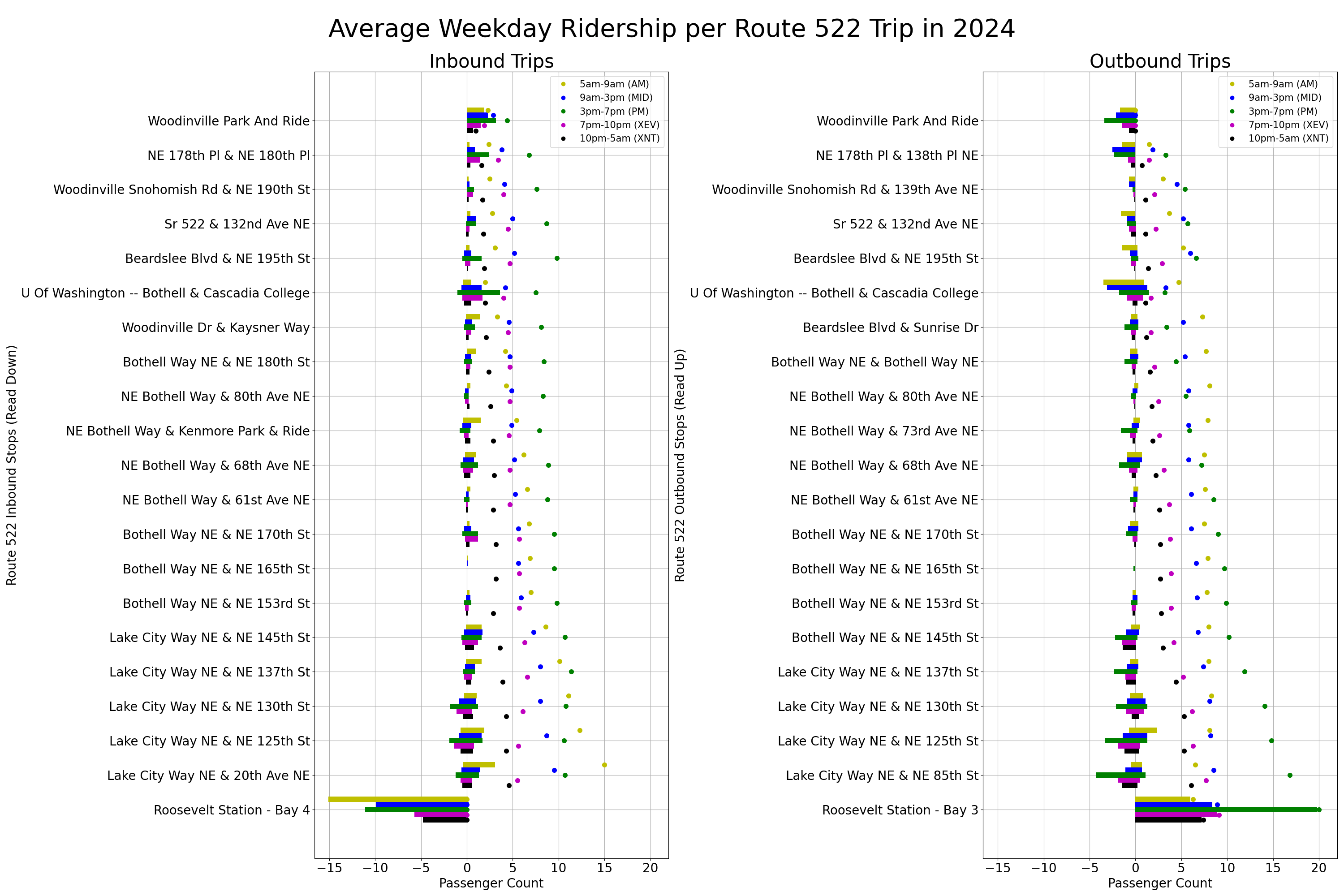
Route 522 is an essential Link connector for Lake City, UW Bothell, and Woodinville. Some observations:
- Route 522’s northern terminus, Woodinville P&R, is located near numerous shops and restaurants in Town Center. This stop is busiest in the afternoon for both inbound and outbound trips with 2-3 passengers boarding/alighting each trip. Metro routes 231, 256, and 931 also serve this P&R. Most morning passengers using the P&R likely use Route 256 (formerly 311) as an express to downtown Seattle. As Route 256 is peak only, mid-day and afternoon inbound passengers use Route 522 instead.
- UW Bothell and Cascadia College operate as an anchor in the middle of the route with a reverse commute pattern. In the morning and mid-day, this stop is busiest with students and faculty alighting from outbound trips. In the afternoon, most passengers board inbound trips. Passengers can transfer here to Metro routes 230, 239, 372, Community Transit routes 106, 120, 121, and Sound Transit Route 535.
- The stops between UW Bothell/ Cascadia College and Lake City are primarily near single family home subdivisions and have lower ridership. Inbound trips have more passengers boarding at each stop in the morning. Outbound trips drop off more passengers in the afternoon. These stops are also served by Metro Route 372.
- Ridership per stop increases as the route enters Seattle at NE 145th St. Starting around NE 149th St, the land use on either side of Bothell Way NE/Lake City Way NE is primarily shops, restaurants, and apartment buildings. Several large apartment buildings are also located one block west of Lake City Way on 32nd Ave NE between NE 135th St and NE 145th St. Ridership at these stops is highest for inbound trips in the morning (1-3 boardings per stop) and is highest for outbound trips in the afternoon (2-3 departures per stop).
- The historic downtown Lake City area spreads on Lake City Way between NE 123rd St and NE 127th St. This area has dozens of shop and restaurants, and a few apartment buildings. Metro routes 61, 65, 75, 322, and 372 also stop in Lake City. The Route 522 stop at NE 125th St has 2-3 passengers boarding inbound trips all day. Outbound trips see the highest number of boardings in the morning, likely from people traveling to UW Bothell. Outbound trip drop off 3-4 passengers on each afternoon trip.
- Roosevelt station is the busiest stop on Route 522. This stop is busier during peak hours, but has about ten passengers board and depart trip each trip outside of peak direction. In addition to the station, this stop is near Roosevelt High School and many shops and restaurants. Passengers can transfer here to routes 45, 62, 67, 79, and the 1 Line.
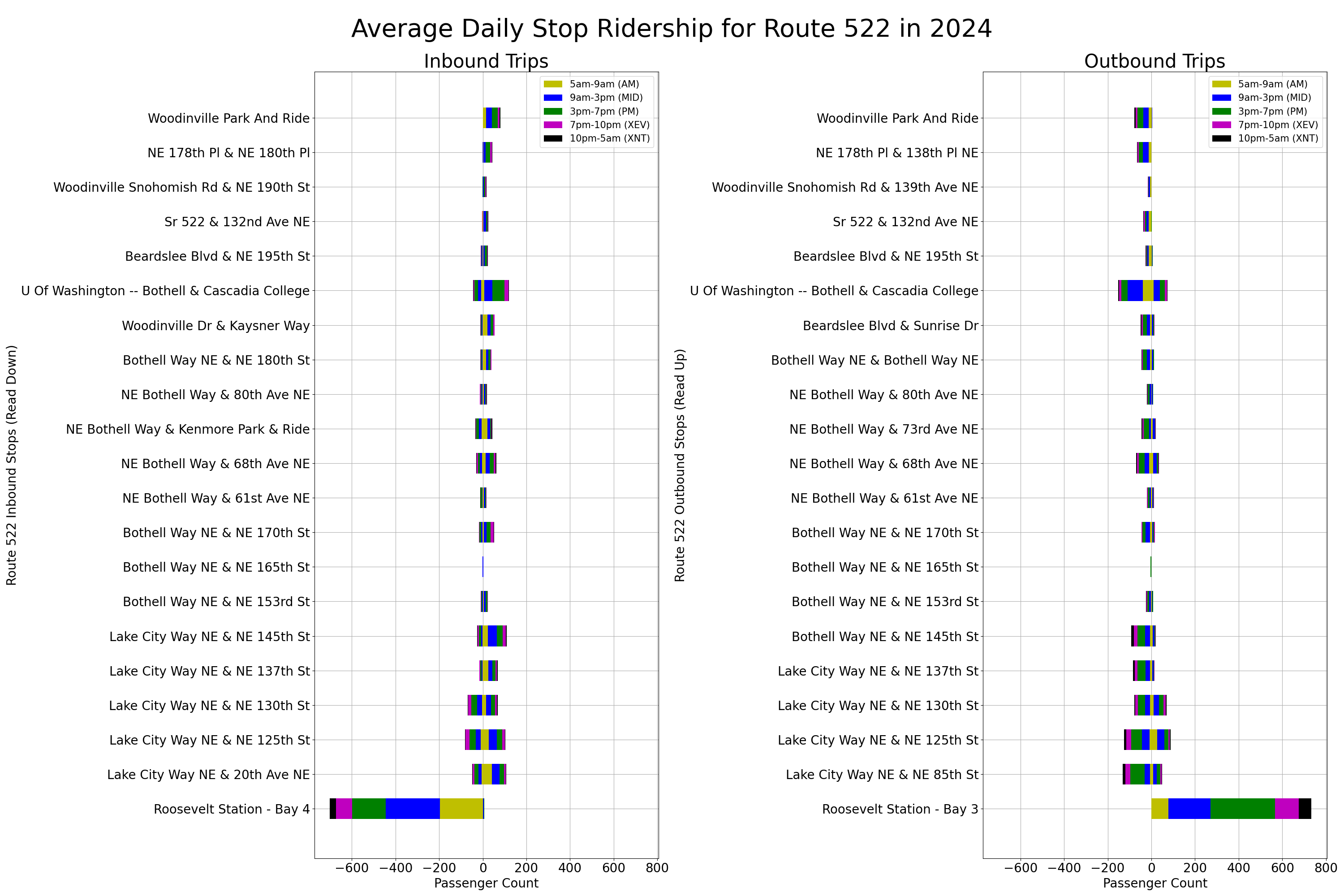
Daily Totals per Stop
Looking Ahead
Route 522 has a few significant changes in the near future. When 2 Line service in Seattle begins (currently planned for Spring 2026), Route 522 will be rerouted to terminate at Shoreline South/145th St station. New Metro routes 72 and 77 will fill in the service gap in Lake City.
In 2028, Route 522 will be replaced by the Stride S3 Line. The S3 Line will follow a similar path to the updated Route 522 mentioned above, but it will be truncated at the future Bothell/Woodinville Transit Center near the I-405 and SR 522 interchange. The new transit center will also serve Stride 2 and other Sound Transit, Community Transit, and King County Metro routes.
Stride S3 has faced local opposition and high cost overruns in Lake Forest Park. Ross Bleakney proposed a solution for these issues in a recent article.

I have lived in Bothell since July 2025 and ride ST 522 nearly every day.
The description of downtown Bothell needs to be updated, since it appears to be based on 2020 pre-oandemic statistics. The town now has a large amount of new large multi-story apartnent buildings and new restaurants are opening every day, based in my observations.
The ride from Bothell to Woodinville, which once was a fast one when Metro 372 would terminate in Woodinville instead of Bothell, now requires a large amount of muilt-looping and gas-wasting maneuvers on 405.. The Woodinville P/R lot that used to serve local commuters is nearly empty now, possibly because former users choose to drive instead of ride?
Stops of ST522 also need to be better aligned to attract local resident users. For example, whereas the northbound stop in downtown Bothell has a perfect location at the end of Bothell-Everett Highway, the southbound stop is about three blocks away (180 (Cougar Way).
The ridership numbers are the most recent ones available, which is starting after the service change of Fall 2024. I believe they average the numbers for six months. So basically this is Fall 2024 to Spring 2025 (definitely after the pandemic).
I agree with your other point, Bothell has grown a lot. It may be a bit hard to read the graph but the numbers are not bad for Bothell (they are a lot better than Lake Forest Park) but they aren’t as good as those on Lake City Way. I see several reasons why this could be. One is proximity. The vast majority of riders are taking this to Link. Riders in Seattle are a lot closer to that Roosevelt Station. Another is competition with the 372. That occurs along much of the corridor but for trips that are not that far (e. g. Bothell to Kenmore) the 372 works just as well. Another is simply timing. A lot of the construction is fairly new — it is possible that the numbers look better now than they did a year ago. There is a pretty big lag time between when people ride the bus and when we have access to stop data.
The 522’s stop pattern in Woodinville feels very strange, detouring to serve a freeway station in the middle of nowhere, while bypassing much of the town center. Is there any reason the 522 can’t just 175th to 131st to reach SR-522, serving stops on 175th St. along the way? Or, perhaps, follow the route of KCM route 231 and take 171st St? This would make the bus much easier to access for people living in one of the many newly built apartments in the area.
I agree. It does seem really weird. The weirdness extends to Bothell as well. Consider a bus coming from Seattle. From the UW Bothell Campus the bus turns around and heads back north to serve the bus stop on Beardslee (instead of continuing south to the highway). There are some apartments there — fair enough. But then the bus gets on the freeway after all. Why? Why not just go straight across on 195th. The potential riders from a stop at 120th Avenue NE seem higher than Beardlee. From there the bus could follow 120th until it become NE 180th Street close to the freeway stations. Then it could continue the route, or better yet, do what you suggested. So that would mean this: https://maps.app.goo.gl/V3eZYWerhHtKCKum8. That seems like a pretty straightforward pathway with a lot more potential in terms of ridership. It is worth noting that the trip up Woodinville Snohomish Road is designed to serve a bus stop that gets less than 20 riders a day.
Of course a change of that nature won’t happen. The future Stride Line will end in Bothell. Who knows what the route will look like in Woodinville but my guess is folks in that large apartment complex on 120th will just be out of luck. They will have to walk to the infrequent Community Transit 121 and the even less frequent Metro 230 (holy cow, I forgot Metro was running buses every hour in some places).
That Canyon Park multi/looping is so odd and fuel-wasting.
CT 120 from Bothell to Lynnwood TC does the same Canyon Park multi-looping.
A couple of time ST522 drivers missed the turnoffs and had to call for help. Once a non-paying rider had to give the driver exact instructions.
The former 372 routing to Woudinville that stopped outside the now-gone Molbak made much more sense and was so much faster.
Being close to Redmond, I am surprised that Woodinville has no service to the ST Link station, but somehow has much Metro service to the Kirkland TC.
The development on 120th is mostly recent. Routes may have been drawn before those were planned. Bothell should have coordinated their land use plan with ST
256 takes a more direct route from Woodinville to its freeway station without going further down on Woodinville -Snohonish road. I asked ST about changing this and they just said they would look into it. They haven’t done anything about it.
The ridership numbers are interesting. Almost all of it involves Seattle. Less than 200 riders travel within the suburbs (Lake Forest Park, Kenmore, Bothell and Woodinville). Over twice that (450) just travel within Seattle. Even excluding the Roosevelt Station, more people take a trip from the suburbs to Seattle than from within the suburbs.
Of course most of the riders (including most of those from the suburbs) are headed to Link. It will be interesting to see the numbers when Sound Transit sends the bus to 148th Station. On the one hand it should rise as with that change comes the end of the 372. Riders who used to take the 372 will have to take the 522. Some will have to transfer as well (which will likely push down overall ridership). But about a third of the southbound riders boarded at 137th or places south. They will have to take a different bus. My guess is the loss of the 372 will counteract the loss of Seattle riders. It would not surprise me at all if ridership on the 522 goes up, even though a lot of existing riders will take a different bus (and many will be inconvenienced).
The higher boarding numbers in Lake City really does make me question the wisdom of the Stride 3 investment.
I think some of the Stride 3 path motivation was to offload some of those Lake City riders that were on the few crowded peak buses. However, taking away those riders appears to tank the likely overall daily S3 ridership.
“I think some of the Stride 3 path motivation was to offload some of those Lake City riders that were on the few crowded peak buses.”
The motivation was to give Bothell, Kenmore, and Lake Forest Park the high-capacity transit they wanted, which was to the nearest Link station (148th). Not enough of them wanted service to Lake City: I don’t recall even one Northshore resident opposing dropping Lake City. All that came from Seattle residents and transit best-practices people (because as Ross points out, Lake City has the highest ridership and density and is on the way). I don’t think Northshore stakeholders’ position was related to bus crowding or “Seattle people” (homeless, violent); they just wanted the fastest way to downtown Seattle and thought 148th station was it.
Yeah, Mike is right. It was a process failure. I get it. I understand why folks in the north-lake suburbs wanted this. It is clear that most of them are headed to Link. Riders may also have assumed that the 372 would follow its current path. It is also quite likely they were never told that the bus could easily provide a one-seat ride to the U-District. But mostly it was a case of focusing only on one set of riders. Parochial interests and all that.
It is great to consider what people want but a transit agency should also consider the big picture. How does this route fit into a future network. If you start thinking in those terms it becomes obvious — send the bus to the UW via Lake City Way.
The funny thing is, this is supposed to be BRT. BRT is supposed to be cheap substitute for Link. That suggests that they would run Link this way, instead of through Lake City. That is just absurd. Why run a train line to Bothell but skip Lake City *and* have riders transfer in the middle of nowhere instead of the U-District?
The crazy part is, this will likely hurt them in the long run. High ridership justifies higher frequency. Until the recent (brutal) cutbacks the 7 ran every 7.5 minutes in the middle of the day. With this route skipping the area with the most riders per hour, it will be hard to justify that kind of frequency, even with the massive investment in right-of-way (and the “Stride” moniker). If you are in Kenmore and you just miss your bus it will suck to wait fifteen minutes (instead of ten) even if the bus takes a shortcut to Link.
It is worth noting that it really isn’t a great shortcut. If your destination is Roosevelt (or anywhere south) it won’t save that much time. Not counting the bus stops and traffic it is about ten minutes faster to get to 148th than Roosevelt. But it takes the train about nine minutes to go between stations. If you left at the same time, you would get on the same train most of the time. Running more frequently would mean you would be more likely to catch an earlier train.
Of course there are bus stops and there is traffic. But nothing will be done about traffic on 145th. In contrast it is quite likely that Seattle would be eager to address traffic on Lake City Way (just as they have addressed it in other parts of the city). You would have more bus stops along the way but with BRT presumably including all-door boarding (and thus short dwell times) that is a minor issue. Ultimately it is quite possible that riders from the north end of Lake Washington would have been better off with a bus that followed the current pathway.
“That suggests that they would run Link this way, instead of through Lake City.”
Bothell Link, if it’s ever built, would terminate at Northgate (ST long-range plan 2008-2014) or U-District (a UDistrict-Bothell-Kirkland concept in the mid 2010s). Both would serve Lake City.
Do you have numbers for the 372 as well? There’s heavy overlap in the northern segment and the 372 seems to do much better overall
Of course! The plots for 372 are below:
Per Trip
Per Day
The ridership patterns for the 372 in Bothell and Lake City are similar to those of Route 522, but Route 372 has much higher ridership around UW.
I live in Wedgwood. My bus is route 79. There is no weekend service. The service is offered once an hour throughout the week. Try to make an appointment that fits that time schedule. You either get there a half hour late or an hour before the appointment. If I were to attend an event in the evening down town Seattle, most events get out after 10:00 P.M. The last 79 bus from Roosevelt Station is at 9:30 P.M. That is not functional.
This is true of a lot of neighborhoods on the north side that are near/past the 85th St. line, in my experience. Of course it has a lot to do with the region being single-family, but there’s also the part where there aren’t former trolley routes that were just maintained as bus lines because they had a constituency that showed up at city council meetings to defend them from cuts.
At the moment though, there’s just not enough density to generate the ridership. That development across from Cafe Javasti and the laundromat is a start. A few more buildings like that and it’ll be hard to deny the need for better service.
Yeah, the density isn’t quite there. Mike is right though, with a little bit more money they could justify running it every fifteen minutes. It is a borderline bus route. The same is true for buses in various places (e. g. Madison Park, top of Queen Anne, Magnolia, a lot of West Seattle). With a decent restructure and just a bit more money I think it is possible that all of Seattle can have fifteen minute or better service midday. I suppose there are still some places where it would be a challenge (e. g. going from a peak only 57 to running it as often as the 21). But it doesn’t seem out of the question, especially if we are willing to change some routes (e. g. the 57 could go from being an express to downtown to a connector bus to other express buses).
Route 79 exists because of decades-long calls for bus service on NE 75th Street, and to backfill NE 55th Street (earlier routes 30 and 74). 75th never had bus service (or at least it didn’t when I visited somebody there in the early 80s). 55th lost service in the 2014 recession cuts, then gradually regained it. Metro’s long-term vision had service on both streets. Metro created the 79 to address these needs; I think in 2022.
But Metro has had a driver shortage since 2022, so it can’t operate all the service it would like to. It has to distribute the available drivers as best it can to serve most of the city’s needs even if it can’t serve all of them. And the 62, 65, 75, and 372 are higher priority than the 79.
Does John live somewhere where walking to one of the other routes is infeasible?
“At the moment though, there’s just not enough density to generate the ridership. That development across from Cafe Javasti and the laundromat is a start. A few more buildings like that and it’ll be hard to deny the need for better service.”
Density is not an absolute reason; it’s just a contributing factor. Metro doesn’t have enough service hours to fill in the 79’s gaps and meet all the bigger needs in Seattle.
Even if 75th gets more apartments and retail, it may have to wait two or three decades after that to get more service. Because lowish density doesn’t automatically mean no weekend service; and higher density doesn’t automatically mean getting it. It just raises the area’s relative priority compared to other neighborhoods, maybe.
It’ll be interesting in the future the bottom third (south of me 125th) https://cdn.kingcounty.gov/-/media/king-county/depts/metro/documents/projects/lynnwood-link-connections/routes/077.pdf will be route 77 from Pinehurst station to Roosevelt and U district.
While the top third will continue as stride 3 brt heading to shoreline south station
Route 77 is flawed: it doesn’t address riders going from north of 125th to south of it, or east of Lake City Way to west of it. The bus stops will probably be inconveniently far from the northeast corner of 125th & LCW, the hub of the neighborhood. And from transfers from the 75 and 72 (372). This will depress ridership from its potential, and make some current bus trips harder.
What we really need is a route from Roosevelt station to at least 145th (with a good transfer to Stride 3), and to reroute the 75 west on 125th to Pinehurst station and Bitter Lake. Earlier Metro concepts would have done that with the 75, but Metro inexplicably retreated from it for some unknown reason, maybe because of opposition to losing bus service on 5th Ave NE. Also, an earlier 65 concept would have continued from Shoreline South station to 155th and Shoreline CC. That was also lost in the restructure we got, with no explanation as to why.
Yes, the 77 is flawed for many reasons. But the future 522 is flawed as well. The current routing is better and could be made even more attractive with an extension to the U-District. Turning at 145th adds transfers and duplication — a really bad combination. That is because the geometry is wrong. Lake City (the neighborhood) is more than a relatively dense area with high ridership. It is also a major hub. There are eight major transit corridors that converge at 125th and Lake City. Several of these overlap but they still converge there. The only pair of corridors that could be combined are 30th NE (Metro 65) and Lake City Way (372). That still leaves seven corridors. By turning the 522 before it reaches this major hub it forces awkward choices upon the rest of the network. Either send every bus all the way to 145th or live with three-seat rides. Then, when you get to 145th you can’t just stop there. The only layover is over by 15th NE. That means overlap. Overlap costs money.
So they did the best they could. The 65 and 72 will go up there. They will go all the way to the 148th Station which means not just a pair of buses overlapping (or overlapping for a few blocks) but three buses all operating on a long, not particularly dense roadway. But the 61 (coming from Northgate Way) and the 75 (from Bitter Lake) won’t go up there. Riders will have to transfer twice to go from places like Sand Point Way or Northgate Way to Bothell Way.
This is Sound Transit shooting themselves in the foot. It is rare for a bus to travel along a major north-south corridor that ends up connecting very well to Link, let alone Link and a major destination (the UW). Head down Aurora, Greenwood or 15th NW and you have to detour to connect to Link. Sand Point Way and 35th NE do converge into a Link station but it is extremely awkward and time consuming. There is really only one major north-south corridor (Bothell/Lake City Way) that does this. If you just keep heading south (and don’t get on the freeway) you run smack dab next to a Link Station! How great is that. If you keep going you get to the UW! Yet ST didn’t want to take advantage of a fantastic corridor. They instead chose a route that at best should be an express overlap during peak (when the main bus is running every five minutes).
I know the politics behind this — I’m just saying it was a big mistake. Oops.
For 2300 weekday boardings per day there will be an expensive BRT line with some major road reconstruction? Why?
Obviously, the short answer is “politics” and “Subarea Equity”. But, wow, what a waste of resources. Not as bad as WSLE, for sure, but head-shaking nonetheless.
Yeah and for no real gains too. ST advertises that spending a billion on new buses; bus stops; a huge concrete retaining wall in LFP; removal of hundreds of trees; displacing people from homes and closing businesses will save potential riders a few minutes. The work for ST3 on 522 is just ST “rebranding” since it doesn’t change anything for riders except going to 148th station. This is a gigantic waste of money and only negatively impacts the public. This project pisses me off so bad knowing that people lost their homes for no good reason other than for politicians and ST to virtue signal about results/benefits that will never happen.
The #372 does NOT run the same distance every day; the route terminates at 130th and Lake City Way on weekends and holidays. Anyone needing to get to Bothell from 130th and Lake City Way on weekends and holidays has to transfer to ST 522. That’s already a problem for some of us; re-routing ST 522 just adds to that problem. If I’m reading the article aright, a re-route of ST 522 will likely make it even more time-consuming and difficult to get to Bothell on those days.
With the revised 72 and 522, the schedule will be the same 7 days/week. You will have to take the 72 from Fred Meyer at 130th to 145th/30th to transfer to the 522. The main difference is that on weekdays, there were two different 1-seat routes, while on weekends there was only one 1-seat route. But essentially, it’s a double penalty in terms of frequency and connections trying to travel across 145th.
The #372 does NOT run the same distance every day; the route terminates at 130th and Lake City Way on weekends and holidays.
Correct. But the ridership numbers are for weekdays, so for these numbers the 372 can be thought of as always going to Bothell.
re-routing ST 522 just adds to that problem
Absolutely. There will be more transfers and the transfers will be more awkward (as Larry mentioned). But hey, at least it will be consistent :)
(Sorry, a little gallows humor there.)
In one of Community Transit board meetings, they mentioned that they are working with ST and Bothell to finalize the design of NE 185th transit corridor. It sounds like both SWIFT Green and S3 will run on that. It is nice they collaborated on that.
Why can’t they make this change to 522 sooner?