Seattle Subway is an all-volunteer, grassroots organization dedicated to promoting high quality transit for Seattle and the Puget Sound Region on the fastest possible timeline. Posts are generally written by the Seattle Subway Communications Team. Seattle Subway is a Washington State nonprofit corporation, pending application as a 501(C)(4).
Sound Transit recently delivered some disappointing news about their estimates for ST3 project costs. When paired with decreased revenue due to Covid-19, the projected 50% increase to Ballard and West Seattle cost estimates present a gloomy outlook for the projects. There is a lot of hard work ahead, but it’s still possible for Sound Transit to deliver the high quality system voters approved. Transit improvements are still essential to our city and these projects must be delivered. We need to look hard at a combination of new funding sources and value engineering to get this plan back on the right track. However, making major decisions about the quality, scope, and schedule of ST3 this year is a mistake with long reaching consequences.
The underlying reasons to build transit in Seattle haven’t changed. Seattleites still want fast, reliable, convenient, low-carbon ways to get around the city. Voters have repeatedly reaffirmed their desire to make progress on transit — including November’s vote that passed by over 60 points in the middle of a pandemic. Seattleites believe in a post- pandemic future, and we need to make sure Sound Transit delivers the progress they demand.
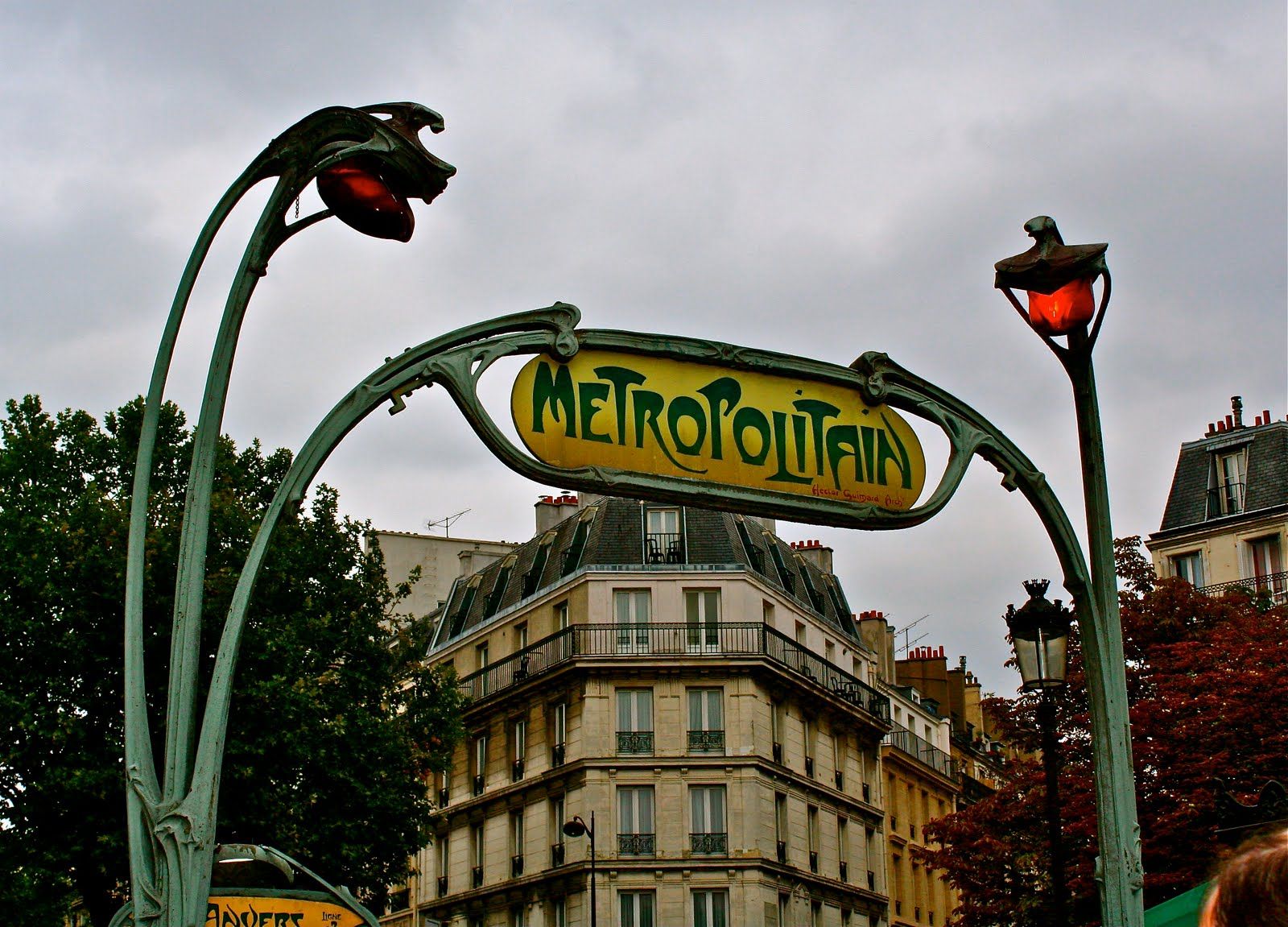
Paris, the City of Lights…and Transit and Urban Form! (Credit: Alissa Smith, Hope College)
As a result of the COVID-19 pandemic, questions about whether transit will thrive post-pandemic have been floating around. In our long term view, the human tendency to gather and the need for urban mobility has not gone away. While the pandemic has paused life for a while, and Zoom has made working from afar possible, none of that has changed human nature, or radically affected the tools we need to combat climate change.
Our species still requires connection. If history is any indicator, post-pandemic we will still have social events, shop in urban villages, and cluster where other people are. We will do these things because we are hardwired to value them. Not only does human nature point to this need for cities, climate science demands we double down on them. Don’t just take my word for it—let’s dive into a city doing it right.
The (thankfully) ex-First Lady likes to say “Be Best.” On transportation, we just say “Be Paris.”
Last Friday, the Seattle City Council Transportation committee met and passed an initial round of amendments to a proposed Transportation Benefits District (TBD) on to full council. The last amendment, to increase the funding from 0.1% to 0.2% sales tax, was proposed by CM Tammy Morales and eventually withdrawn so that council could have more time to consider and get feedback from their constituents.
Though we agree with the concerns voiced in council that adding a regressive sales tax is not ideal, the proposed plan would cut TBD service funding by 75%: a far more regressive outcome. This funding is needed to maintain bus service that an increasing number of Seattlites will depend on just as we try to recover from a recession that is hitting people with lower incomes the hardest.
This change means replacing the $60 Vehicle Licensing Fee (VLF) from 2014’s TBD with a 0.1% sales tax, which will still represent a tax cut for households with lower incomes who own a car. A household would have to spend $60,000, not including rent or groceries, to match the VLF for one car. For lower income households that already fully rely on transit, cutting service could be devastating.
Full council is meeting next Monday, 7/27, to finalize the package that will appear on the ballot. Please join us in letting the City Council and The Mayor know that you support the full .2% TBD and emergency funding for transit next year using this quick form.
The most progressive change we can make to the proposed Seattle Transportation Benefit District (TBD) is to make it larger. Even if we focus on funding transit service as we urged last week, the initial proposal of a .1% sales tax with nothing to replace the current $60 Vehicle Licensing Fee will mean big transit cuts. Those cuts won’t be academic, they will mean cutting critical service just when many Seattleites will need it the most.
After I-976 passed last year it took away the city’s ability to include a Vehicle Licensing Fee as part of the new TBD. This would mean about a 50% cut to the TBD funding in normal times, but in the post Covid-19 recession, the cuts are much bigger. Sales tax receipts have fallen off a cliff and the recovery could be slow. We should be looking to use all the funding available in the TBD, the full .2% sales tax, so that we can return service after as the recession wanes – but we should also be looking for emergency funding for next year.
Though sales tax is a regressive funding source, it’s far better than cutting the transit people will increasingly rely on. This recession is hitting people who were already struggling to afford Seattle the hardest. About 19% of Seattle households don’t own a car and that number will almost certainly rise – cars are expensive. Inaction means forcing people on a tight budget to buy a car or continue to maintain a car because transit doesn’t serve their needs.
Metro should also be looking to structure service to match the demand that exists rather than demand that used to exist. Focus funding on supporting people trying to get to jobs that don’t conform to 9-5 schedules downtown. Transit needs to be flexible and support people’s individual economic recoveries.
We have to think about this in post Covid-19 terms. This is a ballot measure for November with funding that won’t start until April of 2021. As the pandemic fades and more people have to rely on transit, demand will go up sharply. Our transit agencies will need to be responsive and meet that demand where it is – and have the funding to back it up.
We should also be looking to improve transit funding for the future. The legislature has the power to enact progressive options for future transit funding packages. A future TBD should be at the King County level and use a progressive funding source. That work needs to start now so that we’re not having this same conversation again in a few years.
There is a Seattle City Council meeting on the proposed Transit Benefit District this morning at 10 am. Please join us in urging the council to be bold and save our transit by:
Increasing funding as much as possible (both .2% sales tax and emergency 2021 funding);
Focusing funding on Transit Service; and
Structure transit service to better serve the needs of people who are transit dependent
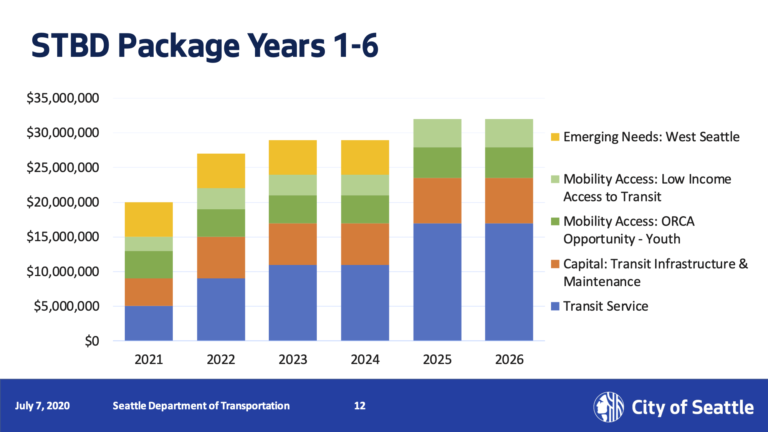
This week, a new proposal for a Seattle Transit Benefit District (TBD) was released by the mayor’s office. As presented, it’s about half the size of the 2014’s wildly successful TBD that contributed to our US leading ridership growth. Putting aside our desire for a larger measure, we have major concerns about what was included in this initial proposal. The primary focus of this transit service measure has to be funding transit service.
Let’s turn those orange bars blue
We take issue with the capital spending in this proposal. “Transit Infrastructure & Maintenance” somehow includes fixing potholes. Major sources of road funding are restricted and can’t be used for transit so we have to guard what precious available transit funding we have against becoming another bucket for road maintenance funding. We also question the other fuzzy goals of the capital section. We already funded signal priority and spot improvements with Move Seattle, though these are generally good goals, being general just isn’t good enough when funds are this tight.
This measure has to be about emergency funding for transit service. We can make this measure better by moving the money allocated to capital to transit service. That change would increase annual service funding by 52% vs the proposed plan.
While we would have preferred a larger measure to build on what the 2014 TBD accomplished and provide more service for essential workers, we understand that it’s a difficult time for people and a regressive tax is a hard pill to swallow. We think funding transit service with a regressive tax is progressive on balance, but know that the politics are difficult right now. As we come out of this uneven recession more people will have to rely on transit, cars are expensive and bills related to cars can be a lead weight on the finances of someone who is already struggling.
This measure can be a lifeline for people. It can fund critical transit that will help people get through this difficult time. Including funding for West Seattle, Low Income Fares, and fares for students are all good decisions and work towards that goal. We have to be smart about how we allocate funds in this new reality, and the proposed capital funding just doesn’t meet the current need.
Please join us in testifying to council the need to remove the capital funding from this proposed measure and use that funding for vital transit service. You can sign up to testify tomorrow, 7/10/20, starting at 8 am.
For the next ten weeks, Link riders will have to contend with infrequent trains, a forced transfer in Pioneer Square, and weekend closures to prepare for Northgate and East Link Expansions. These delays and closures could have been avoided by building for future expansion originally rather than planning and authorizing the system piecemeal. This time, the costs and impacts of the rework are relatively minor, but the consequences of this approach will be severe for future expansions unless the course is corrected.
Before Link opened in July of 2009, Sound Transit closed the tunnel to install tracks, power, and systems in preparation for bus/train operations. Plans were considered for expansions to Northgate and east to Bellevue, but the ballot measure to authorize that expansion, ST2, didn’t pass until November of 2008. Not enough time to plan and execute changes to future-proof the tunnel for expansion.
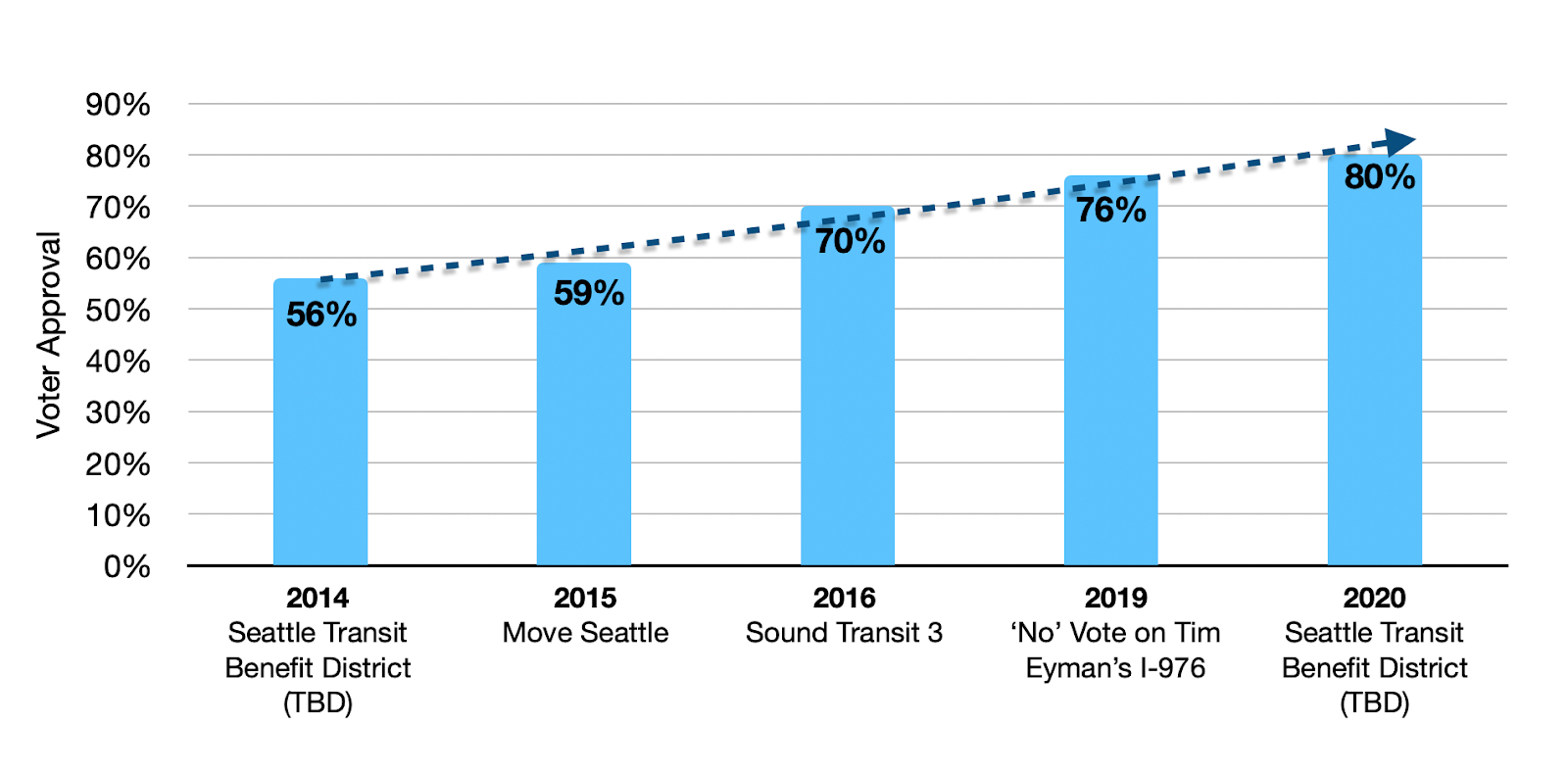
Seattle voters couldn’t be more clear: They demand better transit and they are willing to fund it. Tim Eyman’s I-976 was demolished in Seattle, losing by over 3-1. This follows huge victories in Seattle for transit in 2014 (Seattle TBD), 2015 (Move Seattle), and 2016 (ST3.)
Despite repeated and very clear messages from Seattle voters, Washington State dedicates virtually zero funding to transit. Worse, the State doesn’t properly enable us to fund our own transit.
Since ST3 passed in 2016, most of the debate in the state legislature has centered on various schemes to cut MVET funding, when it should have been centered on finding better ways to fund transit. Voters in the Sound Transit district proved that by voting no on 976 by nearly the same margin they voted yes on ST3 in 2016. That result was in spite of an off year election which meant low turnout which typically trends conservative in most of the district.
Aurora Line conceptual rendering (source: Seattle Subway)
Aurora represents an incredible opportunity for transit expansion. The four urban villages north of the ship canal carry a massive capacity for recently upzoned density. The huge lots of big box stores that dot the landscape are a prime target for Transit Oriented Development. Grade separated transit will allow the street to feature wider sidewalks and fewer lanes. The Aurora that can be is a place the Aurora that is wouldn’t even recognize.
Transit on the Aurora corridor is already a huge success. Aurora carries over 32,500 daily riders in packed buses, including the E line, the busiest bus in the state. It’s clear that even more people will choose transit when we add the speed, reliability, and comfort of Link to the equation.
People love riding Link. The more Sound Transit builds, the more Seattle votes with our feet. But planning and building expansions can take decades. It’s clear that we need Link expansion beyond what is currently planned, and our rapidly growing city and the burgeoning climate crisis demand we take action without delay. That’s why it’s time for Seattle to start working on ST4, the next round of Link rail expansion.
Looking ahead to the completion of ST3’s Seattle expansions in 2035, we see a city that has made huge strides building high quality transit but still lacks a comprehensive subway system. It’s a system that will still have frustrating gaps, lacking stations in our densest residential neighborhoods like Belltown and First Hill. We must think bigger and bring service to the entire city. A true Seattle Subway means being able to catch a train in Georgetown, Wallingford, or White Center and take a ride to Lake City, Crown Hill, or Fremont. ST3 is a huge step forward, but it falls well short of the vision of ST Complete, the vision of a Seattle fully connected by high-quality transit.
Seattle can’t afford to wait; it is imperative that we take charge of our future. Seattle is adding more residents than all King County suburbs combined. Our next expansion vote should come in 2024, on the heels of the opening of major expansions to Northgate, Bellevue, Redmond, Federal Way, and Lynnwood. More people than ever will be riding Link. More people than ever will be asking: Why can’t we have Link in our neighborhood? We must be ready with the best possible answer: You can.
In our last post we asked the Sound Transit Board to focus on elevated West Seattle options for ST3. A tunnel would lessen impacts but $700 Million in Seattle transit funding is far better spent on transit expansion. The focus for the ST3 planning process should therefore be to craft the best possible elevated option.
There are two elevated options presented by Sound Transit:
The representative alignment on Fauntleroy with a station to the east if the Junction and tail tracks nearly reaching the junction.
An elevated alignment that curves through the neighborhood north of Fauntleroy in order to orient the station north/south on 41st.
Elevated options shown in red and orange
Both options will score high on reliability and, with details done right, high on accessibility.
Unfortunately, the first option has a fatal flaw on expandability. Expansion to the south would require crossing California for elevated tracks continuing south on a street to the west. Per Sound Transit, the line would then need to cut back across California at some point to continue south. The property impacts are big enough to make this extremely unlikely. The Junction stop would become the permanent end of the line.
The second option orients the station north/south on 41st (good) but instead of being on an arterial, cuts through the neighborhood at an angle which requires the line to impact the most existing housing of all the proposed alignments. Though we prioritize transit and future transit riders above all other concerns – we can understand why people would not be excited about this option.
With those things in mind, we’d like to put forth a third, “mix and match,” alignment that addresses the weaknesses of both options.
The new elevated option would follow the Fauntleroy alignment to Alaska but take a sharp turn onto 41st. Though sharp turns are generally not ideal, they are part systems worldwide (check out the NYC Subway south of Central Park) and one right next to a station where the train will already be moving slowly will have minimal impacts on operations.
We need to think about the future when making an investment of this scale. Looking at the Sound Transit’s HCT study work, an elevated line to the south of The Junction is likely to be a better investment in terms of capital cost per weekday rider than the line to The Junction itself. It would be an entirely separate process, but see C5 (pages 10-11) in the HCT study for a sense of what that extension could be and how it would perform.
It is our strong opinion that funding a West Seattle tunnel is both a poor use of transit funding and, to put it bluntly, not going to happen. It’s time to look past that distraction and find an elevated option that works for West Seattle transit riders – both now and in the future.
You have until April 2nd to comment on the ST3 level 3 options online. Join us in urging the Sound Transit board to advance an elevated West Seattle option designed for future expansion.