Comment Soon on the Lynnwood Link Bus Restructure

We have until this Friday, March 10th to comment on the Metro Bus Restructure for Lynnwood Link. I’ve written about the initial plan, made suggestions and explored ideas on the subject. Here are my recommendations, in order of priority:

  1. Run a bus on Lake City Way to make up for the loss of the 522. This is important from both a ridership and coverage standpoint. The simplest and cheapest way to do this is with a live loop through the Roosevelt neighborhood.
  2. Send the 348 to the UW, not Northgate. This eliminates the need for the 67, saving money. Riders lose their one-seat ride to Northgate, but gain a one-seat ride to the UW. The station at Roosevelt replaces Northgate for riders heading south.
  3. As a way to save money, eliminate the proposed 324 and cover the area between Kenmore and Bothell with an extension of the proposed 334.
  4. Extend the 72 to Shoreline Community College, and truncate the 333 there. This improves connectivity. This is also a more natural fit in terms of frequency, as the rest of the 333 is a coverage route (while the 72 is not).
  5. Straighten out routes to avoid long delays caused by turning.
  6. Avoid running infrequent routes that overlap or compete with frequent transit.
  7. Put the savings from the various cost saving changes mentioned above into better frequency, especially on east-west routes that run on the main transit corridors.
  8. Explore extending the 61 to 15th NW, with a live loop like so. The bus would then intersect every north-south bus north of the ship canal. This would be especially handy for trips to Ballard from Northgate and Lake City.

To visualize these changes. I came up with two maps, the first of which is oriented towards ridership:

While geared towards ridership, it actually provides better coverage in many places. From a baseline standpoint, most of the buses would run every fifteen minutes or better. The 75, 333, 334 and 336 would run every half hour. But since this has a lot less overlap, and a lot fewer turns, the buses could run a lot more often. East-west service (on buses like the 61, 72, 348, etc.) could be bumped up to 12 or 10 minutes. Some of the half-hour buses buses could run more often. For example, the 334 could run every 15 to 20 minutes to give Northwest Hospital more frequent service, while the 75 could be restored to its current service level (15 minutes).

The second map is geared towards coverage:

This is similar to the other map, but with a few changes. The 336 provides a lot of additional coverage. Service is restored in the Hillwood neighborhood (west of Aurora Village). The bus loops through the Briarcrest neighborhood, passing by a high school, middle school and several elementary schools. The 333 is extended to serve Four Freedoms House. Despite the extra coverage — more than the Metro proposal — it would still have better frequency, as there is less overlap and more efficient routing.

33 comments

News Roundup: Metro Taxis

Metro will expand its on-demand taxi service ($). (Official announcement.) These are app-hailed vans like Uber, charging regular Metro fares within a few last-mile service areas. Starting Monday, It will unify existing services (Via, Pingo, Community Ride) under a new brand “Metro Flex” wth a new app. Service areas are “northern Kent, Tukwila, Renton Highlands, Rainier Beach/Skyway, Othello, Sammamish/Issaquah Highlands and Juanita.” You can pay by ORCA, credit card, or the Transit Go Ticket app. Reduced fares like ORCA LIFT are accepted.

King County repealed its bicycle-helmet law a year ago, but helmet usage remains high. ($) I didn’t know it was repealed.

Amtrak Cascades restores full Vancouver BC service. ($)

Why new developments are ugly. (Adam Something video)

This is an open thread.

216 comments

News Roundup: Get Link Done

Get Link done ($), says ST’s Technical Advisory Group in a report to the board. The group suggests taking a harder line against local government requests, and treating contractors better.

Reconnect South Park gets grant to study removing Highway 99 through the neighborhood.

Zoning, Explained (City Beautiful)

New York state considers joining the zoning-override bandwagon ($) to get more housing, especially in New York City’s suburbs.

Malls are adding housing ($)

Spain’s high-speed rail network (RMTransit)

Empire Builder ($), a documentary about James J Hill, founder of the rail line from Seattle to Chicago.

This is an open thread.

178 comments

Seattle Transportation Plan: How to achieve a 15min city with the help of ultra-high frequency transit

Seattle is currently soliciting input until the end of February for phase 2 of their Transportation Plan engagement efforts: https://seattletransportationplan.infocommunity.org/ – Seattle should strive to become a city of 15min neighborhoods and if necessary use ultra-high frequency transit such as urban gondola lines, people movers, funiculars or 3min BRT lines on dedicated lanes to bridge the gaps.

Continue reading “Seattle Transportation Plan: How to achieve a 15min city with the help of ultra-high frequency transit” | 220 comments

Cities can’t rely on employer RTOs to recover

Photo by author

Last week, Amazon announced a three-day return-to-office (RTO), sparking muted fanfare among the downtown business community but backlash from its workers. Starbucks announced a similar policy several weeks back and it remains to be seen what the long-term trend will be for major employers in our region.

I’ve been thinking a lot about the post-pandemic recovery of cities and transit. Pessimists are calling this the death knell of cities as we know it while optimists envision an opportunity to reinvent our whole concept of the city. The one thing obvious to both camps is that a complete return to the pre-pandemic state is a virtual impossibility.

A successful RTO by Amazon and other employers will undoubtedly provide a short-term boost to downtown life and transit ridership. But it would be foolish for cities to hang their hat on RTO mandates. Some companies will go back mostly in-person, some will stick to mostly remote, and the rest will be somewhere in-between. A hybrid world is our most likely future state.

The silver lining is that mass remote work was likely going to happen at some point so it’s not like this is some inconceivable future that no one thought of.  That said, planners would have been graced with a much longer time scale in a pandemic-free world. That benefit has evaporated with the system shock brought on by COVID.

If the pandemic made anything egregiously obvious, it’s that American cities were just built wrong. We often cast this indictment on the suburbs but it holds equally true for downtowns. The idea that we zoned the hearts of our cities to only accommodate a flood of workers within a 10-hour period each weekday seems comical now, but it’s a reality we have to contend with.

Moving forward, there are certainly practical questions, like the viability of converting office space to residential or rightsizing transit investments. But beyond the practicalities, it’s worth looking to our friends in Europe or Asia, where dispersed density has been the model of urbanism for hundreds of years. Even if downtowns will never be the same again, their loss is every other urban neighborhood’s potential gain.

128 comments

Seattle Bus Restructure for Lynnwood Link

This is another in a series of posts about the bus restructure following the Lynnwood Link extension. This one is geared towards Seattle, although the maps include north King County as well. As before, they cover a number of themes. There is one additional theme worth mentioning:

  • Whenever possible, overlapping buses should increase frequency on worthy areas.

There are advantages and disadvantages to this approach. If timed, the routes can form a nice branching system, where the “trunk” has justifiably more frequency than the “branches”. However, timed branches tend to be “brittle”, in the sense that any change requires a similar change on each branch. For example, the 347 and 348 each run every half hour, but combine for 15 minute headways along a popular corridor. We can’t improve frequency on the 348 to 20 minutes without doing the same for the 347. Otherwise service would be worse for that shared section. In contrast, with enough buses along a common corridor, they can form a “spine“, where timing is not important. But you need lots of buses to get to that point.

Challenging Neighborhoods

There are several neighborhoods in northwest Seattle that are challenging to cover. The first is the Haller Lake neighborhood. Other than Northwest Hospital, this is a very low density area (for Seattle). The hospital is especially difficult to serve (it isn’t “on the way“). Northwest Hospital has surprisingly poor ridership, but that may change over time, given its expansion. I came up with at least a half-dozen ways of connecting it to the network, but none of them are particularly satisfying.

The Four Freedoms area, in contrast, has a lot more riders. My guess is there are plenty from the facility itself as well as surrounding apartment buildings. This particular part of town (close to Linden, between 125th and 145th) is one of the more densely populated north-end neighborhoods, and it continues to grow. The 65 will serve some of the riders, and a stop at Four Freedoms House would complement it nicely. However, detouring to the stop is just not worth it. It makes more sense to end a route there, if possible.

Finally, there is Broadview. It isn’t that far from Broadview to the 130th station, but I couldn’t find a combination that was worth it. Like Metro, I find it hard to justify service there, unless the city (or county) had better overall coverage.

Austere Proposal

As with the previous maps, you can make it full page (in its own window) by selecting the little rectangle in the corner. There are a lot more routes, so I put them in different “layers”, visible on the legend (to the left). Thus you can hide or display the unchanged routes or those that are the same as the Metro proposal. Selecting individual routes highlights them. Feel free to ask questions in the comments if you find it hard to understand (there are a lot of lines).

The baseline frequency for these routes is 15 minutes. The exceptions are the 333, 334 and 336, which would run every half hour. It is worth noting that the word “austere” is a bit misleading. This covers less of the city than the “robust” map (although more than the Metro proposal) but that doesn’t mean it is worse. It has fewer routes and the routes are faster. Thus for the same amount of money, many of these routes could run a lot more often. I would especially like to see better headways on the east-west routes (like the 44, 61, 62, 65, 72 or 348). I could see many of these routes running every 10 or 12 minutes.

Most of the routes are the same as the previous austere map (for north of Seattle). The exceptions are:

  • 76 — The simplest way to cover this part of Lake City Way.
  • 348 — Sent to the U-District instead of Northgate. This saves money, as there is no need for the 67, and the bus spends less time making turns. Riders lose their one seat ride to Northgate, but gain a one-seat ride to the UW. I expect riders on the main cross streets (185th, 145th, 130th) to take an east-west bus to a Link station (that is much faster to access than Northgate) while those in between those cross streets access Link via 185th or Roosevelt Station.

Robust Proposal

With the “robust” map, there are a couple additional modifications:

  • 46 — Northwest Hospital is still connected to Northgate, but via 5th Avenue NE, which means a faster connection from the hospital to Link.
  • 76 — Extended to Four Freedoms.

Several routes are combined for good headways along major corridors, while increasing coverage. The 65 and 76 combine for 7.5 minute headways along 125th/Roosevelt/130th corridor, similar to how the 344/346 and 348 combine along 185th.

Likewise, the 46 and 346 would run every half hour (opposite each other) for combined 15 minute headways along 5th Avenue NE. They would then combine with the 61 (running every 15 minutes) for 7.5 minute headways between 5th Avenue NE & Northgate Way to the station.

As with the previous proposal, there are a lot of options, and I would like to hear what people think in the comments.

61 comments

News Roundup: Cars Running into Buildings

Following a Seattle Times article, the Seattle Bike Blog joins the discussion. (I think the buildings should wear more visible clothing, and stop talking on their phone.)

The Urbanist looks at Sound Transit adding retail to the stations.

There will be some late night work on the Link rails starting tonight. For a complete list of Sound Transit service alerts, check here.

Metro Transit looks to the future (Seattle Times article).

Streetsblog writes about the importance of transit to community colleges.

This is an open thread.

93 comments

The case for Automated Light Metro Technology for Ballard and South Lake Union

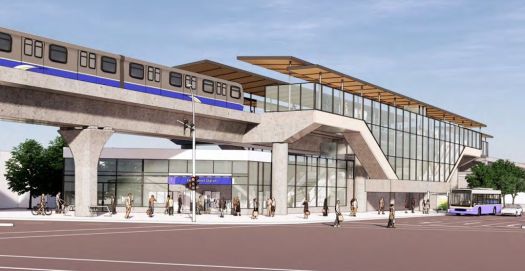
Sept. 2020 rendering of 160 Street Station on the Surrey-Langley SkyTrain Extension. (TransLink)

ST3 passed enthusiastically in the Seattle region because voters were excited to get mobility improvements. However, Sound Transit has had trouble coming up with compelling designs to deliver on this promise. To address this problem, we should revisit some of the design assumptions.

Vancouver’s SkyTrain and Montreal’s REM took far less time to design and construct. We can learn from them and adopt automated train technology. If Sound Transit would interline trains in the existing tunnel and keep the Ballard to Westlake line separate, the new line could use different technology.

Continue reading “The case for Automated Light Metro Technology for Ballard and South Lake Union” | 249 comments

Ask Sound Transit to Study Sending Ballard and West Seattle Trains Through the Existing Tunnel

The deadline for comments on studies for the West Seattle and Ballard Link extensions is today. Please ask the board to study sending the trains into the existing tunnel, rather than building a new one.

Benefit to Riders

From a rider standpoint, reusing the existing tunnel would be fairly simple. All the trains would mix, just as East Link will mix with the main line. Transfers would be much better. Same-direction transfers would be trivial (e. g. Rainier Valley to the UW). Simply step off the train and wait for a different one (on the same platform). Even reverse direction transfers would be fairly easy (e. g. Seattle Center to the UW). Just go up and over, using the existing stairs, escalators and elevators.

In contrast, the proposed transfers vary from bad to terrible. Simply going the same direction could take anywhere from three to five minutes, maybe worse. For many this will mean a new, onerous transfer (e. g. Rainier Valley to the UW). For others, an unnecessary hindrance to the new addition. Someone going from downtown Bellevue to Denny might very well ignore the new tunnel and new line, given the poor transfer experience.

Travel to and from downtown would be worse for most riders as well. The stations in the new tunnel are not as good as the old ones. They are deeper, and there are fewer of them. The vast majority of riders, given the choice, would prefer using the stations inside the old tunnel.

Possible Issues

Sound Transit has expressed fear that the trains downtown would simply be overloaded. I seriously doubt it. As a city and a nation, we are rapidly becoming less peak-oriented. There is still a rush hour, but from a transit standpoint, a smaller percentage of trips occur during this time. With some work, it is quite possible the trains could run every 90 seconds, according to Sound Transit. Even running them every 2 minutes would provide the same potential throughput (30 trains an hour through downtown) as a second tunnel could provide. Running the trains more often would require elevating or burying the tracks in Rainier Valley — something Sound Transit has never even considered. But it is also quite possible that we never see 6 minute trains in Rainier Valley anyway, which means the downtown tunnel could handle the extra load with ease.

In the highly unlikely event that we do have capacity issues during rush-hour, there is a very simple, much less costly solution: run express buses. There are plenty of riders who would love to have their express buses back. You wouldn’t need to bring all of them back, just the ones that have proven very popular. For both train and bus riders, reusing the existing tunnel is better.

Sound Transit has suggested that getting rid of the tunnel would be “Not consistent with ST3 plan”. If find this hard to fathom, given they are studying the elimination of stations like Avalon and Interbay (Dravus). Unlike those changes, this would actually be better for riders, not worse. To the extent that people even care about a new tunnel, I’m quite confident they prefer better transfers with better downtown stations.

There are other technical issues that may make it difficult to reuse the tunnel. That is why a study is needed. It is possible that mixing the tracks (otherwise known as interlining) is more disruptive and expensive than adding three new stations (and a tunnel). I doubt it, but stranger things have happened. That is why it makes sense to study the technical issues, to get an idea of the various trade-offs.

Deadlines for comments are today. Please let the board know you want them to study reusing the existing downtown tunnel for West Seattle to Ballard Link.

196 comments

Sound Transit reviews WSBLE study results

[UPDATE: Several factual corrections, courtesy of Sound Transit. – MHD]

Sound Transit’s System Expansion Committee met on February 9th to review the results of studies on details of the West Seattle and Ballard Link Extension (WSBLE). The full ST board will meet February 22nd to consider this, and March 23rd to choose a preferred alignment (routing) for project, if it’s ready to do so. This article explains the study findings without much opinionating. Future articles are in preparation that will make specific recommendations.

ST has released a 3.5 hour webcast of the meeting, and a 124-page slide deck of the study results. Meeting timestamps: 0:00:00 roll call, 0:04:30 intro reports, 0:16:30 public testimony, 1:14:00 Everett Link studies, 1:43:00 WSBLE studies.

Last year the board selected a preferred alignment in West Seattle, but asked staff to study Chinatown/International District station (CID) and a few other details a bit more. The studies ST ordered last year concern how to avoid negative impacts in the CID, opportunities to mix and match South Lake Union stations from the two routes studied in the DEIS, refinements to the Smith Cove / Interbay stations, and how to reduce cost and improve access in Ballard.

The report presents a lot of alternatives. These address some of the issues identified last year. They may also add construction time, risk, and another $900 million to the already much higher cost than originally planned and promised to voters. Skipping some stations may eliminate those cost increases.

CID

The report first presented ways to reduce the impact of the 4th Ave Shallow option which was studied in the DEIS. This would avoid impact to existing buildings, but would add $700 million in costs, raising the cost of the Pike St to Holgate St segment to $3.1 billion, and the Midtown station would still be 200 ft deep.

Continue reading “Sound Transit reviews WSBLE study results” | 135 comments