
A New Seahawks Parking Option
 The Port of Seattle is offering a section of the airport parking garage at half price before Seahawk games. Between 8am and 1pm tomorrow, parking in this section will be $2 an hour.
As Tukwila’s lot always overflows, this is a good bet if you don’t want to drive into the Rainier Valley and park at one of many private lots, or simply park on the street for free. As no media outlet but this one has spent any effort on publicizing the parking available all along the line, this will probably turn out to be a popular option.
35 commentsHoliday News Roundup

- Confusion among last-minute ORCA buyers. What the post misses is that for the most part anyone using anything other than a standard adult fare ORCA has to buy it the hard way. Also, the Times.
- Bomb threat on a bus.
- Wrong way pickup on I-90 strikes a packed 550. Only the bus driver is at all injured.
- West Seattle Water Taxi to move to Pier 50.
- A group of photo enthusiasts is organizing a Link “photostroll” on January 16th.
- An update on Capitol Hill station work.
- More about bike sharrows than you ever wanted to know.
- The Waterfront Streetcar is still lamented.
- Amtrak train (not in service) kills Puyallup pedestrian.
- SDOT director Grace Crunican quits.
- SDOT still wants your First Hill Streetcar feedback.
- Someone actually wrote a dissertation on the viaduct debate.
- Car-dependent suburbs not so hot when one can no longer drive.
- Canada Line already more or less breaking even on operating costs.
- Study suggests TOD in the suburbs boosts surrounding property values.
What’s Ahead in 2010
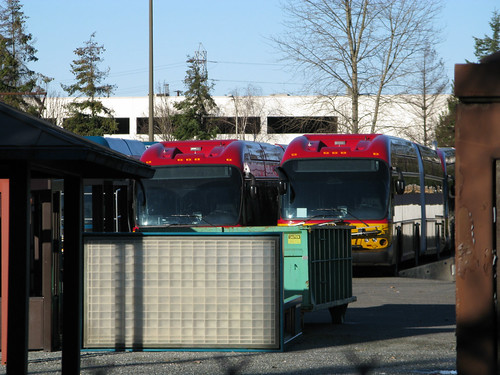
2009 was a red-letter year in Greater Seattle’s transit history, but there are some things to look forward to in 2010:
- In June, the long-awaited opening of RapidRide Line A, from Federal Way to Tukwila/International Blvd. Station.
- Starting today, Metro fares go up a quarter and transfer policies change. By the end of the year the physical PugetPass will have disappeared.
- A Seattle-only rail measure may go to the ballot in November.
- A major revision to Southwest King County bus service in February, including the end of the 194.
- A USDOT decision on the TIGER grant in February could cut years off the opening of Link’s S. 200th St. Station.
- The first two rounds of “low-impact reductions” to Metro service occur in February and September.
- Metro starts installing a new communications system — to include GPS — in the third quarter, with completion in 2011.
- Hopefully, next train signs start working at Link stations in January.
- The Sound Transit Board makes a final decision on the East Link alignment in March.
- Route 542, from Redmond to NE 65th St (Seattle) via the U-District, begins October 4th, at 5:45am.
Late Night Airport Transit

With Airport Link now two weeks old and the 194 on its deathbed, I think it’s worth talking about what transit options are good for people who do fly late at night. Yesterday an author on the Slog had a bad experience with Link on a Sunday night trip, but she didn’t have to, and I’d like to address the concerns she raised.
On Sundays, Link runs 18 hour service instead of 20 hour service – it starts an hour later and ends an hour earlier. When the Slogger made comparisons to other cities, she compared their weekday service to Link’s Sunday service. In addition, as we’ve noted before, the last northbound train on any night doesn’t go all the way to the end of the line. From the airport, it goes to Mount Baker, then goes out of service. This is typical of any system – as Linda Robson mentions in her response to the Slogger, Tokyo, Paris and London all take trains out of service in the middle of lines. Continue reading “Late Night Airport Transit”
Seattle Mayor Greg Nickels

Now that Seattle is about to have a new mayor, it’s an appropriate time to reflect on the outgoing one. Not only is the City of Seattle losing one of its more successful mayors, but the region is losing a giant of the light rail movement just as it begins to pay dividends.
In his capacity as Mayor Greg Nickels has three significant arguments for greatness: first, Bridging the Gap, which is significantly improving transportation in the City; second, the beginnings of the Seattle Streetcar Network; and third, a general willingness to say no to anti-density NIMBYs and bring about the dense, walkable neighborhoods the city so desperately needs. More generally, in all these efforts he displayed an ability to propose, oversee, and complete projects not often seen in Seattle.
On the other hand, there are two items on the Mayoral Agenda in which Nickels was on the wrong side or insufficiently aggressive. First, the Waterfront Streetcar was killed as part of the Olympic Sculpture Park deal for no good reason; and second, the deep-bore tunnel, which threatens to consume the City’s transportation budget flexibility for years.
Although “Mayor of Seattle” will likely be the first line in his obituary someday, it’s actually in a regional capacity that Nickels made the biggest mark on transportation. Nickels started agitating for light rail on the King County Council in 1988. He was an original member of the Sound Transit Board of Directors, and eventually became its chairman in 2008-2009. As we’ve detailed before, during that time he was the crucial figure in getting Sound Transit 2 on the ballot in 2008. Had that not happened, the region’s transportation future would be considerably darker.
More personally, Nickels the man has always struck me as one of us, a genuine railfan. I’ve now had the experience of seeing many politicians at photo-ops, but Nickels riding Link always seemed different: a combination of the completion of a life’s work, and the simple joy of the City he loves getting the system it deserves.
Here at STB, we were thrilled by the platform with which Mike McGinn won the general election. We wish him well, not only in the generic sense wished for all new leaders, but specifically that his agenda is substantially enacted. However, Mr. McGinn and all Seattlites should acknowledge our debt for over 20 years of public service and a record of epochal achievements. Thank you Mayor Nickels.
88 commentsStop Spacing
This post originally appeared on Orphan Road.
Chad Newton has an interesting post at STB on stop spacing, speed and ridership of various rail systems across the US. He’s making the case that more stops on LINK wouldn’t necessarily hurt ridership, and might even help.
That seems fair to me. But the graphs make me think about something else. If you look at the graph of systems sorted by stop spacing, the ones on the left (with the greatest number of stops) tend to be hybrid subway/commuter rail systems, while the ones on the right are strict urban systems, supplemented by a separate commuter rail to provide service to the suburbs (commuter rail systems are seemingly left out of this analysis). It makes sense the hybrid systems (BART, MARTA, DC Metro) are going to have a larger average distance between stops, because they go all the way out into the ‘burbs.

Now, maybe in the 21st century the old hub-and-spoke model doesn’t apply, but there’s still a qualitative difference between a system that’s geared towards commuters who use it once a day, and urban denizens who use it for errands and socializing and the like.
So the bigger question is: what kind of system is LINK? Or, rather, what kind of system does LINK want to be? Thus far, I think Sound Transit has thread the needle quite carefully (and quite well). It’s a regional agency, with a regional constituency, so of course the bias is going to be toward a hybrid system that serves commuters as well as urban metro riders. But they’ve also been very good about avoiding the freeway median stations and massive park-and-rides that characterize other hybrid systems. Thus, density can still occur around stations, and more stations can be added relatively easily (in places such as the Rainier Valley or, later, Bel-Red).
The real test will come later (ST3? ST4??), when the agency is forced to make tradeoffs between developing a true urban system and providing a commuter rail for a mostly suburban constituency.
3 commentsExtended New Year’s Eve Service

In a small bonus for holiday partygoers, Central Link will be operating late the night of December 31 to January 1st. All the extra Link trains will be southbound. A source at Sound Transit informs us they’ll depart Westlake at 12:44 AM, 12:54 AM, 1:09 AM, 1:24 AM and 1:39 AM. Although the tunnel will be open longer for Link, Metro service is completely unchanged – that means if you ride a tunnel route that is on the surface after 1am, it will still be on the surface after 1 am.
Helpfully, the monorail will also operate until 1 am.
Remember that if you get an OWL transfer from Metro on New Year’s Eve, you may be turned away from a Sound Transit bus in the morning – assuming that ever worked. Remember to get your ORCA before New Year’s!
97 commentsCenter Platforms
This post originally appeared on Orphan Road.
I agree with Martin that more center platforms would be better. I’m surprised they didn’t do this while they had the tunnel closed for 2 years recently. They were ripping out all the tracks anyway.
In general, it seems like it takes an awful lot of walking through cavernous underground plazas to get from the street to the platform in the downtown stations, especially considering that the downtown stations are relatively simple: one northbound and one southbound platform. We’re not talking about NY’s 42nd Street or DC’s Metro Center, where multiple lines converge and so you need to move people to the right platform.
The buses would need to switch lanes when entering, or better yet, be replaced by those newfangled buses with doors on both sides.
3 commentsLink Light Rail in the North American Context
by CHAD NEWTON

I developed a matrix for all North American urban rail systems, light rail and heavy rail, including info such as system length, stop spacing, average speed and City population. This post explores the implications from this matrix for Sound Transit’s Link light rail system.
Link light rail, both the initial segment and the Sound Transit 2 (ST2) expansion, has been designed for high capacity and with lots of grade separation. These characteristics have led some to classify Link as metro-light. As shown in the two charts below, its stops are widely spaced and the average speed is high compared to other systems. In fact, only San Francisco’s BART has stop spacing wider than Link with ST2. Based on the advertised travel times for ST2 expansions, Link with ST2 will be the fifth fastest system in North America. The Link system has the characteristics of a system designed to be competitive with automobiles around a large region. Will these characteristics lead to success in terms of high ridership? More after the jump.
Continue reading “Link Light Rail in the North American Context”
| 90 comments