Official First Hill Streetcar Alternatives

Boren Alternative
Boren Alternative

SDOT has just released engineering drawing of the First Hill streetcar alternatives. The alternatives are still generally along 12th Ave, Boren and Broadway with a few refinements. As reported yesterday, all alternatives will use 11th Ave as a couplet with Broadway. The Boren alternative has seen the most revisions with the Broadway and 12th Ave alternatives sharing refinements. I have included links to the PDFs below.

There are two alternatives for the southern most segment in the International District. The first is more direct, staying on Jackson St and either ending where the waterfront streetcar used to end or in a loop that gets closer to Pioneer Square. The other option uses Weller St in Chinatown to turn around, returning to Jackson at 7th Ave. It also has the option for a loop that gets closer to Pioneer Square.

more after the jump

125 comments

First Hill Streetcar: 11th Ave Couplet

The Stranger and Capitol Hill Seattle are reporting that all three of the alternatives will include a one-way couplet on Broadway and 11th Ave roughly between Madison and Denny.

The 11th Avenue segment would be:

* Northbound from Madison to Denny with the Two-Way Broadway option;

* Northbound from Union to Denny with the Boren option;

* Southbound from Denny to Union with the Broadway-12th couplet option.

I have a call into SDOT asking about the reason for the couplet as well as how it will affect travel time and if this means that the streetcar might enjoy some level of exclusive right-of-way. Later today I should be receiving detailed maps of the different alternatives so look for an update sometime later today.

UPDATE: Ethan Melone just got back to me. His response to my questions are below. I also just received maps and images for tomorrow meetings and I’m in the process of uploading them.

Q: Are the alignments the same besides the 11th Ave segment?

A: Yes, the alignments are otherwise the same south of Union or Madison street.

Q: Why 11th?

A: 10th does not continue through to the light rail station, because of Cal Anderson Park and Bobby Morris Playfield. 11th provides an opportunity to loop around the park to the terminus station. This loop has several advantages including:

  • simplest and most efficient turnback option for streetcar service;
  • easier to avoid bike conflicts with tracks in only one direction on Broadway between Madison and Denny (see proposed roadway section on forthcoming drawings);
  • improved reliability with only one direction of travel impacted by traffic congestion in this section of Broadway;
  • reduced construction impacts;
  • fewer utility conflicts.

Q: Does this mean there will be any exclusive ROW?

A: We do not see this as exclusive right-of-way from Denny to Union. It might be exclusive from Madison to Union or possibly Madison to Pike.

Q: How will this affect travel time?

A: The travel time is estimated to be the same as, if not shorter than, two-way on Broadway in this segment. We have not taken into account yet the travel time savings that might be possible if we provide signal priority at 11th & Pine and 11th & Pike (the latter would be a new signal).

45 comments

11th Ave Streetcar

This post originally appeared on Orphan Road.

The Stranger notes the possibility of an 11th-Avenue alignment being thrown into the First Hill Streetcar mix. CHS helpfully draws a map.

Adam @ STB makes a pretty convincing case why 12th Ave is a bad idea, so I’m curious what his take is on this alignment. From my point of view, I like the fact that it runs very close to Broadway but on a street less prone to Broadway’s traffic (north of Union, anyway).

2 comments

News Roundup: Rail Grinding


Video by Eric Jensen.

90 comments

BRT in Clark County

This isn’t really new, but Clark County’s high capacity transit study concluded last year and advocated three BRT lines and other improvements by 2030,  with two of them running substantially in an exclusive lane.  The study did not include the controversial Columbia River Crossing in its scope.  According to spokesman Dale Robins, “One of the main assumptions of the Clark County HCT Study is that [light rail over the Columbia river] would exist as part of the region’s HCT system.”

He added:

C-TRAN is leading the effort to determine which HCT corridor of those identified in the Clark County HCT Study should be the first to be implemented. They are currently in the process of developing a 20-year transit plan, which appears to give priority to the Fourth Plain corridor [depicted above]. C-TRAN is seeking funding for an Alternative Analysis in their preferred corridor and hopes to get started on that process in the near future.

It’s not entirely clear what the revenue source would be, but last year the legislature passed SB 5540, which allows a Sound Transit-style 0.9% sales tax to pay for HCT corridors.  At the time we interpreted that as a bid to allow MAX expansion, but it may very well be used to extend lower higher-quality bus service further into Clark County.

If you read Section 2 of the law you’ll find all sorts of tax constraints that make this a bit more restrictive than the RTA law that authorized Sound Transit.   In particular, C-TRAN cannot go to the voters to fund this until July 1, 2012.  It’s also a one-shot deal; by law, they can’t go to the voters for part of the authority and then have a second measure to use the rest of it.

Estimated costs and ridership, from the Executive Summary:

clark hct

38 comments

Federal Transportation Bill Moves Forward

The House and Senate have agreed on a conference report for the federal transportation budget. (You can read the summary online.) The bill needs to pass Senate and will probably be signed by the end of the year. The high-level overview, which contains plenty of transit and rail funding:

  • $10.7 billion for public transit, including $2 billion for new construction.
  • $2.5 billion for high-speed rail, well above the administration’s $1 billion request. This number will complement the $8 billion in high-speed rail dollars that are part of Obama’s stimulus and hints that Congress will likely have an on-going role in funding rail.
  • $1.6 billion for Amtrak, above the administration’s request.
  • Highways are still the big winner, with $41.8 billion in funding.

Also included $600 million in merit-based transportation grants modeled after the TIGER. Putting more money into competitive grants decided at the federal, and not the state, level is good news for urban areas. These grants can be spent on bike lanes and transit as well as roads based simply on which projects are the best.

In other federal news, the Obama administration is pursuing a staggering $50 billion in new TIGER money for a forthcoming jobs bill, and it would be good move if Congress honors this request instead of choosing to appropriate this transportation spending to the states after the unfortunate experience for transit with the stimulus. A large pile of money could allow for some interesting outcomes. With just $30 million in grant money, for example, Sound Transit could complete the South 200th street light rail station years ahead of schedule.

One thing the transportation appropriations bill didn’t include and isn’t on the immediate horizon: A national infrastructure bank that the Obama administration has requested. This bank would be able to give low-interest loans to municipalities looking to build infrastructure projects without resorting to often costlier privately-held bonds. The proposal is a good one, but may need to be defined outside of the appropriations process and within a new transportation authorization bill that may be authored next year.

36 comments

Senator Murray Comes Through Again

wikimedia
wikimedia

[UPDATE below.]

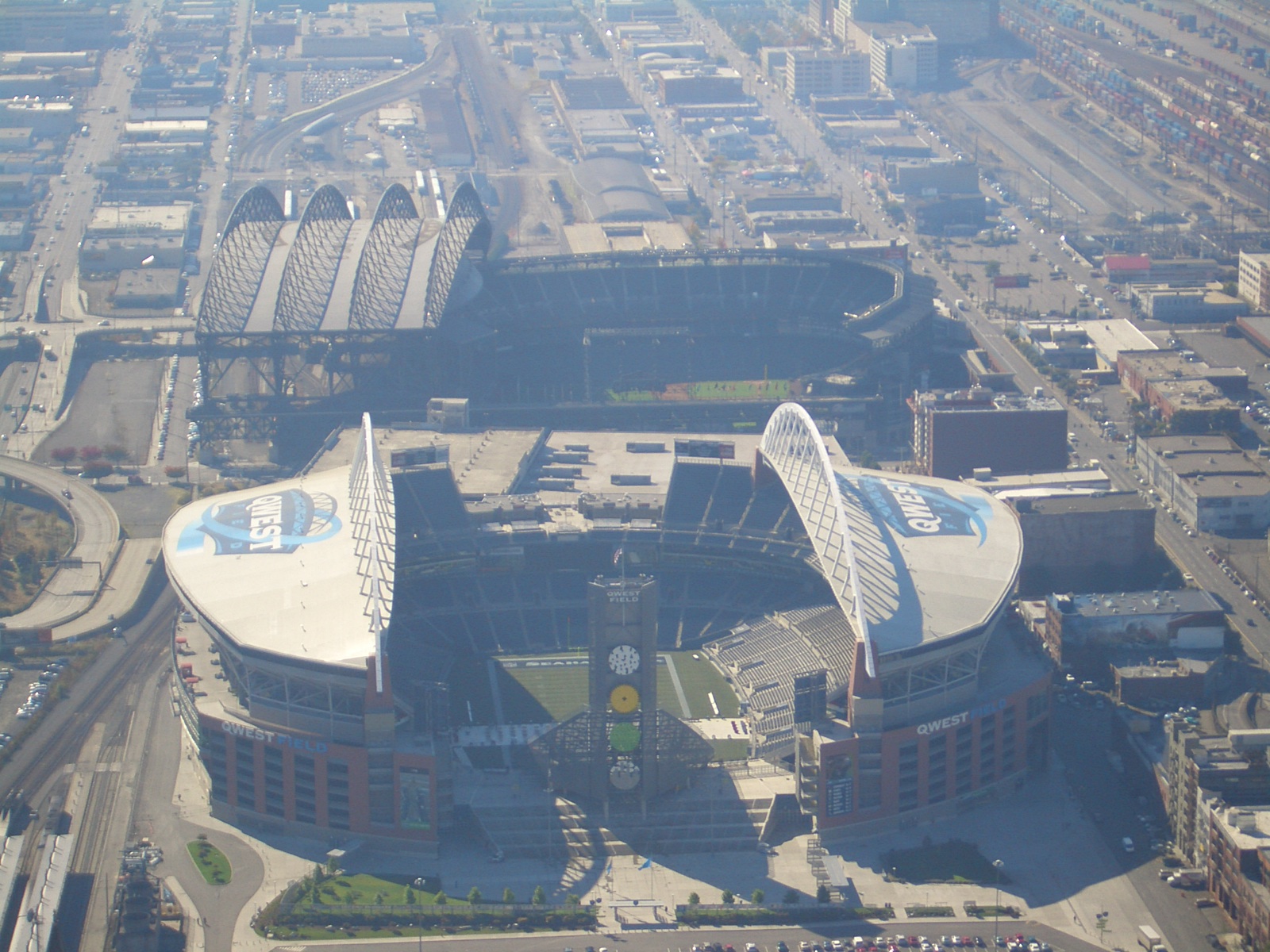
According to Scott Gutierrez of the P-I, Sen. Patty Murray has included a provision in the transportation bill that reverses the Bush-era decision to effectively eliminate special event bus service to the Mariners and Seahawks.  It still has to get through a few votes and be signed by the President, but it sounds like more or less a done deal.  Press release here.

According to Metro spokeswoman Rochelle Ogershok, a lot depends on when the bill actually becomes law.  Since the event organizers (ie, sports teams) must pay the cost of the service beyond farebox recovery, it’s ultimately up to them when such service returns. Nevertheless, she assures me that “the actual process of negotiating a contract for special service can typically be concluded within weeks, once discussions get underway between Metro and the requesting organization.”  So it would appear that Seahawks fans are out of luck this year, but there’s reason to be optimistic about the Mariners’ Opening Day.

The bill also includes money for local transit agencies:

Murray also secured $110 million for Sound Transit’s next light rail link to the University of Washington, as well as $3.1 million for the Central Link project. The bill also will include $600,000 to [help] purchase 15 hybrid buses for Metro’s planned RapidRide bus line in West Seattle, as well as $600,000 $360,000* to study the possibility of commuter rail along existing BNSF rail lines from the Auburn Sounder Commuter Rail Station to Maple Valley, Covington and Black Diamond.

The press release also mentions money for the RapidRide A and B lines, not just C.

The News Tribune says there’s also money in there for the Tacoma Intermodal Transit Center, 6 new buses for Pierce Transit, and money to move along Puyallup’s EZRA BRT project.  I haven’t run down each of these funding items, but I believe that in general this is not “new” money but the fulfillment of previous FTA commitments that don’t revise the budgets of the respective programs.

Note also that the commuter rail study covers an area outside the Sound Transit district and is not a Sound Transit project.  I have a call in to Murray’s office to see who actually gets the money. According to the Senator’s office, the cities of Maple Valley, Covington, and Black Diamond are conducting the study with Maple Valley taking the lead.

* See correction.

36 comments

Montlake Flyer Stops

Photo by Oran
Photo by Oran

[UPDATE: Either people are skimming or I’m not writing clearly, so I’ll make the prescription shorter: A+, no flyer stop; create good 24/7 service from the Eastside to UW; pay for it with some specific revenue increments and by curtailing off-peak service from the Eastside to DT Seattle.  If you work through the permutations, you’ll see that all the connections still work out.]

There’s a lot of fear among transit riders that the loss of a Montlake flyer stop on SR520 will make bus service a lot harder to use in that corridor.  That fear is a reasonable one, in spite of the cost and the wider footprint that would have to be cut out of the neighborhood.   However, it would be a relatively simple matter to reorganize bus service to minimize the impact.  More after the jump.

Continue reading “Montlake Flyer Stops”

| 79 comments

12th Ave Streetcar, a Bad Idea

First Hill Streetcar Alignments

(full size image here, pdf here)

With SDOT kicking off its public outreach effort on the First Hill streetcar line next week, I wanted to outline why we believe that the 12th Ave couplet is a bad idea. The 12th Ave alignment has four major flaws, all of which indicate that the Broadway or Boren alignments (or some variation of these two) is the best option. I have heard many impassioned arguments for the 12th Ave alignment from people that have the same core beliefs as myself but the facts simply make too strong of a case.

Reduced Area with Quality Service

The first and most fundamental problem with the 12th Ave alignment is the couplet. While the couplet increases total coverage of the streetcar, it dramatically reduces the quality of that coverage. By separating the northbound and southbound travel by 3 blocks, the area that is close to both a northbound and southbound station is reduced significantly. To prove my point I spent the day working on ArcGIS to give you the graphics above. Rather than using a 5 minute euclidean circular walking buffer, I used a technique that shows the actual “walk shed” experienced in real life (i.e you can’t walk straight through a building, you have to walk around both sides). This creates a walking shed based on Manhattan distance (this could be a whole other post).

As you can see, I mapped the walking shed of each alternative for 3, 5 and 7 minutes. These are the areas where users have access to both directions. Looking closely at the 12th Ave couplet, you can see how the coverage of the three middle stations is much smaller and of lower quality compared to both of the other alternatives. As I said before, this is an fundamental and intractable flaw of the idea that can’t be overcome.

More after the jump

Continue reading “12th Ave Streetcar, a Bad Idea”

| 250 comments