
This post is the fourth in a series, adapted from an article I wrote for my blog, Transportation Matters, a Pacific Northwest-flavored blog that discusses railway planning, urban planning, and related politics.
The previous post described three proposed improvements to bus transit in Tacoma. This article proposes four improvements for Pierce Transit:
- Secure a Sales Tax Increase for Pierce Transit
- Increase More Busline Frequencies to 15 minutes or Better
- Invest in a Pierce County Bus Transit Grid
- Expand the Pierce Transit Service Area into Greater Pierce County
Secure a Sales Tax Increase for Pierce Transit
For significantly improved local transit service, Pierce Transit should seek a modest sales tax increase. This would secure several million dollars of additional annual revenue for transit operations, facility improvements and maintenance. A plan for how the money would be collected and spent should be given to voters sooner rather than later. Those plans should prioritize better frequency of the most productive buslines, superior connections on the service grid, and incremental reliability improvements over so-called BRT upgrades and expansions of coverage.
Today, Pierce Transit is supported by a 0.6 percent sales tax. Its voter-approved limit is 0.9 percent, which allows the agency to seek a sales tax increase of 0.3 percent, or an additional $0.03 per $10 purchase. For a large urban area with a dominant city of metropolitan importance, the current rate of support is low compared to our peers. As subarea transit expert Chris Karnes notes, Pierce Transit “is funded at half the rate [of King County Metro] in a county with a smaller tax base, with no supplemental funding from the City of Tacoma”. Community Transit, an agency serving a distributed suburban population like that found in Pierce County, also benefits from a 1.2 percent sales tax rate. This discrepancy should be reduced or eliminated. Pierce Transit needs to grow and there is excess financial capacity to do so.
While Sound Transit gets all the attention and big dollars, local transit providers like Pierce and Metro Transit are the actual backbone of our system. They should be recognized and supported as such. With more funding, Pierce Transit should be held accountable for the responsible delivery of upgraded transit service that reflects a careful investment of taxpayer monies.
Pierce Transit’s previous attempt to increase its sales tax rate, in November 2012, failed by 915 votes. At the time, the agency’s transit benefit district had a population greater than 550,000 people.
Increase More Busline Frequencies to 15 minutes or Better
For Pierce Transit, an increase in the sales tax must result in a system that offers all day 15-minute headways for as many riders as possible. Core transit services like Route 1–6th Ave, Route 2, and Route 3 should be considered for peak hour services that see better than 15 minute frequencies. This would bring those lines into operational conformance with the T Line or Route 1-Pacific Ave, the latter of which will be supplemented by the Enhanced Bus overlay to Tacoma Dome Station (but not Downtown Tacoma).
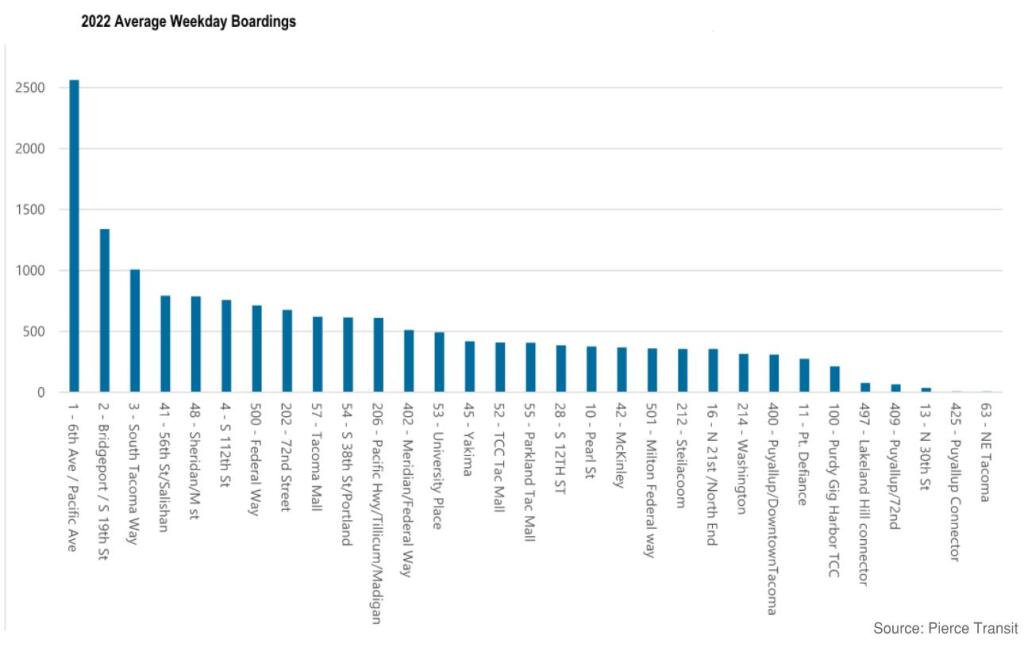
Frequency increases should be prioritized for buslines that have the greatest ridership and highest productivity. Careful attention should be given to routes that are substantially interlined or are closely paralleled by other services. This would ensure that their performance is not undervalued and overlooked as a consequence of their duplication. This should, for example, result in at least one 15-minute service though the North End of Tacoma as Routes 11, 13, and 16—when considered altogether—constitute one of Pierce Transit’s top 10 busiest transit corridors.
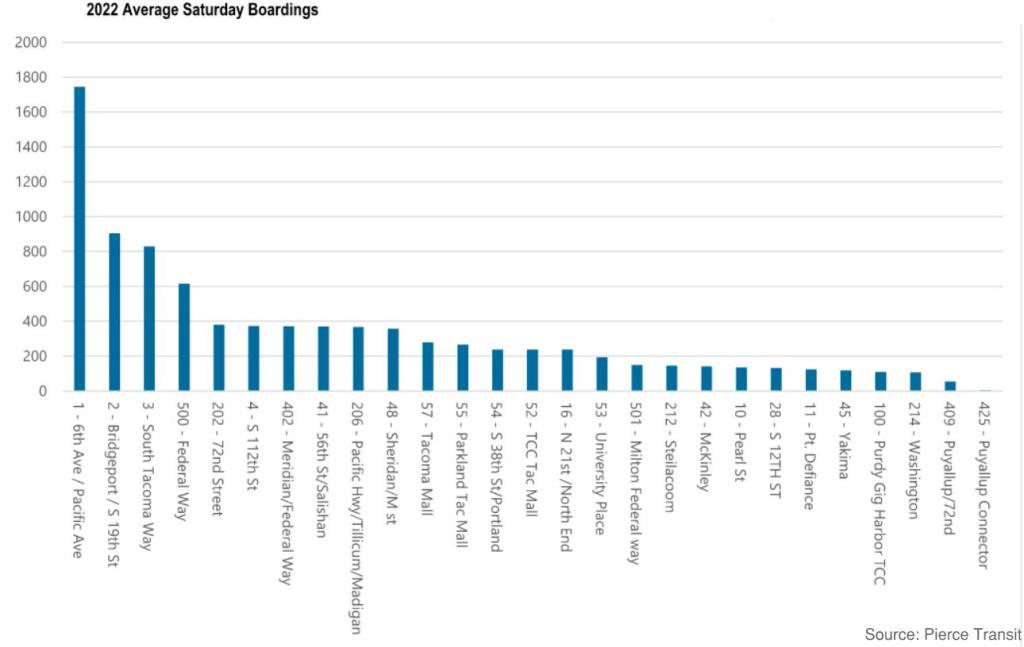
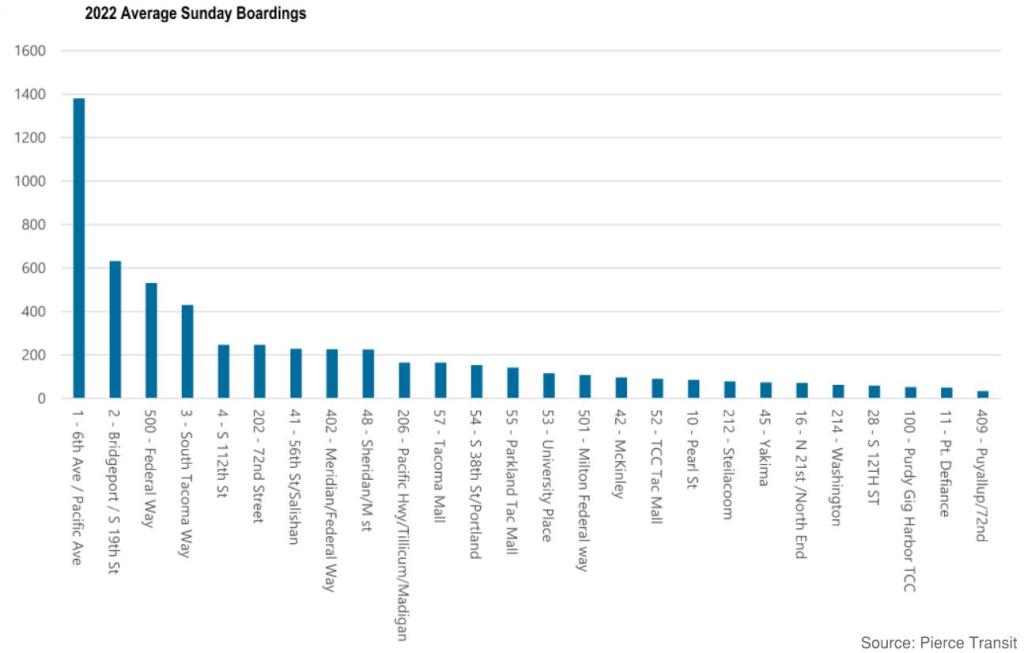
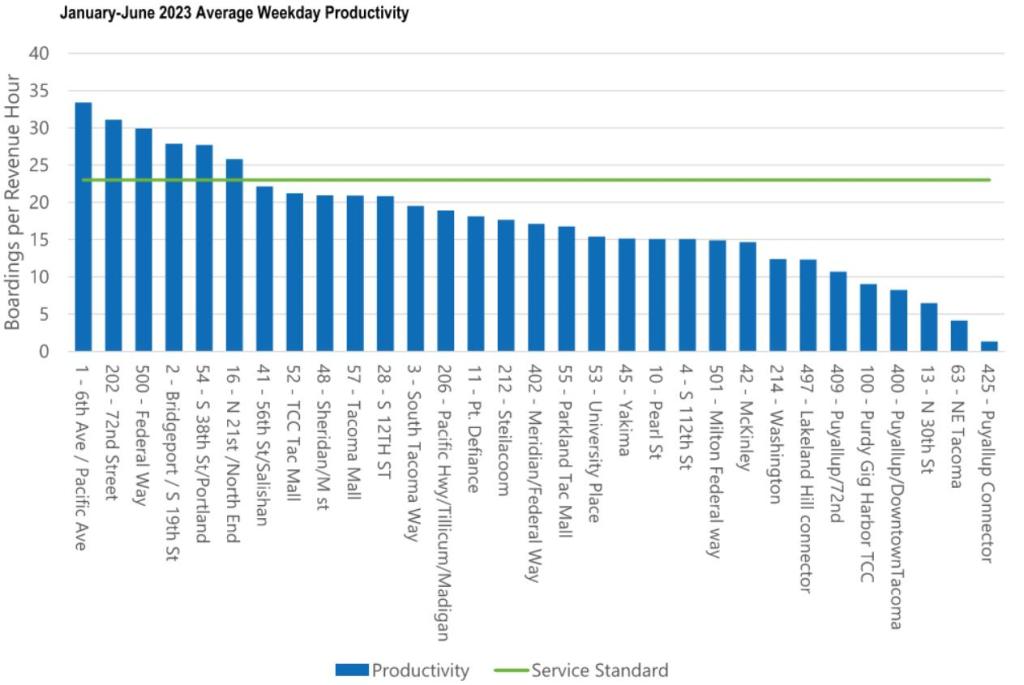
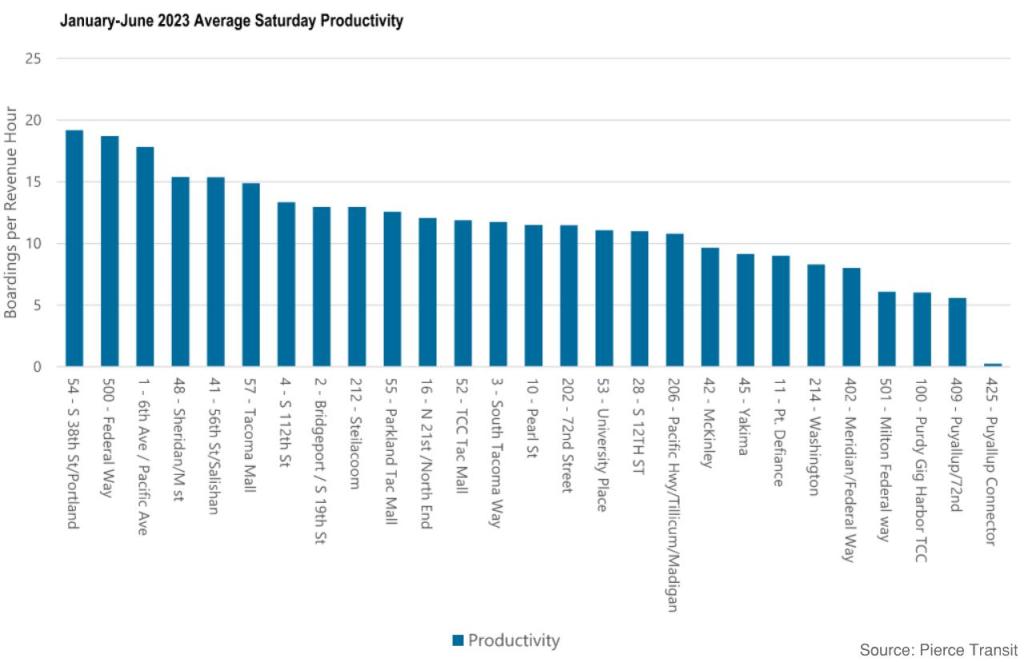
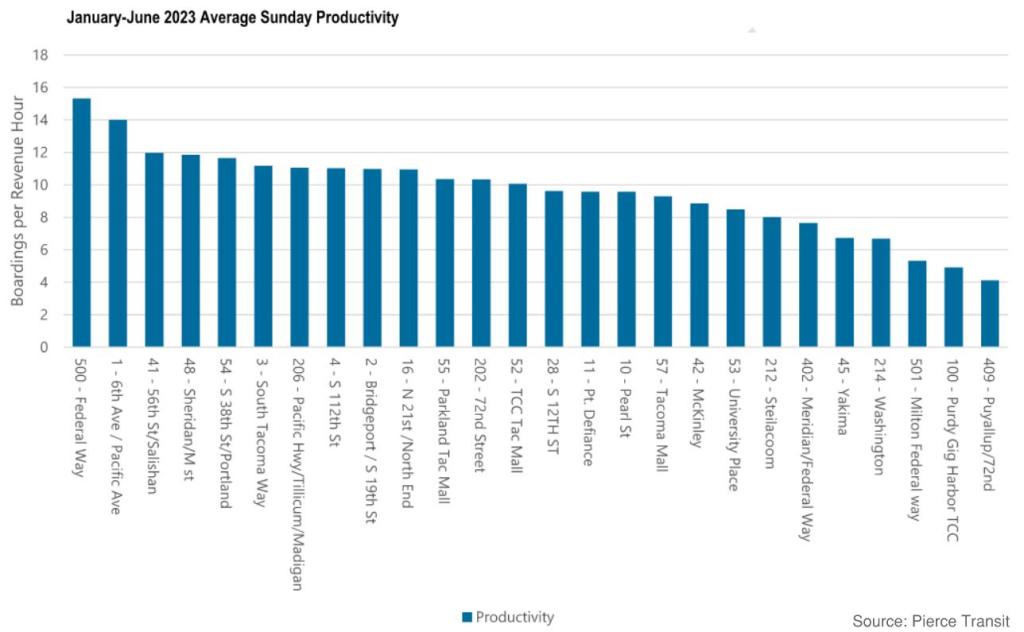
Ridership and productivity data is readily available for review and decision making. Below are recent performance datasheets made available by Pierce Transit. Even a cursory review will uncover dominant transit services and corridors. Invest in those first.





Invest in a Pierce County Bus Transit Grid
Transit in Pierce County calls out for a grid network that takes advantage of the existing arterial road grid.
The grid is both logical and scalable. It can be expanded in a sequential manner that improves upon the strengths of the system. The grid excels as a transit layout by greatly improving frequencies and reliability through simplified (linear) routes and leveraging connections between them. It also maximizes the coverage area by avoiding route duplication wherever feasible. While the use of connections does result in the loss of some one-seat trips, in its place arises countywide transit mobility that is very achievable, fiscally responsible, and intuitive for users. Pierce Transit, with the support of Pierce County and its incorporated cities, should work toward a system that strictly adheres to the grid.
The Pierce County Integrated Transit Plan is one such system. This would require major route changes and corresponding Title VI equity analyses. Existing routes would be either extended, truncated, straightened, lengthened, shortened, or have some unique combination of changes. That is if they are not cancelled entirely for new lines that honor the grid planning framework. While street railways are not held to the grid, they are heavily influenced by it. Rail extensions should avoid harming grid buslines by taking over entire corridors where appropriate, and be extended as needed to close a gap in the grid. Examples of both can be found in the Integrated Transit Plan: a railway on 6th Avenue that preserves the 19th Street busline over the hillside, the extension of the Mildred Street tracks to Regent’s Boulevard, and the majority-rail takeover of South Tacoma Way.
The transit grid does not need to be built all-at-once. However, the countywide system does need to be planned all-at-once so that new funding can be invested into it quickly. Having a well developed comprehensive transit plan would also prevent new development that hinders its realization. Numerous road (re)constructions throughout Pierce County have failed to properly account for transit—if they do so at all. This is the condition of an area that does not take transit seriously. This persists even as jurisdictions craft comprehensive plan updates that rely on transit to achieve aggressive climate, mobility, and equity objectives. For transit, there is a serious misalignment of local public values and action.

When Pierce Transit restructured its system in 2017 and leaned into the grid, it paved the way for similar improvements in the future. It was an intelligent reform by an agency whose roots are a street railway of hub-and-spoke design. Given the County’s dispersed populations and destinations, Pierce Transit’s fiscal limitations, and the increasing need for convenient transit here, the establishment of a robust County transit grid is a necessity. Executing the grid of the Pierce County Integrated Transit Plan will require a significant public investment that will likely exceed present limits of taxation for transit. This represents a major hurdle given the public’s lack of approval of major Sound Transit projects and their long-term financing instruments.
Overall, the use of connections can reduce transit trip times over one seat rides through big increases in frequency, speed, and reliability. However, there must be institutional and interlocal commitment to the reformed system for it to be successful. Without it, inconsistent road designs and development practices may not allow for the reliable operation of buses. Lacking reliability, the regularity of connections that are the lifeblood of the grid will fail to materialize.
Route truncations will be needed that maximize the grid and guarantee reliability. One example—which presumes that 6th Avenue becomes a street railway—is a truncation of Route 1 at Parkland Transit Center. This allows buses to reverse at a deeply logical terminus and head right back to Tacoma’s city center. This would create a nearly 8-mile one-way trip ending at Pacific Avenue / 9th Street. The new line would serve about half of the total Route 1’s existing ridership. During peak hours, the Enhanced Bus service would continue to run the entire length of Tacoma Dome to Spanaway Transit Center. Off peak, a separate service of unknown origin and destination would funnel riders between Spanaway and Parkland.

For more information on the transit grid and quality transit planning principles in general, please visit the blog of public transit consultant Jarrett Walker, Human Transit.
Expand the Pierce Transit Service Area into Greater Pierce County
Undoing a past error, the Pierce Transit benefit district should be expanded to recover lost portions of service area in urbanized Pierce County. No longer can the county afford to have a large portion of its urban population be either un-served or under served by mass transportation.
Even WSDOT recommends such an expansion in its South Pierce Multimodal Connectivity Study of 2023 (read the report, here). The department confirmed that the County cannot expect to build its way out of congestion through roads alone, stating, “future transportation operations will be poor without additional infrastructure investments beyond the baseline improvements, which include only those transportation improvements already funded or very likely to be implemented by 2050”. Those baseline projects alone constitute a giant investment in infrastructure and stress the financial capacity of the County. The department further noted that “very few transit service, active transportation infrastructure, and safety improvements are funded or likely to be in place by 2050”.

The central and southern areas of urbanized Pierce County are densifying, sprawling, and becoming increasingly congested. Existing and new residents are effectively trapped in a cycle of auto dependency and housing affordability, although this toxic relationship is being tested by the rising cost of housing. At least for now, Pierce County has more affordable housing than either King or Snohomish counties. This cost-of-living discrepancy will be reduced (or neutralized) in the future, and the dual housing and transportation crises are a fact that has County planners and political leadership looking for new ways to “bend or end the trend“. The County’s draft comprehensive plan update includes as one of three options for growth a High-Capacity Transit alternative, which “would create dense neighborhoods within a half mile of bus rapid transit lines. It would make bigger investments in different types of transportation” and further preserve “rural areas and forest lands to help the county prepare for climate change”. How the County would accomplish such growth without equally robust transit and supportive infrastructure is unclear. Not limited to Pierce County but all over the United States, the balkanization of our land-use and transit planning bodies will continue to result in unrealizable promises that deliver inferior outcomes.
As noted by WSDOT, the expansion of the transit benefit district “is a policy decision that will require further study and either a popular or elected official vote [for these areas] to rejoin”. If or when that is accomplished, new frequent buslines should be run along core arterials, allowing riders to easily cross the central portions of the county. Those buslines should be supplemented by feeder routes where practical. These new routes are envisioned in the Pierce County Integrated Transit Plan, particularly along 176th Street and Canyon Road.
Even in the absence of such transit lines, Pierce County should be developing infrastructure projects and land-use policies that presume their operation in the future. Continuing to discount transit as a realistic alternative transportation will commit the county to perpetual, worsening auto-dependency. As historian and sociologist Lewis Mumford famously stated, “Adding highway lanes to deal with traffic congestion is like loosening your belt to cure obesity”.
Up next: Targeted Improvements
I very much like this grid. The weave to avoid the ramps on38th, in particular, has frustrated me in the past, making transit far less useful for me in the area. The straight run from Salishan to South Tacoma Way and on to TCC is something I’ve mentioned in the past as being ideal.
If we could get 15 minute frequencies on the 1/A, 2/C, 3, 500, 16/E, and maybe your new F and H, that would allow people substantial ability to get to a lot of destinations via transit. If we were able to fund that for a period of 5 years or so, and allow people to discover it, we might get people to start trusting that transit could actually work for them.
Actually, not 3, unless we are forced into replacing it with a tram.
One of the goals of this plan is to aggressively tie the East and South Side of the City into the subarea transportation system. This is particularly true for the (comparatively) densely populated pocket neighborhood of Salishan, which is a barnacle on the City’s urban fabric. Applying the grid is an effective means of doing so. Pierce Transit has a good start on it and we should realize a fuller version.
Your comment on a Salishan-TCC connection is great. My integrated transit plan proposes a direct line from Salishan to University Place Primary School and does not deviate from the grid. Perhaps a deviation here is worthwhile, though. We would lose the grid along 27th St between Mildred and Bridgeport, but that may be an okay sacrifice for stronger service. Do we honor the grid and impose a high-frequency transfer, or break the grid and go to the big destination?
Area transit bodies and governments should be putting themselves in a position to make these system planning judgement calls. Their determinations should be informed by extensive community outreach and collaboration.
There’s an open thread after this article, just so nobody misses it.
I really appreciate you giving Troy so much space on this blog. I know most of the readership is Seattle and Bellevue-based, so Pierce might not be super high on readership’s priority to focus on. But Pierce actually has both the greatest need, greatest challenges, and the most opportunities and looming pitfalls, of any area in the entire region, so I think it is really important to do more than just throw up our hands and say “well this is what your ignorant politicians wanted 20 years ago…”
So thank you.
I’ve been wanting to have a Pierce ideal network article for months, but nobody else in Pierce was willing to make a comprehensive local+regional recommendation to compare to PT’s/ST’s plans, and I don’t know enough about travel patterns there to write one myself. When I saw Troy’s article, it was much better than anything I’d imagined, so I knew we had to have a stub article linking to it or republishing it. Troy agreed to republish it, and Nathan did a lot of work to split it into five parts, enter it into WordPress with the graphics, and do a bit of rewording to accommodate the split.
I’m a firm believer that to reach a goal, you need an articulated vision of what you want. Then you have something to compare your current network to, and to weigh various proposals and tradeoffs against. And something to show politicians and generate public support for.
Pierce County is clearly within STB’s sphere of interest, and we’ve had several articles on it before. It’s part of Seattle’s metropolitan/urbanized area, Lakewood is 90 minutes away by ST Express, people commute and travel back and forth, and the travel patterns between South King County and Pierce County haven’t been researched enough.
Trips between Snohomish County and North Seattle are the sleeper hit of Lynnwood Link and the 512’s Northgate restructure. That’s pent-up demand that never had a viable transit alternative until 2022, because the express buses bypassed most of it, and local buses took over an hour for a 2-seat ride. There’s doubtless similar latent demand between Tacoma, Federal Way, Auburn, Kent, etc; we just need to identify it and outline appropriate levels of transit for it.
If those two transit markets exist, then a similar transit market must exist within Tacoma; and between Tacoma, Lakewood, Puyallup, and Spanaway too. If the politicians and agencies won’t address it with an adequate network vision and funding proposals. then we need to.
Troy has also found fascinating evidence that the original CLink+TLink vision was much better than the current plans, and that short-term expediencies have been reinterpreted as primary goals, at the risk of leaving most of Pierce’s travel corridors with only coverage-level transit. This needs attention and documentation, both for now and as reference for the future.
Thanks to Troy and Nathan for Troy’s series on Pierce Co. Transit. It is nice to see a Seattle blog focus a bit on Pierce which I think often gets ignored, or misunderstood. A lot of planners and politicians want to force Pierce into a Seattle—Bellevue rubric when the fit is awkward, and the county doesn’t have money to waste.
Mike writes:
“Trips between Snohomish County and North Seattle are the sleeper hit of Lynnwood Link and the 512’s Northgate restructure. That’s pent-up demand that never had a viable transit alternative until 2022, because the express buses bypassed most of it, and local buses took over an hour for a 2-seat ride. There’s doubtless similar latent demand between Tacoma, Federal Way, Auburn, Kent, etc; we just need to identify it and outline appropriate levels of transit for it”.
My comments are I don’t think trips from Snohomish Co. on Lynnwood Link are a sleeper. I think that was the whole point. The stops on Link from Lynnwood won’t be that much more frequent than on express buses today, and the time won’t be that much better either. The trip will still take “over an hour” for a one seat ride, let alone two seat (three including park and ride).
Same for Pierce Co. Link. It won’t be faster than buses today, and in many cases will add transfers, both Link to Link and Link to some other first/last mile access.
Just as I don’t think Lynnwood Link will result in many new transit riders because folks will just shift from buses to Link or they use Northgate Link today, I don’t think Tacoma Dome Link will create many new transit riders which will be only north/south riders when I think transit within Pierce which is east – west is the future, but will cost a fortune to switch from buses to light rail. I think Troy gets that but some Seattle transit people who almost never go to Pierce don’t.
“I think transit within Pierce which is east ”
That’s the kind of thing that needs to be identified and debated. If the predominant travel patterns are east-west, then PT/ST have some serious work to do. However, I’m not sure that east-west travel, while large, is the majority. Tacoma is the most populous area and most likely to use transit, and its long axis is still north-south.
Also, we mustn’t get myopic about whether multiple T lines or the Tacoma Dome extension is justified and lose sight of everything else. The main point of the multiple T lines is the corridors and the travelers, not the mode. If they can’t/shouldn’t be realized as light rail but are instead realized as BRT or frequent bus routes, that’s still a win. The point of marking them as light rail corridors is to say they’re the most important and need the highest level of service.
Mike, that is exactly right. One of the goals of the plan is to stimulate discussion between City of Tacoma, Pierce County, Pierce Transit, and Sound Transit to strategically identify improvements that best serve the Pierce subarea.
I think it is very clear and well documented that this has not occured.
“One of the goals of the plan is to stimulate discussion between City of Tacoma, Pierce County, Pierce Transit, and Sound Transit to strategically identify improvements that best serve the Pierce subarea.”
I completely agree. I think that should be the primary goal! I don’t think that many citizens — even those that post or read to this blog — fully understand how the lack of required coordination to create a good transit system hurts transit riders and wastes limited transit dollars. They “trust” that every leader and staffer are working together.
The ugly truth is that they aren’t truly objectively coordinating. It pervades much of ST3 planning. Sound Transit is the “rich kid” who is dominating the room unchecked. Unchecked by independent local technical committee review. Unchecked by rider experience assessments. Unchecked by frequent schedule delays, terrible cost estimating, maintenance disruptions (Columbia City tiles were supposed to be fixed less than two years ago) and inability to even acknowledge public input. In what universe would it make sense to ignore good rail to rail transfers of a $63B system because building the key transfer points efficiently cost less than $1B to do? And why is it coming out of the blue from an elected official or two and not an objective study?
If only there could be the willingness to table TDLE for just a year (noting it’s already 5 years delayed and even that’s still shaky because of a lack of final cost estimates and needed local funding), as well as an agreement by every one of these entities to not develop projects further without the participation and buy-in by every other governmental entity involved.
I would also add WSDOT, the POT, JBLM and any city over 20K (Lakewood, Puyallup, University Place, Bonney Lake). While not every entity may get on board, sincerely inviting them to the table would help.
Maybe the key is to get PSRC to get some backbone and refuse to program any new projects until a new review and approval mechanism is set up. Maybe that can then be used as a model to change the mechanism in other places in our region too.
Pierce Transit’s productivity profile is actually pretty good. On weekdays only 6% of routes (2 out of 31) get less than 10 rides per hour, a typical threshold for a justified bus route. On Saturdays it reaches 29% (9 routes), and on Sundays 19% (6 routes). Microtransit only reaches 2-4 riders/hour, so it’s 2-3 times less productive.
And we know that some of the missing ridership is simply due to infrequency, because people aren’t willing to adjust their lives around 30-60 minute pulses in transit service, especially for 2+ seat rides. So if frequency were doubled across the board, almost all the laggards would reach or surpass 10 riders/hour. There’s just some special problem with the 63 and 425, but that’s only two routes.
There can be major drawbacks to grids generally. That has to do with making sure that residents can get to local destinations like supermarkets and pharmacies with a one-seat rides in addition to getting to places further away with one transfer.
I caution that a grid can only really work well if frequency is there for both north-south and east-west lines. That’s particularly true when commercial districts run north-south like they do in South Tacoma. The crosstown buses without high commercial activity won’t attract as many riders to sustain their frequencies — and the agency will eventually want to cut service because of it ( like within two years). KC Metro Route 50 is a good example.
Then there is the issue of transfers. It can result in a transferring rider to have to cross two busy arterials to make the transfer. On top of that, a double transfer may be required to reach a locally popular destination like a post office or supermarket just a mile or two away. If a rider has mobility issues, the problem is notable and sometimes detrimental even though low floor buses help a bit.
A slightly different grid system with a “zig-zag grid” can offer riders better service. Sure it’s not as intuitive to a non-rider. But it does address these two situations above:
1. North-south commercial districts become directly reachable to a much wider area as a one-seat ride.
2. Transferring between north-south and east-west directions can occur at a common stop, meaning no need to cross busy arterials.
While there would be some segment redundancy, it may be well worth it to make it easier for riders to reach more places more easily. It really has to be assessed on a case by case basis.
Grids offer a key advantage to other patterns in that they are the most cost effective way to provide trips from anywhere to anywhere along a straightforward path. For every trip you are going towards your destination (no backtracking) without any overlap.
But grids break down for all sorts of reasons. Sometimes the street grid won’t allow it. Other times the agency simply won’t pay for it. This is common when an agency lacks funding. You can’t have a grid for Lake Stevens — there just isn’t enough service.
When the street grid won’t allow it alternative patterns emerge. One is what I call an hourglass, which basically involves two hubs on each end. Lake City to U-Village is kinda like that. The 372, 65 and 75 serve three (more or less) parallel corridors. They converge on both ends (at Lake City and U-Village). There is very little in the way of crossing service, which means riders go to one of the two hubs if they want to get midway in between the two places (https://maps.app.goo.gl/qFiGn7CDkyyPay1V6). A variation of the hourglass is to have buses continue after crossing and then each taking over the other’s corridor. I call this a weave. It is the same basic idea in that you are creating little hubs by having the buses meet. This avoids having to go all the way to the main hub (if that main hub is really far away). (In the case of Lake City/U-Village it is just the natural shape of the land).
A hub and spoke system assumes a popular hub. Thus it has the advantage of providing more one-seat rides to that hub. Seattle’s system used to be very hub-and-spoke oriented, based on the assumption that most people were going downtown. If they weren’t, then the assumption was that going downtown wasn’t a huge detour. For example Queen Anne to First Hill via downtown. To be fair, it was never a pure hub-and-spoke system (it was a hybrid of sorts) but it was more of a single-hub system than anything else.
A hub-and-spoke system basically trades one destination for another. If you are headed to the hub it is great, but if you are headed to some other place it sucks. Not only do you have to make a transfer, but the transfer is often significantly worse than with a standard grid.
I’m not sure if a grid makes sense for Tacoma, let alone most of Pierce County. For example consider the 57, which runs from the Tacoma Mall to downtown. The 3 makes that same connection, so that isn’t the issue. If the bus started at the mall it would be going due north on Union. If it kept going north it would cross several buses before it hit SPU. Even though SPU is a good destination, it is probably pretty small compared to downtown. Are the other buses frequent enough? Without enough funding at some point a system basically just becomes a mix of coverage and a handful of ridership-oriented buses that at least serve a central hub (for those who need to transfer from a coverage bus to another coverage bus). The network for Pierce County looks like that. First priority is the budget.
It seems possible that it could evolve to have a system with a grid in certain (core) areas and then a few spokes (often far apart) outside it. This is also fairly common. Vancouver has an almost perfect grid (https://humantransit.org/2010/02/vancouver-the-almost-perfect-grid.html). It extends quite a ways outside the central core of the city. But as you get far enough out it breaks down (https://www.translink.ca/-/media/translink/documents/schedules-and-maps/transit-system-maps/regional-maps/2024/january-2024/mvtm_2024-01-01.pdf). You just can’t make a grid with only a handful of coverage routes.
The presumption behind the bus grid is that it would intersect with a radiating set of rail and BRT lines through urban Pierce County. Those core lines then funnel into Downtown Tacoma where regional rail connections are made.
Tacoma is at once a weak center and the dominant urban center of Pierce County. It is also built into a hillside, with various micro employment hubs sited at different elevations. A grid serves these elements well and eliminates route duplication, which is already a key planning framework for Pierce Transit.
Most trips on Pierce Transit buses end within a few miles of their origin, and I think many of those trips would be well served by a bus grid. It is absolutely the case that the grid would fail without sufficient funding and coordination with area planning and public works departments. That isn’t exactly breaking news, however. No system is without their weaknesses.
Given the distribution of County jobs and people, it is hard for me to conceive of a better way to serve them than a robust grid.
Ross, I think my “zig-zag grid” and your “weave” are generally similar concepts.
In some cases they may even end up going east-west for one part- and north-south in another part, like PT Route 1 using 6th and Pacific.
I think my “zig-zag grid” and your “weave” are generally similar concepts.
Yes, I forget to mention that. We used to have more weaves in our system. For example check out this old map (that Oran made). There are a bunch of routes doing various zig-zags. Focus on the 68 and 72 though. From the U-Village the 68 used to go straight north on 25th/Ravenna until 75th. Then it would dogleg west to go on Roosevelt. Meanwhile a northbound 72 from the U-District would would go north on 15th but at 80th it would dogleg east to 25th/Ravenna. They essentially swapped corridors.
The closest thing we have now (so far as I know) is the 65 and 372. They follow more or less parallel corridors. The 65 could keep going straight until Lake City Way and keep going (to Bothell Way). The 372 could cut over to 35th. This would probably speed things up a bit (which in turn saves a little service). But instead the 65 doglegs over, and the 372 crosses it (this would be a better example if the 372 had to dogleg the other way). They thus intersect, which means that riders can easily transfer between the two (almost) parallel routes. A little speed and service is lost but the transfers are much better. Trade-offs.
The topography, superblocks, and unimproved rights-of-way of the Pierce subarea does lend itself naturally to some form of a zig-zag.
The zig-zag is especially prominent and valuable in the City of Tacoma. The imagined E Line, which brings me personal excitement, zigs and zags across the city and creates new connections along key corridors that are today poorly served. This is particularly the case for our historic Tacoma Avenue, which only just got bus service weeks ago following a peculiar restructure of the Route 57.
Respectfully, here’s the list of why (and let’s be clear, I mean none, zero) any of these Pierce County transit ideas are ever going to happen.
1. Light rail. There’s absolutely no reason to have light rail in Tacoma or Pierce County. Sound Transit poisoned the public’s good will towards transit by building an overpriced rail line that doesn’t serve many people. Light rail takes years to build and when Sound Transit does it, it takes even longer. Low return on investment is the quickest way to sink public transit.
2. The Tacoma Government has spent millions of dollars planning for growth and none of these transit plans actually support that. If you want to turn politicians against you… ignore the work they’re doing and not recognize the goals they wish to reach. City Council reads stuff this this and it just makes them mad. You think Troy is the only dude who’s written a big manifesto about something and dumped it on City Council? It’s just not the way government works.
3. Tacoma is focused on housing…. and more housing…. and finally more housing after that. Transit is certainly a back burner issue. Even Councilwomen Walker, who’s on the Sound Transit Board, doesn’t put much effort into transit. If Walker doesn’t respond to this pie in the sky plan, it is officially dead. Are there even 25 people in Tacoma who have even read this?
4. Pierce county loves cars…. and hates paying more sales tax. I think increased sales taxes for transit are not politically possible. Thank poorly planned Sound Transit projects for that.
I would support a smaller and reasonable Pierce Transit plan with no light rail that just beefed up our current bus route system with a moderate tax increase. Troy’s plan does help that at all. Let’s try to live in political reality here.
“The Tacoma Government has spent millions of dollars planning for growth and none of these transit plans actually support that. If you want to turn politicians against you… ignore the work they’re doing and not recognize the goals they wish to reach”
Troy has improvements to Tacoma Mall, the Lincoln District, and south Tacoma, three areas you’ve cited as needing attention and in the growth plans. How is that ignoring Tacoma’s work? Or is it all about needing rail on MLK and 19th Street… but then you don’t want rail either. So what do you want? How would you change Troy’s plan to meet what you think Tacoma needs and could get approved?
“Tacoma is focused on housing…. and more housing…. and finally more housing after that. ”
How are people supposed to get around when they leave that new housing?
“Even Councilwomen Walker, who’s on the Sound Transit Board, doesn’t put much effort into transit. If Walker doesn’t respond to this pie in the sky plan, it is officially dead. Are there even 25 people in Tacoma who have even read this?”
We have to try rather than just doing nothing while the Pierce/ST governments fail to address transit needs. Either we’ll get a network that’s effective, or we’ll have documented what we could have had, and how much the official plans fall short, and what a future government could do.
Mike Orr,
Here’s the problem. Troy’s plans need to lose all the light rail expansion immediately. He starts this whole plan with light rail to North Tacoma (6th Ave). He actually has some pretty good ideas, but the light rail dooms everything.
I’ve worked with City government on and off for 20 years. Elected officials flat out hate “know- it-alls” coming up with any kind of comprehensive plan that ignores whatever they’re currently working on. Government doesn’t work that way. Plans without political support are just wish lists.
If Troy wants any of this stuff to happen, he would come up with transit plans using the City of Tacoma growth maps for specific areas to enhance what the City has already planned. Don’t release some kind of massive transit overhaul asking to boost the sales tax to pay for it. Try being a little less egotistical and heavy handed about transit upgrades and maybe some of them will happen.
I guess the bigger problem is the idea that the government is going to take care of you. Need transportation? Public transit is the answer! Need housing? The government can just change zoning and build public housing so everybody who wants to live in Seattle or Tacoma can have their own affordable apartment! I support mass transit and public housing, but I also understand that there’s a limit to “other people’s money”. There’s never going to be enough tax dollars for 25% of Troy’s Tacoma transit plan. There’s never going to be enough money for public housing, or social housing. Changing the zoning doesn’t result in affordable housing no matter how many university studies say so.
I’d like to see Tacoma pass a small transportation levy to increase bus service around the city. That would help people right now and it may be politically possible. Why even bother with bigger plans when the small immediate changes aren’t done?
I’d suggest you all read Strong Towns and learn the difference between “your money” and “other people’s money”. Ask yourself…. “What is my personal investment here?” and veer away projects that need huge influxes for government money.
elected officials deal with people bringing all sorts of big ideas that need funding. Transit isn’t a top 3 issue in Tacoma currently.
“He starts this whole plan with light rail to North Tacoma (6th Ave).”
Most of the suggestions are independent of each other, so you can do some but not others. If 6th Avenue T-Link is rejected, then something else can backfill the corridor, like Stream, a more frequent 1N, or attaching the 1N segment to another route. There are plenty of possibilities.
“Elected officials flat out hate “know- it-alls” coming up with any kind of comprehensive plan that ignores whatever they’re currently working on.”
They may hate it, but its citizens’ responsibility and right to point out that they’re not following transit best practices and they’re not meeting their constituents’ mobility needs.
“I guess the bigger problem is the idea that the government is going to take care of you. Need transportation? Public transit is the answer!”
If you don’t want to work together with your government and fellow city-dwellers to make the city more effective for everybody, go live on a farm and grow your own food like people did a hundred years ago. We can’t keep having non-sustainable cities without responsible citizens objecting.
“There’s never going to be enough tax dollars for 25% of Troy’s Tacoma transit plan. ”
So build the 25%. Pass a TBD levy and spend the money on PT service hours for its existing network and long-term plans. We’d applaud that too. Just do something to improve transit from its almost unusable level.
0.3% sales tax doesn’t raise prices that much. Snohomish County was able to, and King County is partway. The last levy failed because southeast Pierce is ideologically against taxes or didn’t think it would get enough service to its area, not because people flat-out couldn’t afford it. It passed in the cities of Tacoma and Lakewood; they just couldn’t overcome the No votes in the east. So have Tacoma and Lakewood supplement their service hours like Seattle is doing. Then Puyallup and unincorporated areas can remain unaffected if they wish.
“I’d like to see Tacoma pass a small transportation levy to increase bus service around the city.”
See, we agree on something. And I bet Troy would support it too.
But we need to be clear on what effective service would be. 15 minutes full time on the one-digit routes and at least some of Troy’s corridors. That’s what makes transit a viable alternative, maximizes ridership, and makes multi-seat rides feasible.
“veer away projects that need huge influxes for government money.”
We’ve suggested low-cost solutions too. We do that all the time.
The belief that taxes are bad is hilarious if you receive social security, take up medicare health insurance, subsidies for being a senior, among other countless tax breaks and tax loopholes during your working life. I’m sorry but that is being a walking hypocrite in my view. Unless you wanna give back your money from receiving social security, giving back all the money you wrote off on taxes, and giving back money spent on you with medicare insurance, I’d refrain from complaining about taxes not helping you.
Here’s an excerpt from Neil Howe’s book Generations about government and generation’s view on it and honestly goes back in talking about taxes in this context.
“Civic Cohort: An example is the GI generation (born 1902-1924) that was raised in the depression where massive government programs were put in place to help them. As young adults, they fought and won WWII. After the war many of them went to school on the GI bill. They have a strong belief that government works.
Adaptive Cohort: Following the Civics is the adaptive cohort which are referred to as the “Silents” (Born 1925 to 1945). They generally shared the GI’s values. The “silents” work within the system. They are generally trustful of the leadership of previous generations.
Idealist Cohort: This is my group, the “baby boomer” generation (born 1946 to 1960). In our youth there were unlimited economic opportunity, so we turned to spiritual matters, questioning and rebelling against the values of the GI and Silent generation.
Reactive Cohort: This is “Gen X” (Born 1961 to 1981). They are viewed as expressing a cynical, world-weary attitude as young adults. Their life experience with government is exactly the opposite of the GI generation; at every stage of the Gen Xers life, government’s resources have been directed to benefit someone else”
If people want to complain about government services like public transit in this case leading to higher taxes then I’d remind them of how much they receive from the government now to take care of them, to keep a roof over their head, and to keep the lights on in their house despite their insistence that they’re lone wolves doing it by themselves with bootstrapping (which is funny older people bring this up when it was to literally criticize them for the exact thing they’re doing).
No one is an island, it takes a village to raise a society.
> Plans without political support are just wish lists.
The introduction article made it clear that these proposals are literally a “Wish List” of investments.
Zach B
I support paying taxes and government support for public housing and mass transit. I’m just a realist about how much money there is to spend on these projects. Tacoma never had the money for light rail…. Tacoma does have the money a good bus system. What the T-line did was funnel a limited supply of tax money into a 2 mile toy train…. and the Tacoma’s bus system suffered for it. The idea that Tacoma could afford both light rail and good bus service is false. Just the the idea that low income people can have public housing. The wait list for public housing used to a decade… god knows what it is now.
Tacoma has to make choices…. transit or more housing?
And no. There’s no new taxes for transit. Tacoma has other problems… crime, homelessness, poor public education. Transit is pretty far down the list on the problems the voters want to fix. This isn’t my attitude about taxes…. it’s political reality. There just isn’t endless piles on money to fix things.
If the government really is the solution…. why are thousands of people living in tents in Seattle?
“What the T-line did was funnel a limited supply of tax money into a 2 mile toy train…. and the Tacoma’s bus system suffered for it.”
There’s no evidence ST has anything to do with PT’s current level of service.
“If the government really is the solution…. why are thousands of people living in tents in Seattle?”
Because reactionaries are preventing government from being effective. Since the 1970s changes to the tax laws, resources are being funneled to the top 1% and increasing inequality. Corruption is locking this into place. Spiteful people are intentionally harming certain demographics, and collateral damage impacts others. Part of the increasing inequality is the people at the bottom can’t afford a minimum standard of living. Government is broken and needs to be fixed. That doesn’t mean it can’t work. It works in the Nordic countries and New Zealand, and to a lesser extent Canada.
This is what nobody likes about your very cynical “why bother” attitude to this conversation, which is quite frankly an unproductive one. If you wanna continue to be overly cynical for the sake of being cynical, be my guest. But you are being quintessentially someone who would rather throw their hands up at the situation.
I mean we see that time and time again from you on here and all your criticisms of people and their ideas on this forum.
“Don’t bother move elsewhere”
“Don’t bother it won’t work”
“Don’t bother they won’t do anything to improve”
All you’re being is just negative energy and that is not helpful in the slightest.
At least Troy is giving ideas, unlike you who has presented no ideas here in the multiple posts this week and all I hear from you is criticize criticize criticize x, y, or z plan. Even though what Troy presents is what any politician, committee, transit staffer, etc would do to build a proposal. We saw it with ST1, ST2, ST3, Seattle Move, Monorail Levy, & PT Levy and will see it in the future.
And before you criticize me for being too positive, naive, etc. I am progressive who is a political pragmatic realist, but I don’t believe in being overly cynical at everything because it accomplishes nothing in the grander scheme of things.
Wallowing in perpetual cynicism about the possible accomplishes nothing. Shoot for the moon and even if you miss you’ll land among the stars.
“If the government really is the solution…. why are thousands of people living in tents in Seattle?”
For some, it’s because they spent a 3rd of every paycheck keeping a beater car on the road, rather than being able to take the bus and save for a rainy day.
For others, it’s because they didn’t have transportation to get to programs and services, amd get out of their dangerous neighborhoods in middle and high school.
Affordable transit is interconnected with many societal problems, and is sometimes a linchpin to a better life.
Cam Solomon,
I don’t disagree with you. Transportation and housing are important issues. Issues worth working on. The problem with this thread, and every other tread on this board, is the math behind solutions.
I’d guess the bare minimum for enough supported housing to cut the number of people living in tents by, say two thirds, would be 5 billion dollars? That’s 10,000 units of supported housing at $500k each. That’s a lot of money because the problem is so big. And, no, there is no easy or cheap way to fix the problem. I’d guess that every elected official in the City already knows this, but my god! where would Seattle get the 5 billion from?
Do those 10,000 low income people deserve the housing and services? Absolutely. But there are 5 billion reasons it isn’t going to happen.
Let’s talk about Tacoma now…..
Tacoma is a city that lives with the mistakes of the past. The toxic ASARCO smelter. Seemed like a good idea at the time! Environmentally the City is still paying for it. Forever. The 705 freeway. Let’s use up a lot of prime waterfront building a road to bypass downtown! Tacoma is also stuck with that turd forever. And now we build the goofy 2 mile toy train that has a route that doubles back on itself and the butt ugly T-Dome parking garage/transportation terminal. What a complete disaster it’s turning out to be. And there’s no money to fix it.
Maybe Tacoma should just stop building these stupid mega projects and just fix all the little crap that isn’t working? Like more bus service? [inflammatory ad hominem against homeless peopple]
It’s nothing personal against Troy or this plan for light rail in Tacoma. It’s just the dude can’t do math. How much per mile to build his dream of light rail down 6th Ave? How long is rail line? Then divide the cost by 225,000… the population for Tacoma and we’ll get a rough cost for every man, women and child in T-Town.
I can tell you right now the money nor the political will to get the money are there.
The reason Tacoma needs to stick to bus service is because it’s a broke ass poor town and that’s all it can afford. Look around. Tacoma has all sorts of issues! The lack of light rail isn’t one of them. Troy should just try to get a meeting with John Hines. He’ll just tell him the money isn’t there and it’s not possible. End of story.
If you want real change with better transit, it starts with integrating it with the changes the city is already planning. Troy is free to collaborate with Joe Bushnell or Jamika Scott because the City has zoned more housing in those districts and may be willing to spend money on transit and road calming features around the new development. The 6th Ave business district and North End would rather not have any growth. Why upgrade transit for those neighborhoods?
Mike Orr,
“Because reactionaries are preventing government from being effective. Since the 1970s changes to the tax laws, resources are being funneled to the top 1% and increasing inequality, and corruption is locking this into place. Part of the increasing inequality is the people at the bottom can’t afford a minimum standard of living. Government is broken and needs to be fixed. That doesn’t mean it can’t work. It works in the Nordic countries and New Zealand, and to a lesser extent Canada.”
All I can say is if you really feel that way, Move to Canada. I would if I felt that way. People need to proactive in their life choices. Seattle isn’t going to change because you think it needs to. Keep working on transit issues but understand there’s going to be limited impact.
Zach B.
This is my last post here, but I just wanted to say I’m sorry if I pissed you off. I own a house and 1/2 of a triplex. My wife and I have over a million dollars in savings. I’ve had the opportunity to travel in Europe a few times. I’m really a blessed man.
But I bought a house in Tacoma because there was no way I could buy one in Seattle. My body is really beat up from working construction. My lungs have sheetrock dust in them I sure and worry it will give me cancer. I’ve never lived alone and until the last few years I never lived in house with more than one bathroom. I’ve made so many compromises over the years to get what little I have now. I wanted to give up many times, but fuck! I wasn’t living in a tent when I was old.
Some say Seattle is a Liberal City… a Progressive City… But that’s all bullshit. Seattle is meaner than Hell. Ask any broken down ex-commercial fisherman or old concrete worker who’s now living on Third Ave in a tent. There’s not a lot of mercy in the Emerald City. Good Luck.
“Maybe Tacoma should just stop building these stupid mega projects and just fix all the little crap that isn’t working? Like more bus service?”
That’s what half of Troy’s series says.
“It’s nothing personal against Troy or this plan for light rail in Tacoma.”
You’re focused so much on this rail plan like it’s the only thing in the series, or that Troy demands more rail. A quote from the T-Line article: “Should Tacoma seek a robust transit system, then buses are the answer. It will not happen by rail. The small transit ridership found in Pierce County also does not compel huge rail investments, either now or in the future.”
He continues: “However, whether logical or not, more rail is coming. These giant projects must be responsibly planned and their value maximized.”
Then a profound statement, which I think applies to much of the rest of STB’s work too: “This blog consequently aims to bridge two conflicting views: it opposes the expansion of the railways in Pierce County, but for those lines that exist or are voter approved, the County should do everything it can to ensure that they improve the transportation system.”
So he’s not pushing for more rail, but if it’s going to be built, it should be built right. He offers a variety of rail and bus suggestions. You’re saying he or the blog is pushing for more rail in Tacoma, but that’s a strawman. The ones pushing for more rail are Seattle Subway (lots of it), and Pierce politicians (just 19th Street and Tacoma Mall nowadays).
Lay off inflammatory insults about homeless people.
“How much per mile to build his dream of light rail down 6th Ave?”
Maybe the same as is already budgeted for 19th Street.
Your overall argument boils down to, “(A) It’s not gonna happen so don’t hope for it, (B) Pierce residents can’t afford more taxes, (C) transit is low on their priorities.”
Much of our transit advocacy is long shots, so this is something new. In the 70s and 80s I never imagined Seattle could have a subway, because Forward Thrust failed and everybody said support for rail died in the 1950s. But then it happened.
Still, there have been a lot of failures where we couldn’t convince the politicians or public to do something. Our success rate is maybe 10%. The next likely failure is the single-tunnel solution, because ST is strongly going in the other direction and no politician has questioned it yet.
Still, we must articulate our ideals anyway, and show what we think is best. That’s a public service, and a kind of responsibility. If we just kept quiet, we’d be complicit in the bad decisions and the substandard networks. And we’d let down people who want better transit but don’t know enough about it to pinpoint the problems or come up with alternatives themselves.
The reason why I have promoted a 6th Avenue line is because there has been no alternatives analysis conducted for the project to TCC. It has just been accepted that we will use the representative 19th Street alignment and there has been no effort to articulate other options to complete this project. Furthermore, we have no concrete understanding of the costs of this line, to include a large bridge or set of bridges over State Route 16 that need to be built to deliver it. The cost to construct a street railway on 6th Avenue and Mildred Street might very well be a wash or even more affordable than 19th Street—we don’t quite know.
Public engagement related to transit is very odd sometimes. You tell others that something is not right or is bad, and they tell you, well, you need to have a solution. You then propose an idea and people reject it because it’s not 100% fleshed out. You begin to elaborate on details and then some say, well, you need to conduct outreach. You conduct outreach and then some say that you need to do more outreach to more people.
I accept the messy process of planning and public engagement. It actually energizes me. However, the goal is for local planning bodies to do this work and to articulate a comprehensive transit system that effectively serves the public here.
“Move to Canada. I would if I felt that way. People need to proactive in their life choices. Seattle isn’t going to change because you think it needs to.”
This is a democracy. I have as much right to try to convince society to do what I think is right as you do. It’s not like I’m the only one, or that all other Seattlites think its current direction is the best. It’s an ongoing debate among everybody who lives here. Sometimes policies or majority attitudes change.
I have thought about moving to Canada but decided not to. I’m not the kind of person who wants to start over in another country or city. Since this a democracy, I have the right to try to influence and improve my own city and country.
How do you think Canada got that way anyway? They decided to. Universal healthcare started with one province, then more provinces adopted it, until finally it became nationwide. Calgary’s high-quality transit, along with Vancouver’s and Toronto’s, came from observing the best practices in other countries, and deciding to do it too.
I wish this article had mentioned how Pierce Transit deleted the 13, 63, 425, 409(East end) in April 2023, replacing them with “Runner” on demand, this move was rather unfortunate for routes 13 and 63 as I had hoped they would eventually see service increase to equally cover all districts of Tacoma, now Northeast Tacoma has no direct bus connection anymore even though it’s a common route people use runner for (Downtown-North East Tacoma). The 425 was okay since it did see low ridership and the area has other bus routes in it. East end 409 took about 15 mins to do and should have been saved as it goes by several apartment complexes, businesses, and strip malls.
I would have just suspended the 13 and 63 till there’s more money and drivers to run them more.