
This post is the fifth and final in a series, adapted from an article I wrote for my blog, Transportation Matters, a Pacific Northwest-flavored blog that discusses railway planning, urban planning, and related politics.
The previous post described four proposals for improvements to Pierce Transit. This article proposes three improvements corridors to conclude the series:
- Make Targeted Bus Corridor Improvements
- Implement New Buslines that Connect More Local Centers
- Electrify the Core Local Buslines
Make Targeted Bus Corridor Improvements
Pierce Transit should exclusively seek corridor infrastructure improvements that are relatively straightforward, standardized, and affordable. Basic improvements—from queue jumps and bus shelters to bus bulbs and (near) level boarding—would do much to enhance existing bus lines. These incremental upgrades may be able to leverage funds obtained from an increase in the sales tax, via the issuance of long-term bonds, with their expense amortized over a several year period. Transportation benefit districts like those available in Tacoma could also support some improvements.
For transit, what Tacoma and Pierce County need more than anything else is rubber on the road: more service, more frequency, more options for getting around. Discussing major infrastructure improvements is pointless if there is no intention to run a frequent service. Even Pierce Transit’s $325-million (or more) Pacific Avenue project, featuring major rapid transit elements like median lanes and stations, would have seen peak frequencies of only 10 minutes. While that is a huge improvement over recent 30-minute headways for the Route 1—which was frankly unacceptable given the line’s importance and the claimed necessity of its conversion to BRT—it pales in comparison to BRT facilities like Van Ness in San Francisco. There, buses arrive every several seconds throughout the day. In Seattle and Vancouver, B.C., indeed in cities around the world, 10-minute frequencies are commonplace without extensive infrastructure upgrades. Just run more buses.
Where the task of running more buses is impaired by reliability issues, directly target those issues for fixes. In Pierce County, severe congestion is commonly associated with the regional system, whereas local arterials experience delays caused by the stop-and-go nature of the street grid. These problems require different solutions. On Pacific Avenue at SR-512, Route 1 reliability is harmed by congestion related to the exiting and entering of the regional highway network. While long-term fixes should include a wider bridge replacement that includes two median transit lanes, interim fixes could be the bi-directional transit lane of the BRT project, the addition of transit signal priority, or a short deviation to Park Avenue that simply avoids the interchange. The latter solution would pair nicely with a truncation at Parkland.

Pierce Transit recently published the final report of its Stream System Expansion Study. While the report details corridor improvements only for lines now slated for “BRT” upgrades in the agency’s long range plan, the scope of the improvements are nothing like those once proposed for Pacific Avenue. Instead, they are of an incremental approach that could be applied to any popular route or any congested corridor. For Pierce Transit, these salt-of-the-earth enhancements are what should be its focus. As they are often minor civil works projects, local jurisdictions should adopt a muscular approach to realize them. This should range from direct financial support to incorporating the elements into new street designs.
Infrastructure scope escalations should come only after these smaller improvements have been delivered and their benefit exhausted. This would result in upgrades of an intuitive order: organization before technology before concrete; transit signal priority before BAT lanes before median lanes and stations. It is appropriate to note here that after the suspension of the Pacific Avenue BRT project, Pierce Transit pivoted to far more modest corridor upgrades for its replacement Enhanced Bus service. The agency has determined that those changes will save “28 minutes of round-trip travel time between Spanaway and Tacoma Dome Station”. This work, which has a budget of roughly $48-million, would essentially capture the travel time benefit of the $325-million BRT project, even at the grand scope envisioned back in March 2020. There is a lesson here.
When transit is planned and delivered for explicitly transit purposes, it often becomes far cheaper. The inclusion of betterments that exacerbate costs and timelines need to be carefully weighed against the benefit of achieving mobility equity sooner and for more people. When transit costs less, there can be more of it. And we need more of it here in Pierce County, not less.
Implement New Buslines that Connect More Local Centers
The establishment of a transit grid will instigate a remarkable change in how Tacoma-Pierce County residents navigate throughout the county. It raises a gripping question: how do we want to be served? While many routes would continue to exist in some form, there is an exciting opportunity to plan for new routes that serve the public more effectively and which reflect present mobility needs.
This is particularly true for the city of Tacoma. There, transit advocates are leading a push for new services that connect more local centers and corridors. While many of these areas would be naturally served by the grid, challenging geography and other barriers present opportunities for lines that never existed in the past. Historic system underinvestment also leads to original routes that deliver novel trip pairs, helping to further equity and climate goals. Ultimately, every significant destination in urbanized Pierce County should be accessible by transit.
Many new routes are envisioned by the Pierce County Integrated Transit Plan. Six of those routes from the high-frequency network are highlighted in the gallery below. Some of the routes exist by grid necessity, including the F, G, and N Lines. Other routes form a cross-town necklace that tie the city together, like the E Line from Salishan to Pearl Street via Tacoma Avenue. This thrilling transit offering has never before existed. In Downtown Tacoma where numerous lines would otherwise converge—as they do today—the B Line serves to eliminate duplication by serving as a circulator through core neighborhoods. It also overcomes the imposing hillside, tying Downtown Tacoma directly to the Hilltop community and as far west as Sprague Avenue. In many ways it would be the modern reincarnation of the Cable Line, and Metro’s RapidRide G serves a similar function for Seattle. At Sprague Avenue, connections could be made to the D Line, a new service to Old Town that exemplifies the mission that all neighborhoods in Tacoma should be easily accessible by mass transit.
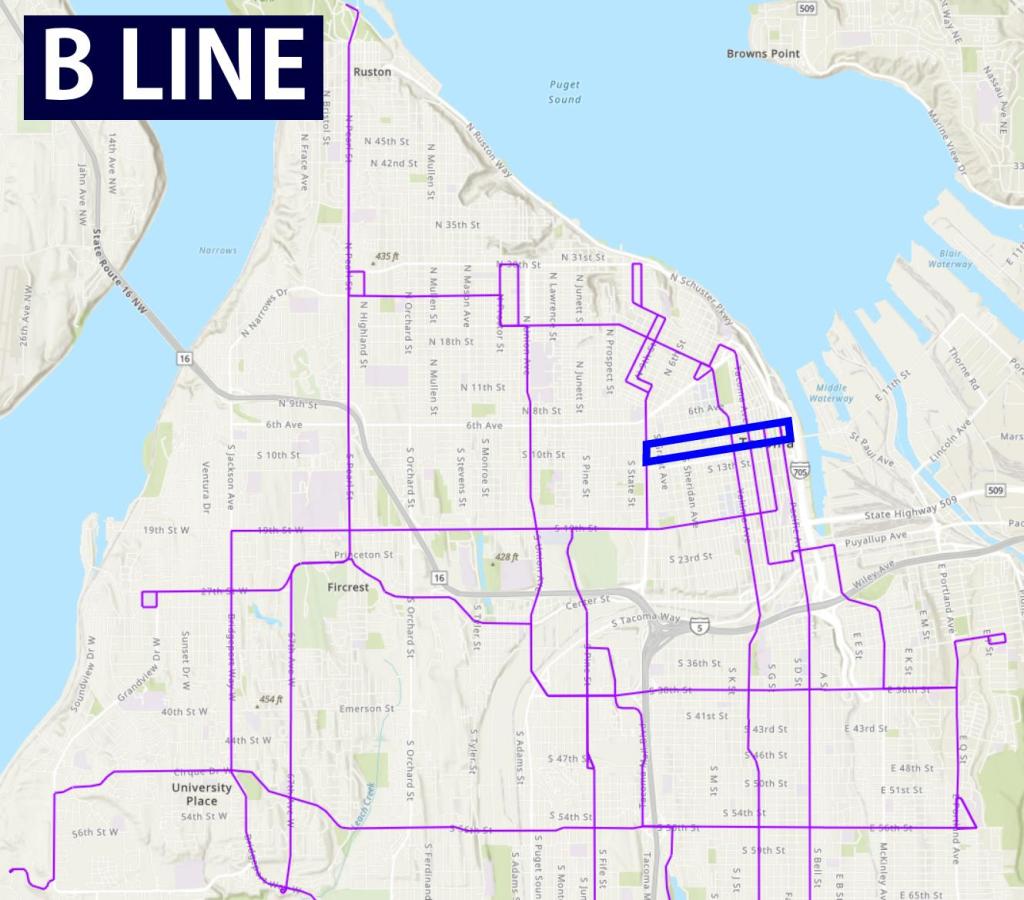
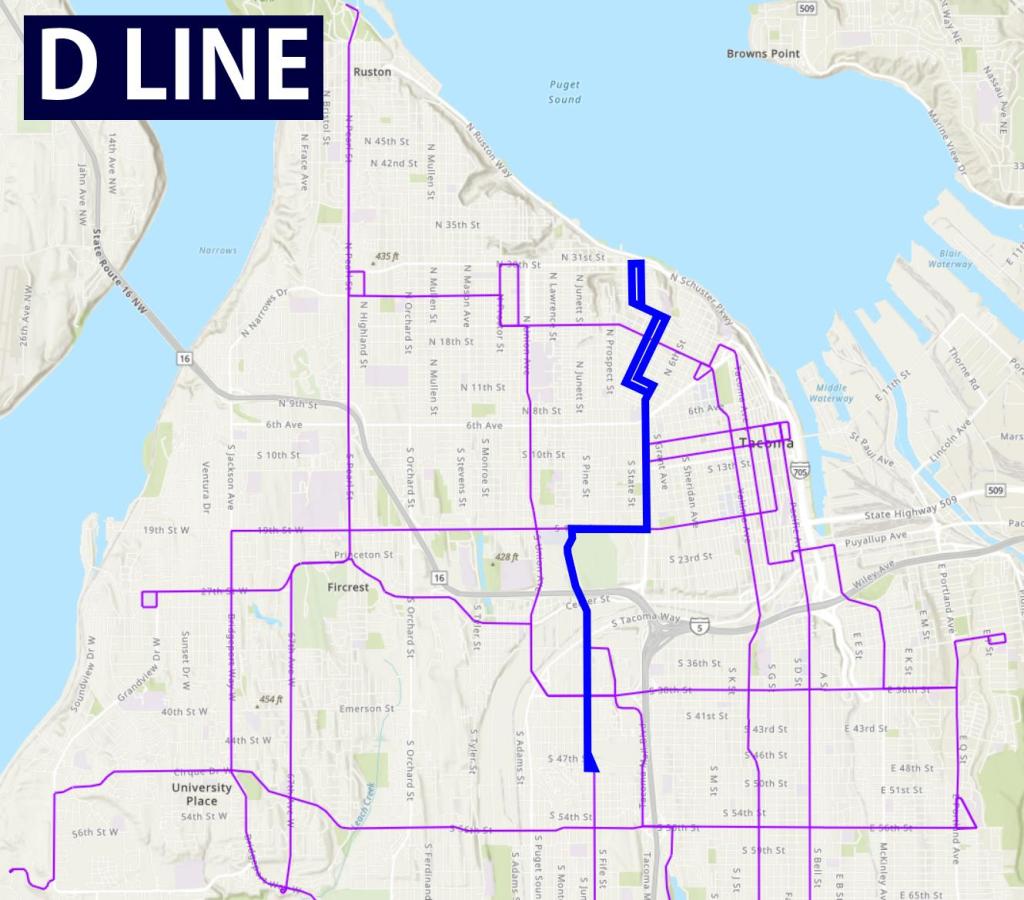

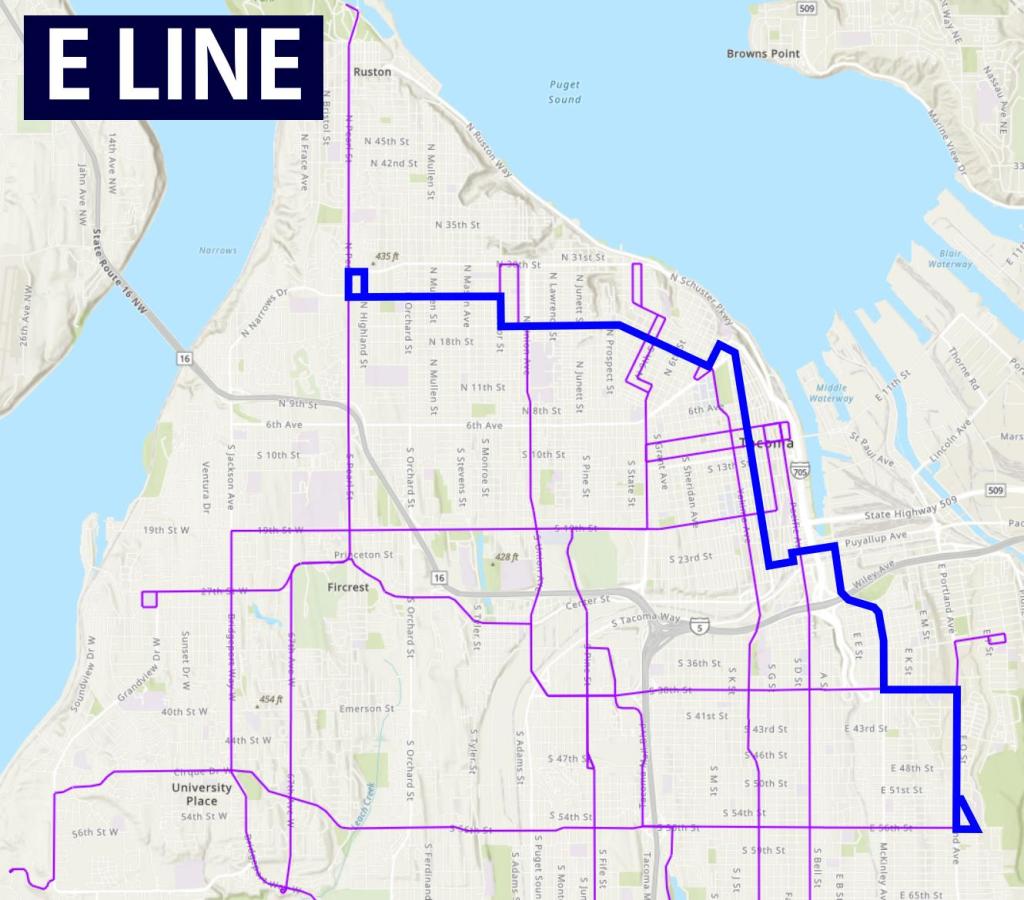

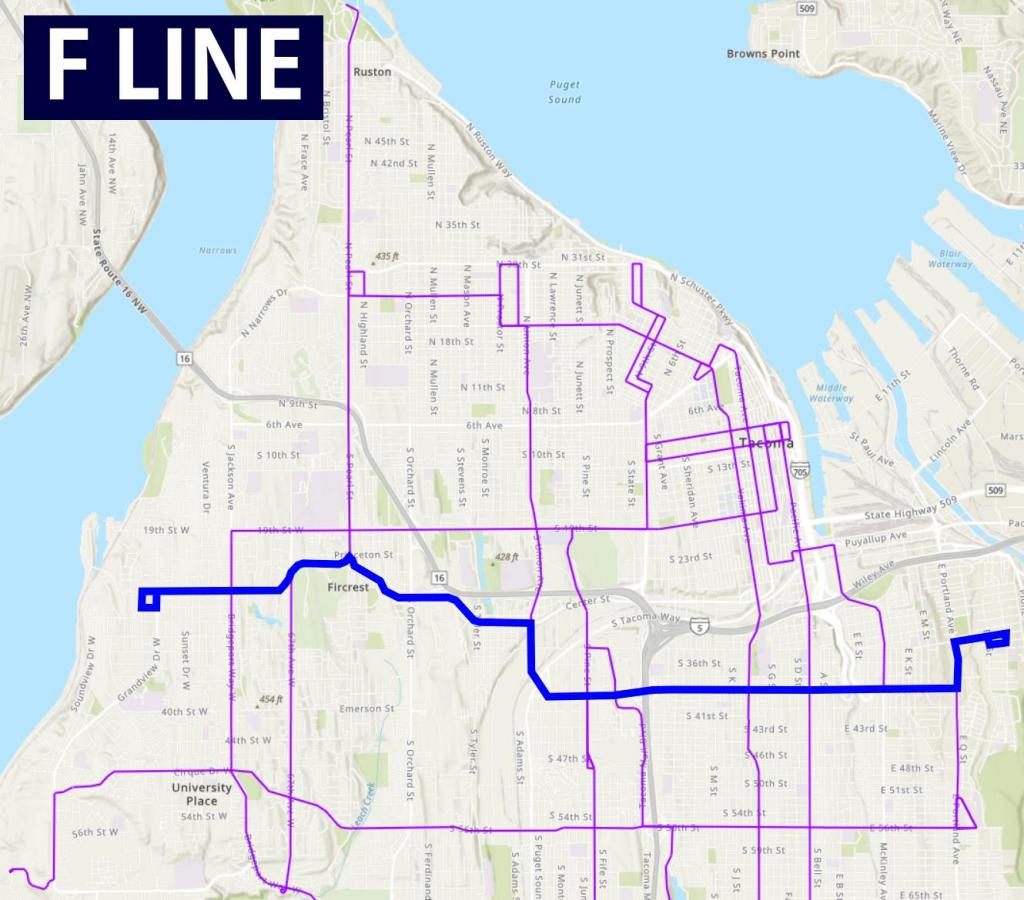

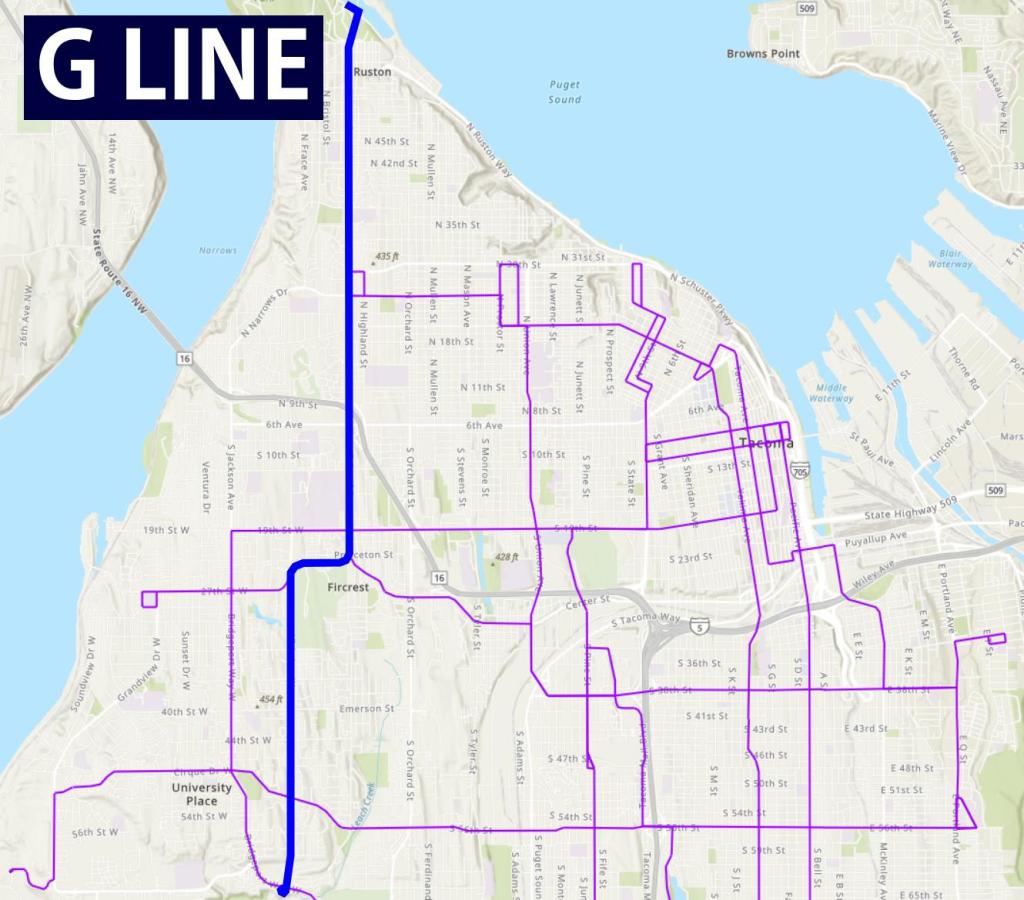

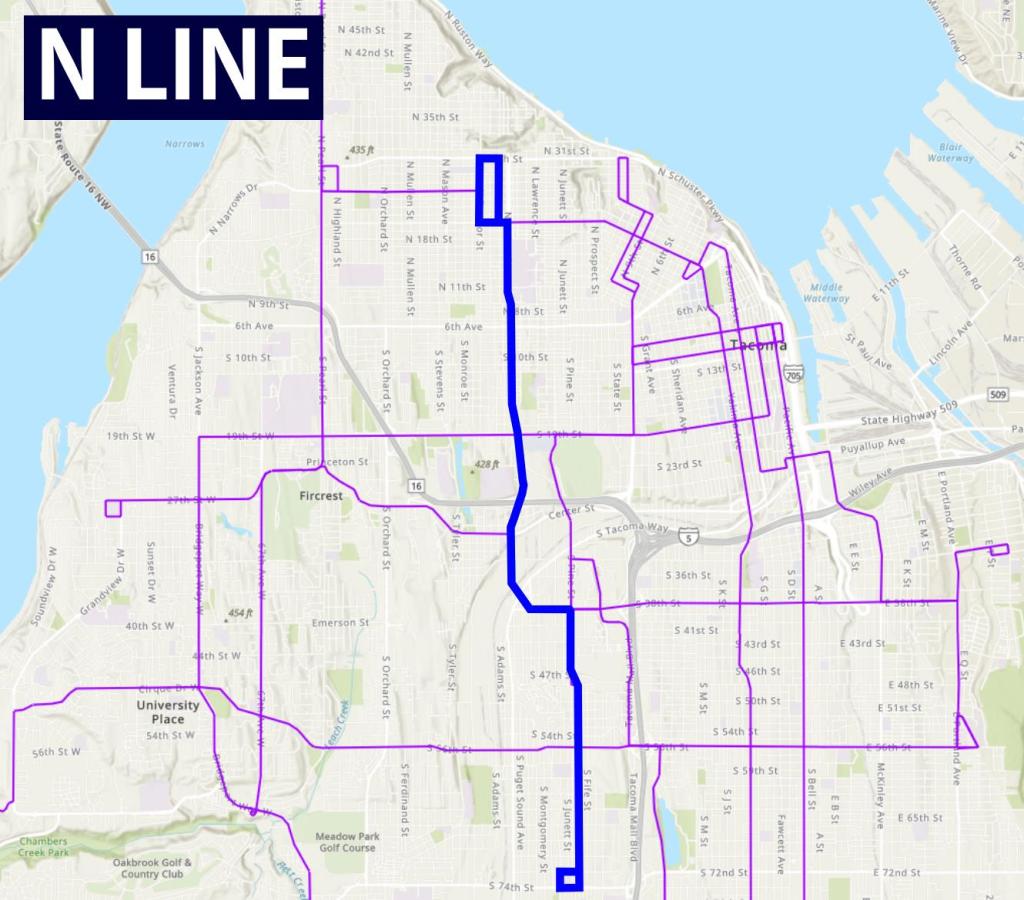

Please review the Integrated Transit Plan for additional routes. Layers can be toggled on-and-off for a better understanding of the transit system. The background basemap can also be changed to better suit any visual preference. Finally, the view can be rotated for a unique perspective.
Electrify the Core Local Buslines
For Tacoma, the great transit mistake of the past was not ripping out the street railway system in 1938. No, the great tragedy was the decision to also destroy its overhead power system. In a different and better world, Tacoma’s transit needs would be served using wildly efficient trolleybuses under overhead wire. They would be emitting zero exhaust emissions in our communities along clearly defined transit routes. It is a shame that this genuinely incredible asset was lost to ignorance and hubris. Other cities made different choices.
As a public agency charged with steering transit in a better direction, Pierce Transit should seek to re-electrify local transit. Bus electrification should not be prioritized over more critical improvements to frequency and reliability, and should instead be ancillary to that work. Fortunately, the agency is working toward an electrification goal that is outlined in its Battery Electric Bus Fleet Transition Plan. However, the plan (rationally) uses the existing network as the benchmark from which to evaluate investment needs. Considering that the Integrated Transit Plan anticipates a different network serving a much larger area with much more frequent headways, unforeseen complications are certain to arise.
A potential middle ground is two-fold. One, focus on electrifying arterials that have high demand and which eliminates emissions for greater numbers of people. Two, explore on-route charging that allows flexibility in operations, particularly as it concerns the re-establishment of origins and destinations for individual lines. With these policies as a guide, Pierce Transit can leverage federal monies for corridor improvements that result in their electrification, as modeled by Spokane Transit Authority and their impressive City Line project.
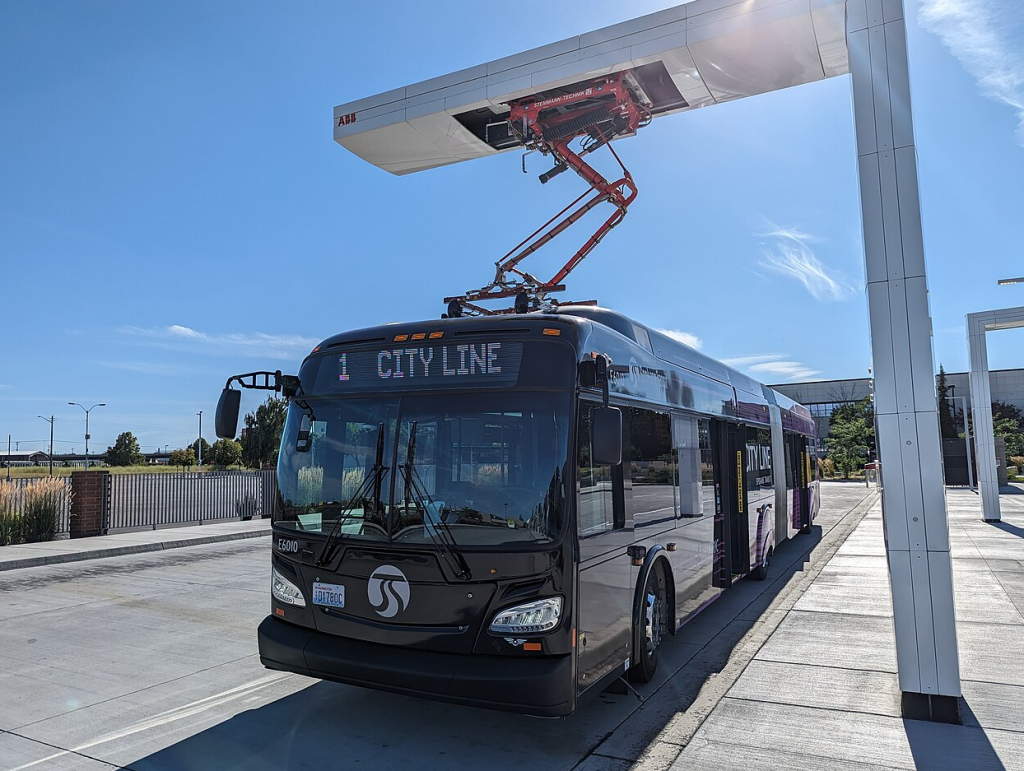
Whether by trolleybus, battery electric bus, battery-trolleybuses, or some new (albeit tested and trustworthy) technological variant, Pierce County should, once again, have electrified mass transit.
Conclusion
The Pierce County Integrated Transit Plan has many details and alignments that can be quibbled with. That is to be expected and it is welcomed. The value of the plan is not that it mandates any particular busline or railway. Instead, it helps pave the way for how we should be understanding transit planning and transit system development within Pierce County.
We must have an integrated, systematic approach. All of our individual investments should work toward the emergence of a cohesive whole that effectively serves the people—to include railways and buses—and at the local and regional scale. That whole should leverage the existing road grid system of the County, and be reinforced by supportive land use and development policies that ensure its success.
If we want a quality transit system that just works, we need to actually plan it. As we have seen here and continue to see, good transit will not happen by accident.
Open thread 51 is looking for readers. It’s hoping you haven’t missed it and has a lot of interesting stuff, really.
The Tacoma-Pierce County “hug” of the Seattle Transit Blog concludes today. Thank you for holding this space and producing these record pages.
The items in the Open Thread are indeed interesting.
Having a comprehensive local+regional vision for Pierce County that we can say meets most of the transit needs is important, and is worth five days. If we had similar ones for Snohomish County and King County, we’d publish them too.
The closest we have in King County and Snohomish County is Metro Connects and Community Transit’s long-range plan. They have many good ideas, but both of them leave gaps and aren’t frequent enough, and work around ST’s plans rather than reevaluating them (which a local agency can’t do). And Metro’s commitment to bold restructures seems to have shrunk since 2020.
We’ve filled some of the gap in King County with ideas for South King County’s bus network, and ideas in Lake City, Greenlake, Aurora, etc. But we usually treat Link and bus routes seperately, either fighting with Sound Transit over station locations or proposing a bus network that works around ST’s plans. And it’s one district or subarea at a time rather than integrated countywide. It may be infeasible to do a countywide one without hiring a consultant, since King County is so large and populous. Currently, Martin and Ross are furiously discussing a bus-based alternative to West Seattle Link, so you may see that soon.
The open thread suffered from being published on the same day as a Tacoma installment, and the Tacoma installments having a longer-than-usual excerpt on the home page, so it may be easy to miss an intervening article. That was due to me not having time to finish the open thread by its dedicated day, and a technical issue with rescheduling the Tacoma articles after the open thread was ready Friday, so we ended up with two articles the same morning.
“Infrastructure scope escalations should come only after these smaller improvements have been delivered and their benefit exhausted. This would result in upgrades of an intuitive order: organization before technology before concrete; transit signal priority before BAT lanes before median lanes and stations.”
Important. Stream suffered from wavering city commitment to transit-priority lanes. Seattle has so many Link lines partly because it’s easier to get grade-separated rail approved than to convert GP/parking lanes to transit-priority lanes over the objections of neighbors and car-myopic businesses.
Most transit agencies look at how far/ long they can run a route to match contract-specified breaks for the drivers while maximizing the coverage that they can get. I know it’s tough to suggest early routing that does this as it’s hard to know unless someone can drive an actual bus on it, simulating stopping and starting to load and unload riders.
If a route takes too long, the agency may have to assign another additional bus to the route. It’s very hard to add a fraction of bus to a route and very expensive to add another bus.
I don’t think any of the major routes suggested here will exceed the distance needed to require driver breaks at anywhere but the ends — but of course it’s hard for any of us to know. With the exception of the Route B, most appear an appropriate length for these driver breaks. So this appears to be a great first attempt at doing this!
However, I would caution that the round trip travel time is a key basic building block in bus routing, and an agency may add or subtract the route path because of this. (Not enough time in the schedule is often why some routes don’t go as further as would seem useful to the average citizen.) It also governs where drivers can take breaks on a route — and drivers do need to place to relieve themselves. Finally, it does affect where bus priority can help to close the distance gap if any routes are slightly too far to make the target round trip travel time (conversely, too much traffic calming on a route can slow a bus down, inadvertently creating a new round trip time problem).
Did you target a particular round trip distance or estimated travel time, using something like Google Maps to estimate the round trip time for driving then adding extra time to account for each bus stop? Are there places where drivers are breaking in an area without restrooms? Are there places where a route can be lengthened or shortened to optimize its service? Are there segments that get congestion that would make meeting the target round trip travel time difficult (the reliability issue)?
By the way, this skill is why a good transit route planner (on staff or periodic consultant) is extremely valuable. Each bus costs several hundred thousand dollars a year to procure, maintain and drive. They can truly be unsung taxpayer heroes (or villains if they’re instead bad at it).
There was an element of creating realistic busline lengths within the planning of the system, although my work is more rooted in identifying rights-of-way for a future system. These streets and roads should be developed for transit use and targeted for zoning improvements. The plan is for Pierce County residents and officials to better understand how transit might serve it in the future, with a larger population, and with greater revenues at its disposal.
There were indeed some lines that are longer than preferable, like the 72nd Street east-west grid line, but they tend to traverse parts of the county that would not have as many stops. The 72nd St Line would function as an express of sorts through the County’s rural separator zone, which prohibits development, presumably allowing for acceptable trip times despite the length.
Generally, 10 mile distances were when I began to get nervous about trip lengths. The lines would obviously be refined by Pierce Transit planners and their consultants during future restructures.
Is the use of bus route letters here done to emulate RapidRide lettering or merely to highlight more frequent routes? There is a difference between frequent service and RapidRide-style frequent service.
There is a difference, but in my experience, not much of one. Metros RRs should be renamed Frequent Rides, as that is almost the only benefit, IMHO. Yes, a little wider still spacing and platform payment, but it really is the frequency that makes them attractive.
Stop not still. No reason to skimp in bootleg whisky.
I assume it’s just placeholders for future route numbers, like how Metro Connects’ concepts have four-digit route numbers. We don’t need an alphabetical overlay like RapidRide. Pierce Transit has a precedent of one-digit numbers for priority routes, so just leverage that. If it needs more than nine, renumber the non-priority routes to above 20 or 50 or 100.
They are absolutely just placeholders to avoid confusion with existing Pierce Transit routes, and also to distinguish these special routes from general grid buslines.
Basically, these are the lines for which I would prioritize investment. They allow for countywide transit mobility. Existing lines with the most productive ridership would be improved first, in my thinking, unless a new line eliminates a significant gap in the system.
Troy, I compliment you on illustrating major routes without intermediate loops and deviations,
Pierce Transit development plan 2024-2029 draft. More comments may be in the open thread (Sunday Movie) after this article.