SR 167 Master Plan. Toll Lanes in Purple, Direct Access Ramps in black diamond
WSDOT completed the SR 167 master plan in 2023 for the next couple decades outlining the freeway expansion. Albeit focusing on single occupancy vehicles throughput, the plan did outline constructing toll lanes, building direct access ramps, and running proposed BRT route for the corridor. While this was a study without funding it might still become a reality. Similar to how the previous I-405 study ultimately became the Stride 1 and 2 freeway BRT projects.
The Puget Sound metro area has made significant effort in expanding transit with both its light rail network and side-running BRTs like RapidRide and Swift. These have established a better transit baseline than many American regions have, enabling people to get around easier. Recent Link extensions like Lynnwood Link and the starter East Link, and future projects like Downtown Redmond, full East Link across Lake Washington, and Federal Way Link, are set to enhance regional connectivity. However, while these extensions are excellent for improving commuter routes and replacing express freeway buses, their freeway-adjacent alignment often bypasses significant job, retail, and residential hubs along existing avenues. This leaves many high-density corridors such as Aurora Avenue, Evergreen Way, Pacific Highway South and Rainier Avenue South underserved.
Enter — Center-running BRTs. Operating in dedicated lanes separated from general traffic, they offer a combination of moderate-high reliability, faster travel times, and relatively low cost compared to light rail. This makes them particularly well-suited for connecting dense urban corridors that are underserved by existing transit.
With the Montlake Lid bus stop opening in April, this article will recap the past and briefly explore the future of transit on SR-520. The opening of East Link will lessen the need for so many bus routes across SR-520 but we should still take full advantage of the infrastructure that is already there.
This article will briefly look at Sound Transit’s planned deletion of ST 541 and ST 545, expansion of ST 542, and future ST 544. We’ll then pivot to a new concept of restoring Metro’s Route 255 to downtown Seattle, or improving the Route 255‘s connectivity to the U-District.
There’s been some discussion about past plans such as Forward Thrust (1970s). However, many other plans were debated. The Link light rail could have ended up as a very different variant of light rail. This article will provide a brief overview of the past plans and some light commentary.
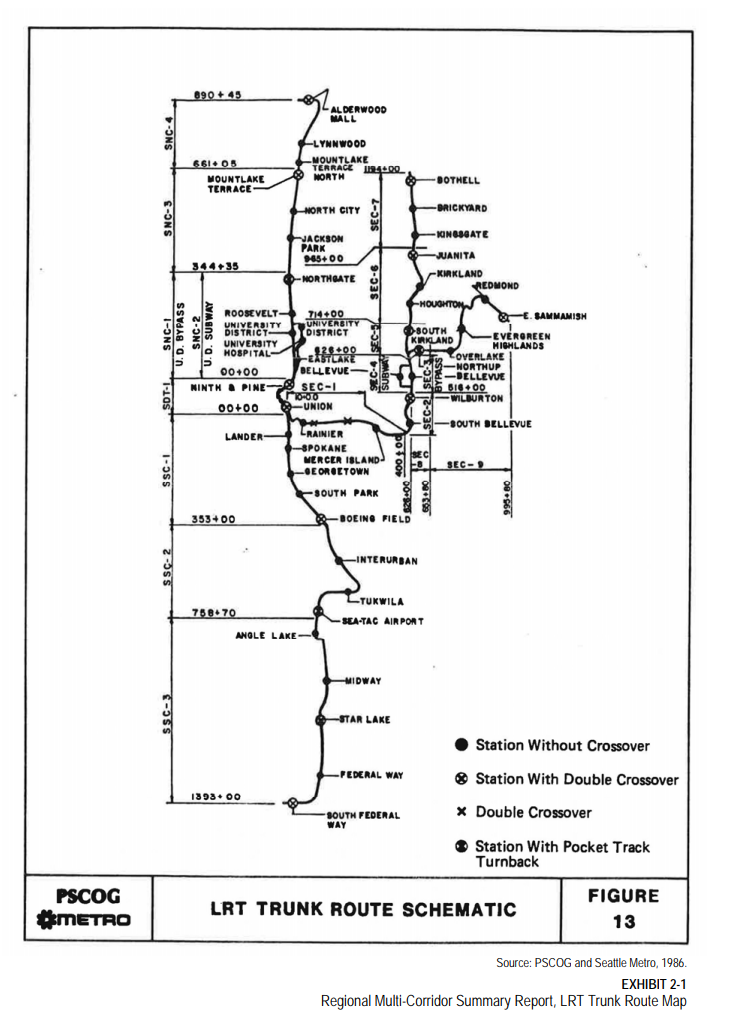
PSCOG 1986
The general alignments in the PSCOG 1986 plans aren’t too different from the eventual ST2 with a branched line heading from Lynnwood to Seattle and then either east via Bellevue to Redmond or south via Sea-Tac to Federal Way. However there are some notable differences with the exact route.
From Seattle to Tukwila, rather than running on Mlk Way, the light rail line ran on East Marginal Way then via the Interurban Ave S to reach Southcenter Mall. This route added stations at Boeing Field, South Park and Georgetown though at the expense of the Rainier Valley ones.
The Federal Way and Lynnwood Link segments generally are the same with an I-5 alignment. For East Link, the line was extended out to Sammamish past Redmond and there was an additional Bothell via Kirkland to Bellevue line.
Thought it’d be fun to look at some spot improvements King County Metro has done. The 2024 report was just published this month. Below will detail a handful of spot improvements alongside previous ones from the 2022 report and 2023 report.
This article will provide a brief overview of Redmond’s Link stations walkability and bikeability. It’s a followup to our Redmond Station Areas article a year ago. In the Starter Line segment that opened in 2024, Overlake Village station added protected bike lanes, while Redmond Technology station added pedestrian bridges across SR-520. For the Redmond Downtown extension opening May 10, Sound Transit added bike tunnels under SR-520. The City of Redmond reconnected the Marymoor Village area with a new street grid, and integrated the existing bike trail next to the Downtown Redmond station. All of these improvements help transit riders reach light rail stations easily and conveniently.
Originally around 2013, the Ballard Link Extension was envisioned as an at-grade alternative. Transit advocates and others pushed for complete grade separation for faster speed and reliability. Sound Transit extended the ST3 a decade and convinced the other sub areas to help fund a second transit tunnel. Unfortunately the preferred Ballard Link Extension has faced large cost overruns from $5.2 billion dollars to now $10.8 billion. In light of the eye-watering cost increases, a second look at the original at-grade options studied in the early 2010s should be considered.
Edit, 11:40am, February 21: Sound Transit provided a newer map of the Federal Way Station area, reflecting a design change moving the bus terminal to be directly adjacent to the light rail station. The article has been updated with this information.
Since Federal Way Link is opening in 2026, here’s a brief overview of the 3 stations opening next year and their layout. The diagrams are from the open house and photos from City of Kent and Sound Transit. The stations’ existing poor walkshed will be improved with a new street grid. Biking to destinations east of I-5 will be moderately improved by new bridges, though new I-5 off/on ramps will also increase car to bicycle conflicts.
Most of the proposed alignments are along I-5 and the alternative stations have generally similar walksheds. Given the amount of information, this article will only provide an overview of the alternatives with some extra detail on South Federal Way and Tacoma Dome. Please browse the links below for more information.
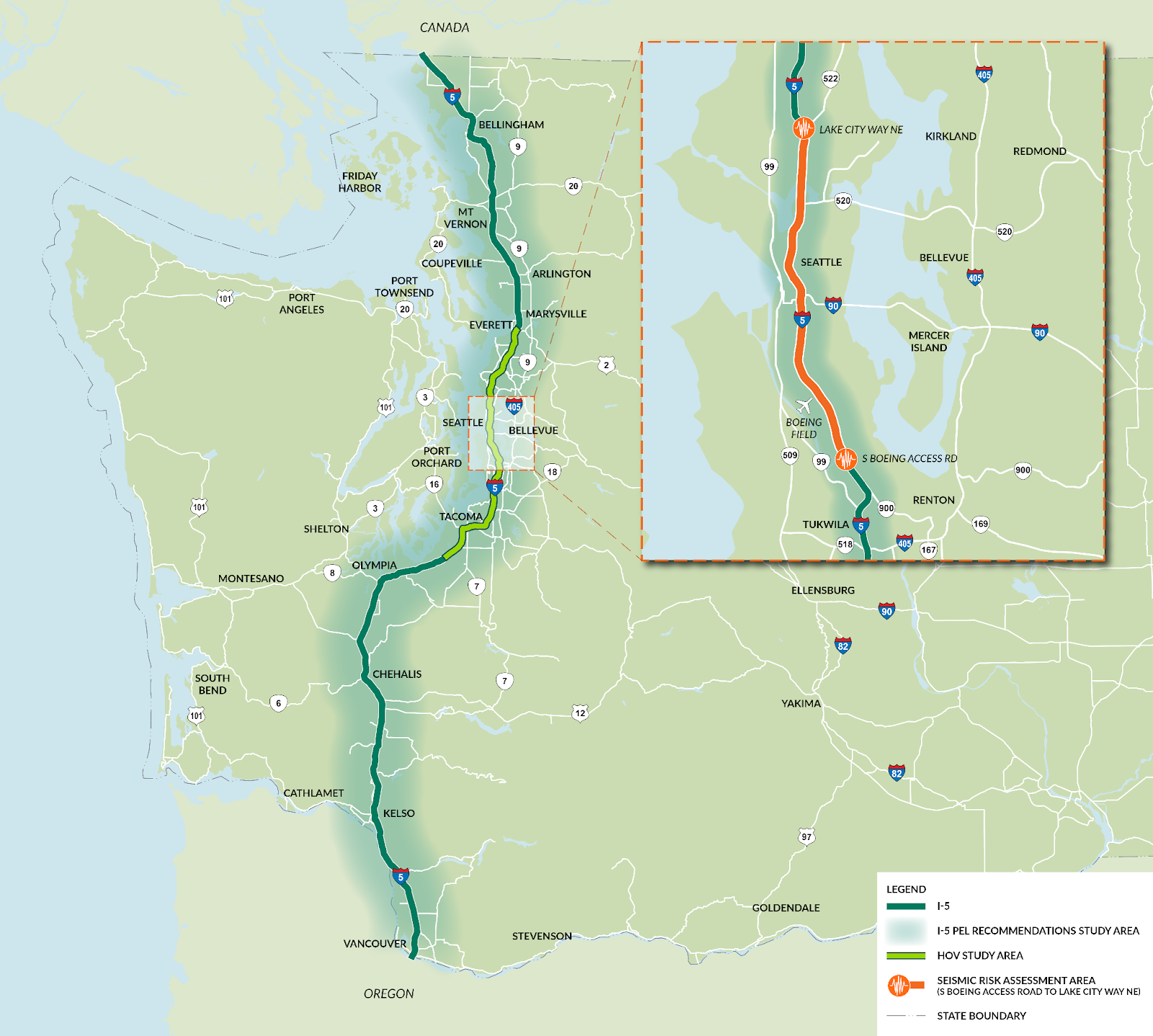
WSDOT is currently conducting an I-5 master plan study. The primary focus for the Seattle metro area involves converting HOV lanes into express toll lanes. While the current study won’t be finalized for another four years (until 2029), previous completed studies from 2010 to 2012 that provide a good starting point.