
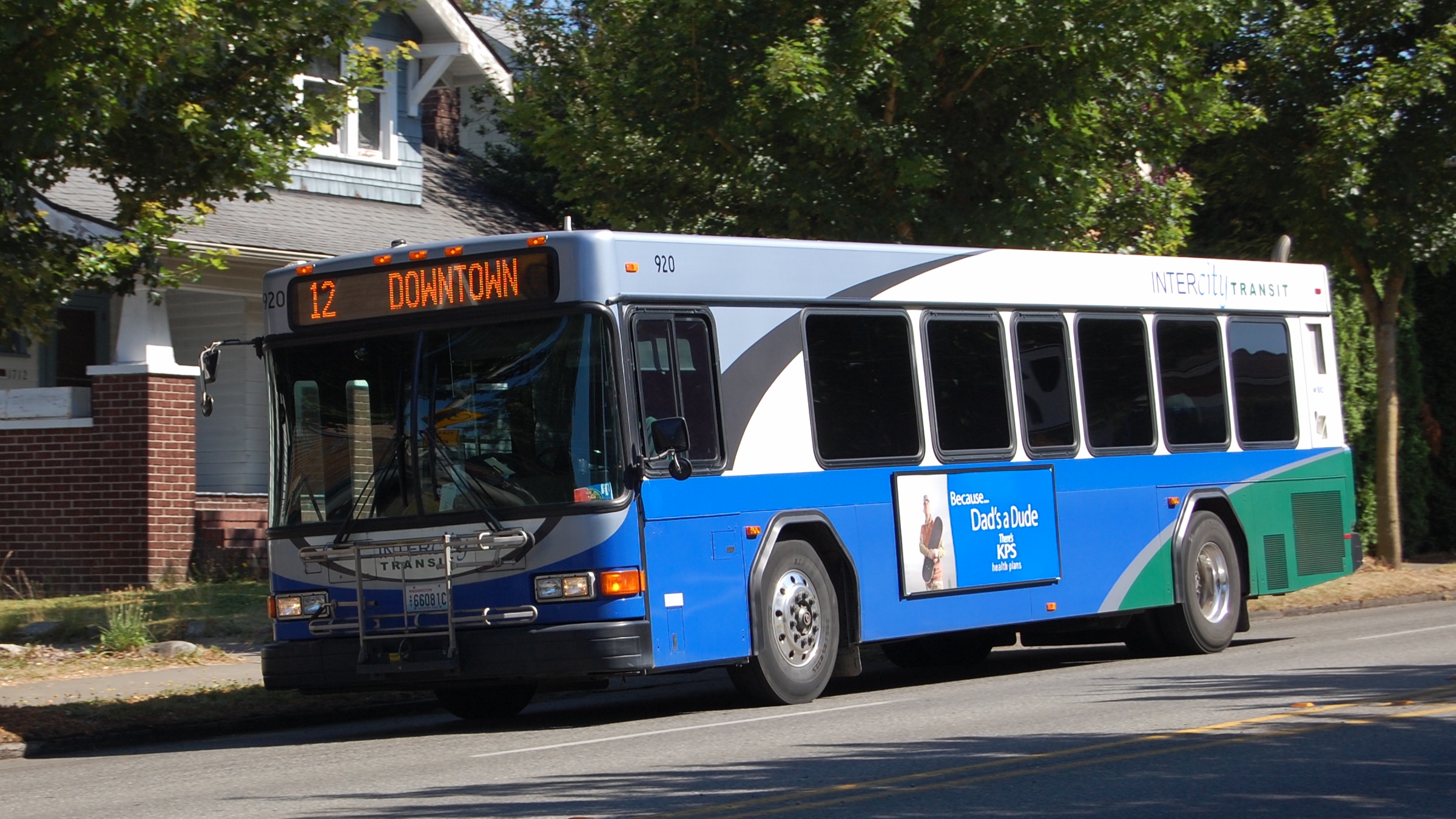
Ranking Washington Transit Agencies by Service Hours. #2 Will Shock You.

Wikimedia. Forgive the clickbait headline, it’s just for fun. :)

Earlier this month WSDOT came out with its annual Summary of Public Transportation, its comprehensive accounting of just how much transit service exists in Washington, how much it costs, and where the money comes from.

Of course, very little service is funded or provided directly by our state, ranking us near the bottom of “Blue States” in terms of the state’s relative funding share. Instead, our patchwork of city agencies, county agencies, and special purpose tax districts combine to provide 9.7 million annual service hours to 5.9 million of Washington’s 7 million people, meaning 84% of the state’s population lives within an area paying some form of transit taxes. As transit is primarily an urban service, the combined ORCA agencies alone (excluding Washington State Ferries) provide 69% of the transit service hours in Washington. But how much does each person get? Which agencies provide the most service per capita?

Now that I’m spending a few days a month in Yakima, I noticed that its transit network – mostly hourly circulators – is abysmal for a city of its size. But anecdotes aren’t data, so I thought it’d be interesting to rank all of our state’s agencies* by per capita service hours – inclusive of all fixed-route, flexible service, paratransit, and vanpool services – to see which ones punch above and below their relative weights in terms of total service provision (rankings below). The results are fascinating, with some small agencies providing high quality service levels (such as Intercity Transit and Spokane Transit), and others (Yakima C-Tran, etc), not doing so well.

Yet all metrics provide only partial insight, and “per capita service hours” is no different. The metric tells us how much is spent and nothing about productivity, and it privileges agencies with either tightly-drawn boundaries, a dense network, or both.

With its dense county-only network, King County Metro comes in first place at 2.12 service hours per capita. On the other end, with pre U-Link data, a tri-county network of “long and thin” express services,  and its current emphasis on capital construction, Sound Transit comes in last place at just 0.23 service hours per capita. Is this damning for Sound Transit? Not at all. To see why, consider an analogy from global currencies.

If our tax dollars are the investment, then service hours are the currency through which dividends are paid. Among the agencies below, all of them except Sound Transit use the same unit of value, the good old bus. Using the same unit of value narrows the range of possible productivity outcomes. You may have 10 riders per service hour or you may have 50, but a bus is generally not going to have 1,000, so analyzing total service output allows for reasonably direct comparison.

Yet upgrading to high-capacity transit is like adopting a higher-value currency, in that a high-capacity service hour has vastly higher purchasing power. RapidRide D has Metro’s highest ridership per platform hour (80). By contrast, Link is projected to have 240 riders per service hour in 2017, and 390 for Sounder. So as we increase passenger density, service hours per capita should fall, plunging Sound Transit to the bottom of the list. Within the bus world, it’s better to be on top, and Metro and Intercity Transit are the cream of the crop. But our recent Yes vote on ST3 told lawmakers that we also want some of our reserves in higher-value currency, grade-separated light rail.

With those caveats in mind, here are Washington’s 31 agencies ranked by service hours per capita.

*Community based providers (HopeLink, People for People, etc are not included below).

Continue reading “Ranking Washington Transit Agencies by Service Hours. #2 Will Shock You.”

| 66 comments

Will Link Waste Its Capacity for the Sake of Operational Convenience?

Photo by Oran (Flickr)

Link’s vehicle shortage provides both challenges and opportunities. By deciding to batch the order for the remaining 122 cars needed to operate ST2 (Lynnwood-Overlake and Lynnwood-Angle Lake), Sound Transit chose economies of scale at the cost of limited operational flexibility in the interim years between ULink and new vehicle delivery (2016-2018). In practical terms for riders, this has meant the inability to operate all 3-car trains at weekday service levels.

Before Sound Transit selected Siemens as the vendor instead of KinkiSharyo (who built the cars you ride today), we asked that the new vehicles feature “open gangways”, nerd jargon for cars that you can walk between and through. Open gangways maximize platform space available to passengers, and are the global standard for urban rail. But in another example of negative American exceptionalism, these best practices are universally ignored here. To see open gangways in practice, Seattleites only need to visit Vancouver and ride the Canada Line.

So with this new procurement, Sound Transit has a chance to align itself with global best practice and build open cars, maximizing passenger capacity and taxpayer return on our investments in ST2 (and soon ST3). Otherwise, every 4-car train set will have 8 operator cabs forever.

In 2015, Sound Transit spokesman Bruce Gray told STB that open gangways would “limit flexibility within the fleet and the Operations and Maintenance Facility (OMF) isn’t set up to handle longer vehicles.” Asked to clarify last week, spokesman Geoff Patrick struck a similar note,

Continue reading “Will Link Waste Its Capacity for the Sake of Operational Convenience?”

| 80 comments

De-confusing Holiday Schedules

Christmas and New Years Day fall on Sunday this year, so both are celebrated on Monday by various transit agencies.

Washington State Ferries adds and subtracts some runs on Christmas and New Years Day, so check your route’s schedule and alerts, and be sure to make a reservation if the route allows it.

Some services extend later on New Year’s Eve. Link Light Rail and Tacoma Link will have extended hours that night. The monorail runs until 11:15 New Years Eve, shuts down for an hour by order of the Fire Marshall, and then reopens 12:20-1:00 am.

For all three days of each coming long weekend, Link Light Rail will be running as 3-car trains all day. Board the rear car, as that will continue to be the most spacious one.

Other altered service patterns on surrounding days include:

  • Intercity Transit shuts down early on Christmas Eve.
  • The monorail shuts down at 6 pm on Christmas Eve.
  • King County Metro runs a reduced UW schedule the week of December 19-23.
  • King County Metro runs a reduced weekday / reduced UW schedule December 27-30.
  • UW Night Ride shuts down between quarters, but the South Lake Union and Harborview shuttles continue to operate on weekdays except holidays.
  • .
    For all agencies running weekday service the day after Christmas and New Years Day, I verified it with the agency if it wasn’t spelled out clearly on their website. The list of agencies around the region, and their service levels, is below the fold. Continue reading “De-confusing Holiday Schedules”

    | 26 comments

    Real Time Info Coming Closer, Farther Away Than Ever

    Silver Line frequency during SafeTrack

    Over three-and-a-half years ago Sound Transit launched a study to solve the myriad problems blocking proper real-time arrival information at Link Stations. Since that time, the returns have been meager: ST took responsibility for OneBusAway  from the University of Washington. OneBusAway still reports only scheduled data for Link. Only the two U-Link stations have onsite displays of next train times, which have problems of their own. These issues will soon be resolved, while onsite info at the other stations is nowhere in sight.

    First, the good news: beginning sometime in January 2017, OneBusAway (and any other application using the data feed) will display actual next train times for OneBusAway. Not only will mobile devices have accurate information, ST’s IT department says that a software upgrade last September “improved the accuracy of the ETA data” for Capitol Hill and UW Stations.

    Unfortunately, there is no clear path to upgrading the other existing stations. The existing “dynamic” screens are severely limited and cannot accept the heavily processed data feed that OBA uses. The study estimated the total cost of replacing the screens at $475,000, which ST deemed “prohibitive.” Blocked there, ST is looking at a “feasibility study” that will figure out what can be done with the existing system, how much it will cost, and funding sources for the work.

    ST could not provide a timeline for this project, but they “remain very committed to finding ways to provide Link arrival and departure information to our riders, and to have this information available on station platforms and in other convenient ways.” It sounds like it’ll be quite a while before we have universal RTA signs, much less ones that list the length of trains (as pictured in Washington, DC, above).

    75 comments

    ST Board Approves 2017 Budget, Lege Program, SIP, TIP, and Northgate Station Land Deal

    The Sound Transit Board of Directors met Thursday afternoon to conduct monthly business, and approve four annual documents.

    The Board adopted the 2017 Service Implementation Plan, and authorized the CEO to implement recommended service changes in 2017. Zach detailed the service additions last month. Board Member Rob Johnson pointed out public comments calling for late night Link service or similar bus service. CEO Peter Rogoff responded that that is something that could be looked into for the future.

    The Board approved the $1.6 billion 2017 Budget and Transit Improvement Plan. At the time the proposed 2017 budget and Transit Improvement Plan were released, voters had not had their say yet on Regional Proposition 1 (Sound Transit 3). The two documents therefore had to prepare for both a win scenario and a lose scenario. The passage of Regional Proposition 1 enabled a substantial increase in projected revenue for next year.

    The final budget includes:
    $396 million for operations and maintenance
    $394 million for East Link construction
    $294 million for Northgate Link construction
    $116 million for Lynnwood Link final design work
    $100 million for a design-build contract for the East Link base
    $59 million for more light rail vehicles
    $38 million to complete the new Tacoma Trestle
    $24 million to complete the I-90 2-way transit & HOV project
    $20 million to finish the second track to Lakewood Station and add cars for the final 2 round trips
    $14 million for preliminary engineering for downtown Redmond Link
    $14 million for five new compressed natural gas buses and four new double-talls
    $10 million for final design of the Tacoma Link extension
    $6 million to complete the environmental review process for Federal Way Link
    $1 million for conceptual design work for Auburn and Kent Station access improvements
    Continue reading “ST Board Approves 2017 Budget, Lege Program, SIP, TIP, and Northgate Station Land Deal”

    | 19 comments

    Trouble on Paradise Lake

    This field off SR 522 is the planned site of a 360-unit apartment development.

    Some years ago, I lived in a residential community east of Woodinville. It’s a typical late 1970s subdivision with houses on acre-lots surrounded by tall trees; the kind of place where deer graze in the yard by day and bears sometimes visit by night. After the Growth Management Act was adopted in 1990, the neighborhood was miles outside the King County Urban Growth Boundary. Zoning was amended to RA-5, effectively freezing pre-GMA development in place with five-acre minimum lots.

    The neighborhood backs onto Paradise Lake Road, a winding rural road into Snohomish County. It was startling, therefore, to learn last week of a large apartment development on 17 acres of farmland alongside that road. The project comprises fifteen three-story apartment buildings with 360 apartments. Other than a church and middle school across the road, it’s a low density rural area with older homes on large lots.

    A drawing of the proposed apartment complex shared by the developer at a meeting on Wednesday evening.

    The rural area, it turns out, is bisected by the Maltby Urban Growth Area (UGA). It’s a long sliver of “urban” area along SR 522, mostly light industrial uses on the north side of the highway as it snakes up the hill from Woodinville toward Monroe. Five miles beyond Woodinville, the UGA was extended in 2005 for a church construction on Paradise Lake Rd. A neighboring landowner asked to be included in the urban area. For obscure reasons, the Snohomish County council agreed and rezoned the farm as Planned Community Business (PCB).

    The zoning also allows multifamily. Hence the peculiar sight of fifteen three-story apartment buildings in a pocket of UGA surrounded on three sides by R-5 zoning, the 5-acre minimum lots that are designed to prevent development into the rural areas.

    It is denser than many new developments in exurban Snohomish County, and will provide more homes than a comparably sized single family subdivision. More affordable too; though many residents will face long commutes, rents are about half the level of core urban markets. But it’s a textbook example of density in the wrong place. The only businesses are a pair of gas stations at the highway intersection, so every errand will involve driving. Roads lack lighting and sidewalks. The 720 parking spots required reflect a realistic estimate of the mode share and traffic impacts. The only bus in the area is the twice daily CT 424 which passes, without stopping, on SR 522.

    The Maltby UGA extends for several miles along SR 522. ‘Urban Industrial’ uses are in purple, and ‘Urban Commercial’ in red. Pale green indicates rural areas outside the Growth Boundary. (Source: Snohomish County Future Land Use map)

    What’s happened on Paradise Lake Road is an extreme instance of the development pressures along the edge of the UGA in Snohomish County. Around North Creek and other unincorporated communities around Bothell and Mill Creek, single family home development is booming. Land use is so inefficient that developers estimate they will soon run out of land within the UGA. Proposals are being floated to extend the UGA between Bothell and Mill Creek two miles east as far as SR 9 Woodinville-Snohomish Road.

    What’s happened on Paradise Lake Road is an extreme instance of the development pressures along the edge of the UGA in Snohomish County. Around North Creek and other unincorporated communities around Bothell and Mill Creek, single family home development is booming. Land use is so inefficient that developers estimate they will soon run out of land within the UGA. Proposals are being floated to extend the UGA between Bothell and Mill Creek two miles east as far as SR 9 Woodinville-Snohomish Road.

    Development on the rural edge generates severe traffic congestion, but is too sparse to support a significant transit share. Snohomish County’s Comprehensive Plan classifies Paradise Lake Rd and two dozen other rural arterials at “urban traffic levels”. LOS standards should act as a brake, preventing growth from running ahead of transportation capacity. In Snohomish County, low LOS standards permit low-intensity development to sprawl for miles into recently rural areas.

    At two well-attended meetings this week, neighbors expressed frustration. Having been caught unawares of the 2005 rezone, their hopes may now depend on traffic issues. Paradise Lake Rd is the last signal-controlled intersection on SR 522 between I-405 and Monroe. A $100 million flyover is planned, but funded only for design (and only after 2025). Though local traffic congestion is severe, it does not yet appear to put the area in arrears under the LOS standard. The developer anticipates breaking ground in late 2017.

    47 comments

    The Status Quo Needs an Environmental Review

    I-5 Construction Separating Capitol Hill from Downtown (Seattle Times Archive)

    Upon signing the National Environmental Policy Act (NEPA) on New Years Day 1970, President Nixon signaled the beginning of a hopeful new era: “[These] must be the years when America pays its debt to the past by reclaiming the purity of its air, its waters, and our living environment.” And make no mistake, the debt was steep.

    Nixon signed NEPA to begin fighting back against the cumulative burden of an unequivocally rapacious century. Though in the 1960s and 1970s environmental conditions were no longer as apocalyptic as the black noons of Pittsburgh, cars still averaged 14 miles per gallonwere 7 times as deadly, and were 5 years away from the mass adoption of catalytic converters. Lake Washington absorbed 20 million gallons of sewage per day until 1963, and at the time it was seen as a major environmental victory to dump it into Puget Sound instead. Meanwhile, the construction of I-5 was busy tearing out 10,000 homes in Washington and separating neighborhoods with an impenetrable concrete barrier. And though NEPA passed in 1970, leaded gasoline continued to legally poison our brains until 1996.

    Against this runaway destruction, NEPA did something extremely valuable: it yelled “Stop and slow down!” to every project the federal government funded or for which it issued permits.  It didn’t relitigate the past, it accepted present conditions as the environmental baseline, and resolved to hold the future to a higher standard. When today we have density without misery, and far cleaner air and water, we have the Clean Air Act, the Clean Water Act, and NEPA largely to thank.

    Yet NEPA also made change itself the enemy, erroneously sanctifying the status quo as a part of the same environment worthy of protection. Millions of decisions that received no environmental review, such as the Interstate Highway System, today owe us no mitigation. But a 10-foot zero emission bike trail can be set back decades by environmental process.

    The EIS process has outlived its usefulness, becoming predominantly a tool for obstruction and delay. Sometimes these appeals serve genuine environmental ends (such as with the Dakota Access Pipeline) but far more often as a way of protecting vested interests against the specter of positive aggregate change. In just the latest example, Seattle will be required to study the ‘environmental impacts’ of housing people closer to where they want to live and work, on land that already houses people.

    We don’t need the repeal of environmental review, but instead a clearer focus on inducing positive outcomes rather than avoiding merely negative ones. Practically speaking, this could mean things like agreeing on a set of principles (such as ‘Housing and transit and bikes are good. Do more of those.’) and aggressively expanding Categorical Exclusions for those projects.

    When environmental goods are held back in the name of the environment and present conditions continue unabated, the process is broken. In the 4-5 years it takes for a Link EIS, cars will make 400 million trips on I-5 through Downtown Seattle, 50,000 new people will call our city home, and tens of thousands more will swallow long commutes because rich people outbid them for undersupplied housing. Those are environmental impacts too. The status quo needs an environmental review.

    40 comments

    News Roundup: The Obvious

    Everett Station on a snowy day

    This is an open thread.

    72 comments

    520 HOV Lanes Will Soon Get Better…For a While

    520 construction timeline
    Rest of the West project scope and timeline

    About a year from now, transit riders and carpoolers traveling between Seattle and the Eastside will notice a big improvement: for the first time in history, State Route 520’s HOV lanes will extend all the way from Bellevue to Montlake.  If your bus or carpool happens to traverse this segment of road, you’ll have a speedier, more reliable commute. It will be glorious.

    Unfortunately, about a year later, it will disappear again, and the HOV lanes will be back to where they are today, ending part way across the lake.

    Chalk it up to a matter of timing and funding.

    The 520 bridge project was designed to be completed in phases, since WSDOT wasn’t sure if or when the legislature would kick in the necessary funds.  And so, in mid-2017, the West Approach Bridge North (WABN) project will complete, and Westbound traffic will be diverted to the new bridge while the old approach bridge is re-striped for Eastbound traffic.  Each approach bridge will carry two general purpose (GP) lanes and one high-occupancy vehicle (HOV) lane.

    If more funds hadn’t materialized, the project would be wrapping up at that point. But the legislature ponied up, and the $1.6B “Rest of the West,” which replaces the old approach bridge as well as the rest of the connection  to I-5, including lids at Montlake and Roanoke, will begin construction in 2018.  At that time, the old approach bridge will be demolished, and traffic will be diverted onto the WABN in both directions.  The WABN will be re-striped to carry two GPs in each direction, thereby ending HOV access all the way to Montlake.   That will be the situation for about five years until the Montlake lid and surrounding elements are built.

    Curious, I asked WSDOT if they had studied the idea of keeping HOV access all the way to Montlake.  Larry Kyle, lead engineer for the project, explained that the northern approach bridge is a bit wider than its southern complement but still too narrow for more than 4 lanes.  According to WSDOT’s models, traffic delays would be too severe in the Westbound direction if there were only a single GP lane. Bicyclists, fortunately, will have access to the full length of the bridge during virtually the entire construction period.

    One other interesting tidbit: some folks were dismayed to learn that the 2nd bascule bridge at Montlake was slated for the very end of the project.  Kyle told me that the phasing was based on funds from the legislature, not engineering.  Therefore, if the city or another entity were interested in advancing the funds for the second bridge sooner, it could possibly be moved up by a few years.

    40 comments