New Bus Schedules

One period in the bus rider’s life that is pregnant with anticipation is the days before the new schedule comes out. As someone who has two non-ideal transfers to get to work, I’m always hopeful that the schedule will be tweaked in such a way so as to make my life a lot easier.

As someone who also works in a very poorly-served area, I’m also eternally hopeful that the service will get better. The comment period in 2005 about major Eastside service revisions got my hopes up, but as usual Metro planning is opaque when they’re not specifically asking for your opinion.

I’m usually disappointed.

Today the new schedules came out. Check here to see what lines are affected beginning Feb. 9. Sound Transit’s new schedule booklet is available here.

Highlights:

  • Tacoma LINK runs later on weekdays, and with more frequency (and fewer hours) on Sundays.
  • Rte 248 replaces the part of Rte 540 east of Kirkland, and extends to Avondale Rd.
  • Rte 221 is a new Route from Eastgate to Education Hill (Redmond) via 148th Ave.
  • Routes 8 and 70 have more frequent service to SLU, thanks to some of the employers in the area.

The Park-and-Ride Dilemma

At the meet-up, we had a short discussion of suburban park-and-rides that got me thinking. Giant parking garages are really a double-edged sword.

First, I’d like to dismiss the utopian-environmental argument that potential train riders will take the bus to the park-and-ride if there is inadequate parking. This is nuts. The whole idea of using transit for strictly local travel doesn’t really take off until non-car-ownership is a reasonably convenient option, which it most definitely is not in the suburbs. People spurned at the garage will drive to work. So you’re losing ridership, short term.

On the other hand, as Ben pointed out to me this weekend, put too many parking spaces around a station, and you suppress transit-oriented development (TOD). I grew up not far from the Shady Grove terminus of the DC Metro, which has 5,467 parking spaces (!) that totally surround the station Dodger Stadium-style. Now, the rules are a bit different for the end of the line, because you want to capture all those people driving from points north, but it’s been over 20 years now and I can’t help but notice the lack of TOD around that station.

So there’s a definite short-term vs. long-term tension there: put in too little parking, and no one rides your system; put it too much, and you end up suppressing the TOD that’s one of the big benefits of rail in the first place.

There are a couple of courses of action this points to:

(1) Build vertically. If you must have lots of parking, build that garage high so as to not take away vital real estate from long term development options.

(2) Manage demand. As I’ve mentioned previously, a nominal parking fee may allow to utilize resources more effectively. For a buck or two, someone who actually would consider taking a bus, bicycle, or walking, might choose the alternate mode instead of going for the most convenient option. A dollar or two also won’t discourage too many people from riding.

As a fringe benefit, this kind of demand management could fund electronic signs to let drivers know when the lot is full, reducing commuter frustration. As commenters from a previous post suggested, this is a major bummer when you have a train to catch.

Tips for Snow Busing

In case in snows again tomorrow, here’s some advice:

  • Wait for buses at the bottom of hills, never at the top. The bus is less likely to get there.
  • Buses might be on altered patterns for severe weather, check here for updates and information.
  • Be patient, your bus will likely be late.
  • Telecommute if that’s an option.

What am I missing?

Transit Meet-Up #2, Success!

I learned a lot yesterday at our Seattle Transit meet-up. Highlights of the night:

  • Bill LaBorde (who is really cool, btw) giving an awesome briefing of Sound Transit happenings.
  • Frank from Orphan Road getting cornered by Ben in the January out-doors at the 47th Parallel.
  • The Fish Tacos at CC Ale house.
  • Learning that having a kid might be a lot of work.
  • We decided that the Blue Scholar’s “Joe Metro” is Seattle Transit’s official theme song.

Next one will be in a month, hope to see you there!

Update here’s the video for “Joe Metro”

Wifi on the bus and Sounder – Not Shabby!

Greetings from Metro Route 212. It’s around 5:16pm and I’m on my way home from work at Eastgate Park and Ride. I must say that besides traffic sucking it’s usual self, this internet is pretty damn fast!

Also, mybus is a godsend. I never used it until now and even though it doesn’t work on my T-Mobile Stripe, the website is good enough considering I’m a 5 minute walk to the campus.

Now if only Metro would install 110volt outlets, I’d be a very happy camper.

Wonder how it is on Sounder…

Guess we’ll find out at 5:55pm =)

Update: 5:22pm Were on I-90 in the HOV lane and traffic is completely stopped on I-90 Westbound. Sucks that this lane doesn’t go into the reversible lanes… I have a feeling I’m going to miss my train now =(

Update: 5:25pm Ok, so we passed the small accident and cruising at 60mph and going through the Mt. Baker Tunnel. Ran a speed test in the tunnel and the connection held! Kick ass!

Last Result:
Download Speed: 391 kbps (48.9 KB/sec transfer rate)
Upload Speed: 109 kbps (13.6 KB/sec transfer rate)

Update 5:31pm I redid the test in the open land. Didn’t really change much at all. Just left I-90 and Rainier Ave Freeway Station. Looks like the interchange for I-5 is jammed in it’s usual affair.

I’ll be back when I walk over to King Street Station.

Update 5:51pm: Onboard Sounder 1511 to Tacoma (Well Kent Station for me) and the wifi is pretty good onboard. Can’t get a speed test though from Speakeasy. Seems about as fast as Metro.

Update: Departed ontime from KSS, this was the only speed test I was able to get.

Last Result:
Download Speed: 43 kbps (5.4 KB/sec transfer rate)
Upload Speed: 138 kbps (17.3 KB/sec transfer rate)

Odd….

Update 6:46pm: I’m now at home… It sucks that the 166 departs 2 minutes before Sounder arrives (Bus leaves at 6:15pm, train arrives at 6:17pm) so I ended up taking the Route 183 home instead of the 166.

Just a comparison to home internet – We use Qwest DSL only cause we got suckered into a 2 year contract…ugh.

Last Result:
Download Speed: 1305 kbps (163.1 KB/sec transfer rate)
Upload Speed: 617 kbps (77.1 KB/sec transfer rate)

After asking a few friends of mine, it seems that ST and Metro both use the same carrier. I think I am going to try it again in the morning if I get a chance. I found a rather addicting game online and been itching to kill time with it!

Just for those wondering, I cleaned this post up a bit. It was kinda sloppy since I didn’t know if the connection would actually hold as well but yes, it does appear that Sounder is pretty slow for wireless internet while Metro (not sure on ST buses yet) are decent. I had no problems surfing the internet and posting the blogs on Metro but on Sounder it timed out a few times while doing Google searches.

Sounder Park & Rides

komotv.com has an interesting story about commuters in Auburn complaining about the lack of parking at Sounder stations.

Since the story could alternately be titled, “Commuter Rail too popular,” I find it hard to get too worked up about this. Still, it’s nice to capture everyone that wants to be a transit user.

“I appreciate that and my suggestion would be to keep calling and e-mailing and writing to Sound Transit and ask them when will the second parking garage be built,” [Auburn Mayor Pete Lewis] said…

“We would like to build more parking in Auburn. We don’t have the money to do it today and to do that, we need voter approval,” said [Bruce Gray of Sound Transit].

Some thoughts:

  • Perhaps disgruntled parkers should direct their anger at their immediate neighbors, who voted more that 60% against Prop 1, and therefore voted down those parking garages. They didn’t vote no because of global warming — it was because they opposed a transit plan that “sent all the money to Seattle.” Well guess what — if you won’t pay for Seattle, Seattle won’t pay for you.
  • This is pretty concrete evidence of rail bias, and that transfers kill ridership. What doesn’t get mentioned in the article is the possibility of taking the bus, although there are 10 bus lines serving the station. Why? Because buses stink and people are unwilling to ride them. It’s also evidence that opposing park-and-rides at the outer stations because it encourages local car use is self-defeating.
  • When demand exceeds capacity of a free commodity, there’s a simple solution: charge for it. A nominal daily parking fee of a couple of bucks will still allow the lot to fill to capacity, but encourages people to seek alternate methods if they live only a couple of blocks away, live right next to a bus line, have someone that could drop them off at the station, etc. And hey, maybe those few bucks can help build a new garage.
  • The fact that people in the Kent valley desire additional Sounder service (and the attached amenities) is useful for building a coalition for more transit. Voters in that area are unlikely to get any direct benefit from any proposed light rail line, except additional mobility from the King Street Sounder station if they work for, say, the University of Washington. It’s good to know that there’s a relatively inexpensive carrot we can give to that region.

Via Orphan Road.

Metro Wants Feedback on Eastside BRT

Here’s the article in the Bellevue Reporter. Metro wants to put expanded service between Bellevue and Redmond for commuters with 10 minute headways, three-door buses, and few stops.

Should be cool, there are four dates for the meetings:

Tuesday, Jan. 15, 5:30-7:30 p.m. at Bellevue City Hall, 450 110th Ave. N.E., Bellevue;

Thursday, Jan. 17, 5:30-7:30 p.m. at Redmond City Hall, 15670 N.E. 85th St., Redmond;

Saturday, Jan. 19, Noon-2 p.m. at Crossroads Bellevue Mall, 15600 N.E. Eighth St., Bellevue; and

Wednesday, Jan. 23, 4-6 p.m. Bellevue Transit Center, 108th Avenue Northeast and Northeast Sixth Street, Bellevue.

Streetcar Network

Yesterday, there was pretty interesting piece in the Daily Journal of Commerce (behind paywall) about the city’s streetcar plans, and Tuesday’s Transportation Committee meeting:

The preliminary plan shows a line running from Ballard through downtown to West Seattle, lines connecting Fremont and the University District with the existing South Lake Union line, a line extending from Pioneer Square through the international district, and lines running to Capitol Hill and through the Denny Triangle to Uptown.

The plan was done by the Seattle Department of Transportation, the Streetcar Alliance and Heffront Transportation, a private consultant hired by the city last year. Most of the lines are similar to ones presented in a report by the Seattle Streetcar Alliance last month. Heffront recommended adding the line connecting Fremont and Queen Anne with South Lake Union based on projected growth in those areas.

I like that route, I really like the “Uptown route” as well as the University District Extension of the SLU car. The Ballard-West Seattle route I dislike, because it sees a cheap way out of getting real rapid transit through that area, and let’s face it, a street car average 10-15 miles an hour would take a long time to get from Ballard or West Seattle to downtown.

The monorail folks (these guys are still around?) have the same fear I do with regard to that line:

But transportation activist Michael Taylor-Judd, president of Friends of the Monorail, testified to the committee that a streetcar network cannot be a substitute for rapid transit.

“They are not a rapid transit solution,” Taylor-Judd said. “Streetcars running in the street with traffic do not solve public transportation problems.”

The get more development and more riders than buses, but yeah, it’s not real rapid transit.

The next steps:

A network plan with specific route options will be presented to council May 1, said Ethan Melone, SDOT’s streetcar project manager. Between now and then, organizers will work with Metro, Sound Transit and others to see how the streetcar fits into existing transit systems and how to pay for it.

Finally, concerns for the bicyclists among us:

Several other members of the public also testified that the right-hand location of the streetcars has been a hazard for bicyclists, who traditionally travel in the right lane through traffic. They testified that bicyclists have been injured when their wheels got stuck in the tracks of the streetcar.

Crunican said SDOT is looking into ways to mitigate the impact of the streetcar on bicyclists and will report back to council monthly on the progress they’re making. She said options include running the streetcar in the center or left-hand lanes in certain areas of the city.

I think it’s overall a positive development, though I hope it doesn’t turn into a way to get transit on the cheap to places like Ballard and West Seattle.

What do you think?

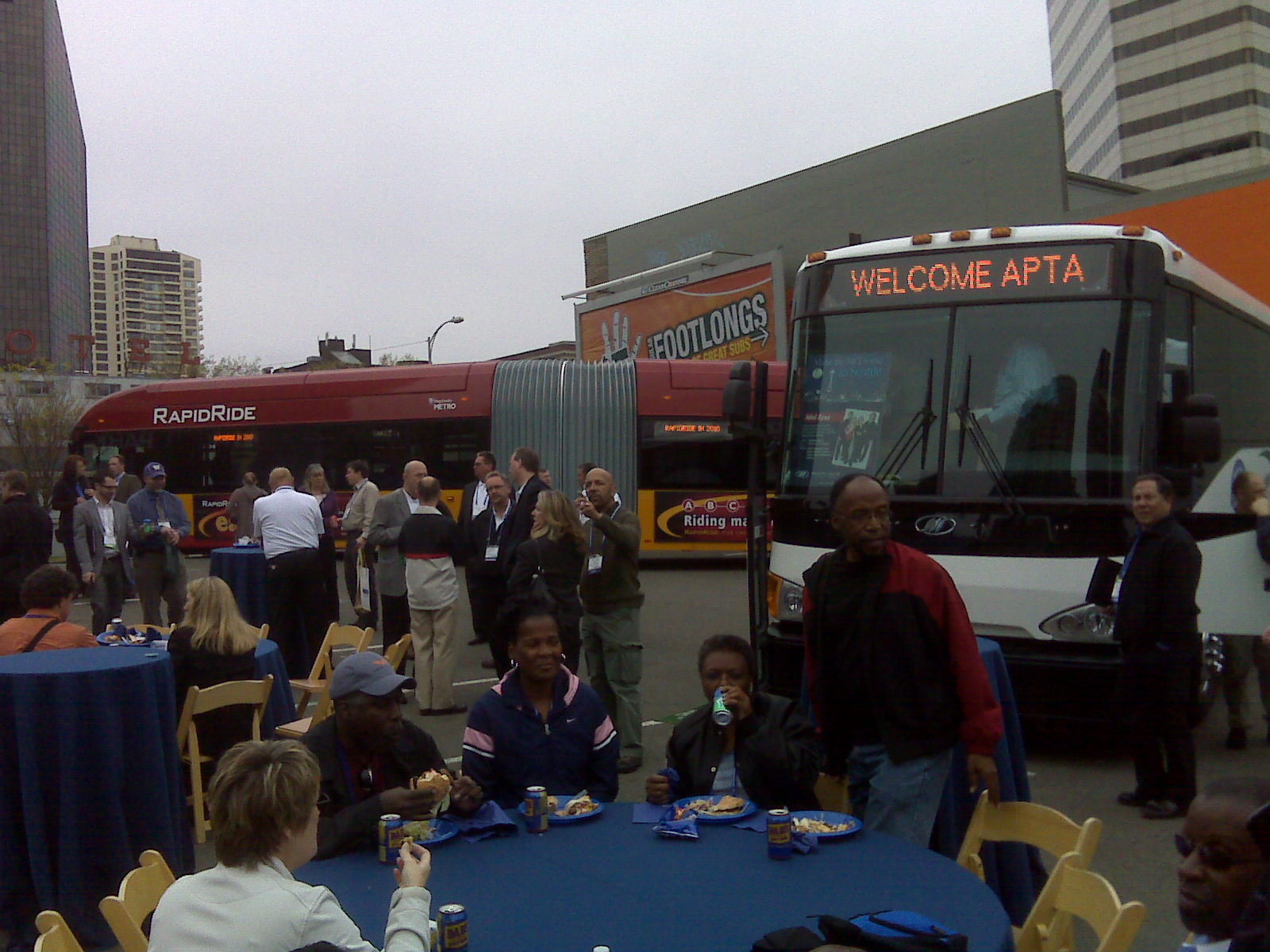
Rapid Ride: This is what 0.1% buys you?

Earlier, I linked to the first details Metro released about RapidRide Bus Rapid Transit (BRT) on the Eastside and to West Seattle. I assumed all the details were the same as for the Pacific Highway segment, but after scrutinizing things more carefully I see I was wrong about that. Metro is promising almost nothing above what we see with a conventional express bus.

Let’s go through Metro’s promises one by one. I’ll use the text from the Eastside line:

After RapidRide service begins, Metro’s plan is for buses to arrive every 10 minutes during the busiest morning and evening travel hours. At other times between 5 a.m. and 10 p.m., buses will come every 15 minutes. Between 10 p.m. and 1 a.m., buses will come every 30 minutes.

We’re talking about less service than Metro route 7. Woo hoo!

RapidRide buses will have low floors and three doors, so people can get on and off quickly. Depending on the outcome of a pilot project, a new fare payment system might be used that would allow riders with passes to pay before they board the bus, and enter through any door.

So we “might” see off-bus payment. I assume they’re referring to ORCA, but doesn’t Metro want to implement that system-wide anyway?

RapidRide stations and stops will be placed where the most riders gather, at reasonable walking distances along the corridor. Bus stops will be farther apart than they are on typical routes, so RapidRide trips will be faster. Metro planners are working with the local communities to choose the best places for stations and stops.

In other words, an express bus. Perhaps you’ve heard of them?

Other features might be added to speed up RapidRide service. For example, as buses approach intersections, they could send signals to traffic lights, requesting that green lights stay green longer or red lights switch to green faster.

It’s nice that they “might” actually do something to actually make the buses run faster. I wonder if that’s contingent on getting more revenue from somewhere, because God forbid that Metro get anything done with a mere $50 million extra per year.

Note what’s not mentioned: any sort of transit-only (or even HOV) lane anywhere along the route. This bus is stuck in the same traffic as the old bus. But it might make a couple of green lights it didn’t before!

All RapidRide stops will be lighted so people can see around themselves and be seen. With buses arriving more often than they do today, people will spend less time waiting at bus stops. Metro Transit Police will be on buses and at bus zones more often for fare enforcement and other security monitoring.

Bus safety is one reason people don’t take transit, but is far behind speed and inconvenience, which this plan does nothing to solve.

At the busiest stops, where many people catch buses each day, Metro will build stations with more room for the expected number of riders. These stations-placed about every mile along the route-will have shelters, benches and trash receptacles. The shelters and signs will look different from those you see at regular Metro stops-they will have a special RapidRide style and color scheme. Waiting areas will be well-lit, increasing security. Electronic realtime signs will tell people the actual number of minutes before the next bus will arrive.

Incidentally, now that they’ve thoughtfully added a legend so that we can actually decode the route map, you can see that not all of the “stops” are actually “stations”. So half the time on this route, you still might be standing next to nothing but a pole in the ground with a route number of it, with no electronic signs, enhanced security, or anything else.

And you can see from the map there are tons of stops, many more than a light rail line would have had. Again, this bus will be anything but “Rapid.”

Between the major stations, RapidRide bus stops also will have signs and other features to give them the distinctive RapidRide look. In some cases shelters and benches may be added or improved. Stop-request signals, which people can use to alert the bus driver when they are waiting for a bus at night, may be provided at these stops.

The buses will be easily recognizable with the RapidRide design and color scheme. All buses will be high-capacity, low-emission hybrid vehicles designed especially for RapidRide.

It’s slow, but at least it’s rebranded! As for nice shelters and so on, what they’re really describing is just bringing up a lot of really crappy Metro stops to some kind of minimum standard. That’s nice and all, but it isn’t a replacement for Light Rail.

In fairness, the West Seattle page adds this:

Other features might be added to speed up West Seattle RapidRide service. Business Access & Transit (BAT) lanes would help buses move faster through the corridor. The City of Seattle is considering transit lanes for portions of work in conjunction with the transit-only lane on SW Spokane Street and the West Seattle Bridge.

It sounds like this depends on other funds from the city rather than the Transit Now package. But hey, it’s better than the Eastside situation.

This is really pathetic. Metro could very easily have hired a few transit cops, spruced up a couple of stops, bought a couple of extra buses, and run a “253 express”. They could have even posted instructions on how to get bus arrival information using the mybus.org SMS service, and gotten about 95% of the benefit for around $1 million. They would also have avoided the confusion that will arise from appearing to add another transit provider to join Metro, Sound Transit, and Community Transit buses operating in this area. And oh yeah, it’ll take till 2011 for this to get realized.

Compare with Community Transit, which was creative with Federal grants and was able to start planning for a superior BRT line without a tax or fare increase. Examples of shoddy projects like this make me wonder why anyone would want to disband Sound Transit and move its responsibilities to the county agencies.

The 0.1% Transit Now levy generates approximately $50 million per year. Collected for 12 years, it would have gotten us half the money required to get to Northgate by 2018! It’s ridiculous to suggest that incremental improvements like these would produce anything like half the effect of the Northgate line.

To argue that Bus Rapid Transit is viable alternative to Light Rail is to insult our intelligence. Won’t someone truly interested in alternatives to sitting in traffic please run against Ron Sims?

More Transit "NOW"

Metro has followed up its details on South King County BRT with info on the line between Bellevue and Redmond, and the one to West Seattle. No big surprises about the design of the lines, and I refer you to my earlier comments here and here.

For a program called “Transit NOW”, it’s sure taking a long time. These two lines won’t be complete till 2011.

Metro is soliciting comments, and the maps are interesting. It would have been nice if they’d bothered to include a legend explaining the difference between the blue station dots and the red station dots.

Anyway, comments are due by February 1st. They’re considering a couple of routing options. I don’t plan to ride either line very much, but I’m usually in favor of picking the route with the fewest detours.

The only RapidRide proposals we haven’t seen are to Ballard and along Aurora.

Metro Raising Fares

As announced previously, Metro is raising its fares by a quarter for most of its ridership beginning March 1. This isn’t surprising given that the last fare increase was in 2001. What’s mildly annoying is that in each case the increased fare means we have to carry more quarters around, and wait longer for people to root through their pockets. I’d almost prefer if they went straight to $2.00/$2.50.

I suppose I could just buy a more valuable pass, but for obscure reasons related to my commute patterns, the structure of my employer’s subsidy, and the fact that each increment of value must be used 36 times in a month to pay for itself, I find it cheaper to buy the $1.50 PugetPass and top it off with the odd dollar for the $2.50 Sound Transit fare. Now it’ll be three quarters — grrr.

2008 Thoughts and Predictions

Happy New Years everyone!

Here are some of my thoughts for 2008…

Rail:

Everett Streetcar – System will get Green Light for full 4 mile long build out and will be operational in 2009. Streetcar will spark faster redevelopment in Riverfront, Waterfront, and Downtown. Everett will be taken serious once again.

Sound Transit will step up the construction process for Mukilteo Southbound platform (Only the Northbound Platform will be built first, yes you can get on both directions) by feeding BNSF more money.

Construction on the “ramp” to Pacific Avenue in Tacoma for the M Street to D Street connection will meet several lawsuits delaying the project further.

Seattle Streetcar will get funding for 10 year study to Fremont using the existing old Streetcar right of way that went to Fremont… Meanwhile, lawsuits will pop up on the idea of the idea of the Streetcar to the University of Washington and Montlake Station.

Another Grassroots idea for the Monorail from Ballard to West Seattle will surface, bubble up from $3.2 billion $19 billion dollars, get rejected by voters, again, then blame Greg Nickels and Sound Transit.

Sound Transit will come back in November for getting Link to Northgate Transit Center ASAP and will purchase a 4th TBM to finish University Link ahead of schedule.

Portland MAX will enter Vancouver, Washington by new I-5 bridge or separate light-rail bridge over the Columbia River in the next 2 to 5 years.

Ron Sims will continue to fight tooth and nail to get the Eastside Rail Corridor into a trail while Tom Payne gets his equipment ready to run from Snohomish to Bellevue @ NE 8th.

Roads:

Gregoire will push for 520 and Viaduct replacement with Dino Rossi coming up. She will also put the fear of god into Sound Transit to prevent more rail.

Oil will reach $150 a barrel by the end of the year.

I-5 between I-90 and Mercer Street will undergo another study to study if fixing that section of roadway is feasible.

Amtrak will start stopping in Stanwood and Leavenworth in November but passengers will be stuck without bus service to the stations. (Leavenworth’s transit starts 1 hour after the train to Seattle arrives and service ends 1 hour before the train arrives enroute to Chicago…)

Buses:

BRT will not be successful in King County but will flourish in Snohomish County. People in King County will be spoiled since Light-Rail will be running first.

Transit Now will shift towards more Streetcar and Light-Rail and change order from more Hybrids to more 60 foot electric trolleys for the 7/9 routes. Breda and MAN buses will be retired, 2 of each will enter the Metro Transit historical society.

I’m sure I could come up with more but Carless in Seattle covers the rest pretty well

Expanded bus service coming to South Lake Union

In addition to the Seattle Streetcar, expanded Metro Transit service is coming to South Lake Union beginning Feb. 11, 2008

  • Route 70 buses, which now run from the University District, past South Lake Union and then downtown every 15 minutes will arrive every 10 minutes between 3 and 6 p.m. on weekdays.
  • The Route 8 bus, which runs east and west on Denny Way, between Capitol Hill — past South Lake Union– and Queen Anne will come every 15 minutes between 6 and 7:30 p.m., instead of every half-hour.
  • South Lake Union businesses and the city of Seattle are contributing $109,000 toward the $817,000 needed to expand bus service on two routes.

While this is an improvement, the Route 8 runs on the heavily congested Denny Way, simply adding to the traffic mess on the road. While this is welcomed, more needs to be done besides adding more service. The Route 70 is plagued with traffic on Eastlake Avenue. Both of these roads needs to be expanded before improved bus service will be noticeable.

More from the Seattle Post-Intelligencer

Snohomish County BRT (Swift)

I’d like to expand on Daimajin’s short comments about Snohomish BRT. First of all, you can find a lot more info than the Times article here. It’s a big improvement over King County’s plans, although of course the geographic scope is smaller.

Kudos to Snohomish County leaders for getting this done with an electorate that is generally less transit-friendly than King County. Bonus points for getting it done without a tax or fare increase, and not taking it through a laborious public vote.

The project should be done in 2009. King County’s version, RapidRide, won’t have its earliest portion done before 2010 despite being launched over a year earlier. It will mesh quite nicely with RapidRide’s Aurora Service, terminating at Aurora Village. People living along this corridor can access jobs in places like Fremont far faster than the current best option of going downtown, and then back north.

Swift would appear to have the same features as RapidRide, except:

  • The 10-minute headways will be 20 hours a day (instead of peak-only).
  • It has on-board bike racks served by their own door(!)
  • Ticket machines are at the stations, while RapidRide envisions that passengers will still fumble for change on board.
  • Seven miles of the route will actually be bus-only instead of HOV. Anyone who’s ridden 405 Northbound in the afternoon can tell you the difference, although Swift will still have to deal with the usual idiots trying to turn right.

I really wish the people responsible for this were running the BRT shop at Metro. They seem to be doing a lot more with a lot less, at least in this narrow case.

But in spite of all the things they’ve done right, it’s still not light rail. An 80-passenger bus every 10 minutes is nothing like an 800-passenger train every six in terms of capacity, and therefore has dramatically lower potential for high-density development along the line. It also will not be truly separated from traffic. At the same time, what they’ve done here is about as much as you can do with buses before you start to approach the cost of rail.

In the long run, light rail can be run with four or two-minute headways. Buses can’t, because the timing is unreliable and they end up bunched up (See: Metro Route 48). Bigger trains, shorter headways: Light Rail moves a lot more people than BRT, even when BRT is done right.

But BRT is a good option for a corridor that won’t see rail for a long, long time.

UPDATE: Reading between the lines more carefully, I should point out one weakness in the plan: apparently, the ten miles of the line that are not bus-only lanes are general purpose lanes. Given the rather tight constraints they were under, I still think they did a really good job. It’s just not quite as much of a slam dunk over RapidRide.

Transit Maps of the World


I picked up this book over the weekend. I didn’t even know it existed until I saw it in Kinokuniya and bought it on the spot.

The book is awesome and fun to look at. Martin, Nick, Ben and I met with Andrew on Saturday at Columbia City Ale House for the city’s best fish tacos, beers and transit talk and I think that we all got a kick out of the book. A couple of disappointing things:

  • For Seattle it lists the monorail, and says that light rail is proposed.
  • It only shows the Metro map for Tokyo, which gives a false impression since those stations are less than half of the total train stations in Tokyo, and it also only shows BART/Cal Train for SF instead of showing Muni.
  • It doesn’t have a map for Yokohama, Portland or Vancouver.

Small gripes, the book is great.

Five more Streetcars?


Here’s a Times article about more street car lines in the future. These conversations should be no big surprise to anyone here, since the city commissioned one study a few years ago.

Anyway this study was done by the UW Urban Planning department and paid for by the Urban League of Metropolitan Seattle. Their study shows that the neighborhoods with streetcars will develop quickly, and create a more permanent and fixed development.

Personally I love the idea of a Capitol Hill-Queen Anne line running along Denny. I worry about building one to West Seattle, however, because that would lower the inertia to build a proper rapid transit line out there.

What do you think?

Prop. 1 Survey Released

Sound Transit Commissioned Moore Information to make a post-Prop. 1 survey earlier this month. The results were not terribly suprising, I’ll make a summary of the ones that stuck out to me:

Most people (72%) support expanding light rail. Not suprising, Seattle leads the way with 84% supporting it, while the rest of the subareas are between 65%-72%. I was suprised to see that Snohomish is the most pro-light rail region after Seattle.

Every Subarea supports future transit packages focusing on light rail over express bus service (52%-62%). Seattle leads the way on this side again. This shows that BRT may be popular amongst talking heads, but not the man on the street. That guy knows better.

Every region supported splitting roads and transit (70%-77%), and every sub region other than Pierce County (only 31%) support a mostly transit package in the future over a mostly roads package.

Every region also supports a series of smaller individual ballot measures for specific projects rather than large comprehensive packages (53%-65%). I reckon this is because people vote know on confusing packages with long time frames and large bills.

65% of people supported the light rail package in Prop. 1, though only 53% of people would have voted for it on its own with 38% against, and 9% undecided. Suprisingly, the roads had a similar result, with 50% for it, 10% undecided and 40% against. Seattle and Snohomish(!!!) were most for the package 73% for Seattle, and 70% for Snohomish. East King was least for it, with only 54% supporting it.

Only Seattle (43% vs. 49%) supports safety and maintance for roads over Capacity, safety and maintence. East King is most for more capacity (69% vs. 29%), but every other subarea is around 56~58% for capacity as well as maintenance, and 35~39% for just maintenance. This shows the Sierra Club side is in a mild minority outside of Seattle.

Another weak point for the Sierra Club/Ron Sims argument is that a minority supports congestion pricing, with only Seattle (53%) being more than 50%. Congestion pricing is going to be a really tough sell.

Sound Transit is more favorable overall than WSDOT, but less favorable than the local agencies (Metro, Pierce Transit, and Community Transit).

Amazingly, Light Rail North and South were the most important issues after Fixing unsafe roads and bridges. Even replacing 520 fell short of that. Light Rail East was important to only 55%, but still more important than widening 405 with it’s $11 billion dollar price tag. Yeah and people say transit is expensive.

Amazingly, the $157 billion tactic didn’t work well against prop. 1, because as many people (16%) thought it cost less than $10 billion as tought it cost more than $100 billion (11%) Most people just didn’t know 67%. That what happens when 10 different numbers float around.

The final blow is that people hate sales taxes. Only 23% of people support using sales taxes to pay for transportation projects. Of course people hate taxes, but the MVET was the most popular with 51% of people supporting it. Unfortunately, there may not be much that can be done on this front, Sound Transit doesn’t have much taxing authority beyond sales tax.

In all, the poll makes a good case for smaller incremental packages, with small taxes that aren’t sales taxes and without roads attached. Let’s hope it gets on the ballot next year.

Update Here’s the a summary, and the full results. Thanks to Bill LaBorde for the link, I was going off a hard-print out.

What’s interesting about the board minutes, is that they authorized $1.5 million to PB Americas to come up with more planning for a phase two, which shows they are serious about getting it back on the ballot!