Ballard Center Station

Originally Ballard was going to be served by a bridge over the Ship Canal along 14th or 15th Ave NW with a station along on that street. Either way such station would be far from the old town or the current center of Ballard along Market Street. While 3 stations were proposed for West Seattle, now that a tunnel is preferred, Sound Transit should consider another station further west and closer to the center of Ballard. This station may even be a surface or very shallow station. It could be designed as the last station on the line or allow for an extension along 24th Ave NW with the ultimate goal to connect back to the 1 Line further north.

Sound Transit should also consider how an east/west line towards Fremont and UW could connect to the Ballard station. If such connection could be made south of the Ballard station and if it would also include a crossover, then trains coming from UW could either turn around and head back or continue towards downtown.

One possible route would go one block further north parallel to Market Street on NW 56th St. and stop at the Ballard Library. A second station could serve the brewery district on 14th (or 15th) Ave NW. A UW line (thin line) could join from Leary Way.

Another possible route would go closer to the old town along Leary Way NW with a single station close to Market Street. A UW line (thin line) could add another station close to Fred Meyer.

Either way, the line would need dive not only under the Ship Canal, but also avoid the stormwater and sewage tunnel north of the canal which extends up to 120 feet below the surface.

It seems a single station along 15th Ave, or even worse 14th Ave, would not be enough to serve Ballard. In particular, if Sound Transit decides to truncate the Ballard line for now, it should consider a station closer to the heart of Ballard at a later time.

Dangerous By Design: Potential Improvements for MLK Way

This is part 2 of a 3-part series.

Martin Luther King Jr Way South is a dangerous street for everyone. As discussed in Part 1, the 2,772 crashes since 2009 prove that something needs to change. Both the Seattle Department of Transportation (SDOT) and Sound Transit have made changes to MLK Way in attempts to reduce collisions and fatalities. Seattle adopted Vision Zero in 2015, setting a goal to end traffic deaths and serious injuries on city streets by 2030. As part of the Vision Zero efforts, speed limits on arterial streets around the city were reduced to 25 mph. The speed limit signs on MLK Way were changed in late 2020 from 35 to 25 mph. In May 2023, Seattle made No Right Turn on Red the default rule for new intersections. The change is still being rolled out in as these signs will be added to intersections when the traffic signal is replaced or modified. Most intersections on MLK Way still allow right turns on red.

In November 2024, Sound Transit released the At-Grade Crossing Program Draft Systemwide Master Plan. This plan outlines a few key changes that have or will be installed in Rainier Valley. These changes include: 

  • Trackway Visibility Pavement Markings
  • LRV Audible Warning Modifications
  • “Another Train Coming” Signage Between Stations
  • Automatic Pedestrian Gates
  • Alternating (Wig Wag) Train Headlights

It is encouraging to see SDOT and Sound Transit take steps to improve safety and reliability for Link and those using MLK Way. Unfortunately, these efforts are not sufficient to reduce speeding and at-grade conflicts. To Sound Transit’s credit, they are working in a constrained environment as the right-of-way is owned by SDOT. This leaves Sound Transit only able to independently change some signage and paint markings within the Link right-of-way. As the owner of the road, the City of Seattle, via SDOT, is responsible for making more substantial improvements to MLK Way. The lack of real initiative from SDOT is frustrating to the thousands of people who risk their lives on MLK Way every day. The City has yet to directly make any physical improvements to the right-of-way, despite the 2,700 crashes and 19 fatalities that have occurred since 2009. Without concrete improvements, it is only a matter of time before someone else is hurt or killed.

Continue reading “Dangerous By Design: Potential Improvements for MLK Way”

Ridership Patterns for Sound Transit Route 522

Sound Transit Route 522 travels inbound from Woodinville to Roosevelt station, primarily via SR-522. This express service has stops in Bothell, Kenmore and Lake City. Outbound trips travel in the reverse direction. In June 2025, Route 522 had 2,318 average weekday boardings.

Route 522 Map (Sound Transit)

Average Ridership Per Trip

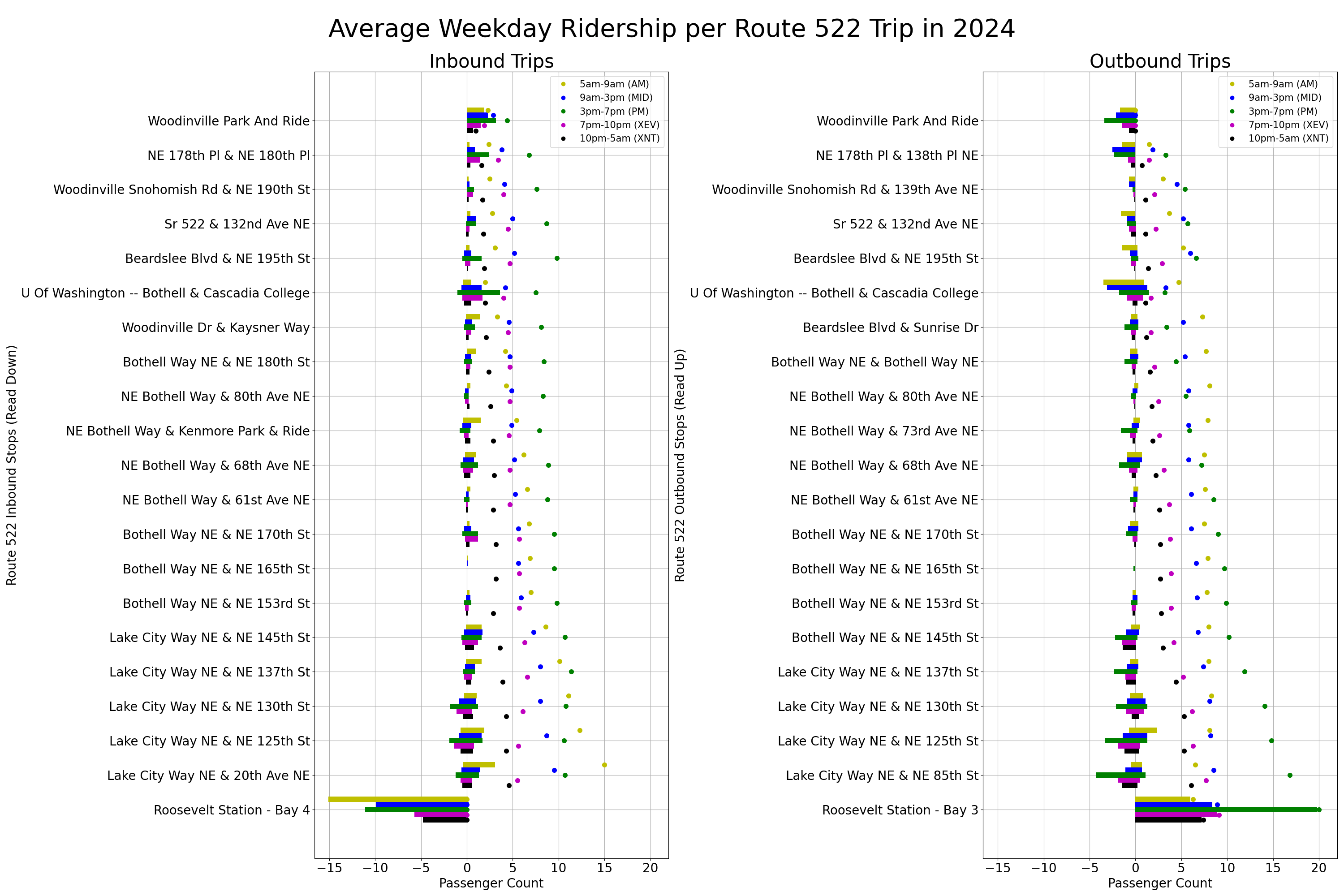
The plots below show the average weekday ridership by stop in each direction, color-coded by time of day. For a more detailed breakdown of how the plots are set up, please refer to the How to Read the Plots section of the article discussing Route 70.

Average Weekday Ridership per Route 522 Trip: September 2024 to March 2025. “Inbound” is toward Roosevelt station; “Outbound” is toward Woodinville P&R. Click the plot to view at full-resolution in a new tab.

Route 522 is an essential Link connector for Lake City, UW Bothell, and Woodinville. Some observations:

Continue reading “Ridership Patterns for Sound Transit Route 522”

Friday Roundtable: Sounder Turns 25

Yesterday marked the 25th anniversary of Sounder, Sound Transit’s commuter rail service. On the morning of September 18, 2000, the first Sounder trip departed a temporary station in Tacoma and headed towards King Street Station in Seattle. Along the way, the train stopped in Sumner and Auburn. A second trip ran later in the morning, and two trips back to Tacoma ran in the afternoon.

Over the past 25 years, the Sounder network has grown to include 2 lines, 12 station, and nearly 83 miles of track. Let’s take a look at a few key milestones in Sounder’s history.

  • September 18, 2000: Sounder begins revenue service with two daily round trips between Tacoma and Seattle.
  • February 5, 2001: Stations open in Puyallup and Kent.
  • March 12, 2001: Tukwila station opens.
  • September 30, 2002: A third daily trip is added.
  • September 15, 2003: The temporary station in Tacoma is replaced by a platform at Tacoma Dome Station’s Freighthouse Square.
  • December 17, 2003: Sound Transit and BNSF agree to a perpetual easement agreement to Burlington Northern tracks between Seattle and Everett.
  • December 21, 2003: The North Line begins service with a Sunday train for a Seahawks game. The line had one stop in Edmonds.
  • December 22, 2003: Regular North Line service begins with one daily round trip from Everett to Seattle.
  • June 6, 2005: A second daily North Line trip is added.
  • September 24, 2007: The South Line adds its first ‘reverse commute’ trip, traveling from Seattle to Tacoma in the morning and Tacoma to Seattle in the afternoon.
  • May 31, 2008: Mukilteo station on the North Line opens.
  • October 8, 2012: The South Line is extended to South Tacoma and Lakewood.
  • March 23, 2020: Service on both lines is cut in half, the South Line is cut to eight daily round trips and the North Line is cut to two daily round trips.
  • September 18, 2021: The North Line and South Line are renamed to the N Line and S Line, respectively.
  • September 19, 2022: S Line is fully restored to pre-pandemic service levels.
  • September 16, 2024: N Line is fully restored to pre-pandemic service levels.
Continue reading “Friday Roundtable: Sounder Turns 25”

Ridership Patterns for Link 1 Line

The Link 1 Line runs between Angle Lake in SeaTac and Lynnwood via Tukwila, Seattle, Shoreline, and Mountlake Terrace. In May 2025, the 1 Line had 105,586 average weekday boardings.

The 1 Line initially opened in July 2009 and ran between downtown Seattle (Westlake) and Tukwila. Since then, it has expanded north to the University of Washington in 2016, Northgate in 2021, Lynnwood in 2024, and south to SeaTac in December 2009 and Angle Lake in 2016. The Federal Way Link Extension is expected to open later this year.

The ridership data discussed in this article is just a snapshot of the current system. Link is still a growing system and many of the non-Link transit projects being built in Puget Sound will have a direct or indirect impact on ridership over the next few decades. The methodology behind the data shown below is discussed in the first comment below the post.

Average Weekday Boardings Per Station

The plot below shows the average weekday boarding count by station in each direction in May 2025. Southbound boarding counts are shown on the left and northbound boarding counts are shown to the right. The alighting count for a given station is similar to the boarding count in the opposite direction.

Average 1 Line Weekday Boarding Counts in May 2025

The 1 Line ridership patterns show that the highest ridership occurs between downtown Seattle and Northgate. U District has the higher number of southbound boardings and SeaTac/Airport has the highest number of northbound boardings. All stations north of the Montlake Cut (UW and above) have more southbound than northbound boardings. All stations south of UW have more northbound passengers.

Some observations for each station:

Continue reading “Ridership Patterns for Link 1 Line”

4th of July Transit Service

Tomorrow is a Independence Day, so Puget Sound transit agencies are running reduced schedules. To help everyone travel to and from the celebrations throughout the region, some agencies are running extra service. The schedule changes are outlined below. Click on an agency’s name to view the official announcement.

Fireworks in Seattle (Source)

Sound Transit

  • 1 Line: Sunday schedule (every 10-15 min) with extra trips running until 2am. Between 2am and 3am, trips will only run on part of the route. View the official schedule for more details.
  • 2 Line: Sunday schedule (every 10 min) with extra trips running until midnight.
  • ST Express: Sunday schedule
  • Sounder: No service
  • T Line: Sunday Schedule

King County Metro

  • Bus Routes: Sunday service with some reroutes planned in Bellevue, Bothell, Burien, Issaquah, Kent, Kirkland, West Seattle, and downtown Seattle. Check Metro’s service advisories to see impacted routes/trips.
  • Trailhead Direct: Trailhead Direct routes will run on Friday. Details of these routes are discussed in a previous post.
  • First Hill Streetcar: Regular service
  • South Lake Union Streetcar: Regular service with extended hours. The last streetcar to Lake Union Park will depart at 9:45 p.m. No streetcars will operate during the Lake Union fireworks display, 10:15pm to 10:45pm. After the fireworks display the last trip to downtown Seattle will leave Lake Union Park at about 11:15pm.
  • Water Taxi: Regular weekday service
Continue reading “4th of July Transit Service”

Future Boeing Access Road Station moves to East Marginal Way

On March 13, Sound Transit staff recommended the East Marginal Way location for the Boeing Access Road infill station rather than the originally planned location between I-5 and Sounder tracks next to the South Boeing Access Road overpass. Sound Transit held an open house in late February and reviewed both possible locations with the community.

The Boeing Access Road station was included in the 1996 Sound Move Plan but was not authorized by voters until ST3 passed in 2016. ST3 promised the station with 300 parking stalls, which is about half of the parking at Tukwila International Boulevard Station. Besides the platform and parking lot, the station will include two bus bays, a “kiss & ride” drop-off zone, as well as space for other drop off services such as Metro Flex or private employer shuttles. The targeted opening date is in 2031.

Locations considered for the Boeing Access Road Station (Sound Transit). Sound Transit staff have recommended a location on East Marginal Way near South 112th Street.
Continue reading “Future Boeing Access Road Station moves to East Marginal Way”

West Seattle Link Route Selection

During their meeting on October 24th, the Sound Transit Board selected the preferred alignment for the West Seattle Link Extension (WSLE). They also authorized staff to have their partners develop the final design for the stations and stub line between SODO and West Seattle. It will also include the connection to the existing SODO operations and maintenance facility. They also asked staff to look for ways to reduce cost. I reviewed the recording and staff presentation and thought I would share some observations.

Continue reading “West Seattle Link Route Selection”

West Seattle Link Costs Keep Climbing

A rendering of the West Seattle Link Extension’s planned cable-stayed bridge over the Duwamish. (Sound Transit)

Last week, Sound Transit released the Final Environmental Impact Statement (FEIS) for the West Seattle Link Extension (WSLE) ahead of its scheduled publication date of September 20. Although there’s technically one more comment period allowed for the FEIS, the massive document and its findings present a detailed review of each of the potential alternative paths Link may take from SODO to West Seattle.

Although the FEIS is focused on a vast range of potential tangible and intangible impacts the project may have, left unstated are the potential impacts of the project costs significantly exceeding Sound Transit’s assumptions in their 2021 Realignment.

Continue reading “West Seattle Link Costs Keep Climbing”

Metro and ST Restructure for Lynnwood Link

Metro and Sound Transit will restructure bus routes in the north end on September 14, 2024 (two weeks after the opening of Lynnwood Link). The changes will occur at the same time as the changes surrounding RapidRide G which is why Metro is listing them on the same service change page. Here is a list of some of the main changes:

New Routes:

  • 61: Lake City to Greenwood via Northgate)
  • 333: Mountlake Terrace to Shoreline South Station via Shoreline Community College
  • 365: Shoreline North Station to Northgate via Meridian Avenue and Haller Lake

Modified Routes:

  • 28, 65, 303, 322, 331, 345, 346, and RapidRide E
  • Sound Transit 510, 512, 513, and 515
  • Sounder North

Deleted Routes:

  • 16, 20, 47, 64, 73, 301, 302, 304, 320, 330, and 347

Details after the break.

Continue reading “Metro and ST Restructure for Lynnwood Link”