Call to Action: HALA Online Feedback Needs Your Input

West Seattle from the Air (Jeremy Reding – Flickr)

Seattle Mayor Ed Murray’s Housing Affordability and Livability Agenda (HALA) initiative is advancing through the cycles of public comment and feedback. One of the major venues is an online tool hosted at http://hala.consider.it, where each neighborhood’s proposing zoning changes are detailed and commented on individually.

Unfortunately, a quick trip last weekend through the current opinion “levels” in some of the HALA pages was disappointing — a whole lot of neutral or negative opinions in many of the places where ST train lines are already coming, and sooner (Roosevelt, Northgate) rather than later (Ballard).

One in particular deserves special mention for its markedly negative responses: the West Seattle Junction proposal, which roughly covers the two denser areas of the Triangle and Alaska Junction. The future of this area is unambiguous, thanks to the passage of ST3; there will be Link stations in the not-quite-so-distant future that can be predictably ballparked to center around the busy intersections of 35th/Avalon and Alaska/California — the two densest parts of the neighborhood. But looking at the zoning proposal’s response pages you’d never know it — a whole lot of SFH ranting and raving about how density will ruin  neighborhood “character” and destroy their property values (?!). West Seattle has a chance to be truly prepared for the arrival of the train lines given the ST3 time horizon, and a lot of people aren’t seeing it.

My point is simple: Seattle needs HALA, and now, HALA needs us, the urbanist, density-supporting community. Those opinion pages won’t be ignored; online comments (especially negative ones) tend to be taken pretty seriously by agencies around here. I want to call on the STB community to act, to take a few minutes and write comments in support of HALA’s proposals. The links below will take you directly to the response page for each neighborhood proposal.

West Seattle: https://hala.consider.it/west_seattle_junction–in-general-the-draft-zoning-changes-for-west-seattle-junction-accur

Roosevelt: https://hala.consider.it/northgate–in-general-the-draft-zoning-changes-for-northgate-accurately-reflects-the-princ

Northgate: https://hala.consider.it/northgate–in-general-the-draft-zoning-changes-for-northgate-accurately-reflects-the-princ

Ballard: https://hala.consider.it/ballard–in-general-the-draft-zoning-changes-for-ballard-accurately-reflects-the-principle

Link Real-Time Arrival Now on OneBusAway

Link at Othello – SounderBruce (Flickr)

In welcome news for riders, Sound Transit (ST) announced this morning that real-time arrival information for Link is now available on OneBusAway, Transit, Google, and other 3rd-party apps. As we reported last month, the update is limited to riders’ personal devices, as no new real-time signage will be available on station platforms for the foreseeable future. Originally planned for “early 2014“, the update finally responds in part to long-standing frustration at lack of rider information on what should be the region’s premier transit product. For SeaTac, Tukwila, Rainier Valley, Becaon Hill, and Downtown riders, this is the first type of real-time arrival they will have ever enjoyed.

So why has it taken so long? Beyond customary bureaucratic delay and budgetary prioritization, the central problem has been technological conflicts between ST’s internal-facing Supervisory Control and Data Acquisition (SCADA) system and the very different demands of user-facing applications and 3rd-party accessible data.

Problems with merely reporting SCADA data are evident to anyone looking at the real-time signs in Capitol Hill and UW Stations. SCADA tracks Link trains in between-station segments rather than continuously along the line, leading to a “step function” type of predictive ability. If you’re standing southbound at Capitol Hill, for instance, the next train may disappear from the screen right before it enters service, leading to signs saying “10, 16, 22” minutes etc even though the next train is only 4 minutes away. Once the train leaves UW, the “4 minute” train abruptly returns, dropping quickly to 2 minutes right before arrival. And the visual display may often conflict with the audio announcements of “2 minutes”, because the audio message gets put into the queue at a lower priority than other announcements such as elevator/escalator outages.

ST says the data will be most accurate in the middle of the line, in the Rainier Valley, where operations are most consistent. Beyond the terminal problems described above – which will endure southbound at Capitol Hill and now northbound at SeaTac Airport – other operational quirks will occasionally produce data gaps. If you’re standing northbound at International District station just before the start of PM peak, for instance, the train you’re waiting for may be coming from the Sodo base instead of from Angle Lake, but it will show as “scheduled” until it’s actually active on the line.

There will still be small discrepancies between OneBusAway, the visual screens, and the audio announcements – they have different rounding rules, for instance – but they should all be within a minute of each other. Real-time data will be especially useful for showing train delays and bunching, something that has been blind to riders since Link launched in 2009.

A universal real-time arrival design and implementation will have to wait a few more years, likely until Sound Transit owns and operates a Link-only Downtown Seattle Transit Tunnel beginning in or around 2019. But with wifi and/or cell service in all underground stations by the end of this year, underground riders will no longer face an information vacuum, and all riders with smartphones can know when their next train will arrive. This is a big, if belated, step in the right direction.

How to be an STB Staff Writer

Readers sometime ask us how to join our writing staff.  While we’re thrilled to have Zach working part time, it is our volunteer writers (including yours truly) who guide the overall direction of the site and allow us to cover far more than one person can manage.  Staff writers get more freedom to publish what they want on the front page, access to our informative and entertaining internal communications, and a few social opportunities. More importantly, the natural flow of things is that many volunteers eventually move on after a while.  Keeping STB vibrant and interesting requires new — and especially diverse — voices.

If you have something unique to share with our readers related to transit or land use or cities generally, writing a guest post is the easiest way to start. Many people have a couple of posts about transit in them (and we welcome guest posts from anyone), but successful staff volunteers have enough inspiration to write at least a post or two a month for an extended period of time.

To write a guest post, simply sign up for Page 2. Instead of hitting ‘publish’ immediately, you might save your piece as a draft and send us a note. An article that gets an editing pass or two has a much higher chance of making it to the front page. If you’re interested in writing, but the mechanics of online writing and publishing seem too intimidating, let us know and we’ll find other ways to collaborate.

After a few successful guest posts, if you still have more to say, we’ll invite you to join the handful of people that have helped lead the conversation on transit in Greater Seattle.  If that sounds interesting to you, sign up for a Page 2 account and let’s start working together.

Fatality Collision on MLK, Link Service Suspended Between Columbia City and Rainier Beach

[UPDATE 9:42am: normal service has been restored at all stations with residual delays.]

Tragedy struck early this morning at Othello Station in the Rainier Valley, as a person was struck and killed by a Link train. At this hour Seattle Police and Seattle Fire Department are working to extricate the person’s body from underneath the train. Photos of the scene are available at the Seattle Times story.

Link trains are not running between Columbia City and Rainier Beach. Trains are running from UW-Columbia City and Rainier Beach-Angle Lake, with the Route 97 Link shuttle to bridge them. Contrary to earlier advice issued by Sound Transit this morning, Route 38 no longer exists in the Rainier Valley and is not an alternative option. Routes 106 and the Route 97 Shuttle are the only options between Columbia City and Rainier Beach.

The circumstances of the collision are not yet clear, but we offer our condolences to the family and friends of the person involved.

This post will be updated as further information is available. 

Roosevelt TOD Kicks Off: Take the Survey

Atomic Taco (Flickr)

[Update: Sound Transit has now said the 3 workshops below, while technically public meetings, are not intended for large public crowds. The format is a more intimate stakeholder outreach event, and the meeting room is small. There will be other opportunities to engage later this winter.]

With the UDistrict and Mt Baker standing out as exceptions, Link-related rezones have been relatively meager and disappointing. Capitol Hill’s TOD will be beautiful but also underbuilt, and 3-story buildings are still going up on the blocks surrounding the busiest neighborhood station in the system. Beacon Hill and many Rainier Valley stations still see single-family zoning adjacent to them, and in many cases suburban jurisdictions such as Kent and Lynnwood have adopted more visionary zoning than Seattle.

To much controversy, the Roosevelt rezone adopted back in 2012 allows higher density on 20 acres immediately surrounding the station, with a mix of midrise (MR) and Neighborhood Commercial (NC 85, NC 65, NC 40), all within a new Station Overlay District. This is very similar to what was adopted at Capitol Hill, despite less existing density. This means Roosevelt’s TOD opportunities could be relatively more transformative.

At the station itself, Sound Transit will have 53,000 sq ft of surplus land available for redevelopment, most of it in a single contiguous group of parcels. After a recent open house on January 12, the Roosevelt TOD process kicks into high gear in February with 3 stakeholder workshops at Calvary Christian Church (6801 Roosevelt Way NE)

  • January 25, 2017 (5:30 p.m. – 8:00 p.m.)
  • February 8, 2017 (5:30 p.m. – 8:30 p.m.)
  • February 22, 2017 (5:30 p.m. – 8:30 p.m.)

Please make your voice heard in favor of abundant housing, diverse commercial uses, and optimized transit, walk, and bike connections. Attend the public workshops, or take the survey that will inform Sound Transit’s RFP early this year.

Just 10 minutes from Westlake and set in a comfortable neighborhood near one of Seattle’s best open spaces (Green Lake), Roosevelt has the opportunity to be one of the most livable and accessible places in Seattle. You can help it get there.

Sound Transit Breaks Ground on Northgate Station

Northgate Station under construction, Jan. 2017
Cranes are up and parking closed at Northgate, as seen on January 15

Sound Transit broke ground last Friday on Northgate Station, bringing the opening for Northgate Link one day closer (though still four years away). As we’ve reported before on the blog, the station will be elevated above NE 103rd Street on the east side of 1st Avenue NE, just west of the current transit center and southwest of the Northgate Mall.

A 455-stall parking garage, the subject of much controversy, will be built on the north side of NE 103rd Street to replace the existing park and ride. The County plans to build at least 200 affordable housing units on the former park and ride to the east of the station (along with a relocated bus station), as part of a mixed-use development funded in part by the City. SDOT will also build a pedestrian bridge over Interstate 5 (funded by Move Seattle) that will extend the station’s walkshed to North Seattle College and surrounding neighborhoods.

Continue reading “Sound Transit Breaks Ground on Northgate Station”

50,000 Expected for Saturday’s Womxn’s March

Sounder Bruce (Flickr)

The day after President-Elect Trump’s inauguration, one of the largest coordinated protest marches in history will take place, with hundreds of cities worldwide hosting the Women’s March on [Your City Here]. The Seattle Times reports that up to 50,000 are expected for Seattle’s 10am Womxn’s March, likely the 3rd largest behind Washington DC and Los Angeles. The march will begin at Judkins Park and make the 3.5 mile walk to Seattle Center via Little Saigon, Downtown, and Belltown.

Metro and Sound Transit have said they will operate normal Saturday service, though extra buses and trains will be on ready reserve and dispatched as needed. The Judkins Park area is well-served generally, but definitely unable to handle a 50,000 person crush at Saturday service levels. Accordingly, riders should expect delays and crowding. And of course, if you are able, walking and bicycling will be by far the most reliable means of getting around.

Saturday frequencies for routes serving Judkins Park are as follows (and have been much improved by Seattle’s Prop 1 funds):

  • Route 4: 30 minutes
    • Nearest Stop: 23rd/Dearborn
  • Route 7: 10 minutes
    • Nearest Stop: Rainier/Norman
  • Route 8: 15 minutes
    • Nearest Stop: MLK/Judkins
  • Route 14: 20 minutes
    • Nearest Stop: 20th/Jackson
  • Route 48: 10 minutes
    • Nearest Stop: 23rd/Dearborn
  • Route 106: 15 minutes
    • Nearest Stop: Rainier/I-90
  • Route 550: 15 minutes
    • Nearest Stop: Rainier/I-90
  • Route 554: 30 minutes
    • Nearest Stop: Rainier/I-90

Following the march, riders can disperse on Routes 1, 2, 3, 4, 8, 13, 24, 26, 28, 32, 33, 62, D, or E, or on any major downtown route with a bit of backtracking.

If you are participating in the march, or will be near Center City, pack your patience in support of important civic freedoms. Try to grab a bite or spend some money along the route, especially in the International District, where mid-January is a critical time for sales ahead of Lunar New Year celebrations. And think ahead to 2023, when a Link station will be at the foot of Judkins Park, hopefully for happier occasions.

News Roundup: The Next Level

Trolleybuses on 3rd Avenue

This is an open thread.

We have traffic because we drive so far

Afternoon traffic on I-405 near Canyon Park. Photo by SounderBruce.

We are regularly reminded that traffic congestion is growing across the region. The median Seattle metro area worker commutes nine miles to work. What if we could live closer to our workplaces? Drivers would drive fewer miles, and spend less time in traffic. Everybody who lives closer to work would contribute less to the congestion experienced by everybody else. This would reduce traffic even if everybody drives. But there’s a multiplier as denser places have higher transit (and walk, and bike) shares. Reduce travel distances by 10%, and there’s a more than 10% reduction in vehicle miles traveled.

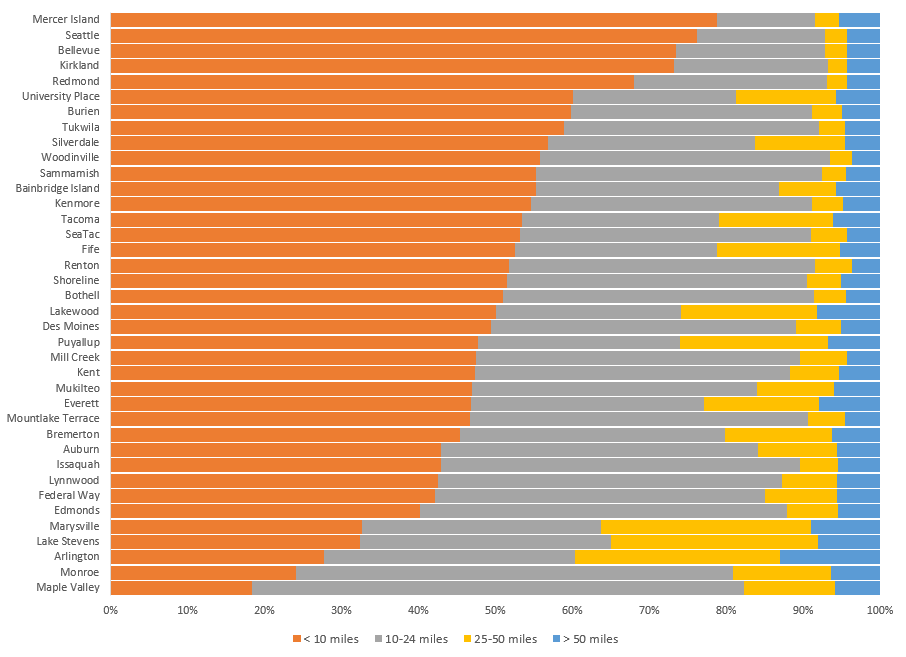
Who has the longest and shortest commutes? The U.S. Census Bureau’s Longitudinal Employer-Household Dynamics has a handy mapping interface to their Origin-Destination Employment Statistics. I’ve charted the length of commute journeys for major cities in the region, per the PSRC classification of Metropolitan, Core, and Larger. (Here’s a similar chart for smaller cities).

The shortest commutes are enjoyed by residents of Mercer Island, Seattle, Bellevue, Kirkland, and Redmond. 75% live within ten miles of their work (vs. 52% for the region). Of course, these are the nearest cities to the two largest employment centers in the region. Commuters from more distant cities to downtown Seattle and downtown Bellevue must travel further.

Among the cities on the chart, the longest commutes are from the exurban communities of Maple Valley, Monroe, Arlington, Lake Stevens and Marysville. 71% of workers who live in those cities are more than 10 miles from their work. 31% are more than 25 miles away. These aren’t the very worst commutes in the region, however. Residents of some of the tiny mountain ‘smaller cities’ drive extraordinarily long distances to work.

Incidentally, Covington and Bonney Lake, both seeking larger city designation so they can grow faster, would have longer commute distances than most of the larger city peer group.

It will surprise few that people who live near Seattle and Bellevue have shorter commutes. But it invites an obvious question. Why is the regional growth strategy constructed around five Metropolitan Cities and 29 Regional Growth Centers? Why not draw more residential development closer to the two dominant business centers?

Continue reading “We have traffic because we drive so far”