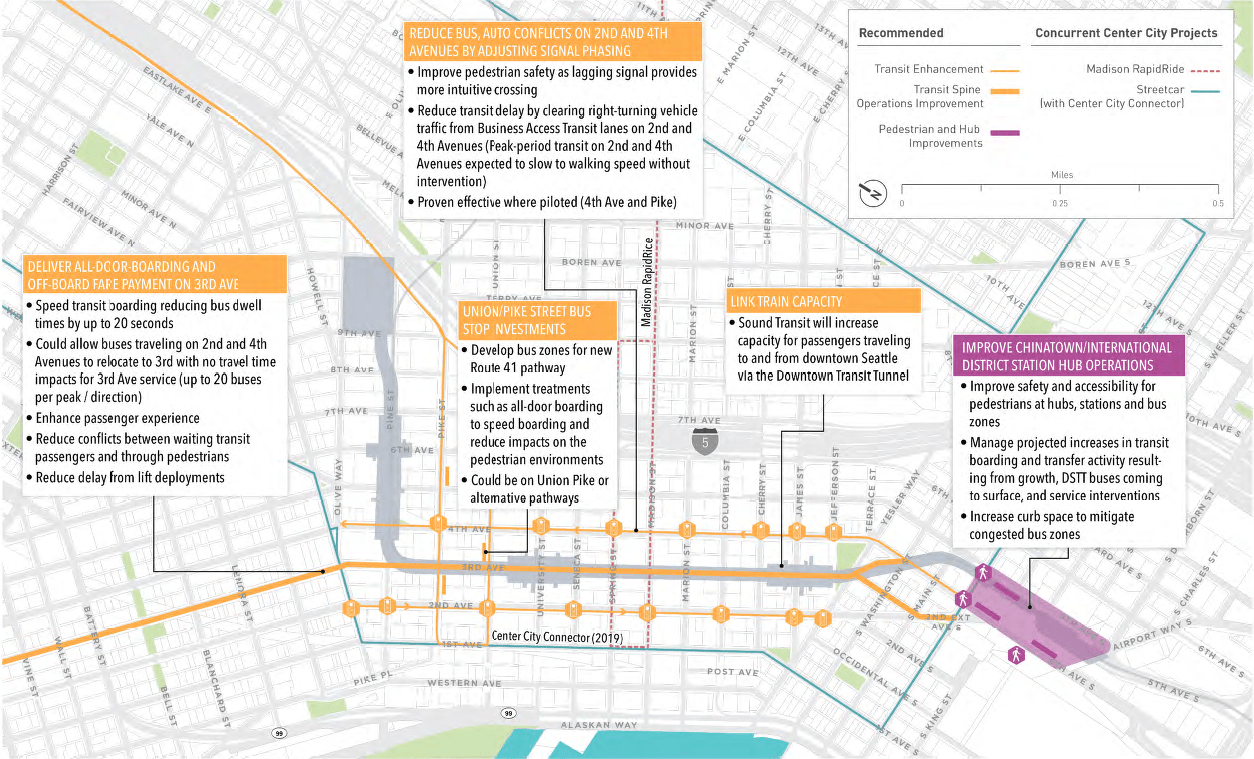
Ride Free Zone Could Save 3rd Ave Bus Ops

A recent presentation on One Center City / Convention Center expansion construction plans teased the possibility of an off-board payment zone on 3rd Ave all the way from Jackson St to Denny Way Ave, with all-door boarding. King County spokesperson Scott Gutierrez quickly threw cold water on the tease by pointing out that the plan amounted to adding RapidRide-style off-board ORCA readers at each bus stop on 3rd Ave, as an additional payment option, all-door boarding, cash payers still paying while boarding at the front, and random fare enforcement on all the buses that traverse 3rd Ave.

The county is considering other measures to reduce the impact of front-door fare payment by (1) buying out the ORCA card fees for cards distributed at county facilities and possibly other facilities in King County; and (2) eliminating the zone and peak surcharges on Metro buses.

Policy changes like eliminating paper transfers, having a cash surcharge, and making the cash fare an even $3 appear unlikely to be proposed, much less stomached by the county council. Even if they were, they still wouldn’t eliminate the impact of front-door change fumbling on 3rd Ave. Nor does it appear likely that Metro or the council will expect everyone to get an ORCA card and keep it filled with ORCA product in order to be able to board on 3rd Ave.

There is another way to remove front-door fare slow-downs on 3rd Ave, and it is something that’s been used before, to great effect: a Ride Free Zone (RFZ).

The problems with the original RFZ included excessive dwell time waiting for passengers to push to the front and pay as they exited, and the mass confusion of when people were supposed to pay while boarding or wait until alighting. Thankfully, Metro’s plan to deploy fare enforcement on all the 3rd Ave buses, but not necessarily on 3rd Ave, helps solve that problem.

A new RFZ would deliver the additional benefit of moving fare enforcement off of 3rd Ave, where it would be difficult to do on crushloaded peak-hour buses.

Those paying with ORCA will be able to tap a reader on 3rd Ave before boarding, board at any door, and then exit at any door when they reach their destination, with or without an RFZ.

Continue reading “Ride Free Zone Could Save 3rd Ave Bus Ops”

DEIS Shows Two Options for Adding 95,000 Homes to Seattle

Last week Seattle released a much-anticipated draft of the environmental impact statement for the Mandatory Housing Affordability program, which allows developers additional height in exchange for building a certain amount of affordable housing.

Three scenarios were analysed: one taking no action, and two slightly different plans for distributing the increased development capacity around 27 neighborhoods in the city. All options would leave most single families areas unchanged. No action is expected to result in “substantially less affordable housing” and “less market-rate housing supply,” according to the report. Alternative #2 implements zoning changes using existing growth patterns. Alternative #3 directs more growth to areas with a low displacement risk and easy access to transit, jobs and public amenities.

In other words, with alternative 3, neighborhoods such as Wallingford, Fremont and Ballard would see larger upzones and an expansion of the urban village boundary, allowing denser development, to areas within a 10-minute walk of frequent public transit. In the second plan, areas deemed to have a high risk of displacement and low opportunity, such as Rainier Beach or Othello, would receive less-dramatic upzones and smaller extensions of the urban village boundary.

Implementing either proposal would create roughly the same number of affordable homes — estimated at 5,500 — and generate 95,000 total units of housing over the next 20 years. The plan of no action would generate only about 200 affordable units and 77,000 new homes, remaining consistent with the Seattle 2035 Comprehensive Plan.

With all scenarios expected to impact the region’s transportation network, the report identified “reducing the share of SOV travel is key to Seattle’s transportation strategy.”

Continue reading “DEIS Shows Two Options for Adding 95,000 Homes to Seattle”

One Center City options narrow

Near-Term Transit Capital Projects, Click for Larger View (OCC Advisory Group)

The One Center City plan for handling near-term disruption in Seattle downtown transit and traffic grinds forward. Anticipating the end of bus operations in the Downtown Seattle Transit Tunnel, staff are narrowing down the options. At last week’s advisory group meeting, we learned several project elements that are moving forward, and some that are not. It’s not clear whether the pared down program of operational improvements will be enough to prevent a substantial deterioration in service performance.

Meanwhile, the exit of buses from the tunnel, previously anticipated for September 2018, is likely to be delayed. On Monday, the King County Council Committee of the Whole approved an amendment delaying Metro’s vacation of Convention Place until at least March 2019. If the Convention Center doesn’t have its permits by June 2018, or if WSCC is not ready to take over the site by September 2018, then joint operations could continue until at least September 2019. The delay might allow another look at One Center City options that need more time for implementation.

What has been dropped?

The earlier proposal to terminate ST 550 at International District Station was dropped because of adverse impacts to riders compounded by East Link construction elsewhere on the route. The closure of the D2 roadway in late 2018 mean route revisions remain necessary, but the 550 will be operating through downtown on surface streets once the tunnel closes. It is not expected to operate on 3rd Avenue.

Continue reading “One Center City options narrow”

News Roundup: Top-Level View

6th & Spring with transit/queue jump signal visible.

This is an open thread.

Reminder: SR 520 open houses

SR 520 service changes could mean more late evening service on Metro 255 and other Eastside routes

Several open houses are scheduled for the public to learn about new service on the SR 520 corridor. The first is on Wednesday evening in Kirkland, with others to follow through the rest of the month.

A particularly interesting opportunity is the open house at UW Husky Stadium on June 19. As well as the regular open house exhibits, staff members will guide tours of the bus-rail transfer experience.

Another way to participate is through the online survey which is open until June 30.

As we reported last week, Metro and Sound Transit are seeking public input on several service options on the SR 520 corridor following the closure of the downtown bus tunnel and other service-impacting changes. The revisions being considered will end most direct service to downtown Seattle across SR 520, but increase frequency and service connections on the Eastside.

Open house details after the jump.

Continue reading “Reminder: SR 520 open houses”

Redmond stations

Redmond’s preferred downtown station (Image: Redmond TRAIN study)

East Link to Downtown Redmond is scheduled to open in 2024, and the Sound Transit Board will update its preferred alternative on June 22. “Concept refinements” are now being considered. These are minor updates to the alignment including changes to station locations and the vertical profile of the guideway. Redmond last week approved a letter to the Board setting out what they hope to see.

In Downtown Redmond, a public process early this year considered four options: elevated vs at-grade, east (between 164th and 166th) vs west (between 161st and Leary). The Downtown Transit Integration (TRAIN) Study (large pdf), and public response, prefer the “East Elevated” option. That places the station opposite the Redmond Town Center parking garage. It allows easier bus-rail transfers because buses could approach both sides of the station, eliminating most street crossings for transferring riders. The shorter guideway for the East option reduces by several blocks the impacts to the Redmond Central Connector trail, and elevating the guideway eliminates vehicle and pedestrian conflicts if gates were opening every four minutes at peak.

Redmond’s second ST3 station is in Southeast Redmond in the Marymoor area. Here, the city prefers an at-grade alignment. Both affordability and trail connection considerations figured in that choice. Continue reading “Redmond stations”

UW Reroutes Bring Several Closer to Station, for Two Weeks

Due to construction on the University of Washington campus, several King County Metro and Community Transit bus routes, as well as ST Express 540, will be diverted off Grant Lane and Stevens Way on weekdays for the next two weeks, as well as for the weekend of June 24 and 25.

All reroutes: Click to enlarge.

Westbound, Metro routes 31, 32, 67, 75, 78, and 372 will all serve:

  • a temporary southbound stop on Montlake Blvd north of the Hec Ed pedestrian overpass
  • a temporary westbound stop on NE Pacific Pl just west of Montlake Blvd
  • the westbound stop on NE Pacific St a block east of 15th Ave NE

Eastbound, routes 75, 78, and 372 will serve:

  • the eastbound stop on NE Pacific St a block east of 15th Ave NE
  • the eastbound stop on NE Pacific Pl at the west point of the Rainier Vista triangle
  • the northbound stop on Montlake Blvd NE in front of Alaska Airlines Arena (formerly known as Hec Edmundson Pavillion)

Metro route 277 and ST Express 540 will skip their campus loop, and just serve their regular stops on Campus Parkway, 15th Ave NE, and NE Pacific St, plus a temporary drop-off-only stop on inbound runs at the flagpole on Memorial Way.

All six Community Transit UW routes (810, 821, 855, 860, 871, and 880) will loop around campus clockwise, using three of its normal stops, serving:

CT routes: Click to enlarge.
  • the regular eastbound stop on Stevens Lane, just east of Memorial Way
  • the regular southbound stop on E Stevens Way NE, just north of Pend Orville Rd NE. This is the last regular stop before the reroute begins.
  • a temporary southbound stop on Montlake Blvd north of the Hec Ed pedestrian overpass
  • a temporary westbound stop on NE Pacific Pl just west of Montlake Blvd
  • the westbound stop on NE Pacific St a block east of 15th Ave NE
  • the regular northbound stop on 15th Ave NE just north of NE 42nd St

Bruce Engelhardt contributed to this post.

Link Light Rail vs. Washington State Ferries

Ferries and water taxi in Seattle

Coleman Ferry Dock / photo by SounderBruce

Washington State Ferries just released its 2017 first quarter boarding statistics, revealing another milestone for Link Light Rail: For the first quarter of a year ever, Link Light Rail had more boardings than Washington State Ferries did.

Washington State Ferries had 4,960,373 boardings among all its lines for January to March of this year. Link Light Rail had 5,171,115 boardings on its single line during the same period.

This is not to say that Link Light Rail has permanently passed WSF as the third-highest ridership transit agency in the state (if treated separately from the rest of Sound Transit). Washington State Ferries’ highest-boardings quarter ever was July-September of 2016, with 7,455,613 boardings. Link’s record quarter was 5,596,453, for the same period.

The Strait Shot Begins June 17

stylized map of the Strait Shot
Travel poster style map by the author

Easier car-free getaways to the Olympic Peninsula begin Saturday, June 17 when Clallam Transit inaugurates the “Strait Shot” daily direct bus service between Port Angeles and the Bainbridge Island ferry terminal. STB previously covered the service in detail, which is a 75-mile route using 40-passenger transit buses making five intermediate stops.

There will be a morning roundtrip and an evening roundtrip Monday to Saturday and an evening round trip on Sunday. Adult fare is $10 per person each way and $5 for children and Regional Reduced Fare Permit card holders. Fare must be paid in exact cash only; ORCA cards are not accepted. Limited space is available for bicycles on a first-come, first-served basis. The bus is scheduled to complete the trip in two hours, making it competitive with driving.

The Strait Shot is a more convenient option than the existing 5-seat local transit ride and costs less than the Dungeness Line. From Port Angeles, riders can connect to other Clallam Transit buses that can take them to Forks (with onward connections to Neah Bay and La Push) or walk over to the Black Ball ferry to Victoria, B.C. Buses are timed to meet with the Bainbridge ferry and will wait for late ferries. More information is available in the full schedule. You can also plan your trip in Google Maps.