
King County Metro’s Route 40 travels inbound from Northgate Station to downtown Seattle via Crown Hill, Ballard, Fremont, and South Lake Union. Outbound trips travel in the reverse direction. In October 2024, Route 40 had 8,539 average weekday boardings.

Average Ridership Per Trip
The plots below show the average weekday ridership by stop in each direction, color-coded by time of day. For a more detailed breakdown of how the plots are set up, please refer to the How to Read the Plots section of the article discussing Route 70.
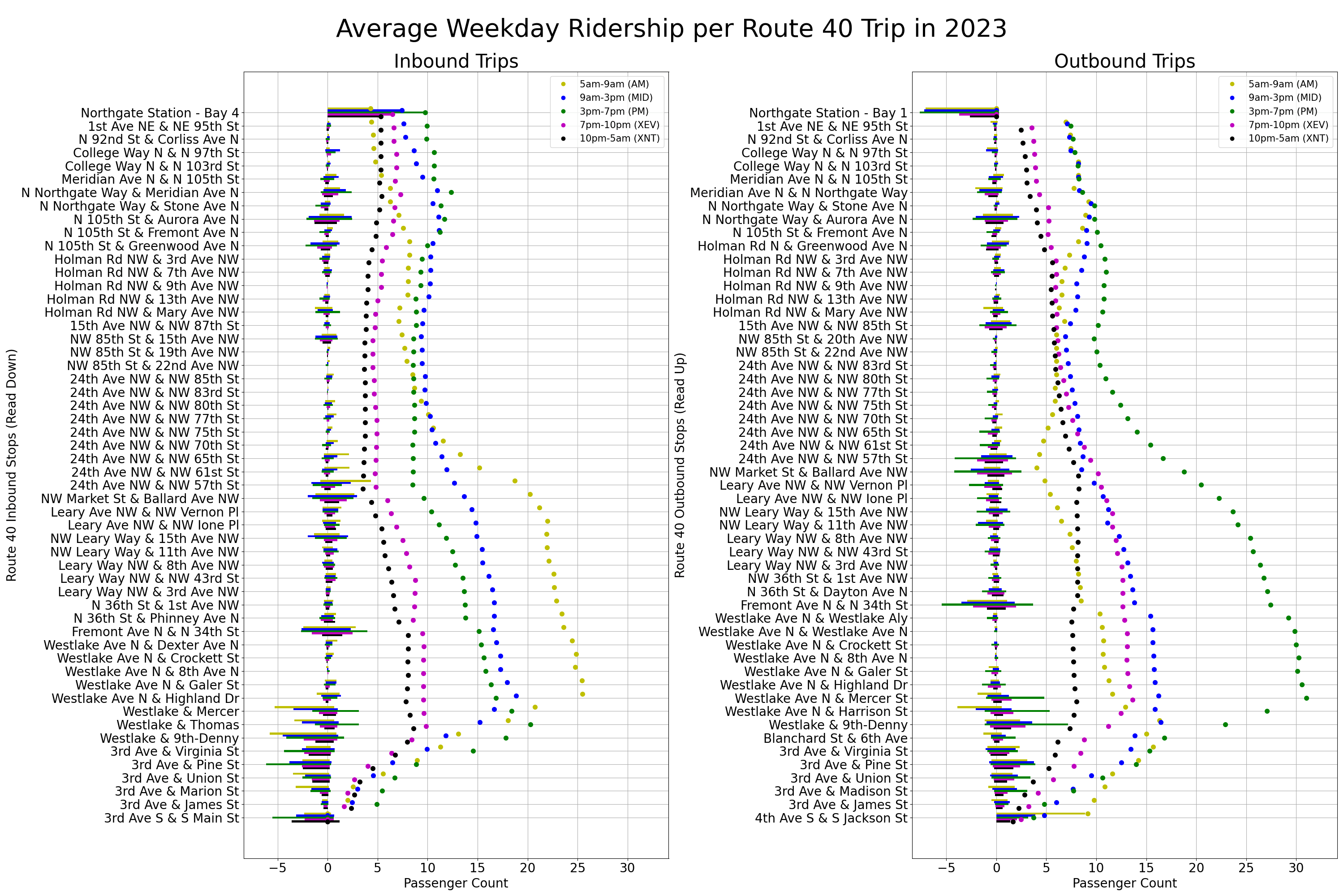
The ridership patterns for Route 40 show a route with strong ridership between the neighborhoods it serves and to downtown Seattle. Some observations:
- Northgate Station is a trip generator throughout the day. Almost all trips have 5-10 passengers board or depart at this stop. Passengers can transfer to routes 61, 67, 75, 303 (peak only), 322 (peak only), 345, 348, 365, or Link. Northgate Station is also adjacent to the Northgate Station mall, Kraken Community Iceplex, and various medical offices. A pedestrian bridge over I-5 provides a direct connection to North Seattle College.
- Route 40 detours around the south and west sides of North Seattle College. The only stop on this detour with measurable ridership is College Way & 97th St. Inbound trips primarily pick up passengers at this stop in the midday and afternoon, while outbound trips primarily drop off passengers in the morning and midday. The lack of ridership between North Seattle College and Northgate Station suggests most potential riders prefer to use the bridge over I-5 instead.
- The commercial area and medical facilities (primarily the UW Medical Center) at Meridian Ave & Northgate Way show reverse commute behavior. Overall ridership on outbound morning trips increases at each stop along Holman Rd, 105th St, and Northgate Way before Meridian Ave & Northgate Way. A decent number of passengers depart outbound morning trips at Meridian Ave & Northgate Way.
- Quite a few passengers transfer between Route 40 and the E Line at 105th St (inbound)/ Northgate Way (outbound) & Aurora Ave throughout the day. The equal number of passengers boarding and alighting suggests these transfers are primarily for all-day trips as there is no spike in the peak direction.
- At 105th St (inbound)/ Holman Rd (outbound) & Greenwood Ave, Route 40 crosses paths with Route 5. Both inbound and outbound morning Route 40 trips see more passengers board than depart at this stop. This suggests more passengers transfer from Route 5 to Route 40 in the morning. Transfer passengers boarding inbound Route 40 trips may be traveling to Ballard while passengers boarding outbound trips may be traveling to the medical facilities on Meridian Ave, North Seattle College, or Northgate Station. In the afternoon and evening, departing passengers outnumber boarding passengers at this stop for Route 40 trips in both directions.
- Route 40 intersects with the D Line at two stops: 15th Ave NW & NW 85th St and Leary Way NW & 15th Ave NW. In between these stops, Route 40 detours to 24th Ave while the D Line travels straight on 15th Ave. Both intersecting stops also serve commercial areas and have ridership churn throughout the day.
- The stops on 24th Ave between 70th St and 85th St have minimal ridership. South of 70th St, the stops closer to Market St have more ridership. Most passengers using these stops board inbound trips and depart outbound trips. Ridership data for the D Line show a similar pattern for it’s parallel segment on 15th Ave. One exception is the much higher ridership for the D Line at 15th Ave & 65th St. Riders who live between 15th Ave and 24th Ave may prefer the D Line for some trips as it provides a faster trip to downtown Seattle.
- The stops in Ballard have strong ridership at all times of day and night. In addition to serving the many nearby apartments, shops, and restaurants, the stop at Market St & Ballard Ave provides an immediate transfer to Route 44.
- In Fremont, the stop at Fremont Ave & N 34th St is busy throughout the day. Inbound trips have a fairly even number of passengers boarding and departing, with slightly more afternoon boardings than at other times. Outbound trips have more passengers departing than boarding during each time period. Ridership in the afternoon is higher than at other times of day. This stop also provides transfers to routes 31, 32, and 62.
- In South Lake Union, Route 40 travels on Westlake Ave N and shadows the South Lake Union Streetcar. Route 40 and the streetcar share four stops, 3 inbound (Westlake & Mercer, Thomas, and 9th-Denny) and 1 outbound (Westlake & 9th-Denny). Unlike the streetcar, Route 40 has strong ridership at these stops. Inbound trips primarily drop off passengers in the morning and midday. In the afternoon, inbound trips pick up a decent number of riders. Outbound trips have the opposite pattern as they primarily pick up passengers, except in the morning. Outbound morning trips primarily drop off passengers. These passengers likely work in SLU and transfer between Route 40 and other routes that travel further south. The ridership discrepancy between Route 40 and the streetcar show the importance of a route that provides a seamless connection to more places (Fremont, Ballard) and transit routes (3rd Ave).
- Outbound morning trips have a significant number of passengers who board at 4th Ave & Jackson St. These passengers are likely transferring from Sounder or Sound Transit bus routes 550, 554, 590, 594, or 595.
Daily Totals per Stop
The average daily total boarding and alighting counts show a similar pattern to the per trip data.

Looking Ahead
The Seattle Department of Transportation is currently in the construction phase of the Route 40 – Transit-Plus Multimodal Corridor project. This project includes 3 miles of Business Access and Transit only lanes or Freight and Bus only lanes, 47 upgraded curb ramps, 8 new bus bulbs, 6,000+ feet of upgraded sidewalks, and 3 new or upgraded crosswalks.
In June 2024, King County Metro released the RapidRide Prioritization Plan. This document identifies Corridor 1003 (Route 40) as a Tier 2 priority corridor. The plan outlined potential alignment changes at both ends of the route. From downtown, the route could be extended east on Yesler Way, then north on Broadway to Seattle University. On the northern end of the route, the alignment may be changed so the route stays on Northgate Way until it turns south on 5th Ave, then terminates at Northgate Station.
Additionally, Sound Transit is in the environmental review phase for the Ballard Link Extension. While this extension does not significantly overlap with Route 40, it will likely change ridership patterns in Ballard when it starts service in 2039.
You think Ballard Link is going to start changing ridership patterns in 15 years? Lol
All transit routes have specific advantages and disadvantages. Ballard Link will be twice as fast to SLU and downtown because it won’t have to follow the speed limit, traffic lights, street grid, or get out of traffic to stop. It will answer the longstanding demand for all-day express-level service to downtown or a regional transfer point (like the peak-only 15X which takes ~15 minutes, but unlike the D, 40, or 44 which take 25-30 minutes and in pathological cases 45 minutes. That advantage will continue further south to Rainier Valley and the airport. It will run every 6 minutes in ST’s plan, unlike the buses which run at most every 10 minutes.
What it won’t do is improve Ballard’s transit access to the U-District, Eastside, Capitol Hill, West Seattle, or northeast Seattle/Shoreline/Snohomish, because the unusually long 10-minute transfer overhead would negate its speed advantage. And I think the largest ridership market is to/from those areas. If Ballard Link is not very good for those, people will at minimum be frustrated, and some may continue driving, or not live in/go to Ballard to avoid that overhead.
The 15X, 16X, 18X, and 29 haven’t run since 2020. The 17X does still run, albeit very infrequently. The 40 isn’t awful in the morning but it is extremely slow in the PM, though a lot of that is just that the bus stops at every stop. A normal commute from Ballard to the terminus downtown in the morning is 40-45 minutes, but if it’s really early or a holiday, it can be done in 30-35 minutes
The 15 and 18 were only officially suspended in 2023, but were both whittled down to very low frequencies due to driver availability – in the case of the 15X, there would only be maybe one or two reliable AM/PM runs each in its final days.
I’m sure all of that is true about Ballard Link, but the point I was making is that if you think we’re going to start seeing those improvements just 15 years from now…would you be interested in a bridge I have for sale?
I find it hard to believe Ballard Link will be finished in 2039, or ever. I’ve spent so many years and decades waiting for Link extensions, and then they come a couple years late, and Ballard/DSTT2 have unique challenges, so I’m not willing to wait 15 years for transit improvements, and I’ll be over 65 by then and my entire youth and working life won’t have Ballard rapid transit. So I want significant bus improvements NOW in northwest Seattle, and Ballard Link can follow along whenever it’s ready.
This series is more useful than the Link ridership data. It could actually lead to route and stop improvements.
The 40 could be shortened by taking over the 62’s path to Northgate, and the D Line completing the 40’s path to Northgate.
If the boardings at Northgate wobble throughout midday, that suggests value in moving midday headway down to 10 minutes, so south bound Link riders will find a 40 there waiting for them. Or is it really picking up northbound Link riders? Or transfers from other buses? Or people visiting or living at or near Thornton Place?
Do you mean the 61’s path to Northgate?
WL reported that Metro rejected switching the Northgate tail to the D in the preliminary Corridor 1003 plan. That’s probably for other reasons than the best network, but it shows what you’d have to overcome to get Metro to do it.
Yes, I meant the 61.
Thanks Brent. I agree that the D line should take over the north part of Route 40. The ridership in that section isn’t super high, but it’s enough to support a RR extension. I would have the RR route skip the North Seattle College detour though.
If we send the 40 down 85th to take over part of the 62, should it go all the way to Lake City? Leaving just the tail of the 62 from Northgate to Lake City as a standalone route would be too short.
IMO, having D+40 on Holman Road/105th to Northgate is needed. The ridership potential is immense IF the corridor had convenient, fast, direct transit service connecting to Link. The 40 deviation to serve North Seattle College, which is essential(!), always feels a bit out-of-the-way for the longer riders.
There’s a solid bus network serving Link stations the east side of the route/I-5, but it’s not as well connected to the west. Yes, I-5 is certainly a huge barrier with limited crossings; which makes transit all that more essential.
“value in moving midday headway down to 10 minutes, so south bound Link riders will find a 40 there waiting for them”
Frequency makes up for not having a timed bus. Timed buses are useless if you just miss them and have to wait for the next one, or if the bus is late. The 40 has multiple major transfers in different places, and you can’t coordinate all of them with all the other routes, because the other routes also have other major transfer point. You can only coordinate at one point, and Northgate Link transfers aren’t the majority of passengers. Reducing frequency in order to time Northgate Link transfers would hurt more people than it helps, and it won’t even help Link transferers if they walk slow or don’t know the way or the bus is late.
The 40 is at 15-minute midday frequency, so 10-minute would be an improvement.
Using this type of analysis with on-vehicle data is exactly how the Route 40 Transit Plus (R40T+) project identified what to do in the key areas, so it’s extremely useful in leading to positive changes. Speaking as the person who did the analysis in 2019-2020 and selected the projects, we had to fit work within a specific capital budget so we had to choose our improvements wisely based on this exact kind of data. It’s a great strategy to say “ok we have about $20M available, how can we maximize that to obtain 10% better travel times and reduce schedule deviation?” when the data shows us the hot spots. Most of the route operates quite well, such as Michael noted in his ridership analysis where ons and offs are low north of 70th, so improvements in those places are less critical to the overall goals. Another advantage of being precise is R40T+ can deliver the same overall transit improvements as a RapidRide full-corridor project with a much shorter project duration as the RR corridors tend to be marquee projects where a lot of outreach, planning, coordination, and engineering is necessary. R40T+ started planning in 2019 and is now under construction, which would have started even earlier than 2024 but was delayed due to the Pandemic. That’s a darn good turnaround!
Personally, I’d love to see the D Line get extended eastward to Link at Northgate. The legacy terminal behind QFC misses out on networking opportunities with 5, E, and Link; as Michael noted in his transfer’s via Route 40. Imagine the positive network effects if both Route 40 AND D Line intersected with 5 and E.
regarding the exchange above re the pathways of routes 40, 61, and Dee, as the Dee is branded, the number of red buses and RR capital is another constraint. In 2012, the through route with the Cee line was also a constraint.
the second paragraph uses the term detour to describe serving NSC and using North 92nd Street to cross I-5. Serving riders is not a detour. See the service guideline on deviation (five?). Avoid I-5 interchange congestion follows the service guidelines on pathway (eight?). Northgate Way is quite congested daily between Meridian Avenue North and 5th Avenue NE. North 92nd Street does not serve an interchange and is not congested. (See parallel on First Hill; Madison and James streets serves interchanges and are congested; Yesler Way does not serve an interchange and is not congested).
My biggest beef with the current routing is not access to Link, it’s the connection to other buses, to go to Pinehurst, Lake City, or down Roosevelt. Having to make the connection at the transit center is a huge detour that would be good to avoid. Currently, the only way to avoid it is to get off at Northgate/Meridian and walk across I-5. But, unless you run, rather than walk, it’s no faster than just sitting through the detour, and intersection at Northgate/1st that you have to cross is quite dangerous as a pedestrian die to large volumes of turning traffic. If the 40 took, 5th, one could make the bus connection on the street and avoid Northgate Transit Center entirely.
the sixth paragraph also uses “detours”. Downtown Ballard is not a detour; it is along the way. Route 40 was a successful route consolidation; before fall 2012, routes 5 and 75 served North 92nd Street; Route 5 had two north tails; after fall 2012, routes 5 and 21 provided 15/15 minute headway between SCC and Westwood Village via Broadview, Greenwood, Phinney Ridge, CBD, and 35th Avenue SW. In it south end, it replaced routes 17 and 30 on Westlake Avenue North. both routes 40 and 62 have a crosstown component and a radial component serving Fremont, SLU, and downtown. Both have many ons and offs along their pathways.
Both serve downtown Fremont. SDOT intends to end the successful northbound common transfer point in Fremont on Fremont Avenue North between North 34th and 35th streets. It allows common stop, no-walk transfers, the best kind. It allows folks in the CBD oriented to routes 31 and 32 to catch either routes 40 or 62 downtown and enjoy shorter waits as they serve common stops in both downtown and in Fremont. SDOT wants a PBL in the block. I have cycled there for several decades; the transfer point is much more important. The new Route 40 stop will be near the Lenin statue; the new stop for routes 31, 32, and 62 will be around the corner on North 35th Street. Riders transferring to/from Route 40 will have a long walk and cross two legs of the intersection.
Did the Seattle Transportation Plan really provide any clarity between the several modal plans? This choice seems backward.
Downtown Ballard is not a detour; it is along the way.
Not if you are trying to get from Crown Hill to Fremont.
Just to back up I would say that any route that has to reverse itself is making a detour. If it goes north for a while and then south it made a detour. Same goes for going east then west. Sometimes the geography forces this. But otherwise it means the route does not provide the shortest distance between at least two bus stops. Detours are inevitable. There are plenty of minor detours that are no big deal (and we don’t even think of them as detours). Quite often a detour fits into the overall network just fine and provides a good complement for straighter routes (like a circle subway line combined with a spoke-and-hub system).
The 40 makes two significant detours. The first is in getting from Northgate Transit Center to Crown Hill (15th & 85th). Initially the bus follows the most straightforward route (south and west) until it gets to 92nd. Then it goes north up to Northgate Way before heading south again. This means that someone from Northgate headed to Crown Hill has to go about a mile north and then a mile south before they eventually get there. At least part of this detour is inevitable (in my opinion). We need to cover Northgate Way. We could then skip the Link station (and just keep going on Northgate Way to Lake City) but I think that would be a bad idea. As Micheal shows so clearly in this post, the Northgate Transit Center stop gets lots of riders. It stands to reason that at least some of those riders arrived via Link.
One aspect of this detour could be minimized. The shortest, straightest connection from the west end of Northgate Way to the station would be to turn on 1st NE (https://maps.app.goo.gl/B7p2Nss7y7Z8PiVH9). You would still make the detour, but it would be smaller. But it would probably be a lot less reliable. This would throw the bus into freeway traffic. You would also force some long walks or transfers (from the 345/365). By my count a little over 200 people (a day) would be impacted. There are other options. A bus could make a different type of detour by continuing on Northgate Way until 5th and then curving around to the station. This would offer some advantages (e. g. for trips to Lake City) but also incur delays along Northgate Way next to the freeway. These are all reasonable trade-offs and I’m not sure which option is best. Of course the 40 doesn’t have to be the bus doing this — that is another trade-off.
The other detour is more subtle and the one I led with. Once the bus gets to Crown Hill it goes west to 24th and then back east to head to Fremont (and downtown). In my opinion this is not that big of a deal. For a trip from 15th & 85th to 15th & Market there is an alternative. The geography of Ballard pretty much requires a detour of that nature or asking riders to transfer. Both have drawbacks.
Speaking of which, in my opinion the best approach is the one I outlined up above, which can be shown on this map: https://www.google.com/maps/d/edit?mid=1pr2Bo1TgPZT7IeqyiwcqbAQgHA_0Igk&usp=sharing. Notice that the 61 and 40 would not have any detours. The D would take over the Northgate Way detour, but that is as good a choice as any. It also means that both the 40 and D keep going straight through Crown Hill (a minor improvement). The 40 is split but at the point where it removes the detour. There is an another advantage. While it adds a transfer (e. g. Crown Hill to Fremont) it removes another (Lake City to Ballard).
But there is another consideration: Overlap. This removes a bit of overlap (with the 40 and D along Holman road) but it also adds plenty of overlap (in various places). This could be reduced but then we would be adding transfers. For example the 40 could just be sent to the locks (with the 61 and the existing 44) but that would mean quite a few riders would have to transfer (as is evident with these graphs). The main part of Ballard (Market & Ballard Avenue more or less ) has a lot of riders going both directions. Thus forcing a transfer for trips there would be unfortunate.
I think the best option is to live with the overlap and look for savings elsewhere. 24th is a fairly urban street (especially the southern parts). Some overlap is a small price to pay for the overall improvement in connectivity that this would bring.
The RossB map has two routes on 24th Avenue NW. Are there loose ends? What of routes 45 and 28? Sunset Hill should have two-way all-day service; it had a streetcar; it had Route 17 between 1940 and 2012.
The RossB map has two routes on 24th Avenue NW.
Yes, that is the overlap I referred to. The 40 and 61 overlap. There are other overlaps as well (the map does not show all of the routes).
What of routes 45 and 28?
The implication is that they are unchanged. The map only focuses on the D/40/61 situation because the routes are so closely related. I don’t see this setting off a cascade of other changes (like to the 45 and 28) although I could see both routes changing. The 28 could be sent somewhere besides downtown. The 45 could go up 8th to layover at Holman Road (next to the QFC). But in both cases those are basically different, largely independent changes.
Sunset Hill should have two-way all-day service; it had a streetcar; it had Route 17 between 1940 and 2012.
That is shown on the map as “Version 1”. I go back and forth in terms of what I favor. Version 1 has better coverage. Version 2 probably has better ridership. North of 65th, 32nd and 24th are similar in terms of density but 32nd is close to the bluff. For example at 77th & 24th I can walk three blocks east or west and get to people. At 77th & 32nd I can walk east three blocks but I can’t walk three blocks west — I run into the bluff. It almost gets down to which group to favor. Do you favor the folks on 24th because they are used to the one-seat ride to Fremont/Westlake/SLU? Or do you favor the folks on 32nd because they are long overdue for a restoration of all-day service? Hard to say.
RossB, Metro used a two-stage public process to set the alignments of lines B, C, and D. re the D Line, public was asked about 15th v. 24th avenues NW. when 15th was selected for the D, Route 40 was chosen to complement it. If the public had selected 24th Avenue NW, then the complementary route on 15th Avenue NW could have extended to Northgate.
Note that Metro deferred to SDOT to design lines G and J and that SDOT did not engage the public about the alignments. They held open houses. You have covered the Metro changes around the G Line; Metro did not even have a mobility board for that exercise.
So, the agencies talk about democracy, but have become less democratic.
Another old example of a two-stage process was the joint ST and Metro process on Route 522, implemented in fall 2002. The public was asked whether the route would be oriented to downtown Seattle or the U District. When downtown was selected, it was longer and not as much Saturday service could be provided with the budget. The complementary service was Route 372.
RossB, Metro used a two-stage public process to set the alignments of lines B, C, and D.
I think that was a mistake. I think all proposals should be taken together. The network is way more important than any individual route. I was excited about the G because I felt it had the greatest potential from a network perspective. But if Metro wastes it with poor routing (and they have) it doesn’t add nearly as much.
RapidRide — just like Link — should not be viewed as some magic form of transit that transforms everything. It is simply one route that has to fit into the rest of the network to achieve its potential. That was the case with UW Link. It is really striking how this happened. A couple stations — one in a very awkward location — completely changed transit in the north end of Seattle. Many of those riders weren’t even taking Link. It was just suddenly a lot easier to get to (and around) the U-District.
For Northgate routing options…the quickest route to Link is probably Northgate Way to 1st Ave. But, 1st Ave. has no good place for a bus stop, so that section would have to be nonstop.
Between Meridian and 5th, I think Meridian (the current route) is better for getting to Link as quickly as possible, while 5th is better for access to local destinations around Northgate. 5th is also better for bus -bus transfers, since you could just switch buses at Northgate/5th, rather than wasting time detouring into and out of the transit center. Meridian is also generally better for reliability, as Northgate is more prone to traffic delays.
So, it’s tradeoffs, and I don’t think the best answer is necessarily clear-cut. The fact that the route is so long and has such high ridership in Ballard-downtown makes me a bit partial towards the current routing, as even minor delays in getting across I-5 can be enough to instigate bus bunching further down the line. But, if the 40 were split in Ballard (which I think it ideally would be, if it weren’t for the fact that such a split would cost money, which would have to be paid for with reduced service frequency), I think I would lean towards 5th to cover Northgate better and make the bus connections less time consuming.
But the reason why all these tradeoffs are necessary in the first place is that the Link station was located too far south, for reasons of inertia, because the powers that be imagined it as a station that everyone drives to and the existing transit center was where the parking is, never mind that the current location was chosen for quick access to the I-5 express lanes, which is totally irrelevant, now that the north-south trunk line is a train. Had the Link station been sited closer to Northgate Way (or an additional Link station built at Northgate Way itself), the Northgate Way routing would have been the clear choice.
At some point, SDOT needs to find a way to give the 40 priority at getting through the traffic mess trying to cross Aurora. I don’t think there’s any bus lanes planned, but if we want to avoid bus bunching on a long route like this, it’s probably necessary. Similar with the 45 and 62 down at 85th.
Unfortunately, the impact that such a bus lane would have on car traffic probably makes it a nonstarter, but one can dream.
Do you mean the 44?
I think the 44 already has a bus lane there. I meant the 45 and 61, which cross Aurora at 85th. (62 was a mistake, should have been 61).
The 40 is significantly longer than the D Line. Originally, the C and D were through-routed. Some wanted the split so that the D could go to the stadia. All they got was ending the route at a layover near Pioneer Square, and so one-seat access to less of downtown.
That layover on Holman is a very weak anchor. It is begging for the D Line to extend to Northgate, so it can get more ridership in the current counter-peak direction, and get more ROW treatments crossing Aurora, etc.
The 61 currently terminates in Greenwood. That feels like it is designed to fail. Extending the 40 along 85th still gets it to North Seattle College — much faster — and without a “detour” on the way to Northgate.
Northgate Station is not too shabby of a transit center. The bus stops are close to a station entrance, and don’t involve crossing a street to get between each other, it isn’t fenced off from nearby businesses. You can walk out in several directions. There is plenty of space for upgraded wayfinding among the buses, to local destinations, and to bikeways, which would be hard to set up at a corner like Northgate Way and 5th Ave NE. And there is plenty of cover from the rain.
The 20 was a decent ridership route. I’d like to see it get a second chance.
Sadly, it will take Metro years to decide it wants the 40/ D north end swap, and several more years to plan, outreach, and construct improvements deemed necessary to be in place before the D gets to be the new anchor tenant at Northgate.
“Some wanted the split so that the D could go to the stadia. All they got was ending the route at a layover near Pioneer Square, and so one-seat access to less of downtown.”
They wanted service like the ancestor 15/18. That’s not just to the stadiums, it’s to the entire lower half of downtown, Pioneer Square, the International District, and Sounder. Terminating at Pioneer Square addresses most of that, and the last little bit to the stadiums is less important or mandatory. People only go to the stadiums when there’s an event, but they may go to lower downtown or Pioneer Square several times a week.
It has become increasingly obvious that the best network has routes going all the way through downtown to the adjacent neighborhood (Pioneer Square, Belltown/SLU, Broadway), or through-routed to continue further. That serves everybody who’s going to any part of downtown, the near-adjacent neighborhood, or the far-adjacent neighborhood. It also serves internal circulation within this area (e.g., Pioneer Square to Belltown or SLU). And on through-routes you see the southern half getting off at several downtown stops, and the northern half getting on at those same stops, so it serves both those simultaneously with one route and one driver. The same thing happens in the U-District with the 65/67 pairing and the 75/45 pairing. Forcing everybody to transfer at Pine Street or University Way for abstract ideological reasons seems not in the riders’ interest, so not in transit’s interest.
It doesn’t have to go all the way to the stadiums, which can be considered “beyond Pioneer Square” and “not something people go to every day”. Of course it would be nice if all northern routes went to the stadiums so people could have one-seat rides on game days. But that clashes with the length of downtown and congestion, which can make bus rides slow and unreliable. It may be better to terminate short of the stadiums to minimize those degredations in bus service. People have Link and a dozen other bus routes to get to the stadiums. In contrast, forcing a transfer just to go two or three more stops to the government district or Pioneer Square seems like unnecessary friction in the network, as well as less cost-efficient.
It has become increasingly obvious that the best network has routes going all the way through downtown to the adjacent neighborhood (Pioneer Square, Belltown/SLU, Broadway), or through-routed to continue further.
Sure, but the drawback is that it sometimes takes too long. Drivers need a break. The other drawback is that if a line gets to long, it tends to be unreliable. This is why the C and D were split. Folks downtown heading to West Seattle were not happy when the bus got delayed because of the Ballard Bridge. Now it connects to SLU, which is a good thing (although congestion is an issue). You could extend the D farther, but you would get very few people through routing. The stadiums are not big destinations most of the time. It would be more about saving service hours (reducing overlap) but if it doesn’t work for West Seattle I don’t see it working for other buses.
Is it even possible for Metro to thru route a RapidRide with a non-RapidRide? Either one route or the other would have to have mismatched branding on the bus.
“The other drawback is that if a line gets to long, it tends to be unreliable. This is why the C and D were split.”
No it wasn’t, or at least that wasn’t the main or only reason. There was a crying need to get more service into SLU, and extending the C is what Metro chose. There were also the persistent complaints ever since the D started about restoring the service to Pioneer Square. And getting more capacity downtown where the C and D overlap.
The C/D was not as long as the 131/132/28, 5/125, 24/124, or the E or A. Yet it was too long for drivers while these others weren’t? Unreliability has more to do with congestion than with the length of the route. The 62 and 131/132/28 suffer heavily from congestion; the C and D not so much.
The C/D was not as long as the 131/132/28, 5/125, 24/124, or the E or A. Yet it was too long for drivers while these others weren’t?
It wasn’t the length as much as it was the unreliability. (And by “length” I mean time, not distance.) If a bus runs for an hour and *also* has a major delay then you get bus bunching. None of the buses you mentioned go over a drawbridge. The 5, 28 and E use Aurora. The 24 never goes north of the ship canal. Different beasts.
I’m not saying there aren’t similar problems elsewhere. But a lot of West Seattle folks complained. I agree that the 62 suffers from the same problem. It is often delayed. But I think it is telling that it isn’t paired with another route despite not being that long.
This also came up with the 31/32. Planners were unhappy with the way it would mess up the 75. So they basically split the two routes. Now the 31/32 goes to the U-District and ends with a little stub (at Children’s). If this proves to be unreliable it isn’t the end of the world (there are other ways to get there).
Yes, congestion is a problem, but it is usually fairly predictable. It isn’t likely to happen at noon. But the backups for the drawbridges can happen any time of day and really mess up a schedule. I’m not saying they did the right thing but I see the point. It is noon and someone downtown is trying to get to West Seattle. They just missed the last bus. The schedule says it will be here in ten minutes (“Yay, RapidRide!”). Twenty minutes later the bus still isn’t there. Finally it shows up and there is another one right behind it. Suddenly RapidRide has lost its luster.
This is why the changes for the 40 are so exciting. It is another step in making the approaches to the drawbridges reliable for buses. This would have major implications for various routes. For example folks (rightly) want to see a bus like the 13 go to Fremont (and beyond). But even if you overcome the issues with wire you still have the potential for really big delays getting over the bridge. But if the buses can get to the front (as the 40 will) then these problems are minimized. It really isn’t the time spent waiting for the bridge to go up and down — it is the huge backup it causes.
“This also came up with the 31/32. Planners were unhappy with the way it would mess up the 75. So they basically split the two routes. Now the 31/32 goes to the U-District and ends with a little stub (at Children’s).”
That gets into why the 31/32 were created. University Village mall was significantly expanded, infill housing appeared, and Children’s expanded and became more transit-interested (probably because of the city’s mandate for large employers to have a non-car commuting plan). So U Village needed more transit. At first the 30 (NE 55th Street) was extended to Fremont (N 40th Street), and that was popular. Later that was restructured and the 31/32 were created, now serving U-Village and through-routed with the 75 and/or 65. That created a one-seat ride from Children’s to Fremont. That proved immensely popular for overlapping trips. For instance, I’d come from Sand Point or Varlamo’s Pizza (36th), see a bunch of people get on at 25th, some get off and others on in the UW campus and Campus Parkway, and continue to Fremont. Then Metro paired the 65/67, and later 75/45, orphaning the 31/32. So they were extended to Children’s in their own right, giving ultra-frequency between Children’s and the U-District since they overlapped with the 65 and 75 (although not always at the same stops).
The 62 is notoriously late every day between 10am and 7pm. Years ago a driver blamed it on the Fremont Bridge. But as I’ve ridden it I’ve seen that it’s not one specific bottleneck: it’s slowdowns all along the route. At worst in the PM peak, it’s bogged down all the way from Sand Point Way to Greenlake, then a reprieve to 45th, then bogged down to Fremont, and that’s where I got off. SLU isn’t as bad, but it still slows down and a lot of people get on/off.
Andrew Bowen, an STB author for a time, and I rode the 40 once from 85th to downtown. We both felt it was long and slow. Again it’s not one particular point, much less the Fremont Bridge, just bogging down the entire way.
Holman Road is hard to judge. Does it have high ridership potential, and is it too far to walk to from 85th? Or is it too low-density and have too few commercial destinations to be a RapidRide or priority corridor? It’s kind of in between. I can see the point for switching the D’s and 40’s tails, but I can also see the point in concentrating the highest level of service on 85th instead of Holman Road.
Just to back up here: Northwest Seattle does not have a full grid. It really can’t. A lot of streets don’t go through. There is also no service on 65th. Now imagine someone trying to get from somewhere on Greenwood Avenue to somewhere on 65th. With a grid they would take the 5 (a north-south bus) and then an east-west bus. But instead they have to make two transfers unless the buses somehow make other connections.
The 40 does this. If you want to get from 125th & Greenwood to 65th & 24th it is trivial. You just take the 5 and then the 40. But if you want to go that Greenwood location to Ballard High School (at 65th & 15th) you are out of luck. Same goes with Aurora to Ballard High. Same goes for various Link stations (e. g. Northgate). All the trips involve three-seat rides.
Thus the buses need to adapt to the limitations in the grid. The 40 does that, but the D does not. Neither does the 28. They both layover too soon (along Holman Road). The same is true with the 61. It does not connect to the D or 28. There are some solutions:
1) Have the 61 turn on 8th and go north to the Holman Road layover.
2) Have the 45 go to Holman Road and have the 61 go to North Beach. This would mean that the buses would be heading the same basic direction the whole time. Northgate to Ballard High School becomes very straightforward.
These changes wouldn’t require much work. Other changes would be more extensive, such as:
3) Combine the 61 with the 40. That means the 61 would continue east on 85th (and not use Holman Road) and then go over the bridge at 92nd, serve Northgate and end in Lake City. Have the D take over the tail of the 61 and end at Northgate. That would likely make the 40 too long. That means splitting the 40 in Ballard, which is appropriate given the fact that it curves west and then east. But that would likely mean even more overlap.
Overlapping is not the end of the world but it effects frequency. It is similar to branching. You have more frequency in some places and less in others. I think there are ways of pulling this off, but it would require more funding (although not a ton more).
That would still leave the 28 a bit isolated (it would not connect directly with the 5 or the E) but I think we would have to live with that.
“Northgate Station is not too shabby of a transit center. The bus stops are close to a station entrance,”
Asdf2’s point is that it’s a large detour if you’re going from east of 5th to east of 5th, or on 5th to on 5th. The layout of the station doesn’t address this; it just keeps it from being worse.
“it will take Metro years to decide it wants the 40/ D north end swap”
It has already decided no, repeatedly, for decades. It’s not a matter of Metro making a decision, it’s getting Metro to reverse its decision. And that’s a bigger lift.
The 40 is a relatively recent route. I think it came into being when the D was created. I don’t think Metro has explicitly said it wouldn’t swap the 40/D, it just hasn’t addressed it. Nothing has happened in the area to spur such a change.
Doing so is not trivial. The D is RapidRide, which means it has special buses and special “stations”. But more than anything, Metro is loath to make changes. We are long overdue for a major restructure, but Metro nibbles around the edges in reaction to other changes (like Link or RapidRide G). I have lost faith in Metro’s ability to make meaningful changes like the ones mentioned here (https://seattletransitblog.com/2013/08/19/your-bus-much-more-often-no-more-money-really/). That was written over ten years ago and it is relevant now as ever. That is simply a much better network.
I think we need to hire third-party consultants to do a major restructure in the city, if not the entire county. I think Jarrett Walker’s team could improve things dramatically.
It hasn’t said it never will, but it declined to do so when the D was created, in several restructures since then, and in the plans for the RapidRide 40 corridor. The first two you can put down to insufficient funding, but RapidRide 40 doesn’t have a budget yet and it could be scaled up to whatever King County wants, but Metro still made a preliminary decision not to pursue it in the future project concept. A larger project just means it might not be as competitive as the other candidate projects. But if Metro thinks it’s important or worthwhile, it should include it, or at least study it as an option. Metro declined to do so, so it apparently doesn’t think it’s important.
“The D is RapidRide, which means it has special buses and special “stations”.”
Of course, so extend the RapidRide corridor. That’s what people are asking for. Give it full-time 15-minute minimum frequency, and connect 15th to Holman Road because that’s a natural north-south travel corridor.
“But more than anything, Metro is loath to make changes. We are long overdue for a major restructure, but Metro nibbles around the edges in reaction to other changes (like Link or RapidRide G)”
It was bolder for a few years between 2012 and 2018. Then it seems to have gotten more timid again over pushback, and leadership changes probably changed the emphasis. Some areas are also more straightforward than others. The Capitol Hill tradeoffs were particularly hard because there were good arguments both ways on several things.
In the north end it’s more straightforward because there are long north-south corridors that many people travel on, so certain travel patterns are much more dominant than others. And if you transfer at U-District or Northgate to go downtown, the distance is long enough that you’re getting a good 3-5 miles out of Link.
On Capitol Hill it’s not that way. The distances are shorter because it’s only two miles between 3rd Avenue and Madison Park, and everybody has to transfer at 3rd to go further: there’s nothing a mile or two west of it to continue to. So the east-west pattern isn’t as dominant, but the north-south pattern isn’t either because there are fewer destinations that way (and some of them are better with Link), so instead of one pattern being dominant, it’s more even every which way including diagonal. People don’t want to ride a mile, transfer and ride another mile: the waiting and walking become too much of the total trip. The 11 allows you to make straight east-west trips the whole way, and the 49 allows you to make diagonal trips. Those were the two you most wanted to replace, along with rerouting the 2. The Summit corridor was a tradeoff because on one hand it’s the lowest-volume, but on the other hand there’s a concentration of elderly people who can’t go up the steep hill to catch the 49, and at the north end it takes longer to walk to Pine Street to catch an east-west bus than it looks, yet that end is still full of apartments.
I can’t get a bus from Pine & Bellevue to Swedish First Hill, Swedish Cherry Hill, or Ba Bar because no route goes that diagonal way, or at least didn’t until the 3 extension started, although it has a big detour and I haven’t tried it for that yet. If you take away the 49, even more diagonal trips would suffer. And having the 11 and 49 on their current routing gives double-frequency in significant segments that people travel between. Would a north-south route from the U-District to lower Broadway and Little Saigon, with everybody transferring at Pine & Broadway to go diagonally, be better than the current alignments? Maybe, but it’s not so certain as you make it out.
I’m pretty sure the 40 was created when the D was created. Since then there have been restructures, but none in the area. It is like Magnolia. The routes stay pretty much the same because Metro isn’t willing to do a full analysis of the system. The only changes it makes are ones that are the result of major changes (like Link or RapidRide G). Even the latter was timid and should have gone much further. But the D was never part of any of the changes since it was basically in a different part of town.
It could make the 40 RapidRide (and should) but RapidRide decisions are rather arbitrary. Is that your point? They have refused to make the 40 RapidRide? Sure, but you could say the same thing about a lot of routes that still aren’t RapidRide. Clearly the process takes a really long time (even though it shouldn’t).
Ultimately though, the situation with the 40 is similar to the buses in Capitol Hill or Magnolia or dozens of other places. Lacking an impetus for change, Metro planners basically just ignore the area. Flaws in the system just aren’t dealt with. Changing the 40 would require more work, but the main problem is that they never look at the area. Nothing much has gone on there since the D (and 40) were created.
But that is much different than say, the 65. Metro did change buses in the area and could have easily changed the 65 substantially. In fact, one of the early proposals had that. But they then backed off, and decided to basically keep it the same (and just extend it a bit).
“I’m pretty sure the 40 was created when the D was created. ”
It was. The D replaced the 15 local. The 40 replaced the 18 local (between 85th and the Ballard Bridge), created a new Ballard-Fremont corridor that never had full-time service, replaced the 26/28 or 17 locals on Westlake (they moved to Dexter [1]), and replaced the 75 from Ballard to Northgate.
SDOT preferred RapidRide on 15th as it is now, because 15th Ave NW is straighter, wider, and had more redevelopment-ready lots than 24th has. Some activists wanted the RapidRide on the Leary/24th corridor instead, because it goes through the center of Ballard’s village density and commercial destinations. The redevelopers won and got 15th. The 40 was created at the same time to replace the Leary/24th service, because the former 18 would have overlapped with the D too much (i.e., also serving Interbay, Uptown, Belltown). The 40 proved immensely popular, so much that Metro finally changed its mind and said, “OK, both 15th and 24th will be RapidRide.” That was in the Move Seattle levy, but it didn’t have enough funding to complete it, and then the Covid recession hit. So Leary/24th got downgraded to less-than-RapidRide improvements. But then it emerged again as a future RapidRide corridor candidate, so it’s getting the lesser improvements now, and may get the full improvements in the future. By now both the D and 40 have gotten into Metro’s top 10 highest-ridership routes, so that makes a case for both of them.
When the D was created, the original plan was to 100th as it is now. Some activists wanted to extend it to Northgate, swapping its tail with the simultaneously-created 40. SDOT declined, saying the project budget couldn’t stretch to that many more red buses.
[1] Traditionally the 26/28 were on Westlake, and the 17 was on Dexter. At some point they swapped, and later the 17 local was deleted. I don’t remember which parts were before or after the 40’s creation. Later in 2016 another newly-created route, the 62, replaced service on Dexter.
Of course, so extend the RapidRide corridor.
Yes, I’m just saying that isn’t trivial. If we are going to have RapidRide, then the following should be RapidRide: the 7, 8, 44 and 70. Yet it has taken forever to convert any of these.
On Capitol Hill it’s not that way. … so instead of one pattern being dominant, it’s more even every which way including diagonal.
Exactly, which is why the restructure is so terrible. The routing made sense fifty years ago. It doesn’t make sense now. People are forced into awkward transfers just to keep heading the same direction. Frequency for a lot of riders is terrible.
The worst part is, it isn’t that difficult to fix. This type of thing is actually fairly obvious: https://seattletransitblog.com/2023/08/30/high-frequency-network-surrounding-rapidride-g/. It is similar to the previous restructure plans because most of the changes are intuitive. It really isn’t that hard. There are variations that are possible (e. g. ideally I would have the 10 dogleg over to 19th via Aloha). With more money you can add coverage (to places like MLK) or additional high-ridership routes (e. g. on Boren). But it is still the same basic idea.
In contrast, the North End is full of areas that are really challenging. Consider the 346. It is way too short. This is a clear flaw, but having toyed around with dozens of different routes in the North End it is understandable. No matter what you do you are bound to have awkward areas — especially close to the freeway. I’m not saying the Metro planners couldn’t have done better but I’m saying it is a much tougher problem.
In contrast a Capitol Hill restructure should be easy. It should be a grid. People should be expected to walk a couple blocks to a bus. Once you make that assumption you suddenly have a network that is a lot better. Buses run way more often and trips are way more direct. Then you quibble over things like the northern tail of the 10.
But Metro refused to do any of that and ridership continues to suffer.
It was bolder for a few years between 2012 and 2018. Then it seems to have gotten more timid again over pushback, and leadership changes probably changed the emphasis.
I also think a lot of the planners just don’t know what they are doing. There are proposals that have been made that are shockingly bad. For example running buses on 85th and 80th. This just doesn’t make sense. Yet it was in the initial proposal (and to their credit it was removed in later revisions). But that is the sort of mistake that a rookie planner would make and a lead would shut down before it left his desk. The lead would then explain the concept of consolidation while thinking “Damn, who is hiring these people?”
Yet it not only made it out of committee it was an official proposal! This suggests not only an ignorant planner (or two) but a dysfunctional organization. They don’t know what they are doing. This makes higher ups less eager to encourage innovation or big changes. It becomes a matter of doing as little as possible so as to not upset existing riders. The problem is, you end up with crap.
[1] Traditionally the 26/28 were on Westlake, and the 17 was on Dexter. At some point they swapped, and later the 17 local was deleted. I don’t remember which parts were before or after the 40’s creation. Later in 2016 another newly-created route, the 62, replaced service on Dexter.
26/28 were on Dexter before the 62. The 30 (Sand Point – U District – Fremont – Seattle Center) ran on Westlake IIRC, until the 31/32, 62 and 40 were created.
Oh, and now that the restructure on Capitol Hill is complete we have an idea of the type of problems it has created. Here are some examples:
1) You leave Kaiser at ten minutes after noon, heading downtown. For sake of argument you are trying to get to 3rd and Pine. This is the type of trip that should be faster on a bus. After all, there are buses all around there and a lot of them are going downtown. You’ve got the 10 and 11 nearby. That means six buses an hour — nine if you count the nearby 12. So, what does it look like? This: https://maps.app.goo.gl/yWKyAYtGqQFsF6177. Your fastest option — by far — is to just ignore Metro and walk all the way to Link, go deep into the bowels of our system, ride it one stop and then exit. If you don’t want to schlep your way to link you have to wait over ten minutes for a bus. It looks like you want to wait on 15th and catch the 10. If it turns out the 11 is a little quicker then you are out of luck (since they don’t use the same bus stop). Thus you have to rely on One Bus Away just to decide where to stand for the bus and even then you may have to wait for well over ten minutes.
2) It is noon and you are trying to get from Summit to Downtown. You are literally standing next to the bus stop at Summit & Mercer. You figure the bus should be along soon. You figured wrong: https://maps.app.goo.gl/pWePFJsHrortyf336. Your best bet, it turns out, is to walk all the way down to Olive and catch the 11. Then again, maybe you are better off catching the 49. Oh, and there is also the 12. None of them are particularly frequent, so you better make the right choice. I think I would walk to Link but along Broadway — constantly looking over my shoulder to see if the 49 is coming.
3) It is noon and you are trying to get from Broadway & Terrace to Broadway & Roy. You figure this should be easy. There are bus stops in both locations. You figured wrong: https://maps.app.goo.gl/nzUb3VBj7ASCs2KR6. The first option involves walking south so you can pick up the 60. Another option is to catch the streetcar, but even then it means walking a ways. It turns out the best option is to actually walk to your destination — even though it takes over a half hour.
This is in one of the most urban parts of the state. It just shouldn’t be this way. There should be frequent, straightforward transit along Broadway. There should be a frequent bus from places like Kaiser and Summit to downtown. There is plenty of service hours to make for a good system, but it is being wasted.
“You leave Kaiser at ten minutes after noon, heading downtown.”
The answer should be to take the 10 because it’s the primary route and more frequent. Or walk four blocks to where the 10 and 12 overlap, because that’s the frequent corridor to 15th — because it’s the highest-ridership corridor. But Metro muddied the waters by giving all of the 10, 11, 12, and 49 a uniform 20-minute frequency.
If the 10 ran every 10-15 minutes, you wouldn’t have to think about taking the 11. I see the 11 as more for trips from Madison Park or Madison Valley to Pine Street (which has no equivalent, because neither the 8 nor the G go to midtown), or from Madison Valley/15th to Olive Way (supplementing the 8’s frequency), not as much for 15th & John to Pine Street (where you have the 10 or the 10/12 overlap).
My first choice would have been to keep the 11 on Pine Street. It’s the most useful east-west route in the area for the most purposes, so it should be the most frequent route and become a trolley route again. Then the 10/11 would overlap on Pine to 15th, and your Kaiser person would take that. The 12 could be deleted, replaced by your 10 extension on Aloha, or rerouted to John and 19th.
But Metro muddied the waters by giving all of the 10, 11, 12, and 49 a uniform 20-minute frequency.
Yes, and then muddied them further by refusing to consolidate routes or try to form any sort of a grid. The 10 should be running every ten minutes. They could do that *at no extra cost* by doing the sort of changes I’ve listed.
Our wasteful, nonsensical routing is not unique. Every so often Jarrett Walker has a “Welcome to your new network!” post. It is almost always jaw dropping. The before and after pictures are like ads for the latest diet plans. On the left is Chris Christie. To the right is Idris Elba. Here is the latest one for Atlanta: https://humantransit.org/wp-content/uploads/Picture1-A.png. Red is frequent. There is hardly any of that now. Suddenly so many routes become frequent!
We can do the same thing. All it takes is the political will to do so.
Skylar chain
fall 2012 included C and D lines through routed, routes 31-32 paired with Route 75, Route 40. Sunset Hill had shuttle Route 61. Route 32 served Uptown as Mercer Street project blocked previous pathway of Route 30. Routes 17 and 30 on Westlake were deleted; Route 40 took Westlake. D line replaced both routes 15 and 18 south of Ballard.
Route 17 was on Dexter Avenue North (paired with former routes 130-132) and routes 26-28 were on Westlake Avenue North. They were flipped in 1998, as there was more ridership potential on Dexter.
Fall 2014 had reductions; routes 61 and 62 were deleted.
In March 2016, routes 26-26X and routes 28-28X were consolidated to the Aurora pathway. Route 62 number reused for current one.
the fall 2023 suspensions included routes 15, 16, 18, and 29 and reductions to routes 20, 28, and 73.
the fall 2020 reductions stemmed from Metro retaining the split of lines C and D as SDOT pulled those hours with a smaller revenue stream from the STBD.
More about the restructure: One of the big problems is that Metro and the city didn’t seem to view RapidRide G as that big of a deal. That is the part that is crazy. For example consider the 10 and 12. Assume for a second that you really want service on 19th (a reasonable idea). Twenty minute service is basically coverage service — nothing fundamentally wrong with that either. But you also want to have high frequency service as long as possible. You don’t want to branch until you really need to. There is no need to branch close to Madison — the 10 and G handle that. Branching at Thomas is reasonable (especially if the 8/11 is the only bus on it) but if your goal is actual coverage (not ridership) then any bus (let alone one running frequently) is good enough. Thus if you are really going to branch then it makes sense to branch at Aloha. That way all of the really dense parts of 15th get frequent service while riders to the north (where there are fewer people) get better coverage.
But doing this would be a major change. Aloha does not currently have bus service. It does not currently have wire. I can just hear Metro and SDOT saying “You can’t do that!” and yet they are spending way more money building RapidRide G. The two go together. The restructure should happen at the same time. Bus stops should be moved at the same time. We should have this discussion at the same time. We shouldn’t have to wonder what the network will look like years into the construction of RapidRide G. Just as Link planning should occur with the buses in mind, BRT planning should occur with the other buses in mind. This includes the routes but also things like bus-to-bus transfers. That doesn’t mean each transfer will be perfect (there are bound to be limitations) but we should have an idea of the trade-offs that were chosen and why.
It also means making other changes to the bus stops. For example in my proposal (where you branch at Aloha) you are losing service on parts of 19th. Riders north of Madison and south of Aloha would walk west to 15th to catch a bus. Thus you would probably want plenty of bus stops along 15th (more than you need now). As it turns out there is plenty. Here is another issue: You want the southbound stop at 15th & Aloha to be just south of Aloha (where the buses would converge). As it turns out that is already the case.
Again, these are the issues that they should have been considering and discussing for a long time now. But instead we appear to have various silos. Not only between the different agencies, but within Metro itself. The project is too narrow. If you are going make Madison a major transit corridor — and you have — you should have a very good idea of how the other buses (and their riders) interact with it. But instead it is way too isolated and riders suffer with infrequent service or really long walks.
The 20 was a decent ridership route.
They kept the part that had decent ridership and got rid of the part that didn’t. Very few people rode it in Tangletown. More took it in northeast Green Lake, but they have likely just switched to the 45. The part they removed contained a lot of trips that could be made on Link or with the 45. The 61 doesn’t go far enough west, but it is still a major improvement. The 62 should be moved to better cover TangleTown (and make it faster) but otherwise it was still worth it.
I’d love to see the 61 go further south too. With the 40 improvements, the utility of the 28 goes down, but 8th still needs local service, and it would be great to see frequent, all-day service on 65th in Ballard at least as far west as 24th as well.
Yes, the 28 used to be the express to downtown. But with other buses being more frequent, very few people use it for that. They either walk up and catch the 5 or they just catch the (fast enough) 40. But we still need service along 8th.
I agree about service along 65th, but I don’t think there is an easy way to provide it. 65th is very narrow close to Phinney Ridge. You could have a bus turn on 8th.
I’ve thought of some other ideas but none of them work particularly well. For starters it should be frequent enough that it works for transfers (every fifteen minutes if not better). So a branch of the 28 is out.
It would be nice to go all the way to 32nd & 65th. But if you do that you have to head north, not south. Buses can’t make the layover at Market if approaching from the north. So that suggests a bus starting at North Beach (32nd & 85th) going to 65th then heading east to 8th and then south. Now you are overlapping the 28 and are heading to Fremont with no good place to go.
“I agree about service along 65th, but I don’t think there is an easy way to provide it. 65th is very narrow close to Phinney Ridge. You could have a bus turn on 8th.*
I’ve mentioned this on other thread, but the complete lack of east/west bus service to Phinney Ridge is a big hole in the network. A proper grid, you should be able to go either north/south or east/west from anywhere with one bus; a transfer should only be necessary to go diagonally. Instead, people in Phinney Ridge are expected to transfer for every trip that is not either due north or due south. That’s not good, and the 5’s poor frequency on evenings and Sundays makes it worse.
If the 61 uses 8th to jog over to 65th, that doesn’t really help Phinney Ridge; 8th is too far to the west.
Yes, I know that 65th St. Is narrow over by Greenwood, but Metro ought to be able to deal with that by running smaller buses so that the turns are doable. It should not be acceptable for an arterial road to just be completely inaccessible to anyone not in a private car, purely for reasons related to the size and maneuverability of King County Metro’s buses. There are also tricks SDOT could do, like move the stop line for eastbound traffic further back to allow room for larger vehicles to make a right turn from Greenwood to 65th.
Even if we could run buses on 65th there are still some issues. The biggest one is money. How can we afford to run a new route, given that the existing routes are running so infrequently? We also have to figure out where it would go. It makes sense to connect to the station at Roosevelt. Then what? Here is one option: Have it take over the eastern tail of the 62 and send the 62 to Lake City (via Lake City Way). So you would have a real east-west bus like so: https://maps.app.goo.gl/UFPvb3RbZFjwBCS18. Looks good. I would call this new route the 63.
That is a much better grid. This improves transit the region quite a bit. It enables you to live with some of the awkward routes and make relatively small changes to enable a much better network. For example do as I suggested here with the 45 and 61. Now the 61 and 63 are east-west buses in the north end. I think you can get pretty much anywhere with a two-seat ride. This would be a huge improvement.
Getting back to the idea of restructures: As much as I would like to see the 40 and D swap tails (and the 40 combined with the 61) that isn’t likely to happen for a long time. That is basically a RapidRide project and those can take years (if not decades).
I think the best thing to do in the short term is what I suggested earlier:
1) Extend the 61 to 32nd & 85th (North Beach) — where the 45 currently ends.
2) Send the 45 up to Holman Road (via 8th NW) and layover there.
This has several advantages:
1) It isn’t that expensive. You are basically swapping tails and then running a bus from Greenwood to the Holman Road layover. That isn’t that far.
2) Both buses go the same direction the whole time. From North Beach to Lake City the bus is always going east or north. From Holman Road to the UW the 45 is always heading south or west.
3) The 45 is a bit shorter while the 61 is a bit longer. The 61 is a fairly short route — making it longer would add more trip combinations. The 45 is paired with the 75. That is already a bit too long (it is stretching what is allowable for the time a driver spends on a particular route). Making it shorter would be a good thing.
4) Both buses would connect to all the routes. Right now the 61 doesn’t connect to the 40 and D — a clear weakness. This means trips from the middle of Ballard (i. e. 65th) to Northgate involve either a two seat ride or the awkward, loopy part of the 40. Riders heading to Lake City are even worse off. Right now a trip from Ballard High School to Lake City involves a three seat ride (https://maps.app.goo.gl/Y6toKzWdxXnKyANY8). Extending the 61 manages to solve all those problems while extending the 45 retains the connection to 40 and D (which is less important because of the direction of the routes).
But there are trade-offs:
1) Folks in Crown Hill and North Beach likely prefer the 45 over the 61. The UW is a major destination, while Northgate/Lake City is not. However, the 61 gets to Link sooner. This means that if you are going to the U-District it isn’t much worse. It is definitely slower, but not a lot slower. Meanwhile, folks along 8th NW and the Holman Road layover get a one-seat ride to Greenwood and the UW.
There are trade-offs, but it just looks a lot better and it wouldn’t cost much money.
The 61 needs to get to central Ballard so that people can take it from Lake City to Ballard. 85th/24th is the most logical way. It can overlap with the 40 or whatever else is there.
The 61 needs to get to central Ballard so that people can take it from Lake City to Ballard. 85th/24th is the most logical way. It can overlap with the 40 or whatever else is there.
Right, but that is really expensive. There is nothing wrong with making a transfer for a trip like that. The problem is that it right now a typical trip involves two transfers and/or a big detour. Right now there is both waste (in terms of overlap) and a lack of connectivity.
Assume for a second that we somehow find the money to send the 61 to Ballard. That means extending it along 85th/24th/Market to the 44 layover close to the locks. We have a fair amount of overlap and the D still doesn’t connect to the 5, the E or Link. So again you have a wasteful system that somehow doesn’t manage to make key connections.
I think you inevitably mess with the D. I get the fact that it needs a place to layover, but otherwise we get nothing out of the section from 15th & 85th to the layover (by the QFC). So have the D take over the tail of the 40. Send the 40 to North Beach (32nd & 24th). This reduces some of the overlap *and* greatly improves connectivity as well as reliability. It is a win-win-win. It is worth noting that the biggest problem with our system right now is not connectivity flaws (like the one for the D) but that the buses are too damn infrequent. Capitol Hill is *full* of buses that run every twenty minutes in the middle of the day. Capitol Hill! It is an abomination and the result of very poor routing. We can’t afford a decent level of service because we are wasting too much money.
So as much as I would like to see the 61 sent to Ballard I don’t see how we can afford it. Even if we send the D to Northgate (and we should) it would still require extra funding. For now the best we can do is make a tiny, relatively cheap change which is to send the 45 to the Holman Road layover and have the 61 take over the tail of that route. Eventually when we extend the D to Northgate we can send the 61 to Ballard (and make the other changes I mentioned).
“The 61 needs to get to central Ballard so that people can take it from Lake City to Ballard.”
“Right, but that is really expensive. There is nothing wrong with making a transfer for a trip like that.”
There is when you might wait 15 minutes for the transfer, or longer if the bus is late. That’s what happened to me when the 75 was split at Northgate and I transferred from the 75 to the 40. I foolishly assumed the transfer would be timed or close, but no. The 61 at least gets you from Lake City to Aurora and Greenwood, which the previous service didn’t, but then it peters out. That turns what could be a 40-minute trip into an hour, as if you were going from Seattle to Kent instead of just across north Seattle. The 45 serves the northwest-southeast diagonal, and there should be a southwest-northeast diagonal route to complement it.
Is there any realistic way to improve the northern end of the 40? If the D takes over the tail of the 40, the D is still stuck with a long detour before reaching the transit center.
Perhaps a signal could get added to N Northgate/105th, and the 40 (eastbound) could go Northgate-105th-Meridian-Northgate-1st-TC. That would skip the college (though it would come close) while passing through the higher ridership stops on 105th and Meridian/Northgate.
There were some initial plans for it at one point, but they fell through. Traffic is one issue, but the bus also gets some riders along College Way.
It is a big detour for riders though. But part of the problem is the location of the station itself. It is a detour from Northgate Way no matter which way you go. If traffic issues can be solved then using First would be a lot faster. There has also been talk about going to Fifth and looping around that way. That makes for better connections (e. g. Lake City to Ballard) and also adds frequency to the “spine” along 5th. All choices have their advantages and disadvantages. Some of the changes would have cascading effects. Assuming that we could overcome the traffic issues, I would do this:
1) Have the 40 continue until Fifth and then loop around to the station.
2) Now take the 75 and send it to Bitter Lake. You would likely have to backfill the north end of Fifth (between Northgate Way and 130th) but that could be done with an infrequent bus (similar to the 79 or 346).
3) Now combine the 348 with the 67. Basically get rid of the 67 and just have the 348 continue straight on Roosevelt to the UW. Riders heading to Northgate transfer to the 61.
The second and third items may seem unrelated but the 75 helps backfill service along 5th. This is what I mean by cascading effects.
Are the traffic issues that bad? I’m not that familiar with the nearby intersections. To me it looks like Northgate to 1st (and vice versa) might be problematic right now but there’s a ton of ROW to work with to fix that. And through traffic looks like it should be able to avoid most of the on-ramp congestion by sticking to the middle lanes.
Northgate Way is a freeway entrance. Cars line up over five blocks to east of 5th, and west to Meridian. That’s what eddiew meant about Northgate Way congestion being a reason the 40 turns down Meridian and 92nd. SDOT could get buses out of it with transit-priority lanes, but so far it hasn’t. It could have addressed this twenty years ago.
Yep, Northgate Way congestion was a big reason why Metro decided not to serve it with the 26X (and later the 20) when the 16 went away. I remember being stuck on Northgate for 15+ minutes because nothing was moving, and those delays made the entire route unreliable (that, and congestion around Seattle Center).