
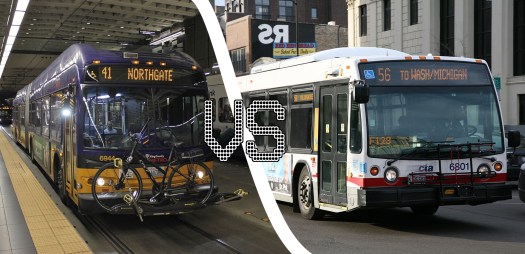
Metro Needs Your Help Toppling Other Metros

(Right picture courtesy of Daniel Schwen/Wikimedia Commons)

For the past two weeks, the American Planning Association has been running a Transit Bracket Challenge, pitting the largest transit agencies in the U.S. against each other in a popularity contest. King County Metro has so far quashed its competition, namely San Francisco’s Muni and the Maryland Transit Administration, leaving us as the sole West Coast representative.

Metro’s winning form has seemingly come teetering to a crawl and is in danger of halting entirely, thanks to its semifinal opponent: the Chicago Transit Authority.

As of writing (near midnight), Metro sits at 44.4%, while Chicago is pulling in 55.6%. Over 17,600 people have already voted in the Metro-CTA matchup, which is more than double the tally for the cross-town MTA-NJ Transit fixture in the other semifinal.

While Metro may not have the history and prestige found in each wooden tie and platform board on the ‘L’, we do punch above our weight in terms of bus ridership. Average weekday ridership on CTA buses is around 765,000, for a metro area of 9.5 million, while Metro carries 402,000 in a metro area half the size of Chicagoland.

And while they may have beat us to the punch in introducing electric battery buses, we’ve still got our reliable old trolleybus system to fall back on while we catch up in battery bus deployment. Our buses are also more frequent, more reliable, and are as busy as it gets in terms of American transit. Plus, we have a dog that regularly rides by herself.

You can vote here. The poll closes on Sunday and you can vote multiple times from multiple devices. The final round starts on Monday and will conclude on Sunday, June 9. The winning agency earns bragging rights at inter-city conferences, while voters can exercise their civic pride in time for the start of Ride Transit Month.

24 comments

The Bellevue Transportation Commission is stalling on downtown bicycle lanes

Main St in Bellevue, where a bike lane is being considered (Image: Dan Ryan)

By BRAD HAVERSTEIN

Bellevue may have decided to make the 108th Ave NE bike lane it built last year permanent, but when it comes to expanding the city’s downtown cycling network the Bellevue Transportation Commission seems to be at odds with City Council. On May 23rd the Commission split 3-3 over whether to add bicycle lanes along two blocks of Main ST between Bellevue Way and 108th Ave NE, despite the fact that City Council strongly supports the project. Following the split, the Commission voted to delay further discussion, but did not choose a specific date to revisit the plan, leaving it unclear how the process will move forward.

This is the second time that the Commission has punted consideration of extending Bellevue’s downtown bicycle network. City staff first proposed the Main ST project at the Commission’s March 28th meeting, but the issue was tabled after the Commission’s 4-2 vote to retain the existing protected bicycle lanes on 108th Ave NE.

The decision to delay comes after Commission Chair Lei Wu has received specific instructions from Bellevue City Council to evaluate options for Main ST and choose an alternative. At a May 13th study session the full Council discussed the proposal with Wu and expressed unanimous support for moving forward with an east-west bicycle facility. Since City Council strongly supports piloting more bicycle lanes, why is the Transportation Commission dithering on its responsibility?

Continue reading “The Bellevue Transportation Commission is stalling on downtown bicycle lanes” | 18 comments

News Roundup: Hiring

A Sound Transit Tacoma Link Car at Union Station Head On
Avgeek Joe/Flickr

This is an open thread.

35 comments

Thinking outside the car

by JOSHUA NEWMAN, Candidate for Seattle City Council District 4

Once upon a time, it was easy to get around Seattle. Hop in the car and in 15 minutes, you were downtown; and outside of downtown, parking was easy. At least, that’s how many long-time residents remember Seattle. Congestion was infrequent and parking was plentiful.  

So today’s congestion feel like dramatic change; a rupture from the Seattle people fell in love with. But people all over the world want a safe, prosperous place to live, and Seattle has offered that. After 40 years of stable population size, Seattle has grown 30%, by 167,000 people, since 2000. We all need to move around the city, and because every level of government has subsidized car use, most people assume they will get around by car.

This assumption carries heavy costs. In 2000, the annual cost to own a car was $7,160 (2018 dollars). It’s now $8,175. A community designed around cars is a community that chains its residents to a large financial liability. This burden falls most heavily on working families, who are forced into long commutes. Meanwhile, our businesses struggle to move freight, transit riders wait for car-clogged intersections, and potential bike riders stay away in fear.

The more expensive burden – which bears repeating – is to our climate. The human species has never, in our entire existence, lived on Earth when the atmospheric carbon content was as high as it is now: 415 ppm. Seattle’s own carbon emissions continue growing, and we won’t stop that with our current incremental approach.

STB readers know it doesn’t have to be this way. We can simultaneously unlock congestion, improve equity, and address climate change locally by making it easy to get around Seattle without a car.

Continue reading “Thinking outside the car” | 42 comments

How Seattle can shape an equitable congestion pricing plan

Traffic on Stewart Street (Sounder Bruce – Flickr)

If done right, congestion pricing can reduce pollution and improve mobility.

by HESTER SEREBRIN, Policy Director, Transportation Choices Coalition

Seattle has a traffic problem. According to the 2018 Global Traffic Scorecard, Seattle is the 6th most congested city in the country, robbing people who drive 138 hours and nearly $2,000 annually. 

Congestion also contributes to our climate crisis, with 66% of Seattle’s greenhouse gas emissions coming from road transportation. Commutes will only get longer and pollution worse as our city grows unless we take decisive action. Cities across the world, facing similar dilemmas, are considering congestion pricing, the only proven tool to reduce congestion. Pricing is also a tool that can be used to achieve other outcomes like mitigating local air and water pollution, and creating progressive revenue structures to support healthier and safer mobility options. While cordon pricing, charging people to drive to or within a downtown area, is the most well-known form of congestion pricing, pricing is flexible and we can find a structure that best meets our goals.

Last Thursday, the City of Seattle released a congestion pricing phase one report that provides case studies and potential pricing tools to inform Seattle’s policy development and engagement process as we explore congestion pricing. The report evaluates a variety of possible pricing scenarios based on criteria related to equity, climate and health, traffic congestion, and implementation, and outlines a process for engaging with stakeholders to ensure benefits accrue to communities who need them most. We all now have an opportunity to help shape a progressive plan that is still in the early stages of policy development.

Transportation Choices Coalition is working to bring more and better transportation choices to Washington State, improving access and mobility for all. As the report identifies, our current transportation system is inequitable, drawing from regressive revenue sources, struggling to provide affordable and reliable options to those pushed out by growth, and creating poor air quality disproportionately in communities of color. We believe that if done right, congestion pricing has the ability to cut pollution and greenhouse gas emissions, and generate progressive revenue to reinvest in a robust transportation system. There are understandable concerns that a poorly planned pricing system could hurt low-income communities and communities of color, and our priority is to develop a congestion pricing policy rooted in equity.  

Here’s what we want to see next from Seattle’s congestion pricing process:

Continue reading “How Seattle can shape an equitable congestion pricing plan” | 63 comments

What makes a train safe?

Cascades at Kelso (WSDOT Photo)

Mike Lindblom, The Seattle Times:

More than 50 Talgo railcars that have served the Amtrak Cascades line since 1998 will be replaced “as soon as possible,” the state announced Wednesday, a day after the National Transportation Safety Board (NTSB) said the lightweight vehicles didn’t adequately shield passengers in the 2017 fatal Amtrak crash near DuPont.

Alon Levy has a blistering response to the NTSB recommendation that is well worth reading in full:

[T]he Talgos on their own, with a typical European locomotive, would not have derailed. Moreover, after the derailment, they stayed upright, unlike the Amtrak coaches in Philadelphia or the Metro-North ones in New York. The reason people died is that the train fell from a bridge. As far as factors that are controllable by the coach builder go, the Talgos performed well.

[…]

So why is the NTSB so dead set against them? In three words: not invented here. The Talgos were designed and built in Europe. They are designed around European ideas of crash avoidance. Trains here have buff strength requirements too (and are too heavy as a result), but they’re much laxer than those of last generation’s American regulations, because at the end of the day lighter trains are no less safe than American tanks on rails. Lighter trains, designed to brake more quickly and not to derail in the first place, underlie the superior train safety of Europe to that of the United States – and Europe is downright dangerous compared with Japan, whose ultralight trains kill passengers in crashes at maybe 1/15th the per-passenger-km rate of American ones.

Replacing all 4 Series VI train sets would cost about $100M, according to the Times piece.  WSDOT doesn’t have to follow the NTSB recommendation, but it seems like they want to.

Continue reading “What makes a train safe?”

| 52 comments

News Roundup: Hat Trick

5th & Marion (SDOT)

63 comments

Reevaluating Woodinville BRT

Woodinville (Image: SounderBruce)

Work has begun on SR 522 BRT, with the first BAT lanes in Bothell coming online in late 2020, and Sound Transit’s Stride BRT service opening in 2024. Although phase 1 design recently concluded and the project is now entering the Conceptual Engineering and Environmental process, planners continue to evaluate how to serve the low-ridership Woodinville segment.

The BRT extends from the Shoreline Link rail station along NE 145th where Sound Transit will add bus queue bypasses and signal priority for transit at key intersections. On SR 522, the patchwork of existing BAT (business access & transit) lanes will be filled in to create an uninterrupted lane for transit from 145th to Bothell. In Bothell, the BRT is likely to operate on downtown streets, serving UW Bothell and connecting to I-405 BRT at NE 195th St.

Beyond that, there is a 3.5-mile segment to the Woodinville Park & Ride where the planned service is more basic. The ST3 plan does not fund any capital improvements east of I-405 and the buses operate in general purpose freeway lanes on I-405 and SR 522. The 10-minute headways west of I-405 drop to every 20 minutes into Woodinville.

Continue reading “Reevaluating Woodinville BRT” | 57 comments