Overview of the current state of high speed rail in the United States.
This is an open thread.
32 comments
Overview of the current state of high speed rail in the United States.
This is an open thread.
32 comments

The congestion pricing study attempted to apply objective criteria to various options. Regardless of the policy merits, it’s a good bet that the choice will be the one with a political coalition to pass it. Who wins and who loses from such a plan?
For bus riders, pricing is overwhelmingly positive. Fewer cars means buses will be faster, and usually the fee is used to add transit. Perhaps the only downside is more crowded vehicles.
For bicyclists and pedestrians, it’s unclear. The zone would have lower car volumes but higher speeds. But if many people are diverted to bikes, numbers increase safety.
That’s a good chunk of who’s going downtown, but the attitudes of drivers are going to be important. For pricing to work, someone has to be deterred off the road, and those people aren’t going to be happy with the deterrence.
Continue reading “What’s the coalition for congestion pricing?” | 50 comments
The draft ST3 plan in March 2016 extended rail beyond Lynnwood in two steps. The first, in 2036, would bring service to North Lynnwood, serving stations at West Alderwood Mall, Ash Way, and Mariner. The second, in 2041, extended around the SW Everett Industrial Center (Paine Field) and north to Everett Station.
When the plan was finalized two months later, the extensions were combined so the Paine Field and Everett stations would open five years earlier. It was a telling decision that all the extra financial resources of the final plan were put into the northern segment. This looks like an error. While all parts of Everett Link have their value, the immediate rider needs are mostly between Lynnwood and Mariner.
Continue reading “Could Link to Mariner open early?” | 37 comments
This is an open thread.
69 comments
David Cole has a largely correct takedown of Sound Transit’s traditional pound-foolish approach to escalators:
Continue reading “Center platforms are the inexpensive escalator design” | 43 commentsWherever long escalators are required to travel between the train platform and street level, redundant escalators should be provided. This could have been accomplished with a single bank of at least four escalators, or two banks of at least three escalators, etc. With a bank of four escalators, one escalator being out of service would be a minor inconvenience at worst. Even with half the escalators out of service, access to and from the station could be maintained …
Beyond the number of escalators at each station, there is also the issue of the escalators themselves. Broken escalators have been a near-constant bane to riders using the Capitol Hill and UW stations since their opening in 2016, to the point that Sound Transit is already planning to replace all 13 escalators at UW less than four years after that station’s completion.
But Sound Transit apparently felt differently back when planning the Capitol Hill and UW stations. According to a source familiar with the design process who declined to be named for this article, Sound Transit insisted on specifying medium-duty “better” escalators at these stations as a cost-saving measure, and then cobbled together a myriad series of customizations to bring them up to heavy-duty standards. As we now know, the reliability of these Frankenstein escalators hasn’t exactly been stellar, and Sound Transit will soon spend a fortune to replace them with more robust, off-the-shelf models. Some old adage comes to mind about how it’s better to do something right the first time than to do it over again.
Seattle’s Congestion Pricing Report looked at ten different schemes that could reduce the volume of cars in congested areas, from variations on a toll, to bans on non-electric or non-autonomous vehicles, to allowing only certain license plate numbers on a given day.

After considering environmental impacts, congestion reduction, equity, and feasibility, SDOT ended up with four alternatives:

If you’re like me, you’ve lost track of all the near-term projects that were supposed to get downtown through a period with multiple disruptive construction projects. It doesn’t help that there’s a near-term set of improvements and other longer-range plans that one can confuse.
Luckily, the City Council mandated that SDOT provide a quarterly report on how the near-term OCC stuff is doing. Here’s a summary of the bus stuff:
On the bike front, all three of the big downtown projects — PBLs on Pike/Pine and 4th, plus the 2nd Ave Extension bike lane — are either behind schedule or threatening to become so.
There are plenty of pedestrian and other programs as well, which you can read about in the report.
10 comments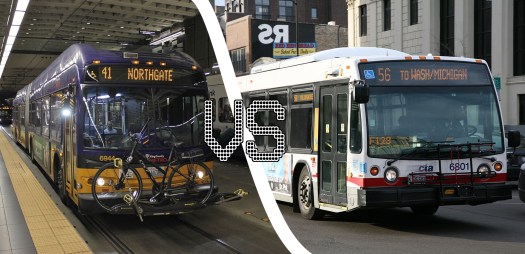
For the past two weeks, the American Planning Association has been running a Transit Bracket Challenge, pitting the largest transit agencies in the U.S. against each other in a popularity contest. King County Metro has so far quashed its competition, namely San Francisco’s Muni and the Maryland Transit Administration, leaving us as the sole West Coast representative.
Metro’s winning form has seemingly come teetering to a crawl and is in danger of halting entirely, thanks to its semifinal opponent: the Chicago Transit Authority.
As of writing (near midnight), Metro sits at 44.4%, while Chicago is pulling in 55.6%. Over 17,600 people have already voted in the Metro-CTA matchup, which is more than double the tally for the cross-town MTA-NJ Transit fixture in the other semifinal.
While Metro may not have the history and prestige found in each wooden tie and platform board on the ‘L’, we do punch above our weight in terms of bus ridership. Average weekday ridership on CTA buses is around 765,000, for a metro area of 9.5 million, while Metro carries 402,000 in a metro area half the size of Chicagoland.
And while they may have beat us to the punch in introducing electric battery buses, we’ve still got our reliable old trolleybus system to fall back on while we catch up in battery bus deployment. Our buses are also more frequent, more reliable, and are as busy as it gets in terms of American transit. Plus, we have a dog that regularly rides by herself.
You can vote here. The poll closes on Sunday and you can vote multiple times from multiple devices. The final round starts on Monday and will conclude on Sunday, June 9. The winning agency earns bragging rights at inter-city conferences, while voters can exercise their civic pride in time for the start of Ride Transit Month.
24 comments
By BRAD HAVERSTEIN
Bellevue may have decided to make the 108th Ave NE bike lane it built last year permanent, but when it comes to expanding the city’s downtown cycling network the Bellevue Transportation Commission seems to be at odds with City Council. On May 23rd the Commission split 3-3 over whether to add bicycle lanes along two blocks of Main ST between Bellevue Way and 108th Ave NE, despite the fact that City Council strongly supports the project. Following the split, the Commission voted to delay further discussion, but did not choose a specific date to revisit the plan, leaving it unclear how the process will move forward.
This is the second time that the Commission has punted consideration of extending Bellevue’s downtown bicycle network. City staff first proposed the Main ST project at the Commission’s March 28th meeting, but the issue was tabled after the Commission’s 4-2 vote to retain the existing protected bicycle lanes on 108th Ave NE.
The decision to delay comes after Commission Chair Lei Wu has received specific instructions from Bellevue City Council to evaluate options for Main ST and choose an alternative. At a May 13th study session the full Council discussed the proposal with Wu and expressed unanimous support for moving forward with an east-west bicycle facility. Since City Council strongly supports piloting more bicycle lanes, why is the Transportation Commission dithering on its responsibility?
Continue reading “The Bellevue Transportation Commission is stalling on downtown bicycle lanes” | 18 comments