Imagine a More Detailed Link Station Schedule

stem-and-leaf schedule for Othello to Downtown
Mockup of stem-and-leaf schedule for Link platforms

The schedules at Link stations show the frequency of service and times for the first and last trains. Some people find that inadequate for planning a trip and want a detailed timetable. Here is my answer to your call, a stem-and-leaf format schedule showing all train departures from a station in a particular direction. I designed it for individual platforms. The size of this exactly matches the existing schedules found at Link stations and can function as a drop in replacement. It can accommodate 24 hour service and up to 10 trains per hour. The tradeoff is loss of first/last train times for the opposite direction and a more cluttered look with no summary of the frequencies. I would keep the existing schedules for mezzanine areas. Or why not have both detailed and summary schedules? That would require redesigning the information panels.

By the way, many schedules at Link stations have not been updated or are missing altogether. Some still list times for the first/last train to Tukwila International Boulevard! I don’t know what the people in charge of this at Sound Transit do all day but it took me about 2 hours to design the mockup from scratch. I could make one for every station, print them out, and go install them at stations in a single work day. Of course I’m bragging a bit; it’ll take more work to make such a major change. However, the missing and outdated schedules are simply inexcusable.

48 comments

ATU Agrees to One-year Raise Freeze

This afternoon, the Amalgamated Transit Union Local 587, which represents King County Metro workers, agreed to a three-year contract that would waive the COLA (cost-of-living adjustment) increase for the first of the three years. According to Slog, this will save about $7.8 million next year.  This is a very surprising turn of events, given the union’s recent position on wage concessions.  Nonetheless, wage increases for the second and third years have not yet been finalized.

Thoughts from PubliCola, which seem to trend toward the view that a one-year freeze is just about as far as the ATU is willing to go:

It’s hard to say who the winner and loser is here. On one hand, the fact that the union (whose president, Paul Bachtel, was saying as recently as last month that he’d rather cut bus service than give up pay increases) has accepted any concession at all is major news. On the other, the fact that the one-year COLA freeze is all Constantine is announcing seems to indicate that the terms of the agreement are favorable to the union.

You can read the full press release here. And previous thoughts from Martin on the subject.

21 comments

News Roundup: Scrapping 40/40/20

Photo by caseyrs77

What we’ve missed:

  • Metro’s Regional Transit Task Force has recommended scrapping 40/40/20 — a policy that allocates new bus service disproportionately away from Seattle toward generally less efficient suburban service — reports PubliCola.
  • Seattle car tabs will cost $20 more beginning next May. The funds will be dedicated to transportation projects.
  • The Obama administration has released more funds for high-speed rail. $27 million will go to King Street and Tukwila Stations. Will future money be appropriated under a GOP Congress?
  • Have you noticed that Verizon is sponsoring some ads on our site? This weekend’s Verizon Urban Challenge is a real life puzzle/explorer game — sort of like The Amazing Race. Apparently, a few of the elements in the game acknowledge Seattle’s public transit system. A two-person team can win up to $3,000 and some new phones.
  • “Some unfortunate soul peed and pooped on the train, and it was not a little accident.”
  • The ATU (bus operators union) and county likely to end up in arbitration — a process that’ll likely favor union interests compared to a process without arbitration. The ATU is one of two county labor groups who has so far refused to give up a raise for next year.
  • Sound Transit CEO Joni Earl gave money to Patty Murray’s re-election campaign. Have you mailed in your ballot yet?
  • Buy a used Metro bus for less than $10k. (h/t cookieguru.)
  • The New York Times has an excellent photo gallery that covers the last century of New York City subways.
  • A Ferris wheel is planned for the waterfront.
  • The Market Urbanism blog is worth subscribing to.

This is an open thread.

35 comments

Bel-Red Corridor Design Update

177 feet - this is not TOD

In (slightly) less flame-worthy East Link-related news from Bellevue, the city council is undergoing discussions on the new NE 15/16th street in the Bel-Red corridor, which will require construction of a new right-of-way for Link.  The street will become the centerpiece corridor for the city’s Bel-Red TOD plan, which has even garnered some recognition from Senator Murray.  From the Bellevue Reporter:

[Council] discussion included the type and size of features to be included on the roughly 1.5-mile long roadway, such as the number of vehicle lanes, on-street parking, whether to have bike lanes or a bike-pedestrian pathway, and landscaping options. These decisions will determine how the various elements fit together and the width of the new street.

The greatest fear I have out of this project is Bellevue’s reputation for street improvements that are notoriously car-centric— leaving the potential that this new 15/16th Street could become nothing but a major thoroughfare.  Slides from the city council’s presentation (PDF) show the various ROW cross-sections, with some designs ranging up to 170+ feet wide.

As the current NE 16th Street is only a back-road for industrial vehicles, the natural assumption is that the new street will provide capacity for drivers frequenting the corridor– completely new demand that is really unnecessary.  The development slated there is supposedly being drawn in by Link as the primary transport mode, making the purposes of a new street counterintuitive.  If new lanes are inevitable, however, I’d rather pedestrians not have to walk more than 130′ just to get to the other side of the street.

The city is hosting an open house (PDF) on the project November 9th from 4:30-7pm at Bellevue City Hall.

49 comments

WSDOT Hedging DBT Bet

Update 6:00 – There is a third possibility. Bid come in a few million “under budget” making the project look good to the general public. If you want to get conspiracy theoryish you could say that today’s comments were made to make low bids look like a pleasant “surprise”.

It looks like WSDOT’s public relations machine is getting into high gear on the deep-bore tunnel (DBT). This great scoop from the Seattle PI:

A sluggish economy that’s helped taxpayers save millions on several large transportation projects is unlikely to have much effect on the state’s planned $1.96 billion deep-bore tunnel replacement for the Alaskan Way Viaduct.

Thanks to a slow construction market, the bids on several large transportation projects have been coming in at 18 to 25 percent below the state’s estimates. But the favorable bidding climate probably won’t mean big savings on the tunnel project, said Ron Paananen, the state Transportation Department’s administrator for the overall project, which is projected to cost $4.2 billion.

“I’m not so sure we’ll see that in this project because of the level of risk assigned to the contract and the nature of the tunneling industry,” he said. “This is a very big contract with a limited number of contractors. We made sure to get the best and put in a lot of protections to ensure any potential damages are minimized.”

Two joint-venture contracting teams are expected to submit their bids by a Friday deadline on how they would build the tunnel and for how much.

With last week’s announcement that WSDOT is throwing the two remaining teams hundreds of millions more, and today’s announcement that the bids aren’t likely to come in under budget because of the poor economy, it’s pretty obvious that WSDOT is trying bring their budget in line with higher costs and reduced expectations of low bids.

WSDOT doesn’t know what the bid are, but I’m sure they have been getting ample hints from the project teams that those teams will need more money. These teams have spent millions of dollars to get to this point, and neither them nor WSDOT are about to give up on this project. It’s in both of their interest to help each other out.

So with an under-budget DBT doubtful, watch for two scenarios. The first is that bids come in “on budget” thanks to WSDOT shuffling of money. The other is the tunnel still comes in over budget but through theses actions is able to minimize harm to the project.

In the next week or so WSDOT will be releasing their Supplemental Draft EIS (SDEIS). With Halloween this weekend and all of the election coverage over the next week or so, this is a great time from a PR perspective to release a such a controversial document and project bids.

19 comments

Fun at Rail~Volution in Portland

Voices from the Rail~Volution (2010) from Streetfilms on Vimeo.

Last week I had the pleasure to speak on a panel about blogging at the 20th annual Rail~Volution conference in Portland. It was a great retreat from work as evidenced by the skyrocket in STB tweeting. Portland really is a great city.

Having been away from professional transportation conferences for a year and a half I was excited to see what the “new” hot topics in the transportation profession were. I wasn’t surprised to find economic development and health on the forefront. With the economy how it is transit advocates are trying to do a better job of communicating  and leveraging the economic benefits of transportation projects. Several presentations focused on how a low car lifestyle is good for everyone’s bottom line. Less money spent on transportation, means more money to spend locally.

Also, the impact of the built environment on our daily physical activity through “active transportation” has started to get a lot of attention. While it might not sound like much the physical activity you get from walking to the bus, walking to the store, or biking to work or school really adds up, especially compared to people who live sedentary lifestyles caused by auto oriented communities. This area of research has exploded over the last few years in academia and is starting to work it’s way into the professional world, thanks in large part to federal funding from FTA, HUD and EPA through their livability initiative. King County and PSRC are both on the forefront of this.

Rail~Volution will be in DC next year. Sounds like a good excuse to visit.

5 comments

Bus Stop Relocation Oversight

Campus Parkway, photo by Atomic Taco

Metro riders who frequent the University District will have noticed that recent building construction in the southwestern part of campus has forced a bus stop relocation along Campus Parkway.  Both bays for the eastbound stop at Brooklyn Ave have been consolidated into one stop on the west side of the intersection, just outside the Lander-Terry dormitory complex.  The stop has fairly high utilization, yielding mostly alightings from riders on the 71-74 series, as well as the 49.

One particular downside to the relocation is that the temporary stop comes to just about 500 feet from another existing stop on the same block.  That’s a distance far shorter than the recommended quarter-mile for stop spacing. This means that passengers getting off at the first eastbound stop at 11th Ave can easily out-walk their own bus to the relocated stop when factoring in dwell times.  Most of all, it’s frustrating for those who have to stay on the buses and sit through unnecessary waits.  It goes without saying that Metro could really do away with the 11th Ave stop.

Though it’s just one stop, this kind of oversight has really become too commonplace with Metro.  Send your comments in about the stop spacing to community.relations@kingcounty.gov.

23 comments

A Look at North Link Alignment Alternatives

Tomorrow is the last day for one to submit comments and take a survey on Sound Transit’s Draft North Corridor HCT scoping document. The corridor’s aim is to serve North Seattle and Lynnwood and the mode will almost certainly be light rail, but by law Sound Transit is going through a more general alternatives process so North Link will be eligible for federal New Start funds. The truly largest unknown for this project is which alignment alternative is the best: along I-5, Aurora Ave, or 15th Ave.


View North Link in a larger map

Each alignment has its own advantages and disadvantages that should become clearer as this process moves forward. Sound Transit has already studied these alignments in an issue paper. While the paper is a good starting point, there are still many unknowns.

All three alignments would serve stations at Northgate, Mountlake Terrace, and Lynnwood — the difference is what happens in-between. Below I’ll outline what the three alternatives could look like and some advantages and disadvantages that I see for each. More after the jump.

Continue reading “A Look at North Link Alignment Alternatives”

| 162 comments

Link Rider Alerts and Real-time Arrival Info

NB-Westlake Seattle xx min, SB-SeaTac/Airport 9 min, etc.
Mock up of Link variable message sign displaying next train times, by the author

Sound Transit recently hired an employee to deal with incident response and provide passengers with service status alerts from the Link Control Center. The rider alerts are better than nothing but sometimes you can have days like this or this when the number of rider alerts becomes overwhelming.

Scott Gutierrez at the PI reports on the recent proliferation of Link rider alerts notifying passengers of train delays. Sound Transit spokesman Bruce Gray explains in Gutierrez’s article:

The agency still is setting protocols on when mass alerts are necessary and when updating electronic signs at boarding platforms is enough to get the word out. A few times recently, alerts were issued about problems that were handled quickly and had minimal effect on service, he said.

On Monday morning, for example, an alert was issued about a mechanical problem that caused delays of six minutes to one train and three minutes to the other.

“That’s why we’re seeing a little more frequent rider alerts. We’re working out some of the kinks as to what rises to the level of needing a rider alert,” Gray said. “We probably don’t need an alert if it only means a five-minute delay.”

The problem is not Sound Transit providing too much information; it is Sound Transit providing the information in the wrong format. Having real-time train arrival information at stations (and elsewhere) solves the problem of issuing too many alerts for minor delays. Instead of posting an alert that trains are delayed 6 minutes, the delay is simply reflected in the predicted arrival times at each station for each affected train trip. If the delay gets severe, then broadcast an alert. While some might want to know why their train is being delayed, what everyone wants to know is how long the wait will be, which is useful information even under normal conditions.

50 comments

Rainier Valley Mobility

[Update: To be clear, Metro would have to add at least a few stops on the 9. I don’t think the impact is big enough to alter the math.]

Although Metro executed a pretty major service revision in Southeast Seattle in response to Link’s opening, that change manifestly failed to provide frequent, efficient worthwhile Link connections to the great mass of people east of the line, particularly in the Rainier Avenue corridor. The, 7 one of the system’s workhorses, was left essentially unchanged and does not provide a transfer opportunity until it reaches Mt. Baker, by which time the transfer is essentially a wash time-wise. If that weren’t bad enough, the transfer from transit center to Link station there is a difficult one.

Aside from the core mission of serving the stations, connectivity within the Southeast hasn’t improved. Unlike more radical plans like my double-loop circulator proposal, trips between the dense, linear corridors along Beacon and Rainier Avenues can still involve three bus trips, with headways as long as 45 minutes.

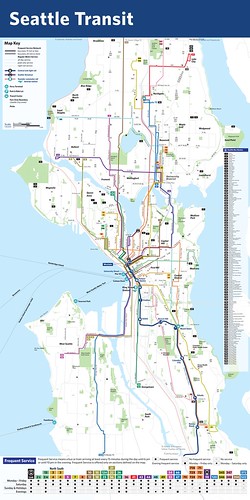
Oran’s frequent service map (detail at right) illustrates the problem very well. Frequent service is siloed into three parallel corridors along Beacon, MLK, and Rainier. There is no frequent east/west connectivity at Columbia City, to the west only at Othello, and to the east only at Rainier Beach. If you live near, say, the Group Health on Rainier, forget it.

However, there is another alternative that roughly maintains the operating costs in this part of the city while improving the situation for most commuters. I have neither the ability nor the inclination to do a full service-hour analysis, but I will estimate the number of simultaneous buses necessary to operate each route during midday operations to show that the changes roughly pencil out.

More after the jump. Continue reading “Rainier Valley Mobility”

| 109 comments