Action Item: Getting Transit Revenue Options

With about five days to go before the end of the legislative session, there’s plenty more we can do to help.

Since the loss of the Motor Vehicle Excise Tax (MVET), many transit agencies have hurt for revenue – and today that hurt is double due to huge falls in sales tax. This year we may have two new options, but only if we tell our legislators we want them!

The first is a transportation benefit district, that would allow transit agencies and municipalities to ask for (yes, ask, this would require a public vote) a $20 car tab – not based on value, just flat. The second would allow King County to use some of our existing ferry district revenue, which is much higher than our ferry needs, for transit. This would fill $30 million of Metro’s $100 million budget hole.

In the House, Representative Simpson was able to add an amendment (PDF) to SB 5433 (“Modifying provisions of local option taxes”) to do these things, but the Senate did not concur. This is normal, it just means that the bill has to go into conference committee.

As this would greatly benefit King County, I’m hoping to see Senator Jarrett take a supportive position on the bill as passed by the House.

This would also be a great time to take a moment to call your legislators to support these tools to prevent transit service cuts! Here’s the District Finder tool, as well as the legislative hotline, 1-800-562-6000 (8am-8pm).

8 comments

Taxing Cars

This is slightly outside the realm of transit, but is definitely transportation related. As you probably already know, in the US we drive very large cars that use a lot of fuel. Venturing outside of the North America, one of the first things you might notice about cars is how few very large SUVs you see and how many more very small, so-called “mini-cars” you see. A variety of taxes on cars and fuel encourage large vehicles while discouraging smaller ones in the United States, at a cost of pollution and a massive send off of American treasure to oil exporting nations. With the US auto industry effectively in Federal receivership, it’s the best possible time for reform of our auto industry, and the laws that give incentive to large vehicles

Below the fold I’ll mention three ways the government could encourage lower fuel consumption or encourage smaller vehicles.

Continue reading “Taxing Cars”

| 36 comments

Orders of Magnitude II

For a while now I have been curious about the relative energy demands of different modes of transportation, especially bicycling and walking. Most people would agree that as a modern society we have lost touch with the environment in many ways. Food production is probably one of the most looked at areas in which this has happened but energy demands of our lifestyle are no less important.

For some context watch this video. Imagine if you had to do this every time you wanted to turn on a light. If that isn’t bad enough, imagine if you had to do this for your car’s headlights. You aren’t even moving yet and the energy demands are beyond what is humanly possible. Industrialization and reliance on fossil fuels has made us completely blind to the energy demands we make in everyday life. These are the types of orders of magnitude I have been curious about.

So I decided to do a little research and I was able to find some data on this subject. A human walking around 3 miles per hour on a level surface uses around 5 kcal/minute(1) and a bicyclist riding at ~10 miles per hour on level surface uses around 8 kcal/minute(2). These values mostly vary with speed of travel and slope. Next, I then converted MPG for an average US car and a hybrid-electric bus into BTU/mile/passenger and got the graph below.


BTUs Per Passenger Mile


Continue reading “Orders of Magnitude II”

| 24 comments

The Gas Tax and the State Constitution

This post originally appeared on Orphan Road.

Martin references Josh Feit’s post on using the state gas tax to fund transit. Here’s Feit:

The current working transportation budget for 2009-11 puts only 4.4 percent of the $5.9 billion total into transit. And even if legislators were more-transit friendly, the rules governing transportation funding—Constitutionally, the gas tax cannot be used on transit—would have only permitted them to put about 7.3 percent of the money into transit.

I’m not a legal scholar, but David Goldstein spoke with one a couple years back and concluded that we can in fact tax gasoline to fund transit, without resorting to a constitutional amendment. The key is that it has to be a sales tax, not an excise tax:

Article II, Section 40 specifically refers to “excise taxes.” There’s nothing in the Constitution that says we can’t also levy a sales tax on motor vehicle fuel, and there’s nothing to mandate how such revenues might be spent. Thus all the hooey we’ve been fed about how we can’t spend gas tax dollars on anything but roads and ferries is exactly that… a bunch of hooey. A simple majority in both houses, and the stroke of the governor’s pen is all we need to create a dedicated fund for building mass transit. And of course, the people are free to vote yea or nay via referendum or initiative.

This isn’t just amateur legal analysis on my part. I checked with a constitutional scholar who assured me that my reading was correct, and that similar proposals have indeed been debated from time to time. And it’s not such an original or off the wall idea; nine other states already levy both sales and excise taxes on gasoline.

To my knowledge, Goldy hasn’t revisited the issue, so I have no idea if any new information has come to light regarding it. Still, I thought it worth sharing.

1 comments

DOT and HUD, Together

Neal Peirce (citistates.com)

I’d spend more time criticizing the Times editorial page if I hadn’t stopped paying much attention to it.  Still, I have to applaud them for continuing to carry Neal Peirce on their op-ed page.  He’s a nationally syndicated columnist who continues to churn out forward thinking pieces on transit and land use.

In yesterday’s column, Peirce tells us that USDOT and HUD are going to work together to consolidate transportation and land use policies.  As someone who’s been in several large organization, I’ll say that kind of cross-agency coordination almost never happens, and these are two subjects that deserve to go together.  We’ll see what comes of it, but it’s a very promising sign.  Check out the whole column.

2 comments

Light Rail Date Announced

Joni Earl, Sound Transit CEO, and King County Councilman Larry Philips watch as Mayor Nickels announces the start date of Link service.

Ever since the construction float disappeared in the Beacon Hill tunnel, the July 3 completion date for Link light rail was under threat.  Today, Sound Transit announced that the opening date will be Saturday, July 18.

I’m told that part of the reason for a two-week delay, besides a margin of error, was to avoid the added demand from both July 4 festivities and the Mariners home game on Saturday, July 11.  That gives them a couple of days to handle all the for-fun riders and work out the kinks before a Monday morning commute.

Given all that padding we’d consider this date extremely unlikely to slip.

Riders won’t have to pay a fare to try out Link during the inaugural weekend.

[NOTE: This post has been revised as more information came in.  Some of the comments below refer to earlier versions of the post, which erroneously referred to July 3 as a previously announced opening date; in fact, it was the project completion date.]

38 comments

Sea-Tac Annoys Me

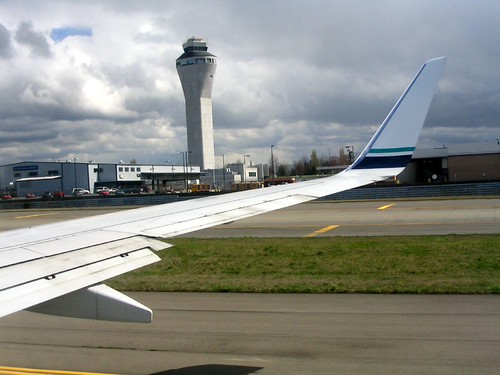
Sea-Tac Tower
Sea-Tac photo by Mozul

These are the steps you have to take between getting off the airplane and leaving the airport for international arrivals in Sea-Tac (or at least all the arrivals I can remember at Sea-Tac):

1) go through immigration
2) get your luggage off the carousel
3) go through customs
4) put the luggage back on a conveyor belt
5) take the people mover
6) go back up and wait for your bags again

Is there any other airport that makes you do steps 4 and 6? It’s crazy.

And why do you have to get your luggage, go upstairs, walk on the sky-bridge and take an elevator down again to get a cab? It’s like 500 meters and a dozens signs to find your way (I don’t take taxis often) while in most airports you can get surface transportation by just walking outside. And what’s up with $4 for a luggage cart? Those are free in virtually every other airport, and would be really nice for the cases you have to walk 500 meters with all your bags from the second baggage claim…

I could go on (and on), but I’ll stop there. The Port should drop the $400+ million parking garage and fix the airport that’s already there.

66 comments

Southeast Seattle Service Changes

Oran, via Flickr
Oran, via Flickr

As mentioned briefly Friday, and covered extensively in the past, Metro is extensively revising bus service in Southeast Seattle in response to the arrival of Link Light Rail.  The main rounds of public comment are finished; the final staff proposal will be presented Tuesday, April 28, at 6:30pm in Room 1001 of the King County Courthouse to two King County Committees.  The citizen sounding board for this project will also present their recommendation, and of course the hearing will be open for public comments as well.  You can see the staff recommendation online, and the meeting will be on King County TV.  There are absentee ways to comment as well.

There will be two rounds of changes: the first, in September 2009, will eliminate several routes, scale back others, and use the savings to fund other improvements and help Metro assume responsibility for the South Lake Union Streetcar.   In February 2010, the completion of Airport Link will allow elimination of Route 194; half of these service hours “belong” to the Seattle subarea and will be repurposed to improve service there, as listed on the chart.

The Southwest King County proposals, on which I have much less to say, are available here.

Here are some reasons for the more interesting changes, both from current service and some of the earlier proposals.

| 27 comments

The Gas Tax and the State Constitution

uhuru1701, via Flickr

Publicola reported this week about potential fundamental shifts in thinking about our state’s revenue system.  Towards the end Josh Feit quotes grumbling from Sen. Ed Murray (D-Capitol Hill, Wallingford) and a collection of environmental and transportation organizations about the State Constitution‘s Section 40, which says that gas tax funds can only be used for roads.  In Feit’s words:

Consider: The current working transportation budget for 2009-11 puts only 4.4 percent of the $5.9 billion total  into transit. And even if legislators were more-transit friendly, the rules governing transportation funding — Constitutionally, the gas tax cannot be used on transit— would have only permitted them to put about 7.3 percent of the money into transit.

Given that 10 percent of all work trips in the Puget Sound region are transit (and 57 percent of all trips are non-single occupancy vehicle—60 percent in Seattle during morning rush hour); and given that vehicle miles traveled has remained flat in the last few years while transit ridership across the state has spiked by 15 to 20 percent, the fact that transit spending is in a straight jacket doesn’t fit our state’s changing profile.

Combine these transit  numbers with the new state mandates and goals about reducing global warming (particularly by reducing vehicle miles traveled), and the transit funding equation seems as unsustainable are the general fund.

Of course, I would be ecstatic if applications of the gas tax were broadened through a constitutional amendment.  At the same time, I understand that amending the constitution is hard.  Meanwhile, I think there are two important points to make:

  • As Feit points out, the budget’s transit funding is $171m below what is Constitutionally allowed, so the attitude of legislators is currently more relevant than Constitutional restrictions.
  • If there was sufficient interest in boosting transit funding but not enough to change the Constitution, there are pretty simple maneuvers available.  For instance, the Legislature could lift the sales tax exemption on gasoline and reduce the gasoline tax by an equivalent amount, and sales tax revenue has fewer strings attached.

Even if the tax revenue were “blown” on schools or something, Metro and ST would capture about 20% of the revenue in their respective districts thanks to their sales tax authority.

The biggest criticism here is that sales tax per gallon varies wildly with the gas price, making for a volatile revenue stream.  However, gas prices are probably near bottom, so it’s unlikely that programs funded with these streams will be left high and dry.  Furthermore, the sales tax is roughly indexed to inflation, whereas the fixed gasoline tax often faces declining purchasing power.

30 comments