In Defense of West Seattle Link

Ever since the Sound Transit 3 ballot measure was being assembled, the West Seattle Link Extension has been a contentious project. Frank Chiachiere wrote in 2016: “not since the days of the Monorail has a rapid transit extension stirred up so much debate amongst the armchair planners.” Transit advocates have long known the project would be expensive and difficult, but for an extension that was strongly demanded by Seattle leaders and definitively approved by ST3 voters, why is it still so controversial? Let’s look at how we got here, starting with a brief history of how the current project came to be, and think about where we should be going.

This map from “The Rapid Transit Plan for the Metropolitan Seattle Area”, 1970, highlights the topographic difficulties facing any project to connect West Seattle to Downtown. Image clipped from a scan shared by Bruce Englehardt on Reddit.
Continue reading “In Defense of West Seattle Link”

The rush to reach West Seattle

Last week Sound Transit revealed more details about three grandiose new stations in West Seattle, one hugely upgraded SODO station, and a big cable-stayed (“suspension”) bridge over the Duwamish. On Thursday the System Expansion Committee will discuss early land acquisitions. This seems to indicate that the Board takes approval of the extension for granted though the final EIS is not expected to be released until June. In the meantime, the target opening of the Ballard extension has been pushed out from 2035 to 2039, partially due to lack of funding. What would happen to land already acquired if the line would fail to obtain federal funding or the Board would decide to focus on Ballard instead? Are we making the right tradeoffs?

Continue reading “The rush to reach West Seattle”

Environmental Impact of Transit Projects such as the West Seattle Link Extension

One of the FTA’s stated goals is to help “metropolitan areas meet national ambient air quality standards (NAAQS) by reducing overall vehicle emissions and the pollutants that create smog” and to reduce “fuel use and greenhouse gas emissions.” So we just need to build more transit, right? But what about construction-related emissions? The recent Seattle Transportation Plan (p. 188 3-98) draft states that, “Given the transient nature of construction-related emissions and regulatory improvements scheduled to be phased in, construction-related emissions associated with all alternatives would be considered only a minor adverse air quality effect.” However, Sound Transit’s draft Environmental Impact Statement (DEIS) estimates that the West Seattle Link extension (WSLE) will generate 614,461 tons of carbon. As so often the answer is: It depends!

Continue reading “Environmental Impact of Transit Projects such as the West Seattle Link Extension”

A win-win for the CID dilemma: Stick with current tunnel

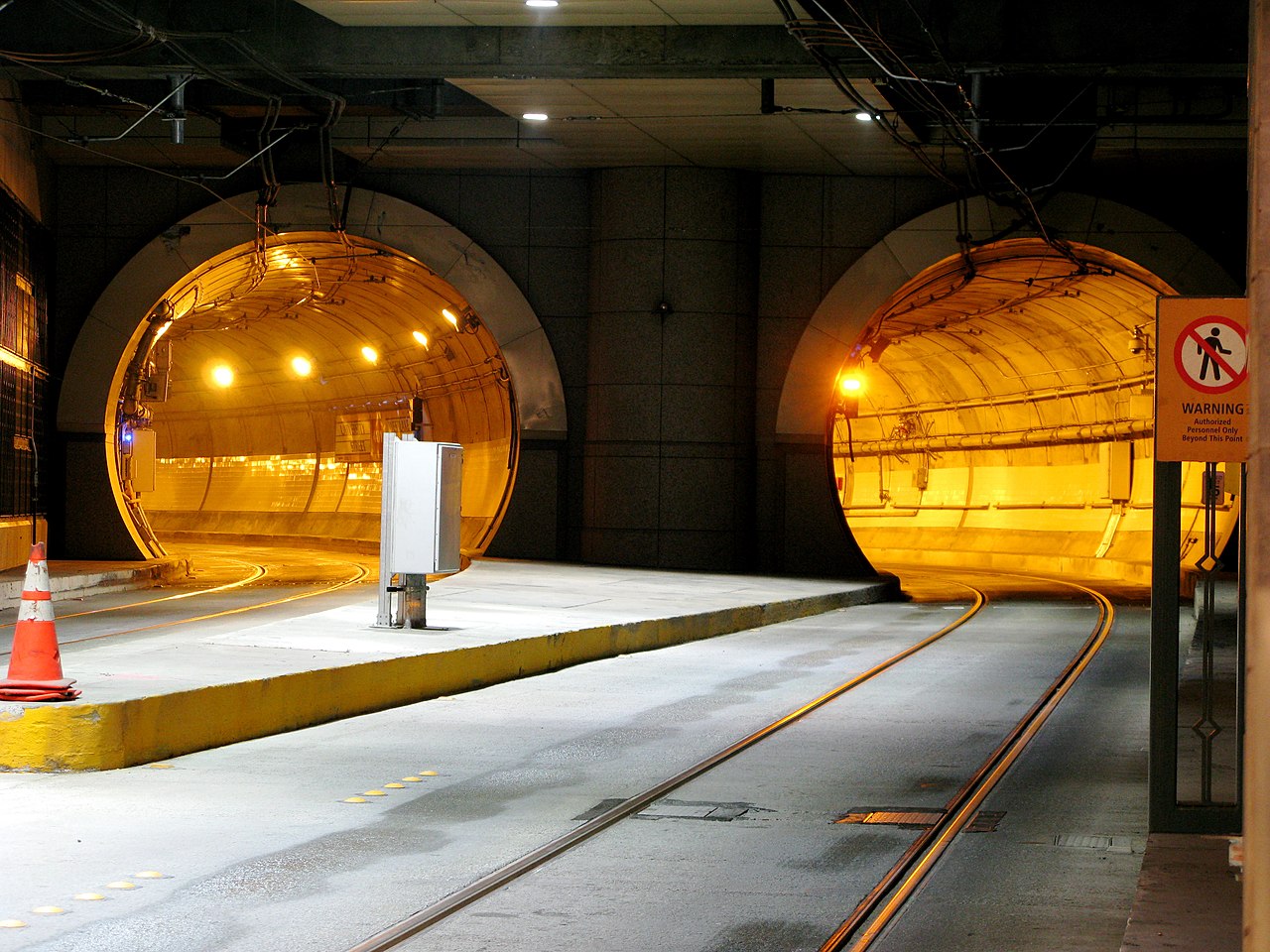
The Downtown Seattle Transit Tunnel bends towards the south under Pine St to Third Avenue after leaving Westlake Station. (Oran Viriyincy)

New proposals for a second tunnel would increase cost, but none provide a compelling rider experience. Let’s just improve our existing tunnel and use the savings to make up for lost time on other projects.

ST3 promised higher capacity transit through downtown by building a second tunnel with seamless transfers at Westlake and Chinatown/International District (CID), along with an additional Midtown station at 5th & Madison. But after looking into the details, the seamless transfers may not be achievable. The tunnel would be far more complex, time consuming and expensive to build than anticipated. It would also burden the CID, which has already seen a lot of construction-related disruption and loss of properties. Sound Transit abandoned the idea of a station on 5th Avenue South and proposed a shallower 4th Avenue South station. But this station would increase construction time and cost. Because of the additional burden to the neighborhood, there have been two recent guest editorials against it, in The Seattle Times and The Stranger. Sound Transit responded by proposing to combine the Midtown station with a North CID station close to Pioneer Square and/or a South CID station as an alternative. Unfortunately, neither station would provide easy access to the heart of the CID, nor to King Street station with Sounder, Amtrak, the streetcar, and many bus lines along Jackson Street, 2nd Avenue, and Yesler Way. Currently the 1 Line stops at 5 stations downtown (Stadium, CID, Pioneer Square, University Street, Westlake). This new line would now stop at only 2 or 3 stations, forcing a transfer at SODO which neither provides frequent service nor is well designed as a transit station, as Stephen Fesler pointed out. Residents are concerned it would break South Seattle apart when they are already suffering from frequent accidents and disruptions due to the at grade alignment.

While various alignments and station locations have been discussed, It is time to focus on an alternative which Sound Transit considered before they put the 2nd tunnel proposal before voters: to upgrade the existing tunnel to allow interlining of all lines through the existing tunnel. Capacity would increase, likely with better signaling systems and better ventilation. MUNI did this in 2010 and Frankfurt just started. This would avoid any disruption of the CID, be available much sooner, and be much better for riders. There are more stations in the existing tunnel, they are closer to the surface. Same direction transfers would be trivial. Reverse directions would be easy, and even easier if center platforms were added. The carbon footprint would be far lower (WSBLE is currently estimated to generate 3 million tons of carbon), and of course, this would be much cheaper.

Continue reading “A win-win for the CID dilemma: Stick with current tunnel”

The case for Automated Light Metro Technology for Ballard and South Lake Union

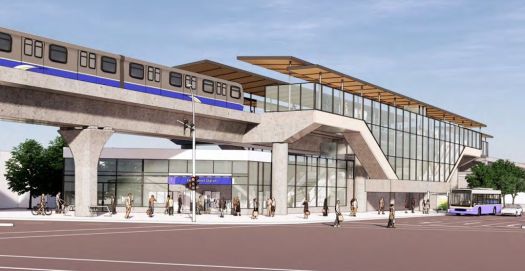
Sept. 2020 rendering of 160 Street Station on the Surrey-Langley SkyTrain Extension. (TransLink)

ST3 passed enthusiastically in the Seattle region because voters were excited to get mobility improvements. However, Sound Transit has had trouble coming up with compelling designs to deliver on this promise. To address this problem, we should revisit some of the design assumptions.

Vancouver’s SkyTrain and Montreal’s REM took far less time to design and construct. We can learn from them and adopt automated train technology. If Sound Transit would interline trains in the existing tunnel and keep the Ballard to Westlake line separate, the new line could use different technology.

Continue reading “The case for Automated Light Metro Technology for Ballard and South Lake Union”

What do we name the different Link lines?

A few months ago, Sound Transit backtracked on their decision to name the different Link lines after colors (e.g. Red Line, Blue Line, etc.). This was a wise move for several reasons, among them the history of red-lining in housing, the difficulty of explaining what “red” is to non-English speakers, and potential difficulties for colorblind users.

While Sound Transit have already committed to changing the naming scheme, they have yet to announce what that scheme will be. While many different name examples abound in transit systems around the world, I will contest that naming our rail lines “L-number” (e.g. L1, L2, etc.) is the best for a number of reasons, including local and international consistency, ease of explanation to new users, and simplicity.

Six possible line designators, chosen to be maximally colorblind safe.

Today, our bus-heavy system already uses numbers (the 8) and letters (RapidRide E), meaning any name will need to distinguish itself from those. Since our rail system is regularly referred to as Link Light Rail, naming Link lines L1, L2, and so on will make it easy for users to know that they need a train, not a bus, in a manner consistent with local standards. Additionally, many systems around the world use a similar naming scheme – Barcelona, Munich, Mexico City, Bilbao, and many more cities use a similar pattern. Copying their consensus will make life easier for visitors used to other systems.

Continue reading “What do we name the different Link lines?”

A “Precedent Setting” $10 million Mercer Island Settlement

I-90 Floating Bridge and Mercer Island (Image: Joe Wolf)

The Sound Transit Board approved a $10 million settlement agreement with Mercer Island after residents lost special access to Interstate 90 due to the expansion of light rail. Tacoma Mayor Marilyn Strickland, a Sound Transit board member, cast the only dissenting vote during the board’s June 22 meeting.

“As a fiduciary of this organization I’m not going to be able to support this today,” Strickland said. “We have to look at things such as equity and fairness.”

“Some of this agreement does include the mitigations we would make, but it’s not a $2 million settlement, it’s not a $4 million settlement, it’s not a $6 million settlement, it’s a $10 million settlement,” she added. “In the world of Sound Transit maybe that’s budget dust, but we are setting a precedent. It’s not about the amount, it’s about setting a precedent, despite the fact that we, Sound Transit, keep winning in court.”

In February the Mercer Island City Council voted to sue Sound Transit and the Washington State Department of Transportation (WSDOT) after the town lost special access to I-90’s high-occupancy vehicle (HOV) lanes to make room for light rail. Mercer Island drivers would now have to abide by the HOV-2 standards. Mercer Island argued that a 1976 agreement provided them with lasting rights to HOV lanes, while WSDOT said that single-occupant vehicle (SOV) access to HOV lanes was intended to be temporary, and allowing continued SOV use of HOV lanes would violate federal law and jeopardize funding agreements.

Bellevue Councilmember and Sound Transit board member Claudia Balducci defended the settlement, calling it fair, reasonable, and the board’s responsibility after conditions changed and Mercer Island was no longer able to retain the same access to I-90. Continue reading “A “Precedent Setting” $10 million Mercer Island Settlement”

SR520 Route Restructure Open House

Eastside bus riders, feeling the slow-down from traffic congestion, have already begun taking advantage of the quick ride the Link Light Rail offers, transferring to the train at the University Washington Station to head downtown.

“It’s just six minutes from UW to Westlake on the train,” said Ted Day, a transit planner for King County Metro, during an open house presentation on June 19 near the UW Station. “That’s incredible. There’s no other way you can do that, except in the air, and I don’t know many people who own helicopters.”

“People are already adapting, getting on the Link at the UW Station to come downtown,” he added.

King County Metro and Sound Transit, preparing for increased congestion on Seattle’s streets on top of the closure of the Downtown Transit Tunnel to buses, are planning a major restructuring of Eastside bus routes for 2018.

This is the first restructuring of Eastside buses to facilitate better connections to light rail, the transit agencies plan to funnel downtown-bound Eastside bus riders to the UW Station. The restructuring would then free up buses that would have been entangled in downtown traffic, allowing the agencies to expand services to new areas and increase the frequency of buses throughout the day.

Three options were presented:

  • No change to service
  • “Frequency focus”: Redirect all routes to the UW light rail station with new service to South Lake Union, Children’s Hospital and South Kirkland
  • “Connections focus”: Redirect some routes to the UW light rail station with new service to South Lake Union, Children’s Hospital and South Kirkland

The June 19 meeting was sparsely attended with most participants wandering in after seeing signs posted for the event. For many attendees of the open house, either alternative option would improve their commute due to the expanded services to SLU and north of the University. The main difference between the two plans is with option b buses would be more frequent while option c allows for better connections for new service areas.

Participants were asked to rank the options, the most popular was option b, focusing on increasing frequency of buses. Riders acknowledged that transferring to link when heading downtown will eventually be faster than traveling by bus.

Jonathan Dubman, a transit rider who has advocated for better bus-rail connections at the UW Station, wants to see the transfer experience improved.

Continue reading “SR520 Route Restructure Open House”