Sound Transit Board to Vote Thursday on P&R Parking Permits

Tukwila Int'l Blvd. Station
Tukwila International Boulevard Station, by l0st2

Paid P&R parking is getting its nose under the tent at Sound Transit.

In its meeting last Thursday, the Operations and Administration Committee of the ST Board voted to recommend that the full Board approve a parking pilot program. The Board is expected to vote in favor at its Thursday meeting. The pilot is described in this draft board motion which was attached to the agenda for the committee meeting.

By far the most noteworthy component of the pilot program is paid parking permits, which would guarantee parking availability at high-demand P&R lots to permit holders, even if they arrive later in the morning. This is a first in the Puget Sound area. ST would initially reserve 20% of the spaces at the following four ST-operated P&R facilities for permit holders:

  • Tukwila International Boulevard Station
  • Issaquah Transit Center
  • Sumner Station
  • Mukilteo Station

This is fantastic news. Details below the jump.
Continue reading “Sound Transit Board to Vote Thursday on P&R Parking Permits”

Improving RailPlus

Photo by the Author

Since October 2004 Sounder commuters with full-fare passes have enjoyed free access to Amtrak Cascades between Seattle and Everett through the RailPlus program.  Barbara Gilliland, then Sound Transit’s Deputy Director of Transportation Services, called it, “One of the easiest agreements I’ve ever worked on.”  Yet very few riders utilize the service; in February 2011 only 126 RailPlus tickets were issued for the entire month.  (Equivalent to 2 people making one round-trip per day!)  Ridership for the past year has generally ranged between 80-160 boardings per month.

Cascades times north of Seattle are hardly ideal for commuter use, with two-peak hour trains from Seattle (510, 516), one mid-day train from Everett (513), and one late night train from Everett (517).  Further, only full-fare passes are accepted, with no E-Purse upgrades permitted.  Due to the higher fare on Sounder vs. ST/CT buses, most Northline Sounder riders have employer-subsidized passes, increasing the likelihood that riders are peak commuters into Seattle for whom the schedules would be unworkable (except for Train 516).  Throw in mudslides, general reliability issues, and the ease of express service from Everett on ST 510, and you have a system that structurally disincentivizes people from trying the train. More after the jump.

Continue reading “Improving RailPlus”

Editorial: “Political” Lines

A pet peeve of mine, and mine only, is the habit of attacking one alignment or another as “political.”  It’s a tool of both Sound Transit critics (North Sounder, Central Link) and those who generally agree with ST (the Wallace alignment). It also turns up in discussions of certain Metro routes.

I think the problem with this accusation is that it presupposes that there is a platonic ideal of an objectively optimal route for any given project. In fact, any routing decision is a complex tradeoff between a number of different objectives and interest groups.  Most people agree that ridership, VMT reduction, lowest cost of service, and improving the mobility of low-income people are important objectives for a transit system. Many people here would add “encouraging dense development.” On some level many people think it’s important that those who pay for the service should benefit from it.  If you’re a rail advocate, speed, reliability, and quality of service are probably important ends in themselves.

Cursory examination of these objectives shows they are to some extent in conflict. There’s a word for trading off competing interests; it’s called “politics.” There is no other way to resolve these conflicts in a democratic society than to have our representatives haggle this out.

I don’t mean to suggest that this always results in sensible outcomes. To make up an example, if there had been a politician from Bothell that was obsessed with rail, and had therefore spent a decade of his time on the ST Board advocating for his constituents, we very well might have seen an earlier emphasis on service to Bothell.  In real life, I believe the recent overwhelming emphasis of certain Bellevue activists on reducing impacts on their neighborhoods to be misplaced, and in any case not an important regional consideration.*

Tarring our opponents’ ideas as “political” doesn’t move the discussion forward because it doesn’t contain any information.  Let’s instead look at what each proposal is trying to achieve and explain why those objectives are invalid or less important than our preferred ones.

*Not important, because Link is destined to run through someone’s neighborhood, unless you (stupidly) push it away from where the people are.  It’s just a question of which one!

New Amtrak Maintenance Facility

As part of both Amtrak Cascades planning and Sound Transit 2, I’ve seen references to a new maintenance facility to be built in SODO to handle all the planned new service.

A year ago, Amtrak made a request for ARRA funding to build this base. It was supposed to start construction a year ago, in fact, but we’re hearing now that the construction contract has just been issued, with expected completion in 2012.

That comes just before Sound Transit and Amtrak will both likely expect new trains for their respective services.

Speaking of Sound Transit, getting Sounder to Lakewood is pushed back to 2013 now, in order for Sound Transit to afford all the changes made to the design of the new track through South Tacoma.

News Roundup: $19.5 Billion from the General Fund

"Coming up to the Station," by flickr user natfoot.

This is an open thread.

Metro Releases Sounders and Mariners Service Schedule

wikimedia

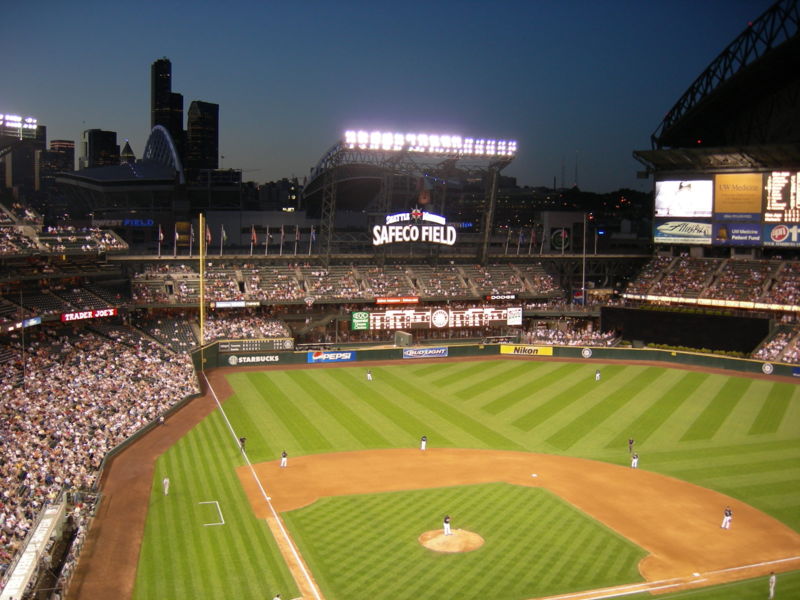
On the heels of newly announced special Sounder service to soccer and baseball games, Metro announced this year’s schedule of special buses from (and in some cases, to) Sounders and Mariners games:

  • to and from all weekend Sounder games from Northgate, South Kirkland, and Eastgate.
  • to and from all weekend Mariner games from Northgate, South Kirkland, South Bellevue, and Eastgate.
  • From all weeknight Mariner games to the same four locations.

In all cases the trip will cost $5 each way, a rise from $3 a couple of years ago.  This fare is cash only and will be waived only for children under 2.

Unlike the Sounder service, whatever costs are not recovered by fares will be covered by the teams, which might explain their draconian structure.  It would appear that Link and Sounder are now covering the old downtown postgame shuttle and trips to points South

In any case remember that we have Senator Patty Murray to thank for lifting the ridiculous Bush-era provision that banned this kind of arrangement.

More Weekend Sounder Specials

wikimedia

[UPDATE: To clear up some confusion in the comments, whatever net costs exist are borne by Sound Transit.  As spokesman Bruce Gray explained:

The teams have never paid extra for this service. It’s part of our job to serve major events. Since the first Seahawks train, we’ve had great response to these services and have found it to be a great way to introduce Sound Transit to some who would never otherwise use transit.

Consider this a marketing or PR cost if you like.]

Sound Transit is expanding their special sporting event service on Sounder to cover all weekend day games of both the Mariners and the Sounders this year.

As I’ve observed before, sporting event service is a nice combo for rail transit: expensive parking, high congestion that traps most buses, focused arrival and departure times, and an opportunity to serve a constituency that may not have the occasion to use your service otherwise.

A Modest Fare Proposal

Sound Transit Fare Zones

The last fare thread had a lot of complaining about differential fares between agencies.  And although ORCA is intended to smooth over that complexity, in ideal world similar service would cost the same on each agency.

Judging from the comments, people seem to think this is really important.  An interesting way to judge the actual priority people are willing to give an issue is to trade it off against other priorities.  As it so happens, people hate fare increases, and given widespread budget crises there’s no way agencies are cutting fares.  So here’s a thought experiment that gives everyone the fare parity they value so highly, while also raising some cash for transit:

  1. Everyone adopts the Sound Transit fare zone map, with a new fare zone created for Snohomish County outside the ST district.  Other outlying areas can be absorbed into the adjacent fare zones.
  2. The unified fare system adopts the highest fares at each level.  For adults at peak times, that’s $2.25 1-zone, $3.50 2-zone, and $4.50 3-zone.  Off-peak, it’s $2.00/$2.50/$3.00.
  3. If you like, raise Link fares 80 cents and .5 cents a mile to match Sounder.  Use the same structure for the SLUT and Tacoma Link.
  4. Form a regional fare board to approve all future fare changes.

Longtime readers know that I don’t wring my hands much over fare increases to plug the budget gap, because a large part of the burden is actually borne by employers and the federal government.  What reservations I do have would be swept away by a more systematic way to get reduced fare passes in the hands of people who need them.  On the other hand, I’m not convinced the reduced complexity would really be worth the ridership declines you’d create.

Scans from the Central Link EIS

Elevated Alaska St (Columbia City) Station on MLK

I wasn’t around for the public process of Central Link and I was curious to what was being considered before the preferred alignment was selected. I found a book of drawings from the 1999 Central Link Final Environmental Impact Statement (EIS) at the UW’s Engineering Library. Combing through the pages, I took some photos of a few pages that I was interested in. You can view the entire set on Flickr. Here are some findings that you may find interesting. It would be nice if someone who was involved could share their stories.

Focusing on the south section, there were quite a few alignment options. Getting to Mount Baker, there’s a I-90/Rainier path and the SODO/Beacon Hill path. Between Mount Baker and Othello, Link could’ve gone down the side of Rainier with a station at Columbia City then tunneling to a Graham St Station or elevated down MLK to Graham. There’s even a cross-section of a Graham Station in a cut below grade.

There was consideration of a center platform for Mount Baker Station. The Mount Baker Transit Center was going to be right next to the station instead of across the street. Rainier Beach Station had a full-fledged transit center. Both of them would be served by trolley buses.

You can see what Boeing Access Road Station might’ve looked like, complete with a Sounder platform and bus bays. Then there’s the Tukwila surface alignment on 99 or a Southcenter alignment with a station by the mall and an integrated Tukwila Sounder & Link station. We all know what we got in the end.

What I wasn’t aware of was the multiple options for serving Sea-Tac. Yes, there was an option with a station next to the terminal. There’s also one that expected shuttle buses to get people to the terminal, one integrated with the automated airport shuttle trains, and one that actually veered away from the airport before heading back to a station at International Blvd and S 200th St.

Proposed Changes to Routes 903, 910, 919

click to enlarge

Metro is proposing a change to Route 903 that both shortens the route and provides new service to the Federal Way City Hall and Federal Way Community Center.

New Route 910 (map at right) would connect the Auburn Supermall and a bunch of other stuff  to the Sounder Station.  Service would be hourly during business hours only.

The new route would also suggest a revision of Route 919 to eliminate overlaps, basically eliminating a large dial-a-ride service area in exchange for regular service on the 910 (current service map here).

The latter two changes are part of continuing Transit Now service improvements, part of a service partnership agreement with the City of Auburn.  You’ve already missed the open house (thanks for the heads-up, Metro!) but you can fill out a survey (on the 903 or the 910 and 919) or email comments on any of the three changes to mary.coltrane@kingcounty.gov until Friday, March 5th.