Federal funds on their way for Federal Way Link

Project flyover video (Sound Transit)

On Monday, Sound Transit announced that the full funding grant agreement (FFGA) for the Federal Way Link Extension project had been sent for Congressional approval, one of the final steps before the grant is awarded. With $790 million in a direct grant and $629 million available through a low-interest TIFIA loan, the final pieces needed for the project to advance to construction are almost in place. Federal Way Link is expected to cost a total of $3.2 billion, having been adjusted by rising property costs and a competitive construction market.

Federal Way Link has already begun pre-construction work, mainly demolishing structures and relocation utilities, and is set to break ground early next year. This will be just over 11 years after the initial vision was approved by voters as part of 2008’s Sound Transit 2 ballot measure. The project was originally set to terminate at South 272nd Street, but was split into several chunks by the 2010 budget shortfall caused by the recession. The northernmost section, between Sea-Tac Airport and Angle Lake, opened in 2016 with accelerated work, while the rest remained in funding limbo until the arrival of Sound Transit 3. Armed with new funding and a one-year extension of the completion date, the project was restored to go all the way to Federal Way.

Continue reading “Federal funds on their way for Federal Way Link” | 67 comments

Book review: Transit

If you’re reading this, there’s some year in which you became very interested in Puget Sound area transit services. For me, that year was 2006, and I found Jim Kershner’s Transit: The Story of Public Transportation in the Puget Sound Region to be a concise, readable, and richly illustrated overview of all that has gone before.

Unlike other books ($) in this genre, this work starts all the way at the beginning, with horse-drawn streetcars, and takes us to the ST3 vote and beyond.

Seattle’s streetcar system began as an amenity common to all modern cities, and entered a period of public ownership in 1919. The system ultimately collapsed due to poor fiscal judgment among city leaders, the apparent superiority of auto ownership at Seattle’s mid-century wealth and population level, and even competition from “jitneys” — the Uber and Lyft of their day. For a work targeted at transit fans, Kershner is admirably clear-eyed about the system’s weaknesses. Partially legitimate critiques of modern streetcars were doubly so for their poorly maintained, always-stuck-in-traffic forebears.

Continue reading “Book review: Transit” | 21 comments

Seattle transit ridership pauses after years of rapid growth

King County Metro buses (image: Zack Heistand)

Last year, a larger percentage of Seattle residents than ever reported using transit to commute to work. Seattle has made remarkable progress this decade in substituting away from drive-alone commuting. Booming employment growth in downtown Seattle and South Lake Union made it easier for workers to access jobs via transit. Large investments in bus and rail service added the capacity to get them there.

But there’s a less celebrated narrative in more recent data. Most of the progress this decade was before 2015. Light rail ridership was lower last quarter than a year ago. Bus ridership has been moving sideways since 2016. Despite large investments in off-peak service hours, non-work trips by transit aren’t growing.  Where transit ridership is growing, it’s not always keeping pace with population growth.

The decline in Link ridership last quarter wasn’t large, just -0.6% vs Q3 2018, but is still remarkable only three years after opening several new stations in a fast-growing city. Ridership for the year to date is a massive 12% below the Sound Transit budget plan, as an expected boost to rail ridership after removing buses from the tunnel failed to materialize.

Continue reading “Seattle transit ridership pauses after years of rapid growth” | 158 comments

Finishing touches for Northgate Link as work continues below

Northgate Station on a recent, not-raining day

It’s been a few months since our last check-in with Northgate Link, and things have changed dramatically around the three stations. Holiday shoppers no longer throng Northgate Mall, which is now split in two and without several of its longtime tenants. Roosevelt has gained the first of two cross-streets and welcomed a few new apartment buildings. U District Station now has furnished entrances and lighter fencing.

There is just about two years left until Sound Transit’s due date for Northgate Link, which is set for September 2021, but the project is currently sitting on enough float time to open months earlier. Sound Transit says that, as of this week, overall construction on the project is 95 percent complete and should be turned over for systems installation soon next year.

Plenty of pictures after the jump.

Continue reading “Finishing touches for Northgate Link as work continues below” | 81 comments

News roundup: a bad year

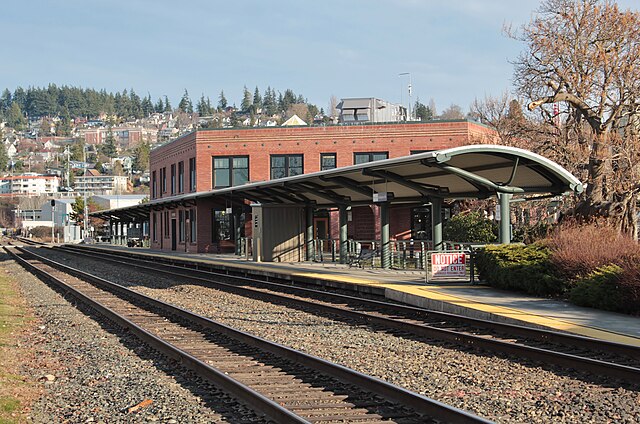
Fairhaven Station (SounderBruce/wikimedia)

This is an open thread.

91 comments

Seattle steps up its affordable housing efforts

Sydney Brownstone in the Seattle Times:

This year, Seattle will invest the most it ever has in affordable housing, a total of $110 million, Mayor Jenny Durkan said Monday.

All of that funding will go toward the construction and redevelopment of new units, the most ever generated through Seattle investments in a single year – 1,944 in full – across the city.

Truly good news to see the city step up its investment like this. Check out the Mayor’s blog post for more about the funded projects.

Thanks, Seattle voters! There are many reasons to be pessimistic about our housing situation but the city’s ability to fund, permit, and construct new affordable multifamily housing is a bright spot. Imagine what would be possible if the federal government got back into the housing game, perhaps by passing Rep. Ilhan Omar’s ambitious $1T housing bill .

Meanwhile, in San Francisco, the city seems stuck in a vicious cycle:

Nonprofit developer Mercy Housing relied on federal, state and city financing to build the project at a cost of nearly $500,000 per unit. The per unit price would have been far higher if the city hadn’t donated the land. The cost to build one new apartment or condo unit in San Francisco today — whether market-rate or affordable — tops $700,000, nearly triple what it cost about 10 years ago.

Construction costs are rising, land values are increasing, and construction workers can’t afford to live in the city, so costs rise even more.

34 comments

Ride2 in West Seattle & Eastgate will end service

Ride 2 in West Seattle (image: Metro)

Last week, we reported on the under-performing Ride2 services in West Seattle and Eastgate which have experienced low ridership and outsized costs per rider. Yesterday, Metro announced they were ending both pilots effective December 20. (The news was first reported by West Seattle Blog).

The Ride2 services were created as one year pilots, and the end comes as the West Seattle version reaches that milestone. Eastgate, which experienced a change of provider from Ford subsidiary Chariot to Hopelink in February, ran for 14 months.

There were some interesting new details on how the services performed from Metro. Over seven thousand users had downloaded the phone app, though fewer than 15% had used the service within the last month as customer interest failed to develop.

Continue reading “Ride2 in West Seattle & Eastgate will end service” | 43 comments

Federal Way Link survey is out

The latest round of Federal Way Link public meetings came with a website. There isn’t anything of interest in terms of station area design that Bruce didn’t cover in detail over two years ago.

Nevertheless, there’s new information about the artists that have been selected for each station. I’m of no use for art criticism, but the word “plaza” comes up far too much. Except where the environment is already quite dense, for plazas read “long walks where buildings should be”.

ST did itself no favors four years ago by publishing a map that exaggerated the turns and deviation necessary to mostly run down I-5. But in the end, there’s one station with a college nearby and in the heart of a very ambitious rezone; one unexciting freeway station with little around it; and one right in the core of Federal Way. If you’re super-bullish about the SR99 corridor’s potential, ST has forgone the possibility of more infill there. But otherwise, the stations are pretty well placed.

Anyway, ST wants your opinion on station names, so fill out the survey.

55 comments

The cost of HOV-2 on I-405

SounderBruce/Flickr

Any regular transit rider coming home from Bellevue, in a bus, in an HOV lane on I-405 southbound, knows well the feeling of moving 0-5 mph. Granted, it’s not always like this. There are certainly some days where it zips by traffic at nearly 60, while some other days it takes over 20 minutes just to get to I-90.

While unreliable HOV travel times are already quite frustrating, very often traffic flow in the HOV lane ends up being as bad or worse than in the general purpose lanes! Why is this tolerated by WSDOT, when the whole point of an HOV lane is to flow faster as an incentive for people to carpool or take transit? Why would anyone want to do this if they are just going to get stuck in the same traffic as if they drove alone?

I-405 south of Bellevue is getting the same type of express-toll lanes as to the north, but not until 2024. You would think that making the current HOV lanes HOV3+ would be a natural precursor to the eventual ETL extension, but WSDOT would not agree.

But how many service hours might be saved if HOV3+ were in place on I-405, in particular from Renton to Bellevue? In this calculation, I’ll assume that traffic in the HOV3+ lanes always moves at 45 miles per hour or better. That is the standard which WSDOT attempts to maintain for the express-toll lanes generally, and is also the point at which WSDOT says it will consider upgrading HOV2+ lanes to HOV3+ (though clearly that doesn’t seem to mean anything in practice).

Continue reading “The cost of HOV-2 on I-405” | 39 comments