The final pieces of rubble are cleared at the north portal
After 15 months of relatively easy digging, Sound Transit celebrated the completion of East Link tunnel excavation in Downtown Bellevue. The tunnel will carry East Link trains from East Main Station (at 112th Avenue and Main Street) to Bellevue Downtown Station (at Bellevue Transit Center and the city hall), traveling for 1,984 feet under 110th Avenue, at a depth of about 12 to 30 feet below street level.
Unlike the neat and tidy bores left by the tunnel boring machines on University Link and Northgate Link, the Bellevue tunnel was dug using the sequential excavation method (SEM; also called the New Austrian tunnelling method), which involves removing soil with heavy machinery and spraying pressurized concrete to support the void. Additional waterproofing and steel lattice girders (479 in total) were then added to support the new tunnel, which moved at a rate of a few feet per day.
Transit has no stronger advocate in the State Legislature than Sen. Marko Liias. Liias serves as Vice Chair of the Senate Transportation Committee, where he has been able to speak up against non-sensical efforts to undermine transit agencies, and advocate for more investment in public transit, with huge success.
STB has covered Liias’ career championing transit in Olympia at length.
Liias sponsored the Senate bill that would have given Sound Transit authority to take ST3 to the ballot without being tied to road funding , where the transit would have required a public vote and the roads wouldn’t. He then got 19 of his colleagues to sign on.
During the fight over reducing car-tab revenue for the voter-approved Sound Transit 3 capital program, Liias proposed various amendments that would have gotten useful gains for Sound Transit to make up for revenue losses, such as permit streamlining for light rail construction.
Liias has been able to fend off schemes like having Sound Transit subsidize parking permits for neighbors and making the ST board elected, even when his colleagues wouldn’t raise their voices.
In what may now seem like ancient history, Liias was one of the chief advocates for tolling on SR 520.
Outside of Seattle, very few candidates are mentioning transit these days. It seems to be an ebb tide in willingness of politicians, including Democrats, to stand up for transit.
Jesse Salomon
Swimming against this tide is Shoreline Deputy Mayor Jesse Salomon, whom we endorsed when he got elected to the Shoreline City Council in 2015. Salomon proved our instincts right when he voted with a majority of the Shoreline City Council for upzones around the future Shoreline Station, over shouting by neighbors opposed to new housing in their neighborhood.
The 32nd District, which Salomon is vying to represent as state senator, includes Shoreline, Woodway, most of Lynnwood, and parts of Edmonds, Mountlake Terrace, and far northwest Seattle.
While most other politicians don’t mention transit, Salomon’s transportation page is all about light rail.
Cars and buses get stuck in gridlock. Most major cities have light rail, subway, or other transportation systems that run on their own dedicated route and have traffic signal priority. We need to complete our light rail system as soon as possible and add bus rapid transit service to high commuter locations not served by light rail.
Replacing Sen. Chase with Jesse Salomon would tell the Democratic caucuses in Olympia that transit is an important priority.
The deadline to return ballots for the primary election is August 7.
The STB Editorial Board currently consists of Martin H. Duke, Brent White, and Dan Ryan.
The railroad stations and 4th Avenue viaduct from above. Credit: Bruce Englehardt
On Monday, the Sound Transit West Seattle and Ballard Link stakeholder advisory group, which includes transit advocates, prominent community members, and business and labor leaders, moved further along the process of selecting alignments and station locations for the West Seattle and Ballard light rail lines.
The advisory group will eventually pass recommendations to a subcommittee of the Sound Transit board, which in turn will recommend the ultimate preferred alternative to the board as a whole.
A breakout group at work. Credit: Peter Johnson
In breakout sessions conducted over pad thai, the advisory group discussed the alignment and station locations of the new West Seattle line’s Sodo station. The advisory group also discussed the location of the new Chinatown/ID station, which will have far-reaching impacts on the future of the light rail system.
The Chinatown station, and the segment of the new line closest to it, was the subject of intense discussion, with good reason. It’s the centerpiece of the project, and it could have the most disruptive construction impacts of any Link project so far.
Tough choices for Chinatown/ID station and alignment
Concept map of the alignments. Credit: Sound Transit
The future Chinatown station is one of the most critical elements of the new Link line. It will be the southern terminus of the new downtown tunnel, the site of hundreds of thousands of intra-Link transfers every day, and the light rail network’s busiest multimodal hub, with connections to Sounder, Amtrak, public and private buses, and the Seattle streetcar.
The station and alignment’s siting and design will have permanent impact on Link’s capacity, headways, and expansion potential. Sound Transit is committed to making the Chinatown station a central transfer hub, so it has to be built adjacent to the existing Chinatown/International District Link stop next to Union Station.
Construction in Chinatown and Pioneer Square is complicated. Much of the area is infilled tideland, which would liquefy during an earthquake. Liquefaction aside, the loose soil requires deep foundations for newer construction, and would force Sound Transit to make a deep bore tunnel even deeper than in most areas of the city.
Plus, many of the buildings in the area are built on pilings, since the neighborhoods are the city’s oldest. Those pilings could be obstacles for any alignment, and might not be replaceable with a new foundation. Demolition isn’t a way out of that problem: a large slice of the area—and King Street and Union Station themselves—are historic landmarks, or in historic districts.
4th Avenue vs. 5th Avenue
Sound Transit’s “representative alignment” is under 5th Avenue, with a station perpendicular to King and Jackson streets and parallel to the current Chinatown/ID station. During the first round of outreach with the Chinatown and Pioneer Square neighborhoods, there was strong demand for siting the line and station on 4th Avenue, or under Union Station. Continue reading “Link Advisory Group Reviews Chinatown, Sodo, Water Crossing Issues”
Boarding Swift and RapidRide buses. Credit: Atomic Taco
On Thursday, the Puget Sound Regional Council’s (PSRC) Transportation Policy Board (TPB) recommended that five transit projects receive additional Federal Transportation Administration (FTA) funding in 2021-22.
The projects were part of a larger disbursement of federal transportation funds, including highway funding, which must be approved in a meeting of the PSRC’s Executive Board on July 26. Area agencies submitted proposals for a competitive bid process earlier this year.
PSRC staff selected the five projects from that group of proposals, and created an additional list of projects, including Rainier RapidRide and Colman Dock, that could receive funding should additional federal funds become available.
Three of the five projects did not get as much funding as they initially requested. Four of the five projects are for BRT, and East Link also got a boost. According to PSRC spokesperson Rick Olson, that’s because the funding competition was remarkably popular. Bidding agencies worked together to make sure that funding dollars could be used to the furthest possible extent.
“The projects that got less funding than requested this round voluntarily took cuts in order to get more projects funded,” Olson says. “We had far more funding requested than was available.”
Link in Redmond
The segment of East Link between Microsoft and downtown Redmond gets $7 million towards the Microsoft and Redmond stations and the guideway between them. According to Sound Transit’s presentation to the PSRC on the project, the Redmond funds will also be applied towards a cycle track near the downtown Redmond station, a bike and pedestrian bridge over Bear Creek, and several trail connections.
The First Hill Streetcar under construction in 2013. Credit: Gordon Werner
The Center City Connector, a streetcar on First Avenue with dedicated right of way, has an uncertain fate. Mayor Jenny Durkan halted construction of the streetcar at the end of March and ordered a project review by consulting and auditing firm KPMG. When Durkan first halted construction on the streetcar, transit advocates speculated that the pause and assessment might be a pretext for canceling the project. The delay in the report has deepened that impression.
Durkan’s office promised to make the report “available no later than June 19,” but, though a version of the report has been delivered, it has not been made public. According to Durkan’s staff, and a June 29 project update on an SDOT website, Durkan was “verbally briefed” on the project on June 19.
However, the mayor “asked for a further analysis on technical assumptions, ridership projections, operations and capital costs, and funding options, as well as more detailed information regarding additional alternatives for providing transit connections moving forward.” The review of KPMG’s findings will be conducted by city agencies including the City Budget Office, SDOT, Seattle City Light, and Seattle Public Utilities.
While the contents of the report remains unknown to the public, members of the transit policy community, who did not wish to be identified, believe that the report contains ridership projections higher than the estimates that accompanied the design stage of the CCC.
The review of the KPMG report will “verify updated ridership projections, material costs and labor, utility relocations and project timelines for a series of options to ensure the final report is accurate for taxpayers.” Sources believe the motivation behind the second round of auditing is to find policy reasons to cancel the project. When asked for an update on Durkan’s decision, the mayor’s staff directed STB to the June 29 statement.
If the project is cancelled, more than the 1st Avenue streetcar might be in jeopardy. Members of the transit community and the city’s D.C. lobbyist worry that turning down federal money for the streetcar could endanger federal funding for other regional transit projects.
Even if the streetcar is not built, the city will still have spent a substantial amount of money. The city has already paid for some utility work and is already on the hook for a total of $90 million of contracts, including an SDOT contract to purchase vehicles. Ironically, if the mayor chooses to cancel the project because of cost, a large amount money will have been spent for nothing.
Last year Mercer Island settled its lawsuit with Sound Transit for some money to improve access issues for the future Mercer Island Station. I’m pleased to say that one of those programs will be easy to like: a 25-Ebike pilot program with Limebike, running from mid-July to mid-October.
The Mercer Island Reporter says that Limebike would have shared data, responded to safety and parking issues within time limits, and rebalanced bikes weekly for free. For a monthly subsidy of up to $1,625, Limebike will rebalance bikes every weekday. Enter the settlement money.
Riders will pay the usual E-Bike rate of $1 plus 15 cents per minute.
Most of Mercer Island’s road network is poorly optimized for buses. Alternative measures like this one come at nominal cost and are likely to somewhat improve transit accessibility on the island. Unfortunately, it’s not clear there are enough “reverse commuters” heading deeper into the community in the morning to insure adequate turnover of bikes and reliable supply in the afternoon. The City should do what it can to encourage trips other than peak-direction commutes to make this a program that helps more than 25 people a day.
“AirPollutionSource”. Licensed under Public Domain via Wikimedia Commons
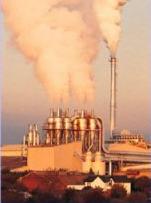
True to their word, climate activists that found reasons to oppose I-732’s carbon tax have gathered the signatures for a new measure, I-1631. It’s now virtually assured of appearing on your November 2018 ballot.
The measure would levy a “pollution fee” on the carbon content of all consumed fossil fuels, and electricity generated or imported here. On January 1, 2020, this would be $15 per ton of Carbon. In each new year, this would increase by $2/ton plus inflation, until Washington’s mandated 2035 greenhouse gas goals are met, and the board judges that compliance with the 2050 goals is likely.
The revenue, after administrative costs, has numerous specified uses. The Department of Commerce would develop a budget (“investment plan”) for approval by a Board appointed by the governor. Some limits on the spending:
70% must be used for “clean air and clean energy”, broadly defined as projects that can reduce emissions. The definition of these projects is very long, but includes public and nonmotorized transportation, as well as “affordable transit-oriented housing”. The investment plan must reduce annual carbon emissions by 20m metric tons in 2035 and 50m tons in 2050. 15% of this fund must “directly reduce the energy burden of people with lower incomes.” Beginning in the mid-2020s, a further $50m of this fund would be dedicated to support workers leaving the fossil fuel industry.
25% is for “clean water and healthy forests” to improve their resilience to climate change and ocean acidification.
5% is for “healthy communities,” basically wildfire preparedness and relocating tribes threatened by sea level rise.
There are further restrictions: 35% of the total must be spent to benefit “pollution and health action areas” (read: poor census tracts) and 10% must be supported with a formal resolution of an Indian tribe.
Utilities can get pollution fee credits for some carbon reduction activities. There are other fuel exemptions for fossil fuels to be exported, aircraft fuels, fuels for “agricultural purposes,” coal plants that will close by 2025, and so on.
This is not a perfect measure: in my view, it would be better to focus the spending more on maximizing carbon reduction and less on carving out funding for various constituencies. But this is a standard that little legislation can pass: building a coalition requires compromises. In any case, the spending seems remarkably focused on emissions reduction and mitigating climate impacts.
This measure would support transit use and dense neighborhoods in two directions, by both discouraging more energy-intensive versions of traveling and living, and providing direct funding to increase the supply of both.
Most importantly, as with I-732, the critical thing is to address the emergency of climate change and not obsess over secondary political priorities. It’s clear that conservatives won’t embrace a climate action plan that addresses many of their policy priorities, so the only coalition that can do something about this issue is one that embraces the entire center and left. This is a good initiative. But even if you have reservations, I urge you to support it strongly if you want Washington to do something about climate change.