On Wednesday, the Seattle Transportation & Utilities Committee approved two ordinances (starts at 1:54:14) related to e-scooter operations. The full council will vote on September 8th.
The bills are CB 119867 and 119868. Slides for both are here. They both passed, with Gonzalez, Morales, and Strauss voting yes and Pedersen no.
The former would allow motorized scooters in streets with speed limits of 25 mph or lower, bike lanes, and on sidewalks that are part of a bike route (e.g. on movable bridges). The latter actually authorizes scooter rental operations and sets up a fee schedule that the city projects will raise about $1m annually ($150/device), used to administer the program and build more bike and scooter parking. The permitting plan is here, but is an administrative document that didn’t need Council approval.
After years of Congressional pressure and the occasional serious accident, Amtrak announced last week that it’s completed deployment of Positive Train Control (PTC) on all track sections and locomotives that it owns.
Cascades PTC work was complete in March 2019. The Coast Starlight and Empire Builder don’t use any Amtrak-owned track, though they do use their locomotives.
Amtrak only owns about 623 miles of track, most notably parts of the Northeast Corridor but also bits of Michigan and Southern California. 86% of all Amtrak route miles are now subject to PTC.
In unrelated news, the Amtrak app and website will now tell you, at booking time, how full a train is relative to its (Covid-reduced) seating capacity (see image above). This is intended to help people make their own health decisions, though it would be a useful feature to keep beyond that. This feature is not operational on the Pacific Surfliner or Capitol Corridor, both in California.
A RapidRide bus at Bellevue Transit Center Image: Oran Viriyincy
SDOT’s proposed RapidRide G line will now open in 2024 after SDOT and the Federal Transit Administration have agreed that the agency has the chops to complete the project. FTA had raised concerns in February about staffing issues and other timeline aspects of the 2-mile BRT line, first conceived in 2011. Those concerns threatened the project’s federal funding as part of the Small Starts grant program.
A “project management oversight contractor” was brought in to help correct some of the outstanding issues in SDOT’s original application. The extended timeline includes more contingency and clarity about the org chart and the balance of responsibilities between SDOT and Metro.
The contractor has also provided a set of recommendations that are not blockers for the current small starts grant but are interesting to consider and examine. It’s like having a federally funded transit blogger:
Provide justification for the use of left-side platforms on this route, which requires a unique sub-fleet of buses, beyond simply stating that “The left side doors will be used to serve island platforms located in the center of the Madison Street BRT running.” References should be made to documents that describe other options that were considered, as well as the alternatives analysis evaluation process utilized.
Reconsider the statement in the draft FMP that an unspecified number of the five-door buses may have their two left-side doors removed if their use on MBRT is not required, since it would seem to be an unnecessary expense that would preclude those buses from ever being used on MBRT if the future need should arise.
A great question! The custom bus fleet has been a concern of ours as well. There are no easy answers here, since the current route veers between running in the median and running curbside. (First Hill advocates argued for the unique center-running section, which makes for great BRT, but is challenging if only partially implemented). But it ought to make SDOT and Metro stop and think if they really ought to make this route such a special snowflake without bringing the rest of RapidRide up to similar standards.
Explain why the non-revenue mileage appears to be high. The draft FMP states that the MBRT bus sub-fleet will operate 1,725 deadhead and other non-revenue miles per week, which is 26% of the total of 6,625 weekly miles.
That’s quite of non-revenue miles for a short, center-city route. Leave your explanations in the comments and maybe the FTA will refer to them down the road.
Update 8/20: SDOT’s Ethan Bergerson responds via email with a note about the left-side doors:
Center-running buses with boarding platforms on both sides was originally addressed in the development of the locally preferred alternative in 2015. Left-sided boarding is necessary to build the bus-only lane in First Hill and over I-5 which does not conflict with right-turn movements. This decision was based primarily on operational analysis showing that center transit lanes would facilitate 40% faster and more reliable service by separating buses from lanes with right-turn movements. Center transit lanes not only lead to more reliable service, they also help make more room for pedestrians in areas with narrow streets or sidewalks.
No doubt the center-running lanes are better. It would have been great to have them for the whole route (and a few other RR routes as well).
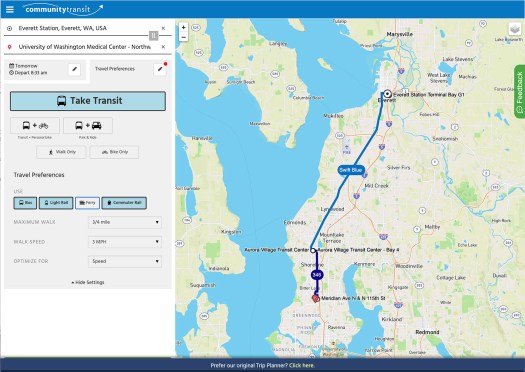
An example result from the beta trip planner (Community Transit)
Community Transit has begun a public beta test of a new trip planning interface on its website using the OpenTripPlanner system. The trip planning website will be able to provide real-time departure information and service alerts for Community Transit routes and integrate with other regional agencies, including Everett Transit, Metro, and Sound Transit, in a manner similar to the current trip planner.
The beta trip planner uses a modern map interface similar to Google Maps, putting destinations first and collapsing time and mode options. The current trip planner puts all of these options at equal importance on the launch screen, which isn’t as intuitive for users. The current interface also requires an extra screen for most addresses to confirm which city they are in, while the beta interface uses a simple drop-down box for suggestions as the user types.
The beta trip planner is also able to mix modes, adding a personal bike or use of a park-and-ride for extra flexibility. This comes in handy for some trips that would otherwise have an extremely short or slow bus connection to reach a high-frequency hub, or is out of range for buses but is in easy driving distance to a park-and-ride lot. As a bonus, the bicycling and walking options also include an estimate of calories burned for those who need some extra encouragement to add an active segment to their commute.
The policy status quo – Link in Blue, bike paths in green (City of Bellevue)
Bellevue is in the midst of its “South Downtown I-405 Access Study,” which is expected to wrap up at the end of the year. The East Main Link Station opening in 2023 is expected to spur development in the area below Main Street, which in turn will add to congestion in the area.
The City of Bellevue wants to minimize traffic congestion and help people get where they need to go, whether they are walking, biking, riding transit or driving.
Study Website
They’re down to seven alternatives, and there’s an online open house where you can comment on them. It’s safe to say they are centering the “minimize traffic congestion” bit, at least in intent.
The first two options merely add on and/or off-ramps to I-405 at various points. In a direct sense, these are entirely useless for bikes, pedestrians, and transit. Proponents might argue that they might keep some cars away from the station area.
The Spokane Transit Authority will be purchasing a set of double-decker buses for use on the Cheney Line, one of its High Performance Transit routes set to begin service next year. A $2.95 million FTA grant awarded this week will help fund the purchase of up to seven coaches, which would enter service in 2023, replacing normal coaches that will temporarily be used on the route.
The Cheney Line is one of several “High Performance Transit” (HPT) projects that were funded by the STA Moving Forward ballot measure, which was passed on its second try in 2016. While the program’s centerpiece is the City Center Line, a BRT corridor set to open in 2022, the other projects will also bring major improvements for Spokane County commuters. Each HPT corridor will have frequent service with buses every 15 minutes during peak periods, enhanced bus stops, special branding, and other features that fit some characteristics of American-style BRT lite.
The Cheney Line in particular will share similarities with the long-haul Community Transit and Sound Transit Express commuter routes where double-deckers have been used over the past decade to great success. It will only have a handful of stops and operate primarily as an express service between Downtown Spokane and Cheney, home of Eastern Washington University. Two routes, 6 and 66, will combine to form 15-minute headways on a common trunk between the two hubs while also serving a new transit center at West Plains.
The project’s $13.47 million budget will be covered by a mix of STA Moving Forward funds as well as grants from the FTA and WSDOT.
Link Light Rail at Rainier Beach Station (photo by nabobswims)
Sound Transit recently revealed that as of September 19, 2020, Link Light Rail will run every 15 minutes during the day on weekdays and weekends, and every 8 minutes at peak. Link will still drop down to 30 minute headways in the evenings. This will be the first time since early April that Link will be running frequent service, as well as the first time since early January that Link will be more frequent at peak than Connect 2020 frequencies. While not as frequent as “normal” service, the restoration of frequent service is a welcome development. In recent months, restoration of Link service has been well behind that of Sound Transit and King County metro bus service, with many major corridors getting frequent bus service while Link still lacks frequent service at all (even at peak). This has been particularly bad for Kirkland riders, as back in March, Metro restructured route 255 to end at UW, with the expectation of frequent Link service to pick up riders headed to downtown.