Roosevelt TOD Kicks Off: Take the Survey

Atomic Taco (Flickr)

[Update: Sound Transit has now said the 3 workshops below, while technically public meetings, are not intended for large public crowds. The format is a more intimate stakeholder outreach event, and the meeting room is small. There will be other opportunities to engage later this winter.]

With the UDistrict and Mt Baker standing out as exceptions, Link-related rezones have been relatively meager and disappointing. Capitol Hill’s TOD will be beautiful but also underbuilt, and 3-story buildings are still going up on the blocks surrounding the busiest neighborhood station in the system. Beacon Hill and many Rainier Valley stations still see single-family zoning adjacent to them, and in many cases suburban jurisdictions such as Kent and Lynnwood have adopted more visionary zoning than Seattle.

To much controversy, the Roosevelt rezone adopted back in 2012 allows higher density on 20 acres immediately surrounding the station, with a mix of midrise (MR) and Neighborhood Commercial (NC 85, NC 65, NC 40), all within a new Station Overlay District. This is very similar to what was adopted at Capitol Hill, despite less existing density. This means Roosevelt’s TOD opportunities could be relatively more transformative.

At the station itself, Sound Transit will have 53,000 sq ft of surplus land available for redevelopment, most of it in a single contiguous group of parcels. After a recent open house on January 12, the Roosevelt TOD process kicks into high gear in February with 3 stakeholder workshops at Calvary Christian Church (6801 Roosevelt Way NE)

  • January 25, 2017 (5:30 p.m. – 8:00 p.m.)
  • February 8, 2017 (5:30 p.m. – 8:30 p.m.)
  • February 22, 2017 (5:30 p.m. – 8:30 p.m.)

Please make your voice heard in favor of abundant housing, diverse commercial uses, and optimized transit, walk, and bike connections. Attend the public workshops, or take the survey that will inform Sound Transit’s RFP early this year.

Just 10 minutes from Westlake and set in a comfortable neighborhood near one of Seattle’s best open spaces (Green Lake), Roosevelt has the opportunity to be one of the most livable and accessible places in Seattle. You can help it get there.

18 comments

Sound Transit Breaks Ground on Northgate Station

Northgate Station under construction, Jan. 2017
Cranes are up and parking closed at Northgate, as seen on January 15

Sound Transit broke ground last Friday on Northgate Station, bringing the opening for Northgate Link one day closer (though still four years away). As we’ve reported before on the blog, the station will be elevated above NE 103rd Street on the east side of 1st Avenue NE, just west of the current transit center and southwest of the Northgate Mall.

A 455-stall parking garage, the subject of much controversy, will be built on the north side of NE 103rd Street to replace the existing park and ride. The County plans to build at least 200 affordable housing units on the former park and ride to the east of the station (along with a relocated bus station), as part of a mixed-use development funded in part by the City. SDOT will also build a pedestrian bridge over Interstate 5 (funded by Move Seattle) that will extend the station’s walkshed to North Seattle College and surrounding neighborhoods.

Continue reading “Sound Transit Breaks Ground on Northgate Station”

| 34 comments

50,000 Expected for Saturday’s Womxn’s March

Sounder Bruce (Flickr)

The day after President-Elect Trump’s inauguration, one of the largest coordinated protest marches in history will take place, with hundreds of cities worldwide hosting the Women’s March on [Your City Here]. The Seattle Times reports that up to 50,000 are expected for Seattle’s 10am Womxn’s March, likely the 3rd largest behind Washington DC and Los Angeles. The march will begin at Judkins Park and make the 3.5 mile walk to Seattle Center via Little Saigon, Downtown, and Belltown.

Metro and Sound Transit have said they will operate normal Saturday service, though extra buses and trains will be on ready reserve and dispatched as needed. The Judkins Park area is well-served generally, but definitely unable to handle a 50,000 person crush at Saturday service levels. Accordingly, riders should expect delays and crowding. And of course, if you are able, walking and bicycling will be by far the most reliable means of getting around.

Saturday frequencies for routes serving Judkins Park are as follows (and have been much improved by Seattle’s Prop 1 funds):

  • Route 4: 30 minutes
    • Nearest Stop: 23rd/Dearborn
  • Route 7: 10 minutes
    • Nearest Stop: Rainier/Norman
  • Route 8: 15 minutes
    • Nearest Stop: MLK/Judkins
  • Route 14: 20 minutes
    • Nearest Stop: 20th/Jackson
  • Route 48: 10 minutes
    • Nearest Stop: 23rd/Dearborn
  • Route 106: 15 minutes
    • Nearest Stop: Rainier/I-90
  • Route 550: 15 minutes
    • Nearest Stop: Rainier/I-90
  • Route 554: 30 minutes
    • Nearest Stop: Rainier/I-90

Following the march, riders can disperse on Routes 1, 2, 3, 4, 8, 13, 24, 26, 28, 32, 33, 62, D, or E, or on any major downtown route with a bit of backtracking.

If you are participating in the march, or will be near Center City, pack your patience in support of important civic freedoms. Try to grab a bite or spend some money along the route, especially in the International District, where mid-January is a critical time for sales ahead of Lunar New Year celebrations. And think ahead to 2023, when a Link station will be at the foot of Judkins Park, hopefully for happier occasions.

25 comments

News Roundup: The Next Level

Trolleybuses on 3rd Avenue

This is an open thread.

70 comments

We have traffic because we drive so far

Afternoon traffic on I-405 near Canyon Park. Photo by SounderBruce.

We are regularly reminded that traffic congestion is growing across the region. The median Seattle metro area worker commutes nine miles to work. What if we could live closer to our workplaces? Drivers would drive fewer miles, and spend less time in traffic. Everybody who lives closer to work would contribute less to the congestion experienced by everybody else. This would reduce traffic even if everybody drives. But there’s a multiplier as denser places have higher transit (and walk, and bike) shares. Reduce travel distances by 10%, and there’s a more than 10% reduction in vehicle miles traveled.

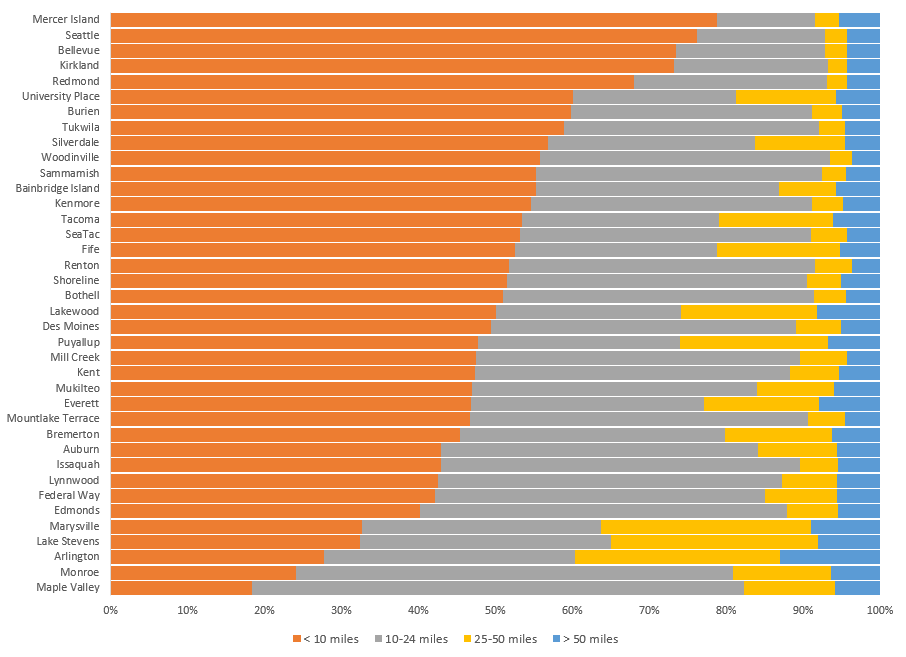
Who has the longest and shortest commutes? The U.S. Census Bureau’s Longitudinal Employer-Household Dynamics has a handy mapping interface to their Origin-Destination Employment Statistics. I’ve charted the length of commute journeys for major cities in the region, per the PSRC classification of Metropolitan, Core, and Larger. (Here’s a similar chart for smaller cities).

The shortest commutes are enjoyed by residents of Mercer Island, Seattle, Bellevue, Kirkland, and Redmond. 75% live within ten miles of their work (vs. 52% for the region). Of course, these are the nearest cities to the two largest employment centers in the region. Commuters from more distant cities to downtown Seattle and downtown Bellevue must travel further.

Among the cities on the chart, the longest commutes are from the exurban communities of Maple Valley, Monroe, Arlington, Lake Stevens and Marysville. 71% of workers who live in those cities are more than 10 miles from their work. 31% are more than 25 miles away. These aren’t the very worst commutes in the region, however. Residents of some of the tiny mountain ‘smaller cities’ drive extraordinarily long distances to work.

Incidentally, Covington and Bonney Lake, both seeking larger city designation so they can grow faster, would have longer commute distances than most of the larger city peer group.

It will surprise few that people who live near Seattle and Bellevue have shorter commutes. But it invites an obvious question. Why is the regional growth strategy constructed around five Metropolitan Cities and 29 Regional Growth Centers? Why not draw more residential development closer to the two dominant business centers?

Continue reading “We have traffic because we drive so far”

| 118 comments

How Much Does Congestion Cost Transit Agencies?

SounderBruce (Flickr)

In 2015, as SDOT began selecting Metro bus routes to improve with Prop 1 funds, much of the first round of funds went not toward frequency or speed, but to ‘schedule reliability’. Basically, congestion was so bad and variability so high that one of the first priorities was simply to pad the schedule to adapt to worsening realities. Later that year in September, facing ever-increasing delays on its Snohomish County commuter services, Community Transit threw “the last $2m [they] could find” to pad their commuter schedules for reliability.

It’s important to note that funds used for schedule padding amount to an indirect subsidy of our single-occupant vehicle culture. While schedule padding can reduce total delay as buses have more chances to recover, padding doesn’t make anyone’s trip faster. It reinforces the perceived right of open vehicular access, increases the cost of each bus trip, reduces all ridership/performance metrics, and downshifts rider expectations into a newer, slower baseline.

Directly quantifying the costs of this congestion is very difficult, but some approximations can be made. Metro has said that its buses are only moving 54% of their run time. 28% is taken up by stop/dwell time and 18% is consumed by traffic delay. Compare this to Link light rail, which is moving 80% of the time, stopped 15% of the time, and delayed up to 5% by (temporary) bus/rail conflict.

In 2015, Metro provided 3.7 million service hours. If 18% of those hours were consumed by traffic, and assuming a conservative $150 per service hour, we can infer that our car habits cost Metro roughly $100m per year in direct service costs. This would be roughly 10% of Metro’s annual budget, imposed by drivers, borne by transit agencies and taxpayers. It’s money lit on fire while we all sit in gridlock, all of us paying more for lesser service. So when we talk about the costs of transit, it’d be helpful to remember the unnecessary costs we already incur, and how transit priority (and enforcement) can often pay for themselves. We shouldn’t be paying to absorb inefficiencies, we should be paying to fix them.

46 comments

Mayor Murray Kills Bikeshare (for now) in Seattle

SDOT Photo (Flickr)

In a surprise Friday the 13th announcement, Mayor Murray quashed any attempt to revive public bikeshare in Seattle after Pronto’s March 31 demise. Whereas the Council had given the struggling system a 1-year lifeline, the city will now not follow through with an immediate replacement. Though city staff were optimistic about a potential replacement as recently as October, the potential contract with Bewegen for an electric bike share system is dead for now.

Mayor Murray has achieved this election-year shut down by diverting the intended $5m funding stream to other bicycle projects. Much-needed Center City bike connections will now be prioritized instead, including 4th Avenue from Spring to Vine and east-west connections on Pike and Pine; and $3m will go towards Vision Zero goals via Safe Routes to School. Diverting the funding to other bike priorities is likely intended to soften or blunt the criticism from the bike community, and supportive statements from Cascade Bicycle Club and Seattle Neighborhood Greenways were in Mayor Murray’s press release (see below). But beyond politics, it’s true that a fully-built Center City network will definitely increase the chances of eventual bikeshare success.

So while there may be future chapters for bike share in Seattle, the Pronto saga will come to a close on March 31 with a series of unforced errors and unnecessary political pain. Severely undercapitalized, hobbled by helmets, and going against best practices for network design, Pronto was doomed to disappointment at least and failure at most. For those of us broadly supportive of public biking in Seattle, the slow-moving demise was sad to watch. For now, a second try will have to wait.

Mayor Murray’s press release after the jump.

 Today, Mayor Ed Murray announced over $3 million in funding for Safe Routes to School, as well as other bicycle and pedestrian improvements throughout the city. These projects will grow Seattle’s bicycle and pedestrian network as we continue to lay the foundation for a multimodal transportation system that reflects our growth and our values. The funding for these new projects is derived from funding previously allocated to the 2017 re-launch of the city’s bike share program. It will instead be invested in safety improvement projects and expanding the city’s bicycle and pedestrian network. Pronto, the city’s current bike share service, will end March 31.

“This shift in funding priorities allows us to make critical bicycle and pedestrian improvements—especially for students walking and biking to school,” said Mayor Murray. “While I remain optimistic about the future of bike share in Seattle, today we are focusing on a set of existing projects that will help build a safe, world-class bicycle and pedestrian network.”

The funding will go to the following projects:

  • Adding pedestrian safety improvements, including traffic calming and crosswalk improvements, at 19 schools through the Safe Routes to School Program.
  • Completing a missing link of the 4th Avenue bicycle lane and extension to Vine Street.
  • Accelerating design and outreach for the east/west connections in the Center City bicycle network.
  • Improving accessibility in Pioneer Square by adding curb ramps at key locations.

These projects are scheduled to begin in 2017.

“Cascade Bicycle Club applauds the Mayor for accelerating the downtown bicycle network and connecting key neighborhoods to where people live, work, play, and shop,” said Blake Trask, Senior Policy Director, Cascade Bicycle Club. “These new safety improvements around targeted schools will amplify the bike and walk education that Cascade provides in every Seattle Public elementary school.”

“I’m thrilled Mayor Murray has renewed his commitment to safer routes to school! Any investment in safe routes is a good investment in our children’s health and in Seattle’s future,” said Cathy Tuttle, Executive Director, Seattle Neighborhood Greenways. “Mayor Murray’s targeted spending on a downtown bicycle network is also a bold statement that Seattle values safe streets for all people, whether they choose to get around by walking, riding a bike, or in a vehicle. Great choices for a healthy Seattle, Mr. Mayor!”

66 comments

Should Small Cities Grow Faster?

Downtown Snoqualmie

For over a year, regional planners have wrestled over growth plans with six small cities that are planning to ‘grow too fast’. Last month, the PSRC Executive Board tabled a decision on reclassification that could have eased the way for faster growth in Covington and Bonney Lake.

Six smaller cities, four of them in King County, are planning for growth that runs ahead of regional targets.

The region’s growth management strategy, VISION 2040, focuses most development within an urban growth boundary. Inside the growth boundary, the highest planned growth in each county is in “Metropolitan Cities” like Seattle and Bellevue. The next highest growth rates are planned for “Core Cities”, with progressively lower growth in “Larger Cities” and “Small Cities”. Small cities outside the contiguous urban area should grow more slowly than cities within.

In the last round of comprehensive plans, Six small cities created plans with growth capacity well above their regional targets. Four of these (Carnation, Snoqualmie, North Bend and Covington) are in King County, and two are in Pierce (Gig Harbor and Bonney Lake). In response, their plans were certified conditionally until they could come into compliance with regional goals. To date, the conditional certification has not impacted their access to grant funding, but might do so in the future.

Small cities have lower growth targets because they are typically further from major business centers. This means longer commutes that increase demands on regional transportation infrastructure. Unplanned growth impacts traffic in neighboring communities and on rural roads. The character of small towns is to be preserved. (Some small cities are indeed charming, others maybe less so). But slow growth strains the budgets of many smaller towns, dependent on an influx of new residents or businesses to fund existing services and infrastructure.

Continue reading “Should Small Cities Grow Faster?”

| 85 comments