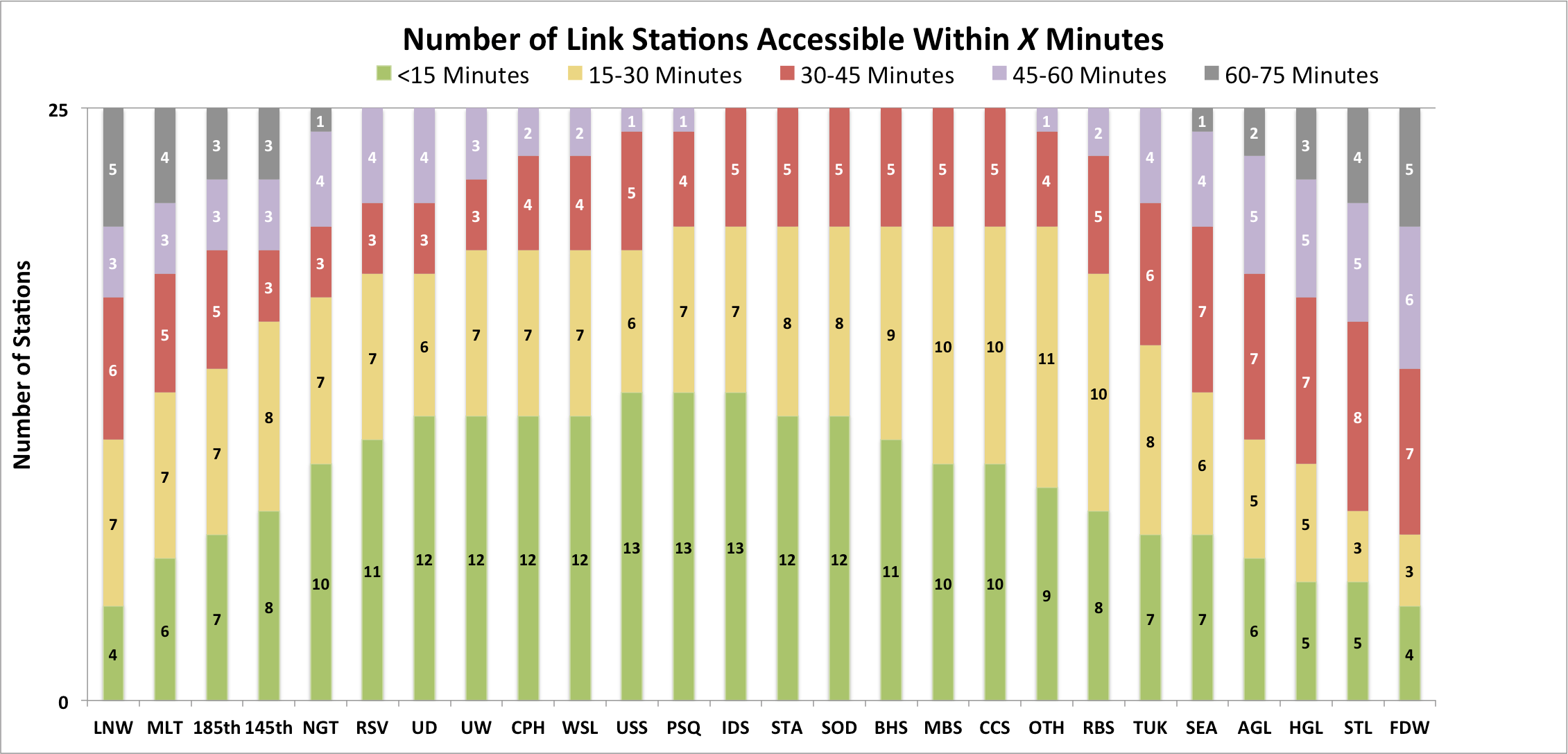
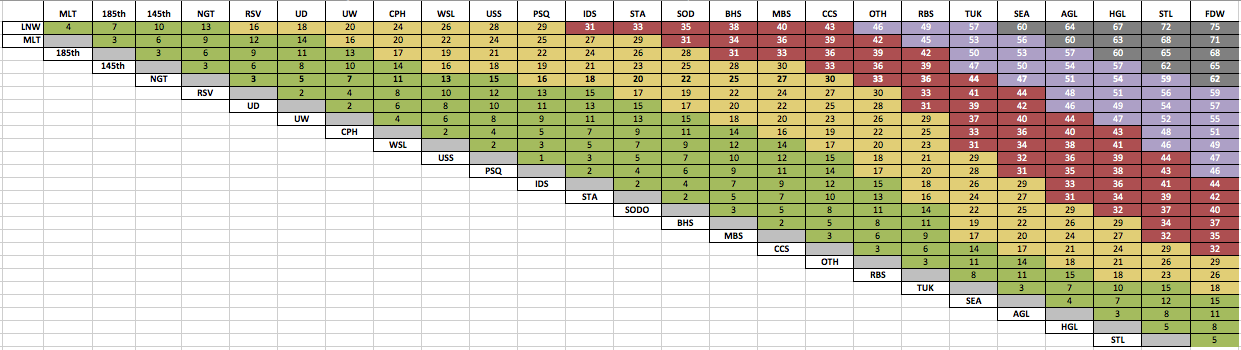
On Monday we looked at travel times on Link’s ‘Red Line’, the central spine that will run between Lynnwood and Des Moines (or possibly Federal Way) in 2023. We made a few observations along the way, including the relative benefit to Snohomish County compared to South King, about the gifts of Link to the Rainier Valley, and more. Today we’ll look at the Blue Line – or East Link – which will run from Lynnwood to Redmond via Bellevue.
At the outset, two characteristics differentiate the the Blue Line (‘East Link’) from its spiney anchor, the Red Line, namely demand symmetry and affluence:
- Demand symmetry. Beyond Northgate in the north and Rainier Beach in the south, the Red Line serves predominantly bedroom communities with intensely asymmetric demand that today is served by rivers of peak-direction express service. With the exception of Route 512, no suburban corridors along the Red Line currently sustain all-day frequent service, with the 578 and 594 dropping to half-hourly off peak. By contrast, the Blue Line will serve the both the Seattle-Bellevue and Seattle-Redmond markets, both of which sustain frequent all-day service and achieve the most symmetric demand of any city pairs in the region. Seattle, Bellevue, and Redmond are job centers in their own right, and reverse peak demand is very strong. The buses that the Blue Line would ostensibly replace – the 545 and 550 – are the most successful all-day bus routes in the Sound Transit system (page 32), nearly breaking even at the farebox with costs of roughly $3 per rider.
- Affluence. The Red Line will provide a critical link both for middle class suburban communities and those hit hardest by the continuing suburbanization of poverty, linking low cost housing to job centers, primarily in Seattle. (As I’ve written before, the long travel times from South King County to Seattle should have spurred a stronger movement for intra-South King mobility and development, and the I-5 alignment choice makes that more difficult, though not impossible.) By contrast, the Blue Line will stitch together the wealthiest centers of the region, namely North Seattle, Central Seattle, and the Inner Eastside. The balance between choice and non-choice riders on the two lines will likely be stark, with a much more moneyed set of folks traversing Lake Washington compared to those crossing the Duwamish.
Travel Times
Much like the Red Line, the Blue Line will supplant already successful bus corridors while also creating new travel opportunities via intermediate stations. Relative improvement in travel times is greatest for the new intermediate stations that currently require transfers, while for destinations that replace current bus service, Link’s primary selling point is reliability.
The Blue Line will likely replace Route 550, force a restructure or deletion of Route 226, provide a faster alternative to the B-Line, and replace the Bellevue-Redmond tail of the 566/567. The chart below shows Link travel times to Westlake atop today’s scheduled bus variation for each Blue Line station area. As you can see, the Blue Line halves travel time between Westlake and Overlake Village, Bel-Red, the (yet unbuilt) Spring District, and the East Main area. For today’s big transit markets at Microsoft, Bellevue TC, South Bellevue Park & Ride, Mercer Island, and Judkins Park, the train is slower than the fastest bus trips, but the Blue Line virtually guarantees a median travel time or better in perpetuity, everywhere along the line. For anyone stuck in reverse-peak traffic on I-90, the gold-plated Blue Line is likely actually worth its weight in gold.
Continue reading “Blue Line Travel Times in 2023”
| 61 comments