Metro 255, and ST Regional Express 540, arriving at Kirkland Transit Center
Among the projects that Sound Transit has suggested for the Eastside are I-405 Bus Rapid Transit and Light Rail between Totem Lake and Issaquah. While light rail is a clear priority, Eastside cities are interested in BRT on the Eastside Rail Corridor (ERC) as an interim solution. So there are several proposals in play that could serve as a high capacity transit (HCT) corridor in Kirkland.
Kirkland is attempting to balance these options. Some form of I-405 BRT is very likely to be included in any ST3 package, but requires an expensive station at NE 85th St to be relevant to Central Kirkland. The City has asked for a NE 85th St station along with a fast, frequent connection to downtown. A fixed guideway connection – aerial tram or people mover – has been suggested, but bus is surely more probable.
Light rail on the ERC gets closer to more Kirkland transit riders, but still has a last-mile problem in downtown Kirkland. BRT on the ERC could resolve the last mile issue with a deviation to downtown and at much lower cost than a rail alignment.
Kirkland seeks a new project for the Project Priority List, adding BRT between Kirkland and Issaquah with the Kirkland leg to run largely on the Eastside Rail Corridor. Source: Letter from Mayor Amy Walen to Sound Transit Board Chair Dow Constantine, July 8, 2015.
Casual observers surely take for granted that any of these new transit options will be better and faster than today. Surprisingly, this is not the case for many riders to the most popular destinations. For riders to Seattle, neither light rail nor I-405 BRT would even approach the travel time of today’s Metro services. For travel to Bellevue, light rail would be slower than current bus service. I-405 BRT could deliver somewhat improved times for some customers, but would mean longer travel times for others. BRT that follows the Eastside rail corridor would handily beat any of the alternatives for a much larger number of transit users.
Full ST2 buildout, with Star Lake and Federal Way added. Map by the author.
In 2023, Link Light Rail’s Red Line will travel from Lynnwood to either Highline College or Federal Way Transit Center, depending on funding. Lots of digital ink has been spilled about things like long endpoint travel times, armchair quarterbacking the time savings that might be achieved from buses leaving the tunnel, with no real clarity on the answers. In addition, we usually look at Link in fragments, with the nomenclature of “Central Link”, “U-Link”, “North Link”, “the Spine” etc far more common than the Red Line and the Blue Line. But no one in Portland still refers to the Blue Line as “Eastside MAX” and “Westside MAX”, and come 2023, the wonkier segment names will give way to simple color.
So I thought I’d take a look at the nascent Red Line in its entirety. Where will it take you? In how long? If you were to rent or buy a home to maximize the value of Link’s frequency and reliability to your life – if in Jarrett Walker’s phrase, you wanted to be on the way – where should you live? Where is Link’s ‘center of gravity’, the place along the line where the most places are accessible most quickly?
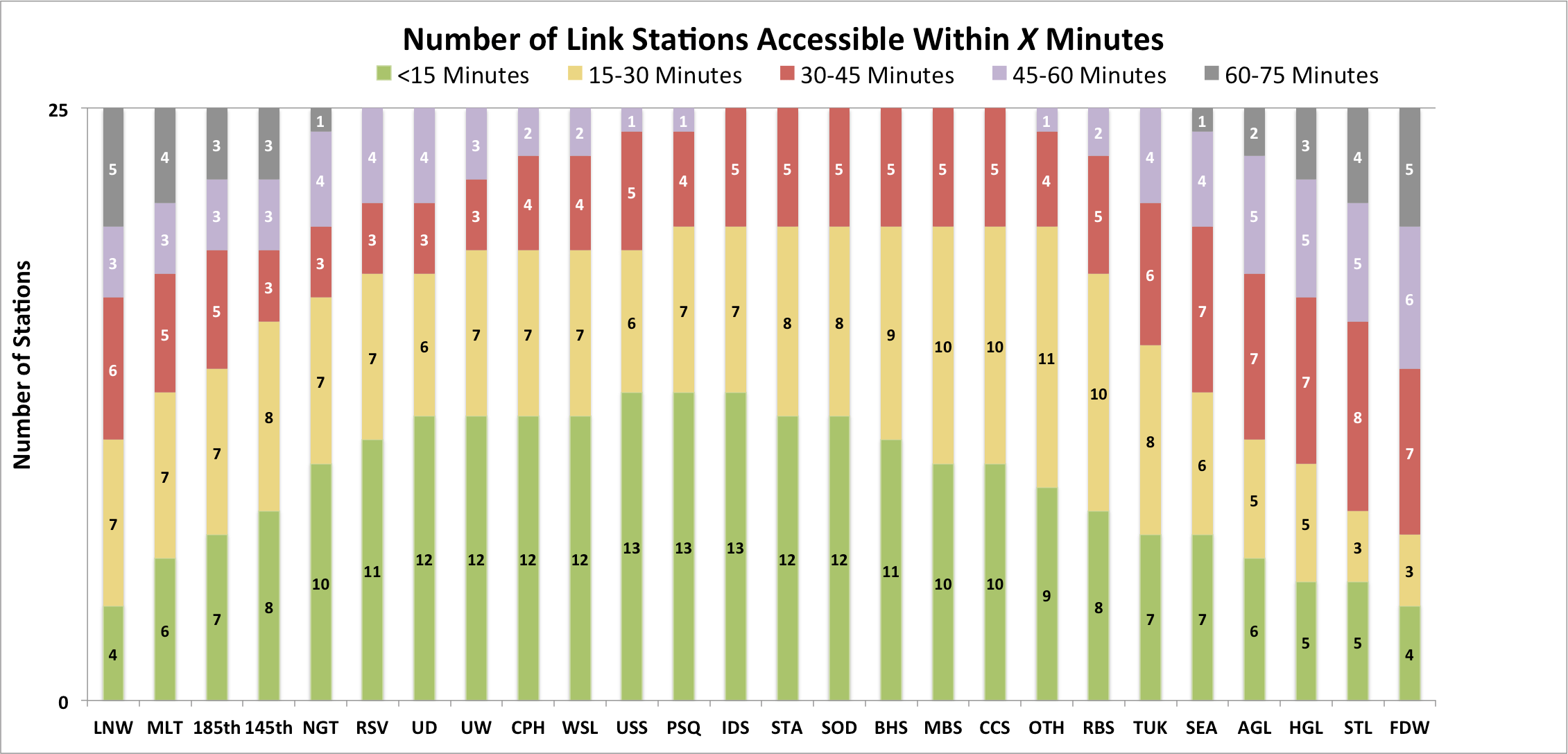
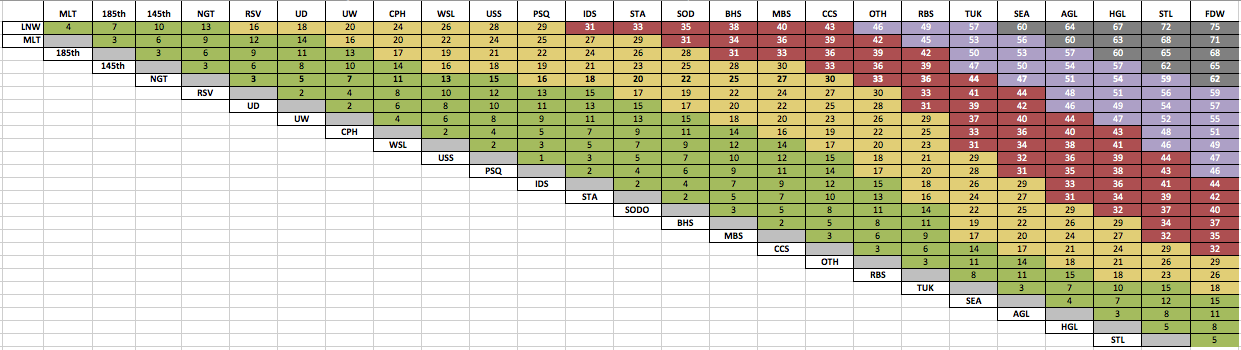
I asked Sound Transit’s Bruce Gray for travel times between all stations for the full ST2 buildout, and I’ve reproduced those with modification below (also adding Star Lake (STL) and Federal Way (FDW)). I then split the travel times into 5 tiers to show where you can travel from any given station in 0-15 minutes (green), 15-30 minutes (yellow), 30-45 minutes (red), 45-60 (purple), and 60-75 minutes (gray). While the first chart is most useful for seeing the relationship between individual stations, the second chart below presents the same data in a way that is most useful for relating an individual station to the Red Line as a whole.
Abbreviations in the chart are Lynnwood (LNW), Mountlake Terrace (MLT), Northgate (NGT), Roosevelt (RSV), UDistrict (UD), Capitol Hill (CPH), Westlake (WSL), University Street (USS), Pioneer Square (PSQ), International District (IDS), Stadium (STA), Sodo (SOD), Beacon Hill (BHS), Mount Baker (MBS), Columbia City (CCS), Othello (OTH), Rainier Beach (RBS), Tukwila International Boulevard (TUK), SeaTac Airport (SEA), Angle Lake (AGL, Highline College (HGL), Star Lake (STL), and Federal Way (FDW).
Toronto is building a crosstown LRT line. Current bus ridership in the corridor is over 78,000 daily. The 10-kilometer, 12-station, underground portion is about the same distance from the Ballard Locks to Children’s Hospital.
They’re wrangling signatures for Initiative 732, which would put a new tax on carbon burned in gasoline, natural gas and other fossil fuels — while cutting other taxes by an equal amount. By raising the price of dirty energy, I-732 aims to cut greenhouse-gas emissions and encourage development of cleaner alternatives.
Jim Whitehead called for people to sign the petition on Page 2, citing its relevance to transit advocacy and he’s right. I’d like to expand on why. But first, our climate-activist state leadership is on board with this, right?
Nope. Instead, a powerful coalition that includes the state’s major green and labor groups is trying to squash the effort…
As a “revenue-neutral” plan, I-732 would not fill state government coffers with cash. While the carbon tax would raise an estimated $1.7 billion a year — and cost the average family an estimated $300 a year in higher gas and energy prices — it would give away an equivalent amount back to consumers, mostly through a full percentage point cut in the state sales tax.
That differs from cap-and-trade legislation offered up by Inslee and backed by the alliance in this year’s legislative session. That plan would have raised more than $1 billion a year from fees on carbon and directed the proceeds to the state education budget, transportation projects, affordable housing and other programs.
The establishment version seems like a classic example of chaining a popular cause (doing something about the climate) to an unpopular one (increasing the size of generic “government”). I can’t help but think of I-1098, the 2010 Income Tax initiative, which chained a very popular progressive tax system to the most beloved of all local government spending, education.
Obviously, there is some segment of the population that prefers a regressive tax system, but not nearly enough to defeat an income tax. But by not making the measure revenue-neutral, I-1098 made the following additional enemies: Continue reading “Carbon Tax Initiative”
One of Metro’s very newest buses, which may still be around to see some results of this plan. Photo by SounderBruce.
Metro is taking a survey in preparation for its new Long-Range Plan, which Victor Obeso generously talked with us about a few months ago. The Long-Range Plan, which is separate from Metro’s short-term Strategic Plan, will be the agency’s first long-range plan in decades. The last day to take the survey is Sunday, August 9. We encourage all STB readers to weigh in today, no matter how (or whether) you use the bus, and no matter whether you typically agree with our views or not.
A bit more about some of my own answers below the jump, for those who are interested.
The last few years have seen explosive growth in Seattle proper, the fastest growth since the early days of the last century. But how long can the boom last? By the available data it doesn’t look like it is going to slow any time soon. From a Seattle Time’s article on the construction industry:
Still, he said, indications favor continued growth for the [construction] industry, with overall permits for the Seattle market up 53 percent through April compared with the first four months of 2014.
Permits for multifamily construction rose 104 percent, he said, with 6,700 units permitted compared with 3,313 permitted [in the first four months of] last year.
And the job growth in the area that is pushing population growth doesn’t appear to be slowing:
Having successfully met our fundraising goal last month, we’re thrilled to announce that Zach Shaner, who has been volunteering for us on-and-off for the last few years, will be our first staff reporter!
Zach has lived in Seattle since 2009 and has been writing for the blog off-and-on since 2010. In addition to volunteering with STB, Zach has worked at Pierce Transit, the City of Tukwila, and Commute Seattle, and he also recently co-founded a bike rental delivery service. Zach recently served on the ULink Sounding Board, and will soon serve on the first iteration of the Seattle Transit Advisory Board. Due to his busy work schedule, we’ve only been able to get a taste of Zach’s writing, and it’s left us hungry for more (the preceding food analogy is in honor of one of my all-time favorite Zach posts, How to Cook a Train).
We couldn’t be happier to find someone who can hit the ground running. Expect to see a lot more news and analysis in the coming months as Zach gets ramped up. Between the elections, Move Seattle, Sound Transit’s System Plan, ST3, Metro’s Long Range Plan, and U-link opening, there will be plenty to talk about. If you have news tips, story ideas, or well-informed gossip, please send it Zach’s way.
And rest assured that our existing volunteer staff isn’t going way. Zach is going to supplement, not replace, the opinion and analysis you already get from STB.
Thanks again to all of you who gave during the fundraising drive. We’ll keep the link up on the right-hand side for a little while longer if anyone still has a deep desire to give.
Back in 2013, Sound Transit introduced a modest pilot project to test permit parking at a few high demand Park & Rides, namely Mukilteo Station, Issaquah Transit Center, Sumner Station, and Tukwila International Boulevard Station. Riders could apply for a space and pay a nominal fee (just $5-$33 quarterly for HOV/SOV respectively, equivalent to 8¢-53¢/day), and in return would be guaranteed a parking space before 9:30am. After 9:30, the spaces reverted to general parking. There was no test of daily parking pricing.
The results of the pilot – which ended last summer – were encouraging enough that Sound Transit will soon ask the Board to proceed with an expanded program. 515 permits were issued (out of 1,427 applications), though just 56 of those (11%) were HOV permits, despite being basically free. Lots were still generally as full as before, though permit holders took advantage of the 9:30am guarantee and took the opportunity to arrive later. Whereas Sumner was usually full by 5:30 am, providing service for only the first two trains of the morning, permits allowed those riders to arrive 1.5-2 hours later. Tukwila Int’l Blvd (TIBS) saw a small decline in usage, indicating that many permit holders didn’t park there daily but were willing to cough up a few bucks for the right to do so a couple times per week. TIBS also saw its peak occupancy shift from 7:00am to 9:30am. So to a small extent, Sound Transit proved the ability to shift customers to later buses and trains, effectively reducing pressure at peak-of-peak. This is a good thing.
The new proposal would issue HOV permits in mid-2016 at a nominal fee at an expanded list of Park & Rides, the four mentioned above plus Auburn, Federal Way, Kent, Mercer Island, Overlake, Puyallup, and Angle Lake (which would be unique in having permit parking from Day 1). With Board approval, in late 2016 or early 2017 ST would issue SOV permits at a yet to be determined fee. Whether the fee will continue to be purely administrative or tied to revenue and demand management goals is a policy question for the Board. All permit applicants would have to prove possession of a valid ORCA card and to renew, prove that they rode transit an average of thrice per week during the previous quarter.
Sound Transit will host a series of info sessions in the coming weeks, and they are also taking input via a short survey. If you believe that managed parking is good policy, please let ST hear from you.
At 8:15 tonight the first results of the August primary will be posted. Turnout has been estimated at 30%, but as of tonight only 15% of registered voters have returned ballots. In keeping with tradition most everywhere, the initial results are usually the least progressive on urbanist issues, with decent trending in our direction thereafter. And results may not be known for days, with Kshama Sawant’s slow bleed of Richard Conlin being the most recent example.
The unfortunate tensions in the progressive community between pro-development urbanists and social justice urbanists may also lead to very unpredictable results, so there will be much to watch. Primaries may often seem boring, but they occasionally come in with a bang, elevating the Mallahans and McGinns of the world and sending the sitting Mayor packing for Harvard. And in any case, a 47-candidate free for all and unprecedented district elections leave a little something for everyone to analyze tonight. So go at it! We’ll be liveblogging off-and-on with any interesting observations.
8:26: Quick hits. Godden is the only threatened incumbent, with Johnson a clear winner and Maddux and Godden too close to call. Banks is consolidating the anti-Sawant vote, but that isn’t likely to be anywhere near enough. Braddock and Herbold will almost surely face off in D1. Roderick’s showing is disappointing, and Grant looks to have successfully ridden Sawant’s coattails and consolidated the rent control vote. Bradburd didn’t come close, and Gonzalez will cruise to election in November.
8:43: I agree with Erica’s basic analysis.
The neighborhood pitchforks are blunt. Urbanists look to have survived the night, with candidates like Bradburd losing badly. The interesting races to watch will be D1, where Braddock and Herbold will likely go neck and neck, and Grant vs. Burgess, which will likely be a very ugly contest.